Anyword Pricing: Plans, Costs, and Value
Understand Anyword pricing, plan differences, cost drivers, limits, and which marketing teams are likely to receive value.
Direct answer
Anyword pricing is best evaluated by seats, brand voices, prediction volume, performance-data needs, and annual commitment rather than generated word count alone. The entry plan fits an individual marketer; team and business tiers become relevant when collaboration, intelligence, and governance matter.
Prices change, so this guide focuses on the buying logic and the official plan structure checked on August 14, 2026.
Anyword pricing at a glance
Anyword’s official pricing page separates entry, team, and business requirements through limits on seats, workspaces, brand voices, predictions, data rows, and advanced intelligence. Some higher-level pricing may require contacting sales.
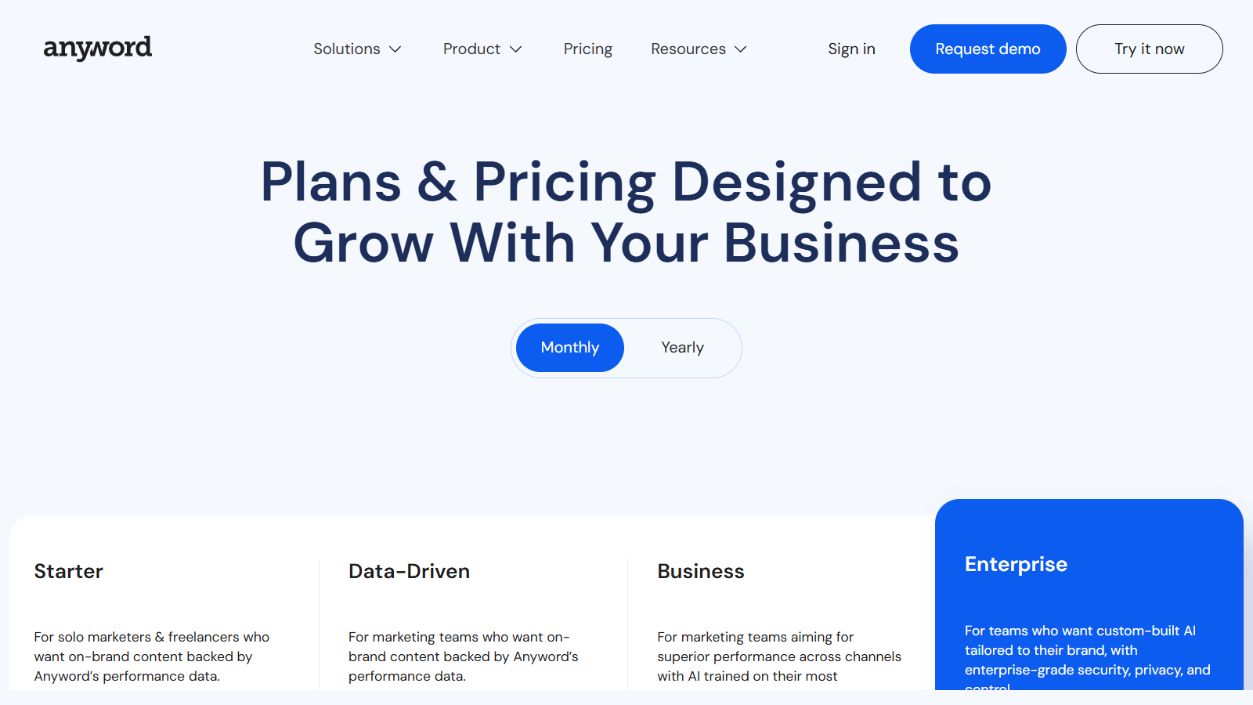
Because the page can change, confirm every quoted amount and limit at checkout. Taxes, regional pricing, temporary discounts, add-ons, and contract terms may change the final cost.
The cost drivers that matter
Seats and collaboration
An individual plan can look economical until several marketers, reviewers, or agencies need access. Count creators and administrators separately, then verify whether reviewers require paid seats.
Brand voices and workspaces
Teams handling several brands, products, markets, or clients need enough separation to avoid mixing guidance. The number of supported brand voices and workspaces can therefore matter more than raw generation volume.
Predictions and performance data
Anyword’s distinctive value sits in prediction and intelligence workflows. Check how many predictions or performance-data rows the plan supports and whether those limits match actual campaign volume.
Annual commitment
Annual billing can reduce the effective monthly price but increases commitment risk. Run a short pilot before choosing an annual term, especially if the team has not established repeatable use cases.
Operating cost
Software cost excludes brand setup, source preparation, content review, testing, integration, training, and governance. Those hours belong in the total-cost model.
Which plan should you choose?
Choose an entry plan when: one marketer needs structured campaign drafting and a limited number of brand contexts.
Choose a team-oriented plan when: several users need shared brand context, more predictions, and repeatable campaign workflows.
Talk to sales when: custom models, advanced performance intelligence, security review, contractual controls, or enterprise integration are required.
Do not upgrade only because a higher plan has more features. Upgrade when a measured workflow is hitting a documented limit or a required control is unavailable.
A simple Anyword cost model
Calculate:
- subscription cost for the required billing period;
- additional seats or capacity;
- setup and integration hours;
- monthly editorial and compliance review;
- experiment and measurement effort;
- migration or exit cost if the workflow changes.
Compare that total with measurable outcomes: cycle time, revision count, campaign throughput, brand consistency, and controlled performance tests. Generated words are not a business outcome.
Questions to ask before purchase
- Which limits apply to seats, workspaces, brand voices, predictions, and data rows?
- What happens when a limit is exceeded?
- Which integrations are included in the selected plan?
- Is historical performance data portable?
- What security and administration controls are available?
- Can the team export brand context and generated assets?
- What support and onboarding are included?
- Does cancellation differ between monthly and annual billing?
Is Anyword worth the price?
Anyword can be worth its price for a marketing team with recurring campaign volume, maintained brand context, reliable performance data, and a testing process. It is harder to justify when a team only needs occasional copy or already has a general AI workspace that covers the same job.
Final recommendation
Start with the lowest Anyword plan that supports the real workflow, verify current pricing on the official page, and pilot one repeat campaign. Upgrade only after the team can show reduced review effort or better controlled campaign results without increasing factual or compliance risk.
Sources: Anyword pricing , Anyword product , Brand Voice documentation , integrations , and release notes.
Frequently asked questions
How much does Anyword cost?
Anyword uses tiered plans with public entry pricing and higher plans that may require a sales conversation. Current prices, seats, prediction limits, brand voices, and annual discounts should be verified on the official pricing page before purchase.
Which Anyword plan is best for a small team?
A small team should choose the lowest plan that covers required seats, brand voices, prediction volume, and workflow needs, then pilot one repeat campaign before moving to a higher tier.
What drives the total cost of Anyword?
Seats, workspaces, brand voices, prediction allowances, performance-data features, annual commitment, and implementation or review time drive the real cost.