Anyword Review (2026)
An evidence-based Anyword review covering brand controls, predictive scoring, marketing workflows, pricing fit, limitations, and ideal users.

Direct answer
Anyword is a strong fit for marketing teams that need AI-assisted copy tied to reusable brand context, campaign formats, predictive scoring, and performance data. It is less compelling for teams that only need occasional drafting or one general assistant across many business functions.
This review uses official sources and does not claim hands-on testing. Anyword’s prediction system should be treated as decision support, not proof that copy will convert.
Review summary
| Area | Assessment |
|---|---|
| Best for | Marketing teams producing repeat campaign copy across channels |
| Core value | Brand context plus marketing templates, predictions, and content intelligence |
| Strength | Workflow specialization for performance-oriented marketing content |
| Limitation | Narrower than a general AI workspace; value depends on disciplined testing and data |
| Research basis | Official product, pricing, documentation, integrations, and release notes |
What Anyword does
Anyword organizes AI writing around marketing jobs. Official pages describe a data-driven editor, campaign and content templates, brand voices, target audiences, predictive performance scores, content improvement, and performance data. The platform is therefore more structured than an open-ended chat interface.
That structure can save setup time when a team repeatedly produces ads, landing pages, email, social content, and blog material. It does not remove the need for source accuracy, brand review, legal review, or channel testing.
The strongest capabilities
Brand Voice and audience context
Anyword’s documentation describes reusable tone, vocabulary, audience, formatting, and messaging elements. This is useful when several people need to create material without rebuilding brand instructions in every prompt.
The limitation is maintenance. A stale or vague brand profile can standardize weak guidance just as efficiently as strong guidance.
Predictive Performance Score
Anyword presents a 0–100 predictive score for marketing copy. The score is intended to estimate engagement or conversion potential. This is the clearest product differentiator, but it remains a model output. Buyers should ask what data informs the score and compare it with controlled experiments in their own channels.
Content Intelligence
Anyword’s performance-data and Content Intelligence workflows connect prior content or channel information to future recommendations. This becomes more valuable when a team has enough clean historical data and a repeatable content process.
Marketing workflow coverage
Official product materials cover short-form copy, blogs, content improvement, brand governance, and browser-based assistance across other writing environments. The benefit is workflow continuity; the risk is adding another specialist tool before the team has enough production volume to justify it.
Usability and implementation
The implementation work is less about installing software and more about defining brand context, audiences, permissions, accepted source material, review rules, and measurement. A useful pilot should include one high-volume campaign type and a control group.
Measure time saved, number of edits, brand-compliance issues, factual corrections, approval time, and actual channel results. Do not use generated volume as the main success metric.
Pricing and value
Anyword uses tiered plans with different seats, workspaces, brand voices, prediction allowances, and intelligence capabilities. Current prices and limits should be checked on the official page immediately before purchase.
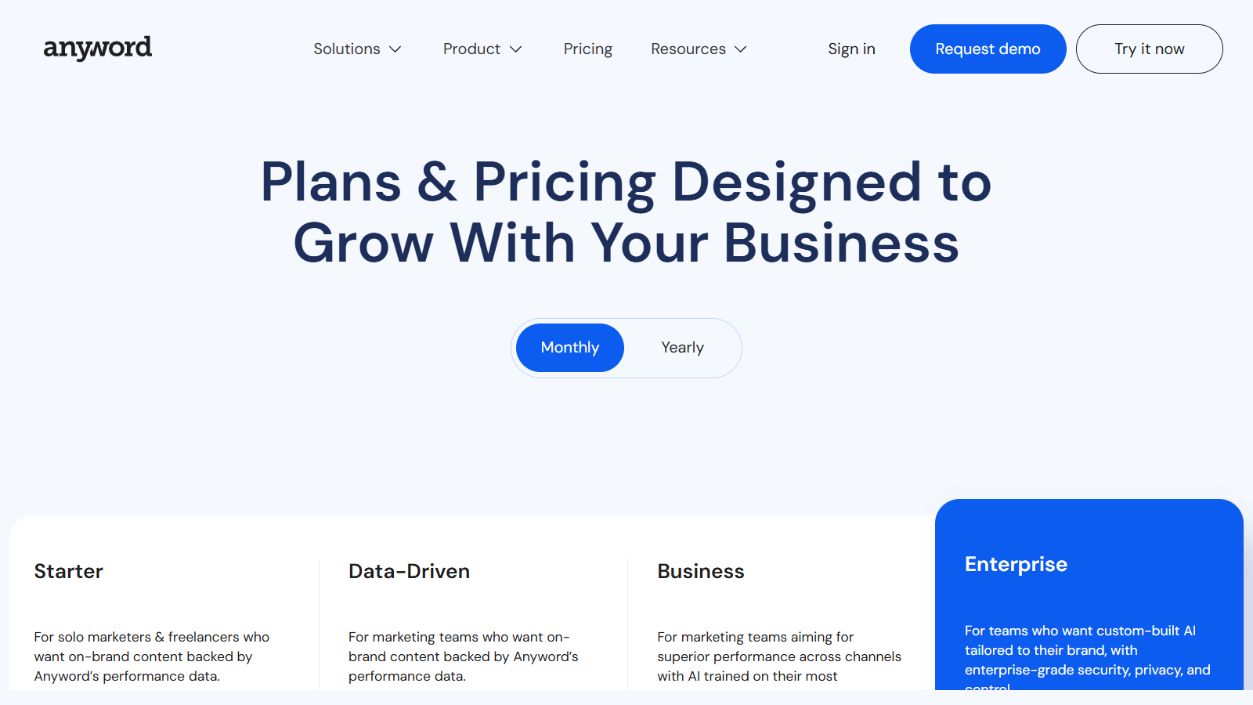
The value calculation should include review time, testing cost, data integration, additional seats, and whether a general AI tool is already handling most writing tasks.
Strengths
- marketing-specific workflow rather than generic generation alone;
- reusable brand and audience context;
- predictive scores and performance-data features;
- support for multiple campaign formats;
- clearer specialist use case than a general assistant.
Limitations
- prediction is not proof of business performance;
- specialist value may not justify another subscription for low-volume teams;
- brand and performance data need active maintenance;
- generated claims still require source and compliance review;
- we did not independently test output quality or prediction accuracy.
Who should use Anyword?
Choose Anyword when a marketing team produces enough repeat content to benefit from structured brand context and performance-oriented workflows. Avoid it when the requirement is occasional copy, broad business assistance, or hands-off content production without editorial review.
Verdict
Anyword earns consideration as a specialist marketing AI platform, not as a universal writing replacement. Its best case is a disciplined marketing operation that can supply brand context, connect reliable performance data, and validate predictions through real experiments.
Sources: Anyword , pricing , Predictive Performance Score , Brand Voice , integrations , and release notes.
Frequently asked questions
What is Anyword best used for?
Anyword is best suited to marketing teams that need structured brand context, campaign-copy workflows, predictive performance scores, and content intelligence rather than a general-purpose AI assistant.
Is Anyword's predictive score a guaranteed result?
No. The score is a vendor-provided prediction, not a guarantee of conversion or revenue. Teams should validate recommendations through controlled tests in their own channels.
Did The SaaS Education test Anyword hands-on?
No. This review uses official sources checked on August 14, 2026 and does not claim first-hand product testing.