Best AI Tools for Agencies
Compare ChatGPT, Claude, Canva Magic Studio, Zapier, and AgencyAnalytics for agency strategy, delivery, creative, automation, and reporting.
Direct answer
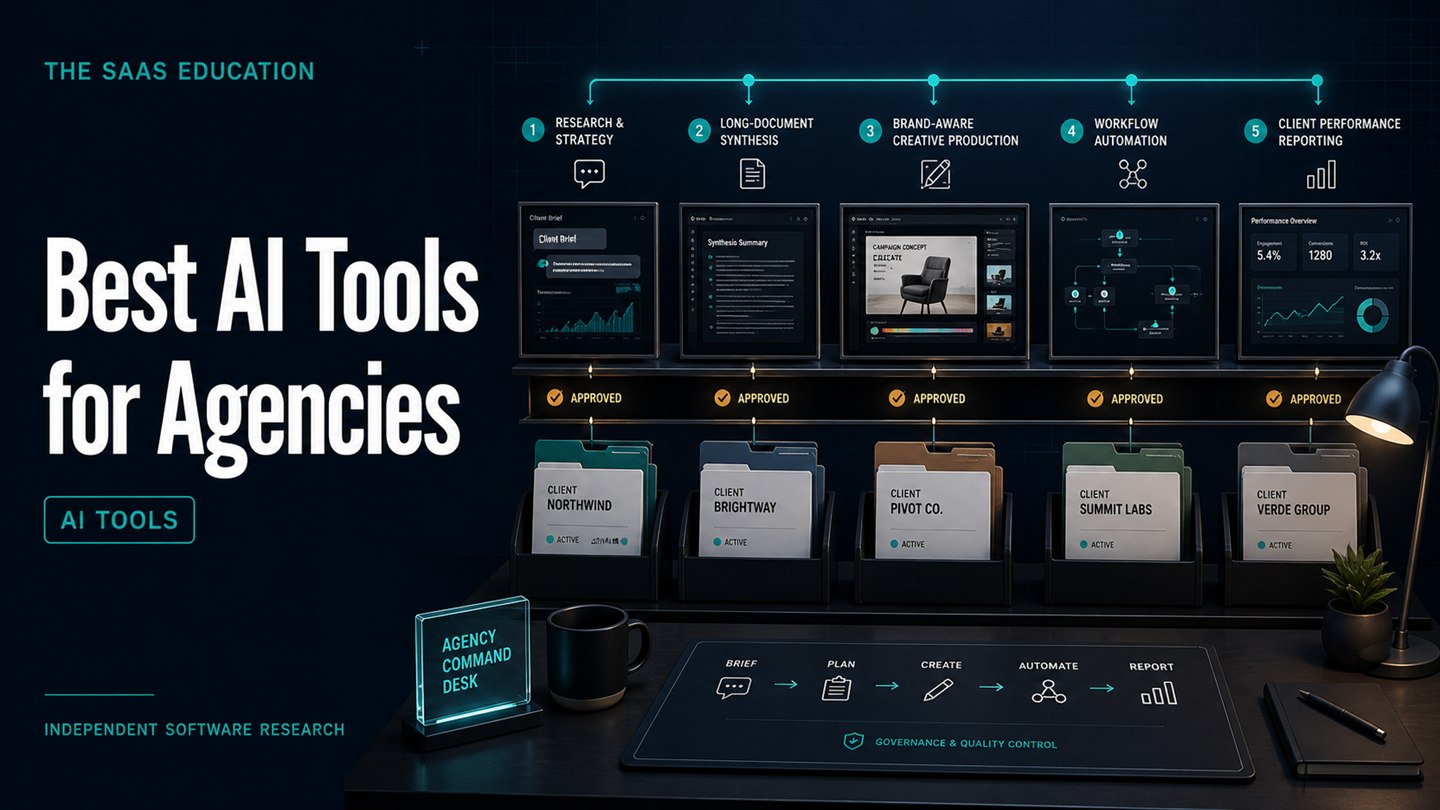
ChatGPT is the best broad AI starting point for agencies that need one assistant across client research, strategy, writing, analysis, file work, and visual ideation. Claude is best for long documents and nuanced synthesis. Canva Magic Studio is best for accessible, brand-aware creative production. Zapier is best for automating controlled handoffs across the agency stack. AgencyAnalytics is best for connected, white-labelled client reporting and AI-assisted performance summaries.
The right stack follows the client lifecycle, not AI popularity. An agency must win and scope work, understand the client, plan a strategy, produce approved deliverables, coordinate execution, report results, and retain knowledge without leaking one client’s information into another account. A tool deserves a place only when it improves one of those jobs measurably.
This guide combines a live review of ranking pages with official product sources checked on September 3, 2026. We did not run a controlled multi-client deployment. Recommendations describe documented fit, selection criteria, and risks rather than hands-on performance.
Agency AI shortlist
| Tool | Best agency job | Strongest reason to shortlist | Main control question |
|---|---|---|---|
| ChatGPT | Broad strategy and production support | One conversational workspace across research, files, writing, analysis, coding, and images | Can client context, data, review, and workspace access be governed? |
| Claude | Long-form synthesis and nuanced drafting | Strong document-centered workflow for briefs, proposals, research, and detailed content | Can outputs remain sourced, factual, on-brand, and within client boundaries? |
| Canva Magic Studio | Brand-aware creative production | Accessible design, templates, brand assets, collaboration, and AI-assisted formats | Does the workflow preserve rights, editability, consistency, and approval? |
| Zapier | Cross-app workflow automation | Connects triggers, actions, data, and AI steps across the agency stack | Are failures, permissions, retries, costs, and human checkpoints controlled? |
| AgencyAnalytics | Client reporting | Connected marketing data, automated reports, portals, white labeling, and AI insights | Are metrics, narrative, client isolation, and claims reviewed before delivery? |
What ranking pages often miss
Search results usually organize tools by writing, images, video, automation, project management, SEO, advertising, and reporting. That helps discovery, but it can encourage agencies to collect subscriptions before defining a delivery system.
Agency work has three complications that generic lists underweight. First, the agency handles information for multiple clients whose data, strategies, audiences, and intellectual property must remain separate. Second, deliverables are judged against contractual scope, brand standards, platform rules, and measurable outcomes rather than whether an AI output looks impressive. Third, efficiency can reduce billable effort without improving margin if pricing, utilization, and scope do not change.
The stack also needs ownership. One system should be authoritative for client identity, brief, tasks, approved files, campaign data, and reporting definitions. When AI tools create private copies of these records, teams lose provenance and repeat work.
Our shortlist therefore covers five distinct jobs instead of naming ten overlapping writing assistants. It is intentionally not a complete stack. CRM, project management, storage, finance, media platforms, analytics, and specialist production tools may remain necessary.
How we selected the tools
We evaluated each product against twelve agency requirements:
- Client fit: separate workspaces, permissions, naming, context, and data boundaries.
- Brief quality: goals, audience, claims, evidence, brand, channel, deliverables, exclusions, and approval.
- Research and strategy: source quality, current information, uncertainty, synthesis, and traceability.
- Production: writing, design, analysis, variation, editing, accessibility, and downstream usability.
- Brand control: approved voice, templates, assets, terminology, claims, and legal restrictions.
- Workflow: intake, assignment, handoff, review, approval, delivery, revision, and archiving.
- Automation: triggers, actions, credentials, retries, exceptions, idempotency, monitoring, and rollback.
- Reporting: source data, metric definitions, goals, narrative, white labeling, and client access.
- Governance: identity, roles, audit, retention, deletion, acceptable use, and shadow AI prevention.
- Quality assurance: factual, numerical, creative, accessibility, policy, rights, and brand review.
- Economics: subscriptions, usage, seats, review, rework, integration, administration, and margin.
- Resilience: export, continuity, model change, vendor outage, knowledge retention, and exit.
1. ChatGPT: best broad agency starting point
ChatGPT combines conversation with current product capabilities for web research, documents, data analysis, images, coding, and other work depending on plan. That breadth can support an agency from initial discovery through planning, drafts, analysis, and production assistance.
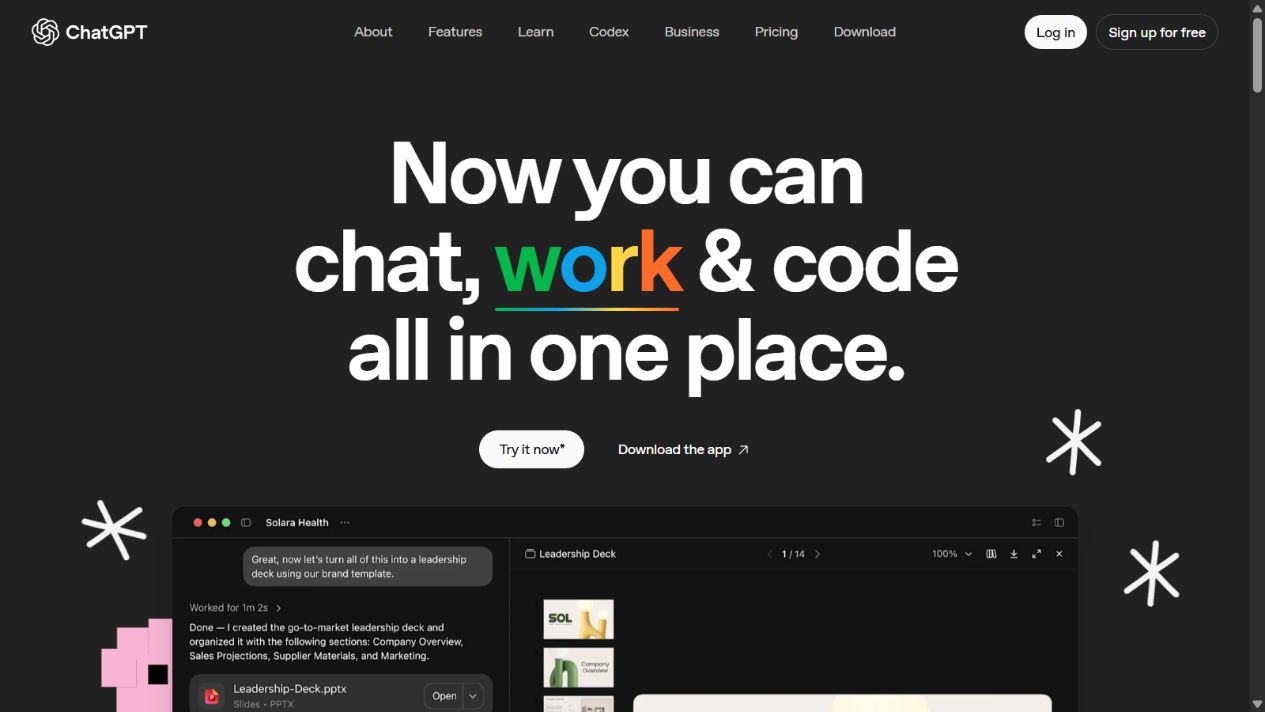
ChatGPT homepage captured September 3, 2026. Verify current plan features, connectors, data treatment, limits, and workspace controls.
ChatGPT is our broad starting point because agencies often lose time translating context between separate research, writing, analysis, and visual tools. A continuing conversation can preserve the brief while a user examines source material, develops a direction, challenges assumptions, and creates deliverables.
Choose ChatGPT when
- Strategists, account teams, writers, analysts, developers, and creatives need a flexible assistant.
- Source files and client context should inform multiple types of output.
- Conversational iteration is easier than configuring a specialist tool for every task.
- The agency wants to standardize reusable instructions and workflows.
- Non-image and image tasks both contribute meaningful subscription value.
Agency workflows
Use ChatGPT to turn a discovery transcript into open questions, organize source material, challenge positioning, outline a campaign, draft variants, analyze a CSV, explain code, or create an early visual direction. Keep each output connected to its sources and acceptance criteria.
It can also support quality review. Ask it to compare a draft with the approved brief, identify unsupported claims, flag terminology drift, create an accessibility checklist, or propose test cases. Human reviewers remain accountable and should inspect the underlying evidence.
Check before buying
Choose the appropriate business offering and validate data-use terms, identity controls, connectors, retention, sharing, export, and administration. A personal account is not an agency-wide governance model.
Separate clients by approved workspace and access design. Do not rely on a prompt telling the model not to mix data. Restrict source systems and files, remove unnecessary personal data, and define which projects cannot use generative AI.
Create reusable agency instructions for evidence, tone, prohibited claims, citation, review, and delivery format. Version them. Model changes can alter behavior, so maintain regression tasks and sample outputs.
Sources: ChatGPT overview, ChatGPT Business , and ChatGPT pricing .
2. Claude: best for long documents and nuanced synthesis
Claude is a general AI assistant with team and enterprise paths, document work, analysis, writing, and collaborative capabilities. Its fit is strongest when an agency regularly works through long briefs, interview transcripts, proposals, research packs, and detailed narrative deliverables.
Claude homepage captured August 15, 2026. Confirm current plan limits, workspace controls, integrations, data terms, and model availability.
Claude earns a separate place because long-form synthesis is an agency job, not merely “more writing.” Teams must preserve nuance across research, brand context, stakeholder feedback, and editorial constraints. A tool that helps structure that material can reduce omissions and weak handoffs.
Choose Claude when
- Long source documents and transcripts dominate the workflow.
- The deliverable requires coherent narrative and careful tone.
- Teams build proposals, strategy documents, reports, or detailed content.
- A document or project workspace is more useful than isolated prompts.
- Reviewers need clear reasoning and revision rather than high-volume variants.
Agency workflows
Claude can help extract decisions and contradictions from discovery material, organize a research synthesis, build a proposal narrative, compare stakeholder feedback, and revise a long document against a structured rubric. It is also useful for creating an evidence table before drafting.
The agency should preserve source boundaries. Upload only authorized files, label client and version, and require the output to distinguish source facts, interpretation, assumptions, and recommendations. A fluent synthesis can still omit a qualification or invent a connection.
Check before buying
Test the exact documents your teams handle, including tables, appendices, comments, scanned material, and contradictory instructions. Measure extraction accuracy, missing evidence, citation usefulness, and revision effort.
Validate workspace ownership, identity, permissions, sharing, retention, deletion, integrations, and offboarding. Determine whether project context creates a useful client knowledge layer or another ungoverned copy.
Do not buy both ChatGPT and Claude for every employee by default. Run matched workflows and assign a primary assistant by role. A second tool should solve a measured gap, not provide novelty.
Sources: Claude , Claude for Work, and Anthropic Trust Center .
3. Canva Magic Studio: best for accessible brand-aware creative production
Canva Magic Studio brings AI-assisted image, design, writing, translation, resizing, and related creative capabilities into Canva’s template, brand, collaboration, and publishing environment. Its advantage is not a single generation model; it is placement inside an accessible production system.
Canva homepage captured August 29, 2026. Confirm current Magic Studio availability, plan rights, AI limits, brand controls, asset licensing, and export behavior.
Canva fits agencies producing repeatable social, presentation, proposal, campaign, and client assets where brand kits, templates, dimensions, collaboration, and editability matter. Non-designers can contribute within a controlled starting structure instead of generating disconnected images.
Choose Canva Magic Studio when
- The agency delivers many common marketing formats and sizes.
- Brand kits and approved templates can constrain production.
- Account and client teams need accessible creative tools.
- Collaboration, comments, versions, and export are part of the workflow.
- AI output must remain editable inside a familiar design environment.
Agency workflows
Build locked or governed templates for recurring deliverables. Use AI for first-pass layouts, imagery, copy variants, background work, or resizing, then require a designer or trained reviewer to inspect hierarchy, brand, typography, accessibility, rights, and platform specifications.
Create separate brand systems and folders for each client. Establish approved logos, colors, fonts, photography, disclaimers, and claims. A reusable template can increase speed while reducing the chance that one client’s identity appears in another client’s asset.
Check before buying
Test exact export formats, dimensions, transparency, print requirements, animations, video, editable handoff, and downstream compatibility. A design that looks correct in the editor may fail on the destination platform.
Review licensing and AI terms for uploaded and generated content. Keep source and rights records. Avoid uploading confidential unreleased creative unless the plan and client authorization permit it.
Measure accepted assets per hour and revision rate. Faster generation does not help if designers spend more time repairing layout, text, identity, or visual consistency.
Sources: Canva Magic Studio, Canva pricing , and Canva AI safety.
4. Zapier: best for controlled cross-app automation
Zapier connects applications through triggers, actions, data steps, and current AI or agent capabilities. For an agency, its value is moving approved information through the stack without repeated copying: from intake to project creation, review, delivery, reporting, and follow-up.
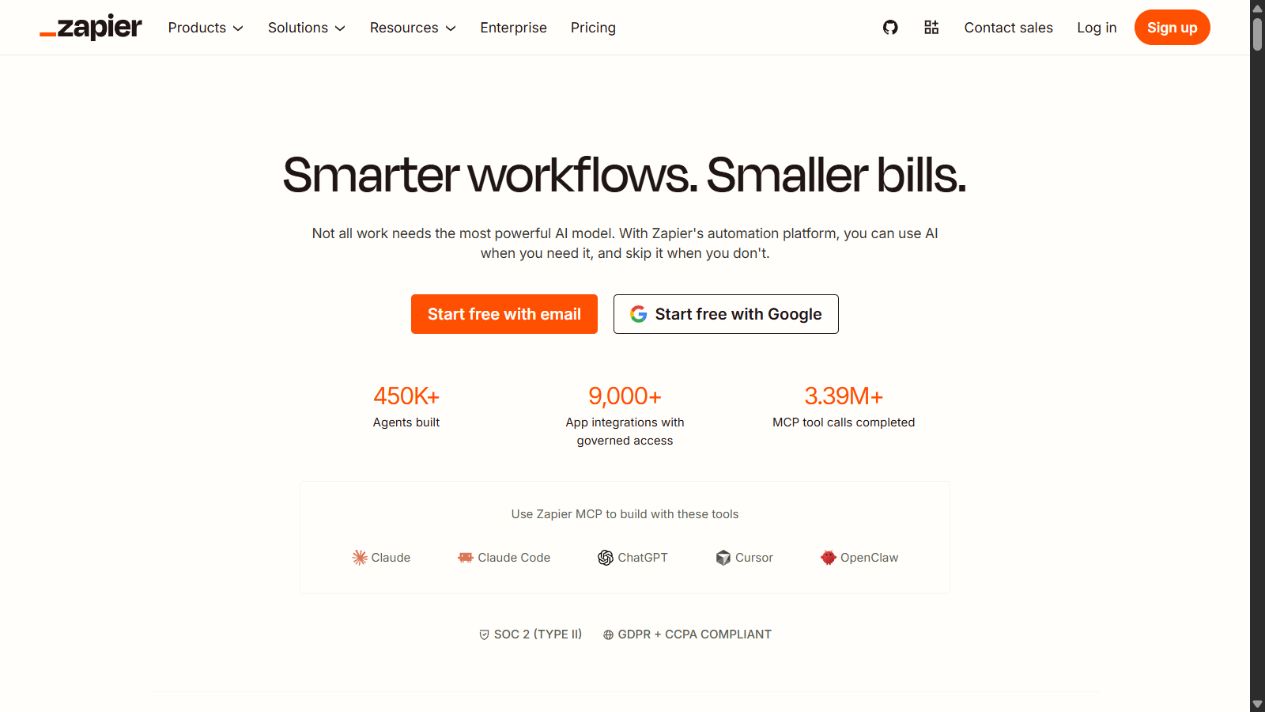
Source: Zapier homepage , captured September 4, 2026. Pricing was not treated as verified for this guide; confirm current tasks, products, limits, premium apps, AI usage, and support directly.
Zapier belongs in the shortlist because agency efficiency often depends on handoffs more than content generation. A strong draft still creates no value if the brief is incomplete, the reviewer is not notified, the client receives the wrong version, or campaign data never reaches the report.
Choose Zapier when
- Repetitive work crosses CRM, forms, email, project management, storage, and reporting.
- The agency can define deterministic steps around AI-assisted judgment.
- Operations staff need automation without maintaining a custom integration for every workflow.
- Human approvals can be inserted before consequential actions.
- Monitoring and ownership can be centralized.
Agency workflows
Examples include creating a project from an approved opportunity, validating an intake form, assigning tasks from a signed scope, routing a draft to review, filing approved assets, notifying an account owner about anomalies, and preparing a reporting checklist.
Use AI only where ambiguity genuinely requires interpretation. Keep identifiers, permissions, status transitions, and financial actions deterministic where possible. An AI step should return structured output, confidence or exceptions, and evidence for human review.
Check before buying
Map credentials and access for every connection. Use service accounts where appropriate, least privilege, secret rotation, and owner offboarding. One departing employee should not silently disable client operations.
Design for duplicates, retries, partial failures, changed fields, rate limits, expired tokens, and unavailable APIs. Use idempotency keys or authoritative status checks where supported. Send failures to a monitored queue with a named owner.
Model total usage using real volume and peak periods. Since this guide’s Zapier pricing evidence is not verified, obtain a current proposal or official pricing confirmation before publishing a cost estimate internally.
Sources: Zapier , Zapier AI , and Zapier Help Center .
5. AgencyAnalytics: best for AI-assisted client reporting
AgencyAnalytics is designed around agency reporting. Official pages describe connected marketing data, AI insights and summaries, automated reports, dashboards, goals, alerts, custom metrics, client portals, white labeling, and integrations across many marketing sources.
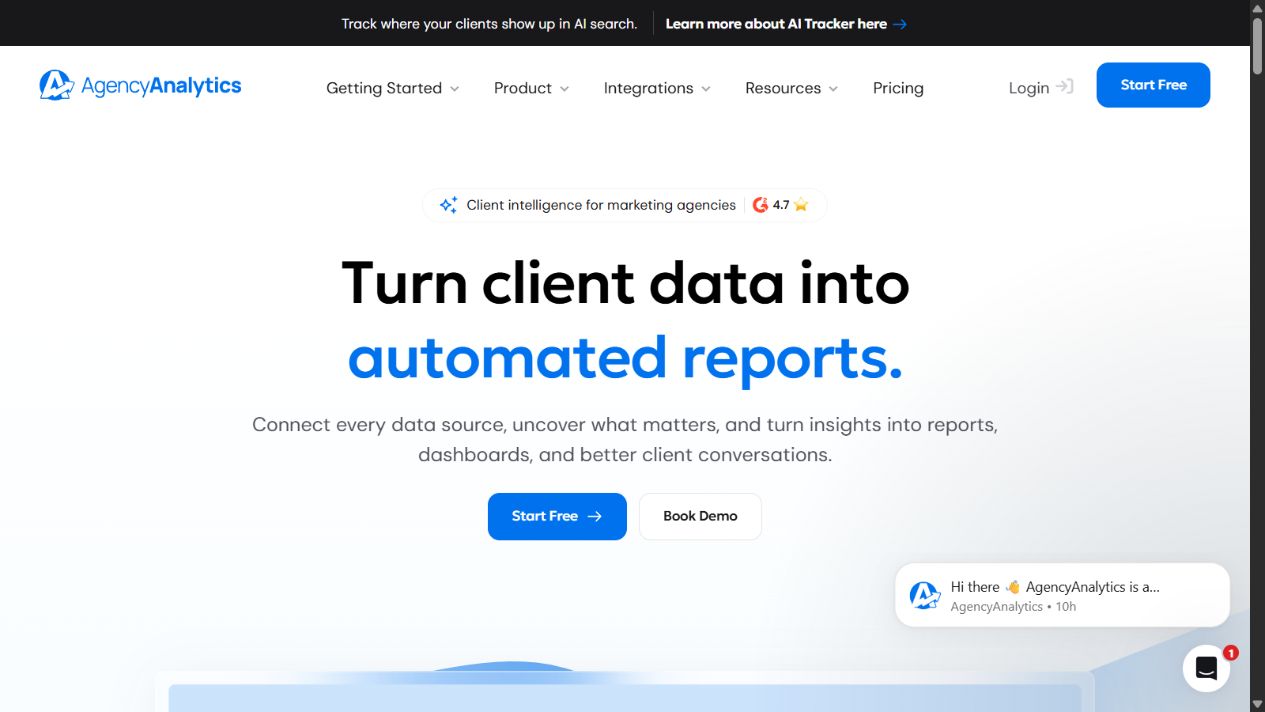
Source: AgencyAnalytics homepage , captured September 4, 2026. Verify current client-based pricing, add-ons, integrations, AI features, and approval controls.
AgencyAnalytics is the reporting choice because a general chatbot should not become an improvised marketing data warehouse. An agency-specific reporting system can connect sources, preserve client structure, schedule delivery, and provide a controlled location for commentary.
Choose AgencyAnalytics when
- The agency repeatedly builds cross-channel reports for many clients.
- White-labelled dashboards, reports, and client access matter.
- Goals, budgets, anomalies, and custom metrics should sit with reporting.
- AI summaries can accelerate interpretation without bypassing account review.
- The agency wants connected data available to approved AI tools through current API or MCP options.
Agency workflows
Create a standard metric dictionary and report template by service. Connect authorized client accounts, validate data, configure goals and alerts, and schedule a review window before delivery. Use AI to surface trends and draft summaries, then require the account owner to verify causes and recommendations.
An AI system can identify correlation but may not know that a promotion changed, tracking broke, media paused, inventory disappeared, or the client altered the site. Expert context turns metrics into an accountable narrative.
Check before buying
Reconcile sampled figures against each source platform. Document time zones, attribution windows, currencies, conversion definitions, filters, late data, and refresh schedules. A polished white-labelled report can damage trust faster when the numbers are wrong.
Test client permissions and offboarding. A user should see only authorized clients and data. Verify export, retention, deletion, custom domain, email delivery, audit, API, and support behavior.
Price under current and growth scenarios: clients, add-ons, implementation, templates, data quality, review, and account management. Evaluate value by hours saved and reporting trust, not the number of dashboards produced.
Sources: AgencyAnalytics features , AI reporting tools , AgencyAnalytics pricing , and AgencyAnalytics Knowledge Base .
How the five tools work together
A disciplined agency stack can use ChatGPT for broad planning and production support, Claude for long-source synthesis, Canva for governed creative assembly, Zapier for controlled handoffs, and AgencyAnalytics for client reporting. That does not mean every agency needs all five.
Define the authoritative system at each step:
| Record | Recommended authority |
|---|---|
| Client and commercial relationship | CRM and signed contract system |
| Scope, brief, decisions, and approvals | Project or work-management system |
| Approved client files and assets | Governed document or asset repository |
| Prompts and reusable AI instructions | Versioned agency knowledge repository |
| Workflow execution state | Automation and operational system with logs |
| Campaign performance | Source platforms, analytics, and governed reporting layer |
| Final client narrative | Approved report with accountable reviewer |
AI tools may read or transform these records, but they should not quietly replace ownership.
Build a client-safe operating model
Create an AI policy that is practical enough to follow. Classify data and tasks into allowed, conditionally allowed, and prohibited. Specify approved products and plans, client authorization, retention, human review, copyright and likeness, disclosure, incident reporting, and who can create automations.
Separate clients through workspaces, projects, folders, permissions, service accounts, and naming. Do not include one client’s prompt examples in a shared template unless those examples are authorized and sanitized. Test access after role changes and offboarding.
Require an evidence packet for consequential outputs. It can include the brief, sources, prompt or workflow version, generated draft, human changes, factual review, rights review, final approver, and delivery record. The packet should be proportional to risk.
Run an agency pilot
Choose three representative workflows rather than releasing tools to everyone. One might be a strategy brief, one a creative campaign, and one a monthly client report. Include a simple and difficult client, sensitive information boundaries, normal revisions, and an exception.
Measure the current baseline: cycle time, labor, review, rework, errors, on-time delivery, margin, and client satisfaction. Then run the AI-assisted workflow with the same acceptance standards. Record every human touch and rejected output.
Test failure scenarios. Use an incomplete brief, unavailable integration, duplicate trigger, changed source field, unsupported claim, wrong brand asset, anomalous metric, and employee offboarding. Observe whether the workflow stops safely and alerts an owner.
Adopt only after documenting which steps improved, which risks increased, and which controls are required. Expand by workflow, not by purchasing seats for the whole company.
Measure real ROI
Use accepted work as the denominator. Track:
- Time from approved brief to approved deliverable.
- Percentage accepted after the first review.
- Revision cycles and reviewer hours.
- Factual, numerical, brand, rights, accessibility, and delivery errors.
- Subscription, usage, integration, administration, and training cost.
- Gross margin by service and client.
- Client satisfaction, retention, and outcome metrics.
- Employee adoption, workload, and ability to override automation.
An agency can generate twice as much content and become less valuable if quality falls or clients cannot distinguish the work. Efficiency should improve judgment, responsiveness, experimentation, or outcomes, not simply volume.
Final recommendation
Start with ChatGPT when an agency needs one broad assistant across strategy, research, analysis, writing, and visual ideation. Add Claude for measured long-document and synthesis needs, Canva Magic Studio for governed creative production, Zapier for controlled cross-app operations, and AgencyAnalytics for repeatable client reporting.
Keep the stack small. Map each tool to one bottleneck, one owner, one approval path, and one measurable outcome. The best agency AI stack is not the one with the most models; it is the one that protects client trust while producing better accepted work at a sustainable margin.
Frequently asked questions
What is the best AI tool for agencies?
ChatGPT is the strongest broad starting point for agencies needing one assistant across strategy, research, writing, analysis, and visual ideation. Claude fits long documents and nuanced synthesis, Canva Magic Studio fits brand-aware creative production, Zapier fits cross-app automation, and AgencyAnalytics fits client reporting.
How many AI tools does an agency need?
Usually fewer than a roundup suggests. Start with one measurable bottleneck and one primary tool, then add a specialist only when it improves accepted work, control, or client outcomes enough to offset cost, training, governance, and handoffs.
Can an agency send AI-generated work directly to clients?
It should not do so without accountable human review. Validate facts, calculations, brand voice, rights, privacy, accessibility, platform policies, and client-specific approval requirements before delivery or publication.
How should agencies protect client data when using AI?
Use approved business plans, isolate clients, minimize inputs, apply role and retention controls, review vendor data terms, prohibit sensitive categories where appropriate, keep audit records, and obtain client authorization when contracts or law require it.
How should an agency measure AI ROI?
Measure cost per accepted deliverable, cycle time, revision rate, error rate, margin, client satisfaction, employee adoption, and business outcomes against a baseline. Generated volume alone is not evidence of value.
Which AI tool is best for creative agencies?
Canva Magic Studio is the strongest accessible starting point when brand kits, templates, collaboration, resizing, and broad content formats matter. Specialist visual tools may fit advanced production, but should be tested against real briefs and review standards.
Which AI tool is best for agency reporting?
AgencyAnalytics is the most agency-specific option in this shortlist because it combines connected marketing data, automated reports, client portals, white labeling, goals, AI summaries, and reporting workflows. AI commentary still requires expert review.