Best AI Tools with a Free Plan
Compare five AI tools with ongoing free plans by task, verified limits, review effort, data permission, and the work you can actually finish.
The best AI tools with a free plan depend on the job: evaluate ChatGPT or Claude for general assistance, Perplexity for search-led discovery, DeepL for translation, and Canva for design work with limited AI access. Each has an official ongoing free offering in the sources checked on 30 October 2026. None should be treated as unlimited, guaranteed to remain unchanged, or automatically appropriate for confidential work.
Research scope and limitations
- Research type
- Official-source documentation review and editorial analysis
- Hands-on tested
- No
- Last verified
- October 30, 2026
- Limitations
- No paid-account or accuracy benchmark; unverified entitlements excluded. Editorial analysis is not first-hand testing.

Table of contents
Direct answer
The best AI tools with a free plan depend on the job: evaluate ChatGPT or Claude for general assistance, Perplexity for search-led discovery, DeepL for translation, and Canva for design work with limited AI access. Each has an official ongoing free offering in the sources checked on 30 October 2026. None should be treated as unlimited, guaranteed to remain unchanged, or automatically appropriate for confidential work.
Start with one recurring task, use non-sensitive material, and compare accepted results rather than impressive first responses. Keep a second tool only when it solves a distinct problem. A collection of free accounts can still be expensive if it creates duplicated work, inconsistent sources, or excessive checking.
Who this guide is for
This guide is for an individual, freelancer, student, or small team that wants to evaluate useful AI work before paying for more capacity. It also helps a buyer distinguish an ongoing free tier from a time-limited trial, a promotional credit, or a paid plan advertised with a free starting period.
Who should avoid choosing only by price? A team handling restricted business information or requiring centralized administration must evaluate those requirements directly. A zero subscription price does not establish suitable access controls, retention terms, or contractual protection. An employee’s ability to open an account is not the same as organizational approval to upload information.
Our AI tools evaluation guide provides the wider selection framework. This shortlist focuses on eligibility, limits, and accepted work under a free tier. It does not replace our separate product comparisons, detailed tutorials, or a company’s security review.
How we evaluated the tools
We reviewed official plan or product information on 30 October 2026. Candidates needed an ongoing free offer and a clear role in a common task. We chose five across general assistance, research discovery, language work, and design rather than filling the list with nearly identical chat products.
We did not operate paid workspaces, benchmark model accuracy, or test private account entitlements. Documented facts are linked in the relevant sections. Our recommendations, trial tasks, and cautions about workflow quality are editorial analysis. No tool is declared the universal winner, and the order is not a measured performance ranking.
The important distinction is between free access and useful completion. A tool might accept a prompt but reach a limit before the work is finished. It might produce a fluent response that takes longer to verify than the original task. A meaningful evaluation must include those outcomes instead of counting every response as a success.
Selection criteria table
| Criterion | What we looked for | What the user must still test |
|---|---|---|
| Ongoing free offer | Official documentation of a free tier or version | Eligibility and current account access |
| Clear task role | A useful job distinct from the other candidates | Whether it fits the user’s actual material |
| Stated boundaries | Limits or a meaningful distinction from paid offers | Whether interruptions affect completion |
| Verifiable output | A way for a person to inspect the result | Accuracy, suitability, and revision effort |
| Responsible use | No assumption that price grants data permission | Applicable terms and organizational rules |
We exclude time-limited paid trials from the meaning of a free plan. A trial can be useful, but it creates a different purchasing decision. Read the activation screen carefully and distinguish a card-free account, a trial attached to payment details, and an ongoing free tier. This guide does not guarantee card requirements for every region or signup route.
Best tools shortlist and comparison table
| Candidate | Task to evaluate | Verified free-offer basis | Limitation to plan around |
|---|---|---|---|
| ChatGPT | General writing, learning, and file-based assistance | Official Free plan | Core features have usage limits |
| Claude | Conversational work and small interactive artifacts | Official Free tier | Usage limits apply |
| Perplexity | Search-led exploration of a question | Standard free tier | Advanced models and image generation are excluded from Standard |
| DeepL | A bounded translation task | Official free version | Usage and feature limits differ from paid offers |
| Canva | A design task with limited AI assistance | Official Free plan with limited AI access | Allowances depend on the feature and plan |
Do not buy or adopt all five because they appear in one table. A good starting stack may be one general assistant and one specialist. Add another candidate only when your existing method fails on a recognizable task and the new tool produces a useful improvement.
Tool-by-tool analysis
ChatGPT: evaluate a general starting point
ChatGPT’s official Free plan page describes writing and learning assistance, web search, and work with uploaded documents or images subject to limits. It states that the Free plan has no set time limit. That supports ongoing evaluation; it does not promise unlimited capacity or every paid capability.
The editorial strength is flexibility across related tasks. A user can investigate a question, ask for a clearer explanation, and revise a draft in a conversational workflow. The limitation is that a coherent response can still be inaccurate, incomplete, or unsuitable for the intended reader. Treat the output as material to inspect.
Try a bounded task using a public document you have already read. Ask for a short explanation for a specific audience, with explicit separation between what the document says and what remains unknown. Compare the response with the original. Check whether the explanation preserves qualifications rather than merely sounding confident.
Next, request a revision that changes the audience without changing the underlying facts. For example, adapt an internal technical explanation for a non-specialist reader. A useful result should simplify the language while preserving essential constraints. If simplification removes the important limitation, the work is not accepted yet.
Record how much review was required and whether the free tier allowed the task to finish. Do not assume that a feature visible in a paid product description will be available in your account. Our ChatGPT use guide can help frame an initial workflow, but current account limits remain part of the decision.
Claude: evaluate writing and small artifacts
Claude’s official pricing page lists a Free tier and includes conversational access and Artifacts among the documented capabilities. It also states that usage limits apply. This makes it a candidate for a bounded writing or explanation task without treating free access as a production capacity commitment.
The editorial pro is the possibility of moving from a conversation to a concrete artifact that can be inspected. The limitation is acceptance: an artifact that looks finished may still contain incorrect assumptions, weak accessibility, or missing edge cases. A polished presentation is not a substitute for reviewing the content or behavior.
Use a small public information set and ask for an explainer or a simple interactive representation of it. Define the audience, the required facts, and what should happen when an input is missing. Then inspect whether the result communicates uncertainty clearly instead of presenting an unsupported answer.
For writing, use the same source material and rubric you used for another assistant. Compare factual fidelity, clarity, editing effort, and useful completion. Do not change the standard merely because one result uses a more appealing tone. The purpose is to find a reliable fit for your work, not to declare a universal model winner.
If the result reaches a free usage boundary, record the interruption and its effect on the job. Do not create a plan around an exact quota copied from an old social post. Limits can depend on current product terms and circumstances. Our Claude use guide offers a broader starting point for planning tasks.
Perplexity: evaluate search-led discovery
Perplexity’s official plan guide identifies Standard as its free tier. It describes basic search and limited file uploads, while excluding advanced models and image generation from Standard. Do not transfer a paid-plan feature into your expectations for the free offer.
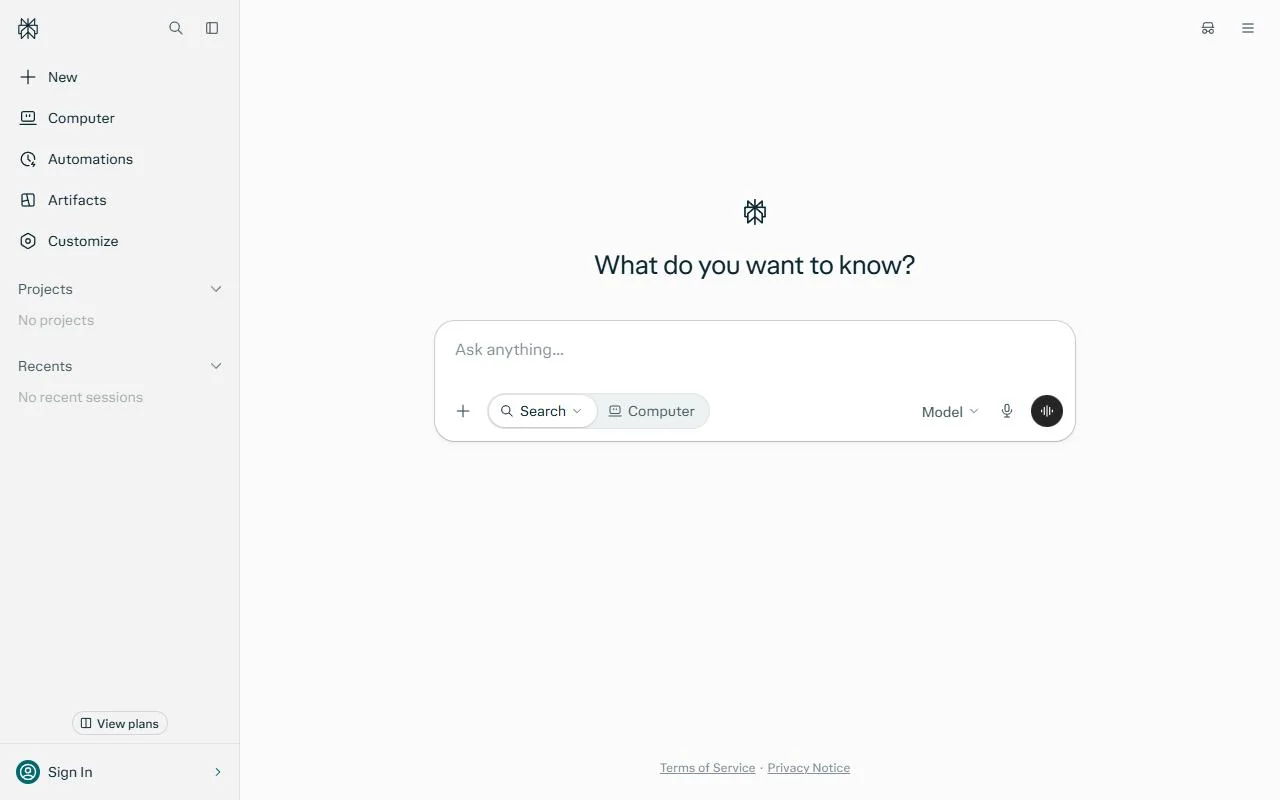
Official perplexity public page, captured 30 October 2026. Source . This public-page capture illustrates the entry point, not paid-account testing or plan entitlement.
The editorial strength is a search-first route into a topic. The limitation is evidence quality. A linked source may be relevant to the broad subject without supporting every sentence in the response. A citation should invite inspection rather than end it.
Try a question with a clear time boundary and an identifiable primary source, such as a product’s current documented availability. Open the supporting page and check the exact claim, its date, and whether the source refers to the same product or plan. Record unsupported interpretations separately from directly established facts.
For a second test, ask a question where the evidence may be incomplete. The useful behavior is not always a confident answer. It may be a clear statement that the available material does not resolve the issue. Judge whether the workflow helps you find and evaluate sources rather than whether it produces the longest response.
Use this role alongside, rather than automatically instead of, your normal research process. Important decisions still require the underlying evidence. A discovery assistant can accelerate navigation while leaving source appraisal to the person responsible for the final conclusion.
DeepL: evaluate a focused translation job
DeepL’s official plan comparison distinguishes a free version from paid offers and shows limits for the free service. This supports its inclusion for a bounded translation task. It does not establish that every document workflow, language pair, feature, or confidentiality requirement is covered without payment.
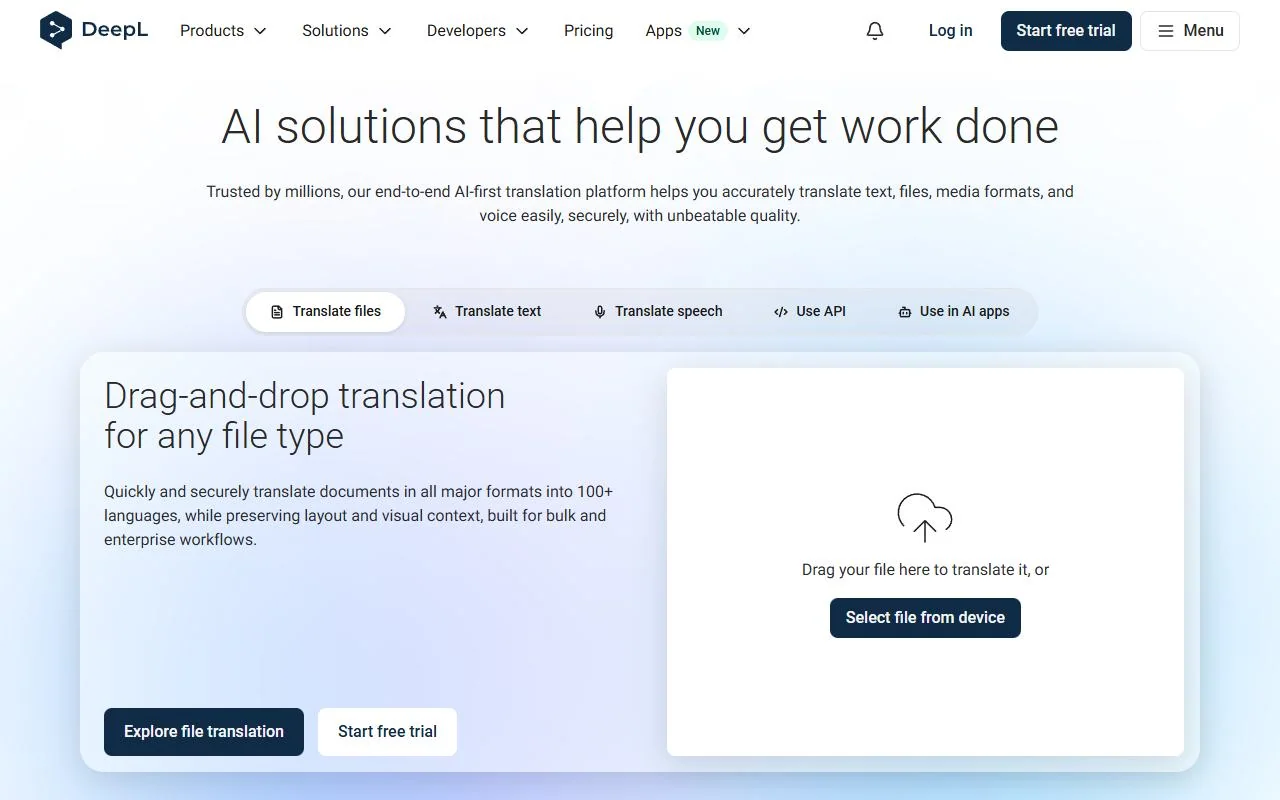
Official deepl public page, captured 30 October 2026. Source . This public-page capture illustrates the entry point, not paid-account testing or plan entitlement.
The editorial strength is a clear task boundary: translate a specific piece of text for a specific audience. The limitation is that linguistic fluency does not prove preservation of meaning. Product terminology, negation, units, contractual language, and tone can require a qualified reviewer.
Begin with a short public or synthetic passage whose meaning you can verify. Include a product term that should remain unchanged and a sentence containing an important exception. Ask a competent reviewer to inspect whether the translation preserves both the main message and the exception.
Do not judge only by back-translation. A passage can return to a plausible version of the original while remaining awkward or misleading for a native reader. Use the result for its intended audience, and request review proportionate to the consequence of an error.
Keep sensitive material outside the test until the applicable terms have been reviewed. A free version and a paid business offer may have different provisions. This guide does not infer confidentiality guarantees from the existence of a free translation box or from a general marketing statement.
Canva: evaluate limited AI inside a design task
Canva’s official pricing comparison lists a Free plan with limited AI access. It explains that allowances vary by feature and plan. That establishes a place to try AI-assisted design without assuming access to every capability shown elsewhere in Canva’s marketing.
The editorial strength is context: the AI work can be judged as part of a real visual deliverable rather than as an isolated generation. The limitation is that an attractive asset still needs accurate wording, appropriate rights, accessible presentation, and the correct export for its intended destination.
Choose a small public-facing task with non-sensitive inputs, such as a simple event announcement. Define the required information, audience, dimensions, and final format. Review every date, name, and factual claim manually. The design should serve the message rather than hide an error behind visual polish.
Inspect the result at the size where it will actually appear. Small text, weak contrast, and unclear hierarchy can make a design unusable even if the full-size preview looks appealing. Verify that the specific AI feature used is available under your current plan and that the final output meets the relevant usage terms.
If the free allowance is insufficient, record which step failed and whether the task has another acceptable route. Do not automatically upgrade because one generated variation consumed the remaining allowance. Decide whether AI assistance improves the finished result enough to justify the cost.
Strengths and limitations of free AI plans
The main strength is low-cost learning. A free tier can help a person identify which tasks benefit from conversational assistance, source discovery, translation, or visual work before committing to recurring spending. It can also reveal that the existing manual method remains the better choice for a particular job.
The main limitation is uncertainty about capacity. A free service can be useful for exploration while remaining unsuitable for a deadline that requires predictable access. Record what happens when the task reaches a boundary, and decide whether the work can wait or needs a different approved process.
Another limitation is fragmented context. Moving the same task through several assistants can produce inconsistent assumptions and repeated uploads. Keep the authoritative sources, accepted draft, and decision record somewhere you control. Do not rely on memory of which chat contained the correct version.
Free access also does not resolve ownership or data permission. Before uploading work material, establish who is authorized to share it and under which terms. Before using generated content externally, review factual claims, rights, privacy, and audience suitability. Those responsibilities remain even when the subscription bill is zero.
Buying advice: use a completion ledger
Create a small record for each task: intended output, approved input, tool and plan, date, result, corrections, time spent reviewing, and whether the final work was accepted. You do not need a sophisticated scoring system. The record should make it obvious whether the tool helped complete useful work.
Use the same acceptance standard across candidates. For a research summary, require fidelity to the source and visibility of unknowns. For a translation, require preservation of meaning and appropriate audience language. For a design, require correct information and usable presentation at the intended size.
Do not confuse generation speed with completion speed. A response produced quickly may require extensive correction. Conversely, a tool that takes slightly longer may reduce restructuring or source checking. Record the entire job from preparation through approval so the decision reflects usable outcomes.
A practical first-week evaluation
Choose a small set of ordinary tasks you already understand. Avoid high-stakes or confidential work for the initial comparison. Write a short specification for each: what the output must do, which source it may use, which claims it must not invent, and who will review it.
Complete a baseline task using your current method. Then try one suitable candidate using the same standard. Record what improved, what became harder, and whether any new review work appeared. Use a second tool only when it offers a distinct role or a meaningful comparison.
At the end of the week, retain the smallest useful setup. One assistant that reliably helps with a recurring task can be more valuable than several accounts you barely understand. Remove unnecessary copies of uploaded material according to the applicable product controls and your organization’s rules.
When a paid plan becomes reasonable
Consider payment when a specific recurring limitation prevents accepted work, when the required controls are available only under an appropriate paid offer, or when a well-defined workload justifies more capacity. Verify those requirements in current official terms rather than assuming that any paid plan will solve them.
Build the comparison around the actual period and workload. Include subscription cost, review, administration, and transition effort. A paid tool is not automatically better value, and a free tool is not automatically cheaper in total effort. The right decision depends on the amount and quality of work the team can use.
Use our AI productivity stack guide to control unnecessary overlap. Our review methodology explains why documentation-based recommendations should not be read as completed first-hand benchmarks.
Keep a fallback for unfinished work
Decide what happens when a free tool becomes unavailable partway through a task. Save the approved source material and the latest accepted draft in your own working files. A conversation history is useful context, but it should not be the only copy of an important deliverable.
For a deadline, establish a manual route that can still meet the output standard. That may mean writing the final summary yourself, asking a qualified translator to review a shorter passage, or using an existing design template. The fallback should preserve quality rather than encourage a rushed upgrade or an unchecked result.
At the end of an evaluation, write a short adoption decision: which task the tool supports, which material may be used, who reviews the result, and what triggers reconsideration. Revisit that decision when the plan changes or the workload becomes more consequential. This turns a casual experiment into a controlled, understandable working practice without requiring a large procurement exercise.
Evidence and verification notes
The cited official pages were reviewed on 30 October 2026. Free-plan existence and the specific boundaries described above are the verified product facts. Exact quotas, regional eligibility, card requirements, model availability, contractual rights, and private-account behavior are not generalized beyond those sources.
No competitor wording, customer reviews, or private interface captures are used as factual evidence. The cover is editorial artwork. No generated visual is represented as a screenshot. The suggested tasks are evaluation designs, not claims that we completed them in each product.
The central recommendation is deliberately modest: choose by task, validate the free offer, inspect the result, and record the actual completion cost. That process remains useful even when a vendor changes a limit or reorganizes its plans.
Frequently asked questions
Which AI tools have an ongoing free plan?
The official sources checked for this guide identify free offers for ChatGPT, Claude, Perplexity, DeepL, and Canva. Each has limits, and availability or included capabilities can change. Check the linked current terms before adopting a workflow.
Is a free trial the same as a free plan?
No. A trial lasts for a defined period or promotional allowance and may require a purchasing decision afterward. An ongoing free tier is a separate offer, although its features and limits can still change.
Can I upload confidential company documents to a free tool?
Do not assume that you can. Review organizational authorization and the terms applicable to the actual product and plan. Use public or synthetic material for initial evaluation and provide only information necessary for an approved task.
Which free AI tool is best for research?
Perplexity is a candidate for search-led discovery, while general assistants can help explain and organize material. In either case, inspect primary sources and verify whether each material claim is supported. A citation alone does not establish correctness.
When should I upgrade?
Upgrade when a verified limitation prevents a recurring accepted task or when required capabilities and controls justify the cost. Compare total effort and contractual suitability rather than buying simply because an account reached a temporary boundary.
Decision guidance
Choose the best AI tools with a free plan by the work you need to finish. Start with a general assistant or a focused specialist, use approved inputs, verify the output, and retain only tools that improve accepted results. An ongoing free tier is an opportunity to evaluate fit, not a promise of unlimited or consequence-free use.
Browse the AI Tools category for related independent software research.
Frequently asked questions
Which AI tools have an ongoing free plan?
The official sources checked for this guide identify free offers for ChatGPT, Claude, Perplexity, DeepL, and Canva. Each has limits, and availability or included capabilities can change. Check the linked current terms before adopting a workflow.
Is a free trial the same as a free plan?
No. A trial lasts for a defined period or promotional allowance and may require a purchasing decision afterward. An ongoing free tier is a separate offer, although its features and limits can still change.
Can I upload confidential company documents to a free tool?
Do not assume that you can. Review organizational authorization and the terms applicable to the actual product and plan. Use public or synthetic material for initial evaluation and provide only information necessary for an approved task.
Which free AI tool is best for research?
Perplexity is a candidate for search-led discovery, while general assistants can help explain and organize material. In either case, inspect primary sources and verify whether each material claim is supported. A citation alone does not establish correctness.
When should I upgrade?
Upgrade when a verified limitation prevents a recurring accepted task or when required capabilities and controls justify the cost. Compare total effort and contractual suitability rather than buying simply because an account reached a temporary boundary.