Best Character.AI Alternatives
Compare Character.AI alternatives for character discovery, interactive adventures and writing-led stories, with practical switching checks and limitations.
Direct answer
Talkie is worth considering for character discovery and chat, AI Dungeon for interactive adventures, and NovelAI for writing-led stories. These alternatives solve different problems. Choosing between them starts with deciding whether you want a conversation partner in a fictional scene, a world to play through or a piece of prose you can shape.
Switching only because another product promises more freedom or better memory can be disappointing. Those labels do not explain how the interface works, what context the system uses or what happens to your material when you leave. Start with a specific reason to switch and test it before committing.
This guide uses official sources checked September 4, 2026. We did not conduct a hands-on benchmark or verify automatic migration from Character.AI. The recommendations are conditional starting points, not measured winners. We also avoid numerical prices where a complete current purchase configuration has not been verified.
Shortlist by creative task
| Your main task | Candidate | Important limitation to evaluate |
|---|---|---|
| Browse fictional personalities and start conversations | Talkie | Community content and individual Character quality vary |
| Make choices inside an unfolding adventure | AI Dungeon | A story-oriented experience differs from a character directory |
| Develop and edit a longer fictional text | NovelAI | More authoring responsibility may mean more setup |
| Preserve a long-running story | Test the context workflow | Saved information does not guarantee consistent use |
| Move an existing conversation automatically | Not verified here | Check actual import compatibility before switching |
This is deliberately a focused shortlist. Adding products with uncertain fit would not help you decide. The three options cover distinct creative workflows without implying that one should replace Character.AI for every user.
1. Talkie: for discovering character conversations
Talkie’s official site presents a searchable character-discovery interface with categories and community-created entries. That makes it a closer starting point when your main interest is finding a fictional personality and beginning a conversation. Source: Talkie .
Availability caveat: during our September 4 browser check, Talkie redirected to a notice saying the service was not available in our region. Check access from your location before shortlisting it. Because the homepage could not be accessed, the image below is the product’s official Google Play listing rather than an error page or a fabricated homepage.
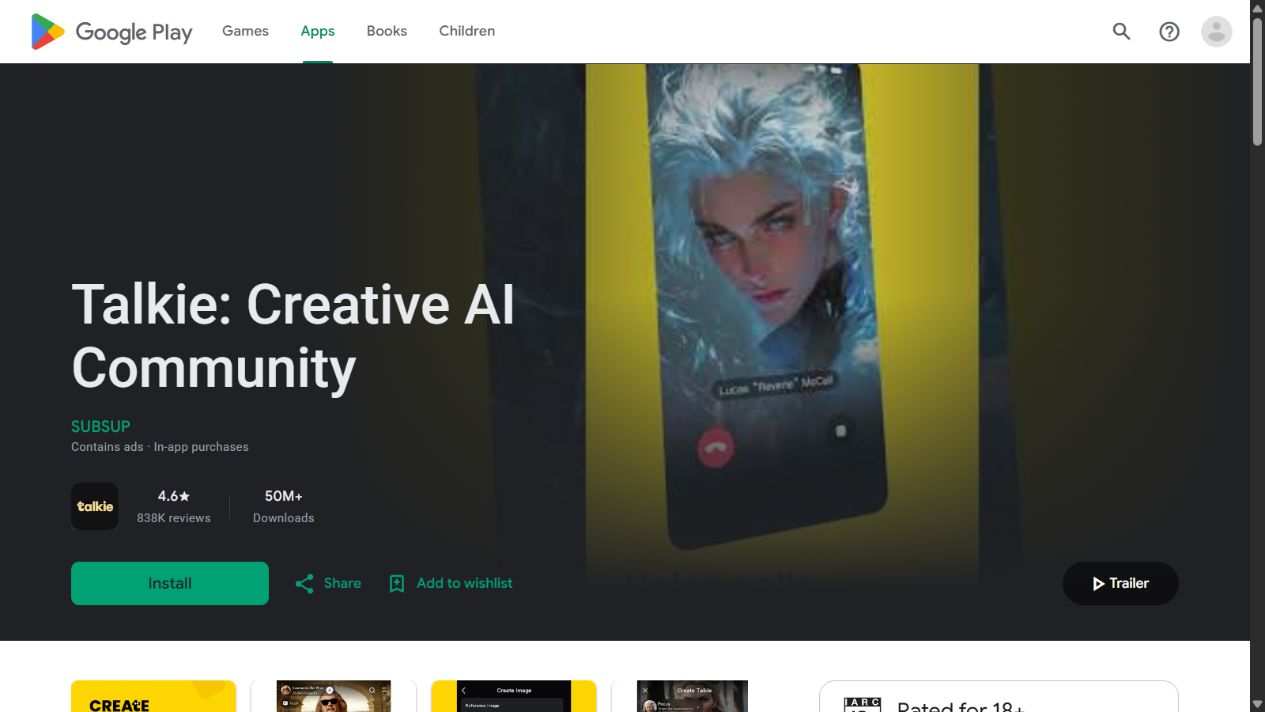
Source: Talkie on Google Play , captured September 5, 2026. Store metadata and promotional artwork are vendor-provided; this is not a hands-on quality test.
The practical advantage to evaluate is how easily you can find an appropriate premise. A large directory is useful only if its descriptions, search and browsing help you reach something you actually want to use. The most prominent result is not automatically the best fit for your preferred tone.
Choose it when: you want a character-centered interaction and prefer browsing before creating your own setup. Start with a clearly described fictional scenario and check the conversation itself rather than judging only the profile artwork.
Check before committing: current account requirements, content controls, visibility and the limits of the selected offering. This guide does not establish that the service is unrestricted, suitable for every age group or capable of remembering every detail. User-written descriptions are not evidence of product capabilities.
Suggested test: use a short, original scenario and ask for a particular pace, such as one question at a time. See whether the interaction remains understandable after several turns. If you need repeated corrections to maintain the premise, record that as a limitation of the experience you tested.
2. AI Dungeon: for interactive adventures
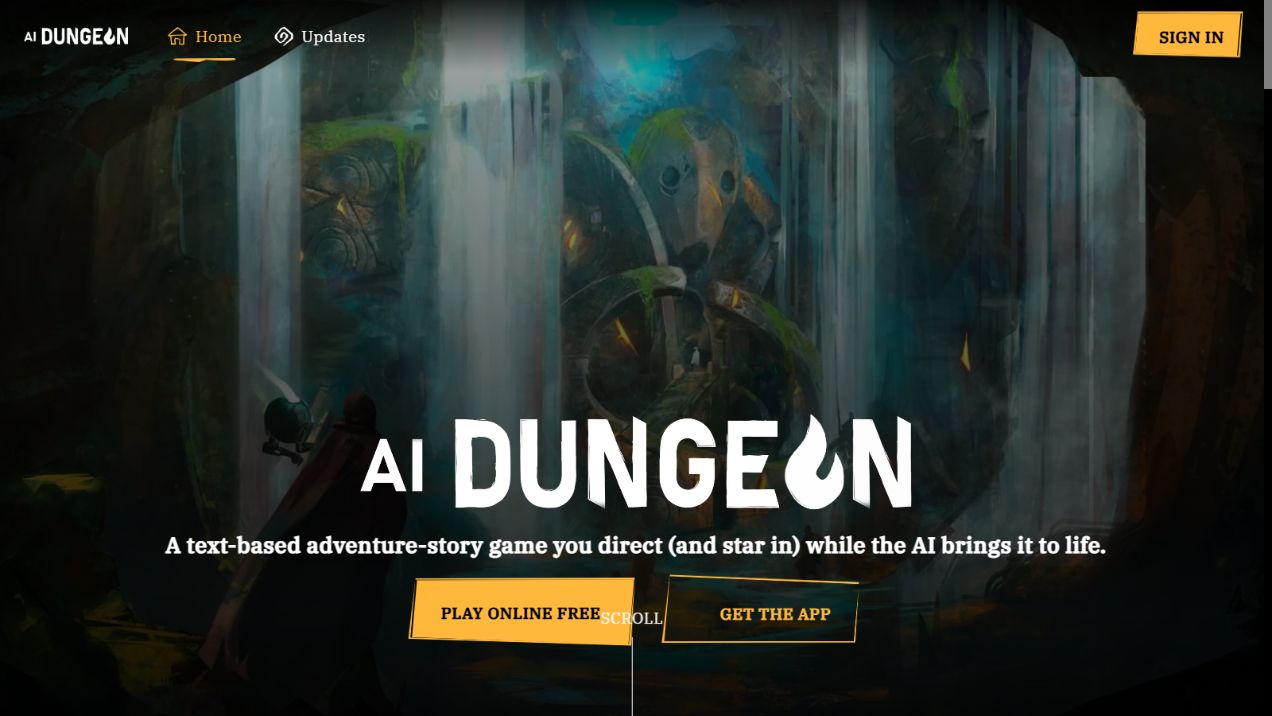
Source: AI Dungeon homepage , captured September 4, 2026. This shows vendor positioning, not a hands-on gameplay test.
AI Dungeon describes itself as an AI text-adventure game with open-ended stories, custom scenarios and community adventures. It is a candidate when the world and the choices matter more than a single personality. Source: AI Dungeon .
For example, you might want to explore a fictional city, investigate an invented mystery or guide a journey. In that case, the evaluation should focus on whether the unfolding situation remains coherent and whether your choices meaningfully shape the next passage.
The official documentation describes Story Cards as contextual notes about story elements, activated through relevant triggers. That is a specific mechanism, not a promise that every fact is always available to the model. See AI Dungeon Story Cards .
Choose it when: you want to play through a scenario and are comfortable managing some story context. Do not expect the same experience as selecting a familiar Character and chatting without a world-building step.
Suggested test: establish a location, a current objective and one important constraint. After several choices, check whether the story still respects them. Try a correction and inspect how much work it takes to return to the intended situation. Evaluate continuity across the passage, not just the quality of one dramatic sentence.
3. NovelAI: for writing-led stories

Source: NovelAI homepage , captured September 4, 2026. The homepage markets both art and stories; the writing recommendation below relies on its documentation, not an image-generation test.
NovelAI presents both image and storytelling tools. For a Character.AI alternative, the relevant reason to consider it is the writing workflow rather than its image-generation marketing. Source: NovelAI .
Its official documentation includes a Lorebook for contextual information and export options for stories. These are useful features to investigate when you want to maintain fictional material and work with the text outside a single conversation. See the Lorebook documentation and official FAQ .
Choose it when: your desired result is prose you can review, revise and organize. A writing-oriented environment can suit someone who wants to remain the author of the scene, deciding what to retain instead of treating every response as the next accepted event.
Check before committing: how much configuration you want to manage, which capabilities your selected offering includes and whether the export contains the material you need. An available export does not establish compatibility with a different service’s format.
Suggested test: begin with an original paragraph, continue the scene, revise a passage and inspect an export. Ask whether the workflow helps you make a better draft. If your real preference is effortless character browsing, the additional authoring decisions may be a disadvantage rather than a benefit.
Why the distinction matters
Character chat, interactive adventures and prose writing can all involve fictional dialogue, but they organize the work differently. A chat centers on turns between participants. An adventure centers on events and choices. A writing tool centers on a text that the author may reorganize and edit.
A person who wants a quick conversation may dislike a system that asks them to maintain lore. A writer may dislike a conversation interface that makes revision awkward. Neither reaction proves the product is poor; it may simply be the wrong creative workflow.
Before opening another account, complete this sentence: I want to switch because my current process makes it difficult to do this specific thing. Keep the answer concrete. Difficulty maintaining a setting or exporting a draft is more testable than wanting a smarter AI.
Evaluate memory with a small continuity test
Avoid treating memory as a single yes-or-no feature. The useful question is which details remain available and influence the output when they matter. A stored note and a correctly applied fact are different forms of evidence.
Create a short fictional setup with three details: a location, a relationship and a restriction. For example, a museum is closed for renovation, the curator trusts a visiting archivist and the damaged east wing cannot be entered. Keep the scenario harmless and invented.
Continue for a few turns, then ask a question that depends on one of those details. Record whether the answer respects the setup. If it fails, use the product’s documented context mechanism and repeat the check. Do not declare permanent recall from a single successful answer.
This is a suggested evaluation method, not a benchmark we performed. Use your observations to decide whether the amount of correction is acceptable for your creative purpose.
Check control over your own role
Some users want rich narration; others want the system to stop before deciding what their character does. Make that preference explicit during a trial. A visually appealing interface does not answer whether the interaction respects your preferred rhythm.
Ask for a short scene that ends with a choice. Check whether the response leaves that choice to you. Then change your direction and observe whether the next turn accommodates it. The test should reflect how you actually want to participate.
For writing, the equivalent question is whether you can comfortably reject and revise material. An AI-generated passage is a suggestion, not an obligation. A useful workflow makes it easy to retain good ideas without accepting every invented detail.
Pricing and free access
Do not compare products solely by a free label. A trial, a limited ongoing tier and a paid subscription are different arrangements. The relevant cost depends on the capabilities and volume you need, not just the availability of a signup button.
Write down what you expect to do in a normal week. Separate text use from optional image or audio activity. Then inspect the current purchase page for limits, renewal terms and additional charges. Avoid assuming that access to one feature includes all the others.
Begin with the smallest commitment that lets you evaluate the required workflow. Keep a reminder of any renewal date you accept. Paying for a longer term before testing the experience can turn a minor mismatch into an unnecessary ongoing expense.
Privacy, visibility and community content
Use invented information while comparing tools. A creative test does not require personal identifiers, confidential documents or another person’s private story. Treat a fictional character profile as fiction, even if it resembles a real person.
Check whether a creation is private, discoverable or accessible by a link. Do not assume that an account-level privacy preference controls every individual creation. Review what will be shared before publishing or inviting someone else into the experience.
Community libraries can contain material you do not want to encounter. Inspect the current controls and reporting options, and follow the service’s eligibility requirements. This guide does not certify any library as universally appropriate or recommend bypassing restrictions.
Talkie’s terms of service specify a baseline minimum age of 14, with higher minimums in listed countries and where local law requires them. Do not interpret that eligibility threshold as a guarantee that every community interaction is appropriate. The terms also describe the service as personal-use software unless commercial use is expressly authorized; check that boundary before treating it as a business writing workflow.
AI Dungeon’s moderation explanation distinguishes unpublished single-player stories from published community content. It says private single-player content is not moderated, while generated responses still have safety boundaries. It also explains that story elements are decrypted for model processing. Consequently, neither “private” nor “encrypted” should be read as meaning that generation operates on encrypted text or that the AI has no restrictions. These are vendor-described policies, not an independent security audit.
Generated dialogue can sound confident or emotionally convincing without being reliable. Keep important decisions outside the fictional exchange and verify factual claims through suitable sources. These products are creative software, not substitutes for qualified advice or real-world support.
Switching without losing the story
This guide does not verify an automatic transfer of Character.AI conversations into the shortlisted products. Do not buy on the assumption that a complete history, personality or memory will move intact.
Instead, prepare a concise summary of your own fictional material: the setting, central characters, current situation and facts that should remain consistent. Remove private information and anything you do not have permission to share. A clean summary is often a more manageable test input than a long, contradictory transcript.
Check export and import separately. Being able to download a file from one product does not mean another can interpret it. Open the exported material and inspect what it contains before relying on it as your only copy.
For a concrete exit check, AI Dungeon’s system-settings guide documents a Download Adventure option that exports adventure text in a ZIP file. That provides a backup route to inspect during evaluation, not evidence that Character.AI or NovelAI can import the archive. NovelAI’s story-export documentation likewise needs to be considered separately from its Lorebook import and export controls: preserving prose and preserving contextual notes are different checks.
Keep your original material until the new workflow meets your needs. There is no requirement to abandon a working tool immediately; you may use one for conversations and another for writing if their roles remain clear.
When staying with Character.AI makes sense
If you already enjoy the character-discovery experience and the main problem is an unclear setup, switching may not resolve it. A more focused greeting or simpler premise may be worth trying first. Our Character.AI tutorial explains that starting process.
Stay only if the current offering still fits your requirements. Familiarity should not hide a genuine mismatch, but novelty should not be mistaken for improvement either. Compare a specific task under similar conditions and choose based on the result you can observe.
Final recommendation
Start with Talkie for character discovery, AI Dungeon for adventures or NovelAI for writing-led stories. Test one original scenario, inspect continuity and control, and check how you can preserve your work. Choose the workflow that fits your creative goal rather than a promise of unlimited capability.
Frequently asked questions
What is the best Character.AI alternative?
Talkie is a candidate for browsing character conversations, AI Dungeon for interactive adventures and NovelAI for writing-led stories. The best fit depends on whether you want to chat, play through a world or edit prose.
Is AI Dungeon the same as Character.AI?
No. AI Dungeon emphasizes interactive text adventures and scenarios. That differs from choosing a Character as the center of a conversation.
Is NovelAI a direct character-chat replacement?
It is better considered a writing-oriented alternative. Its story and lore tools suit people who want to shape text, rather than simply browse a character directory.
Will an alternative remember everything?
Do not assume that. Context tools and saved notes can support continuity, but they do not establish perfect or permanent recall. Test the facts that matter to your story.
Can I transfer my Character.AI conversations?
This guide does not verify a compatible automatic migration. Keep an approved summary of your own fictional material and check each service's import and export options separately.
Should I choose based on a free label?
No. Distinguish a trial from ongoing free access and check limits, paid capabilities and renewal terms against the way you plan to use the product.
Are these tools reliable sources of advice?
Treat generated stories and character dialogue as creative output. Verify important factual claims independently and use appropriate professional sources for consequential decisions.