Best Customer Support Software for Startups
Compare five customer support platforms for startups by support model, product context, AI cost, knowledge workflow, integrations, and scaling risk.
Direct answer
The best customer support software for a startup is the platform that preserves customer context while the product, team, and support model are still changing. In this guide, Help Scout is the best general starting point, Plain is best for technical B2B support connected to product teams, Intercom is best for AI-first in-app customer service, Tidio is best for website-led chat and automation, and Zendesk is best for startups approaching complex omnichannel operations.
This is a contextual shortlist, not a universal ranking. A pre-seed SaaS startup answering founder emails needs a different system from a consumer app handling thousands of in-product conversations or a scale-up supporting contractual SLAs. The right platform should make ownership, escalation, product context, knowledge reuse, and customer feedback easier without creating more administration than the startup can sustain.
We used official sources checked on August 24, 2026. We did not operate production accounts, measure vendor AI resolution claims, or independently test response speed. Product facts are sourced; the “best for” labels are editorial inferences from documented capabilities and commercial models.
Best customer support software for startups at a glance
| Platform | Best startup fit | Commercial model to verify | Main risk to test |
|---|---|---|---|
| Help Scout | General relationship-led support | User- or contact-based plans plus AI and messaging usage | Plan model and AI costs as volume grows |
| Plain | Technical B2B support connected to product and engineering | Seat plans, included credits, higher-tier workflows | Smaller ecosystem and technical implementation responsibility |
| Intercom | AI-first in-app support and customer engagement | Seats, AI outcomes, channels, and add-ons | Outcome costs and operational complexity |
| Tidio | Website chat, ticketing, and lightweight AI automation | Conversation quotas, AI usage, agents, and plans | Usage limits and depth beyond chat-led support |
| Zendesk | Omnichannel support preparing for scale | Agent plans, automated resolutions, add-ons, and channel usage | Administrative load and total cost |
How we selected the five platforms
We started with the work a startup support system must make reliable. A qualifying product needed current official evidence for customer intake, team handling, self-service or knowledge, automation, integrations, and a commercial path that could be explained without inventing facts.
We then compared products using eight criteria:
- Startup stage fit: Can the team start small without rebuilding the operating model immediately?
- Customer context: Can agents see enough account, product, billing, and conversation history to solve the issue?
- Channel fit: Does the platform support the channels customers actually use?
- Knowledge workflow: Can repeated answers become maintainable self-service content?
- Human and AI handoff: Are automation boundaries, escalation, and review understandable?
- Product feedback loop: Can bugs and feature requests reach product and engineering with context?
- Control and reporting: Can owners inspect workload, quality, response, resolution, permissions, and failures?
- Full cost: How do agents, contacts, messages, AI outcomes, credits, channels, add-ons, and implementation affect the next stage?
We excluded products that duplicated these operating models without adding a clearer startup use case. This guide is distinct from our small-business customer support comparison , which covers ten products across a wider set of conventional small-business requirements. This page focuses on startup uncertainty, product context, fast feedback, founder-to-team handoff, and AI cost control.
Define the support system before selecting software
A startup should decide what qualifies as support before evaluating interfaces.
Map five request classes:
- Product questions: setup, behavior, limits, errors, and how-to requests;
- Account operations: access, identity, permissions, subscription, and billing;
- Incidents: degraded service, security concerns, data problems, and urgent escalations;
- Customer feedback: bugs, feature requests, objections, and reasons for churn;
- Commercial conversations: trials, upgrades, renewals, and expansion requests that may move to sales or success.
For each class, define the intake channel, owner, urgency, required context, escalation path, permitted automation, resolution evidence, and where the learning should go next. This prevents the tool from becoming a mailbox with prettier labels.
The minimum useful support record should answer:
- Who is the customer and which account do they belong to?
- What product, plan, environment, or workflow is affected?
- What has already happened?
- Who owns the next action and by when?
- What would prove the issue is resolved?
- Should the answer update documentation, product work, or policy?
1. Help Scout: best general starting point
Help Scout is the strongest default in this shortlist for a startup moving from founder inboxes to a structured but approachable support operation. Its current product positioning combines a shared inbox, customer context, team collaboration, knowledge, chat, proactive messages, analytics, mobile access, and AI-related assistance.
The attraction is operational focus. A startup can manage conversations and publish a help center without first building a complicated service architecture. Beacon can place help content and contact options inside a website or application, while APIs, webhooks, and embedded apps create paths for product context and workflow connections.
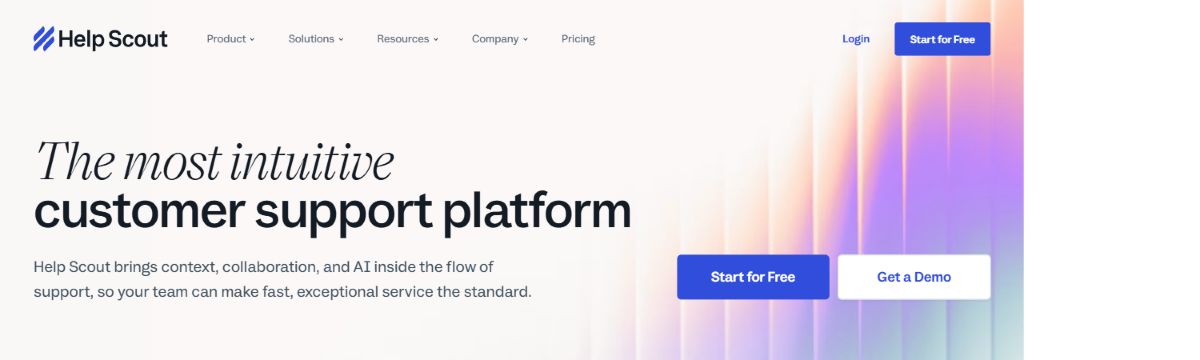
Help Scout official homepage. Source: Help Scout . Captured August 24, 2026, to document the platform’s current positioning.
Why Help Scout fits startups
- the shared-inbox model is easier to adopt than a heavily configured service suite;
- Docs and Beacon support knowledge and in-context self-service;
- conversation history and customer context help teams avoid disconnected replies;
- APIs, webhooks, and sidebar apps allow product information to reach support;
- current product updates show an expanding path into account health, company-level context, SLAs, SMS, and customer portals.
Limitations to test
Help Scout documentation distinguishes user-based and contact-based billing. AI Answers uses a per-resolution model after its trial, and AI Drafts, proactive messages, additional sites, channels, and other capabilities can vary by plan or billing type. Confirm the exact account model before projecting cost.
A focused support platform may also need external systems for deep product telemetry, engineering issue management, success operations, or advanced workforce planning. The startup should test whether APIs and integrations preserve enough context.
Choose Help Scout when
Choose Help Scout when the company values clear email- and chat-led support, wants a maintainable knowledge base, and needs enough structure without a dedicated support-operations administrator. Avoid treating simplicity as proof that every future requirement is included.
Sources: Help Scout , developer platform , Beacon , AI Answers .
2. Plain: best for technical B2B startups
Plain is the most startup-specific support architecture in this shortlist. Its current plans are explicitly organized around early-stage companies, newly established support functions, and larger organizations. Official pages document Slack, email, live chat, in-app forms, Linear and Jira connections, customer cards, APIs, webhooks, workflows, knowledge, AI assistance, and free viewer seats.
The distinctive idea is product context. Plain customer cards can retrieve relevant information from a startup’s own systems when an agent opens a customer, while customer records and groups can reflect concepts such as plan, account, or segment. That can reduce the common failure where support must search product dashboards, billing tools, and internal messages before answering.
Plain official homepage. Source: Plain . Captured August 24, 2026, to document its product-led support positioning.
Why Plain fits startups
- the Foundation plan is explicitly designed for early-stage teams;
- Slack, Linear, Jira, email, chat, and in-app support connect support with how technical teams already work;
- customer cards can show live product and account context;
- free viewer seats can expose customer issues to product, engineering, and leadership without buying full support seats for everyone;
- APIs, webhooks, headless portal options, and custom channels provide an extensible path.
Limitations to test
Plain’s flexibility and product-data model can require technical implementation. Customer-card performance depends on the connected API, and a startup must decide which information may be exposed to support roles. Evaluate authentication, caching, redaction, failure behavior, and least-privilege access.
The ecosystem is also smaller than established help-desk platforms. Confirm every required channel, regional need, migration source, report, security control, and integration rather than assuming general extensibility solves it automatically.
Choose Plain when
Choose Plain when a technical B2B startup needs support conversations closely connected to product and engineering work, values Slack or in-app channels, and can maintain the integration layer. A nontechnical team wanting a large prebuilt marketplace may prefer another product.
Sources: Plain pricing , Plain integrations , customer documentation , headless portal .
3. Intercom: best for AI-first in-app customer service
Intercom is the strongest option here when customer support happens inside a software product and the startup intends to combine human agents, a help center, workflows, messaging, and an AI agent. Its official pricing material currently packages the help desk and Fin AI Agent around seat plans, with additional usage for Fin outcomes and selected communication channels.
Intercom’s architecture can cover live chat, inbound email, in-app conversations, tickets, knowledge, reporting, outbound engagement, and AI assistance. Fin uses approved support content and data to answer, follow procedures, qualify, or hand off conversations, while Copilot assists teammates inside the inbox.
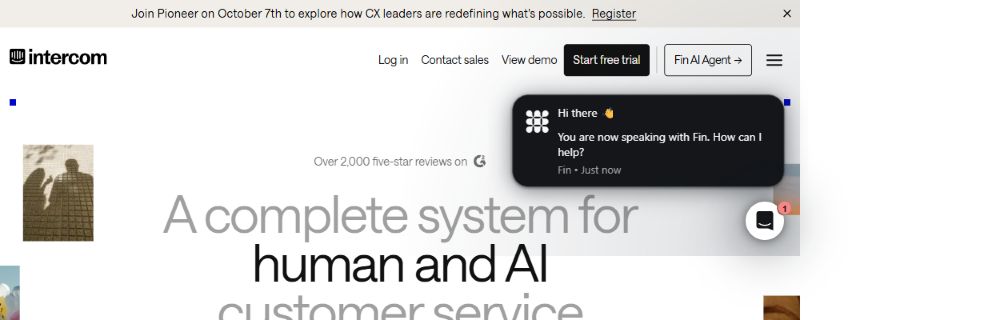
Intercom official homepage. Source: Intercom . Captured August 24, 2026, to document the platform’s current AI-first service positioning.
Why Intercom fits startups
- in-app messaging can connect support to the page and workflow the customer is using;
- help desk, knowledge, human inbox, automation, and Fin operate in one service environment;
- Fin can use public and private knowledge sources and escalate when configured conditions require human help;
- the platform supports more than 450 official apps and integrations according to current pricing documentation;
- eligible startups may have a separate early-stage commercial path.
Limitations to test
Intercom cost is multidimensional. Buyers should model full seats, Fin outcomes, phone, SMS, WhatsApp, email campaigns, proactive-support usage, and add-ons. A low seat count does not guarantee a low total cost when customer volume grows.
AI performance also depends on knowledge quality, procedure design, audience controls, escalation, and review. A startup should not deploy an AI agent to billing, security, cancellation, or account-access requests without explicit boundaries and human recovery paths.
Choose Intercom when
Choose Intercom when in-product service, knowledge, proactive communication, and AI-assisted resolution form one deliberate customer experience. Avoid it when the company only needs a straightforward support inbox and cannot monitor outcome-based usage.
Sources: Intercom pricing , pricing FAQs , Fin outcomes , AI and automation .
4. Tidio: best for website-led chat and lightweight automation
Tidio is the strongest fit here for a startup whose support and conversion workflow begins on the website. Official pricing and documentation divide the product into live customer service, flows, and the Lyro AI Agent, allowing teams to combine or purchase parts of that model.
The platform can turn incoming live chat, email, and social conversations into tickets, assign work, add notes and tags, and use automation for common interactions. Flows follow configured paths, while Lyro uses the startup’s support content to answer less predictable questions. This distinction matters: rule-based automation and generative assistance should solve different classes of work.
Tidio official homepage. Source: Tidio . Captured August 24, 2026, to document the product’s current website-support positioning.
Why Tidio fits startups
- live chat creates a fast path for website visitors and early customers;
- ticketing can organize chat, email, and supported social requests;
- Flows can handle predictable qualification and support paths;
- Lyro can answer from approved support content and can be purchased separately in supported configurations;
- free entry and time-limited trials let a startup test demand before a larger commitment.
Limitations to test
Tidio’s commercial model includes conversation limits, visitor or flow usage, Lyro conversations, agent limits, and higher-tier capabilities. Model the expected mix rather than comparing only the plan label.
Website chat can also pull a startup toward constant interruption. Define operating hours, response expectations, ticket conversion, escalation, and which questions should become documentation. For complex B2B account support, test whether customer context and product integrations are deep enough.
Choose Tidio when
Choose Tidio when website chat and fast automation are central, the team wants to combine human and AI handling, and support volume is still measurable enough to model. A technical account-based startup may need deeper product context than a chat-led system provides.
Sources: Tidio pricing , Tidio FAQ , plan guidance .
5. Zendesk: best for startups approaching complex operations
Zendesk is the strongest candidate in this shortlist when the startup is becoming a scale-up: multiple support channels, contractual service levels, specialized roles, broader reporting, more complex routing, or regional operations now matter. Its Suite and Support products provide a mature service foundation, while AI agents, Copilot, voice, privacy controls, capacity, and other capabilities can be included or added depending on plan.
The platform’s depth is the advantage and the risk. A company can build structured omnichannel operations and connect a large integration ecosystem, but doing so usually requires stronger administration, governance, and cost control than a founder-led inbox.
Zendesk official homepage. Source: Zendesk . Captured August 24, 2026, to document the platform’s current service positioning.
Why Zendesk fits scaling startups
- Suite can combine email, messaging, chat, voice, knowledge, automation, reporting, and ticket operations;
- routing, roles, views, SLAs, and reporting support more specialized service teams;
- AI-agent functionality and a baseline number of automated resolutions are available across current Suite and Support plans, with usage controls and additional packs;
- a large marketplace supports connections across customer, engineering, data, commerce, and workforce systems;
- higher plans and add-ons create a path for complex privacy, capacity, collaboration, and enterprise requirements.
Limitations to test
Zendesk can be more system than an early startup needs. Configuration, taxonomy, automation, permissions, apps, reports, and channel policies require ownership. Without governance, teams create duplicate views and triggers that make the service operation harder to understand.
The total cost can include agents, automated resolutions, Copilot, voice or messaging usage, privacy controls, storage, API capacity, and other add-ons. Use a scenario-based quote and verify which capabilities are included in the intended edition.
Choose Zendesk when
Choose Zendesk when support has become a formal operation with multiple channels, roles, service commitments, and integration requirements. Avoid selecting it for prestige or future-proofing when the team cannot yet maintain the configuration.
Sources: Zendesk , Zendesk pricing , and product add-ons .
Which support platform should your startup shortlist?
Reduce the decision to the operating model:
- Start with Help Scout when the team needs a clear, relationship-led support workspace with knowledge and manageable administration.
- Start with Plain when product and engineering context are central to B2B support.
- Start with Intercom when in-app customer service and AI-assisted resolution are part of the product experience.
- Start with Tidio when website chat and lightweight automation drive most early support demand.
- Start with Zendesk when the startup already needs mature omnichannel operations, SLAs, routing, and governance.
Take two products into a pilot. One should optimize today’s dominant request flow. The other should represent the strongest credible architecture for the next stage. Testing every platform creates shallow configuration and weak evidence.
A four-week startup support pilot
Week 1: define requests and boundaries
Sample at least 30 recent requests. Classify their channel, urgency, product context, owner, repeated knowledge, escalation, and outcome. Identify questions that automation may answer and those that always require a human.
Week 2: configure one complete flow
Create queues, roles, tags, routing, business hours, one escalation, one knowledge collection, and one connection to product or engineering work. Use approved test data and least-privilege access.
Week 3: operate with the actual team
Handle representative requests. Record the time spent finding context, assigning work, drafting, escalating, and updating the customer. Inspect missed notifications, duplicate replies, and unresolved ownership.
Week 4: test failure and cost
Make an automation fail, revoke a user, export conversations, correct a customer record, remove sensitive data, and inspect the weekly report. Model current cost and the cost after the next two hiring or volume milestones.
Score each product on:
- agent workflow;
- customer context;
- channel coverage;
- knowledge reuse;
- product and engineering feedback;
- automation control;
- AI escalation and cost;
- reporting trust;
- permissions and data handling;
- projected total cost;
- migration and export risk.
Common startup support-software mistakes
Automating before the knowledge is reliable
An AI agent cannot repair conflicting policies or missing product documentation. Audit source ownership, dates, audience, and escalation before allowing automated answers.
Letting every channel create a separate process
Email, chat, Slack, social messages, and in-app requests may need different interfaces, but ownership and resolution definitions should remain consistent.
Treating support as a ticket disposal function
The system should return learning to documentation, product, billing, onboarding, and sales. A closed ticket without reusable learning can be an expensive repeated event.
Ignoring usage-based cost
AI resolutions, outcomes, messages, phone minutes, contacts, and conversation quotas can grow faster than seats. Model volume and set alerts or limits where the vendor supports them.
Buying enterprise controls too early
SLAs, advanced routing, and complex reporting are valuable when the company has commitments and owners. Before that, they can create configuration work that distracts from solving customer problems.
Final recommendation
The best customer support software for startups should make the customer easier to understand, the next action easier to own, and repeated knowledge easier to reuse.
Help Scout is the most balanced general starting point. Plain is the strongest product-connected option for technical B2B teams. Intercom offers the broadest AI-first in-app service model. Tidio makes sense for website-led chat and automation. Zendesk becomes compelling when the support operation is already complex enough to justify its depth.
Choose only after running representative requests through the full lifecycle. A polished inbox does not prove that the platform can preserve product context, control automation, manage sensitive requests, support human escalation, and produce trustworthy operational data.
Frequently asked questions
What is the best customer support software for an early-stage startup?
Help Scout is the strongest general starting point here when the startup needs a shared inbox, knowledge, chat, and collaboration without a large administrative burden. Plain may be better for a technical B2B company that needs customer and product context connected to engineering.
Which support tool is best for an AI-first startup?
Intercom has the broadest AI-first service architecture in this shortlist. Tidio offers a lighter website-led combination of chat, ticketing, flows, and an AI agent. Evaluate knowledge quality, escalation, expected outcomes, channel fit, and cost limits before deciding.
When does a startup need Zendesk?
Zendesk is more appropriate when the company needs mature routing, SLAs, multiple channels, specialized roles, deeper reporting, or a larger integration surface. A small team should not adopt that complexity before it has an owner and a clear requirement.
How should a startup estimate customer support software cost?
Include full and occasional users, AI resolutions or outcomes, contacts, messages, telephony, knowledge, integrations, add-ons, implementation, migration, and projected volume. Calculate at current scale and at the next two milestones.
How should customer support software be tested?
Use representative billing, access, incident, bug, how-to, and escalation requests. Test intake, assignment, product context, knowledge, automation, human handoff, reporting, permissions, export, deletion, and failure recovery before purchase.
Frequently asked questions
What is the best customer support software for an early-stage startup?
Help Scout is the strongest general starting point in this shortlist when a startup needs a clear shared inbox, knowledge base, chat, and collaborative support workflow without a large administrative burden. Plain can be a better fit for a technical B2B startup that needs product context and engineering integrations.
Which support tool is best for an AI-first startup?
Intercom has the broadest AI-first service architecture in this shortlist, while Tidio combines live chat, ticketing, flows, and its Lyro AI agent for a lighter website-led model. The better choice depends on knowledge quality, expected AI outcomes, human escalation, channels, and cost predictability.
When does a startup need Zendesk?
Zendesk becomes more relevant when the startup needs mature omnichannel routing, permissions, SLAs, reporting, multiple brands, or a larger integration and administration surface. A very small team should test whether it can support that complexity before buying.
How should a startup estimate customer support software cost?
Model full agents, occasional collaborators, AI outcomes or resolutions, message and telephony usage, knowledge features, integrations, add-ons, implementation, migration, and the next hiring stage. A seat price alone rarely represents the total support cost.
How should customer support software be tested?
Run real request types through intake, assignment, product-context lookup, escalation, resolution, knowledge reuse, reporting, export, and deletion. Include an incident, billing question, account request, bug report, and a request the AI system should refuse or hand to a human.