Best Cybersecurity Software for Enterprise Teams
Compare five enterprise cybersecurity platforms for detection, response, endpoint protection, analytics, integrations, and security operations.
Direct answer
Microsoft Defender XDR is the strongest enterprise starting point for organizations centered on Microsoft 365, Microsoft identity, endpoints, email, collaboration, and cloud applications. CrowdStrike Falcon is strongest when endpoint-led protection, threat intelligence, managed services, and platform consolidation drive the program. Palo Alto Networks Cortex XSIAM fits organizations redesigning the SOC around unified security data, analytics, and automation. SentinelOne Singularity fits teams prioritizing autonomous endpoint-led protection with connected cloud, identity, and SIEM capabilities. Splunk Enterprise Security fits data-intensive security operations that need broad telemetry, SIEM, detection engineering, SOAR, UEBA, and flexible deployment.
None is complete enterprise cybersecurity. Security architecture also includes identity and access, email, network, SASE, cloud posture and workload protection, application security, data security, vulnerability management, attack-surface management, backup, resilience, awareness, governance, third-party risk, and incident response. This guide deliberately narrows the comparison to enterprise security-operations platforms that help prevent, detect, investigate, and respond across multiple domains.
Official sources were checked on August 30, 2026. We did not deploy agents, replay attacks, test malware, measure false positives, benchmark detection, or validate vendor performance claims. Recommendations are architecture-based editorial inferences. Run controlled evaluations with your own telemetry and approved simulations.
Enterprise cybersecurity shortlist at a glance
| Platform | Best-fit enterprise context | Primary buying risk |
|---|---|---|
| Microsoft Defender XDR | Microsoft-centered endpoint, identity, email, collaboration, and cloud-app protection | Misunderstanding licences, service prerequisites, Sentinel data costs, and non-Microsoft coverage |
| CrowdStrike Falcon | Endpoint-led consolidated security with threat intelligence and managed options | Expanding modules, devices, workloads, data, services, and platform cost without control mapping |
| Cortex XSIAM | SOC transformation using unified data, SIEM, XDR, analytics, and automation | Large migration, telemetry economics, detection redesign, and operating-model change |
| SentinelOne Singularity | Autonomous endpoint-led protection connected to cloud, identity, data, and AI SIEM | Assuming automation removes analyst validation, tuning, integration, and incident ownership |
| Splunk Enterprise Security | Broad, data-intensive SIEM and threat detection, investigation, and response | Ingest, workload, retention, content, staffing, and data-pipeline economics |
How we selected the five platforms
We reviewed official product, pricing, documentation, architecture, security, and support material. Each candidate needed documented enterprise relevance across endpoint, identity, cloud, telemetry, detection, investigation, automation, response, or SIEM workflows. We evaluated ten areas:
- Coverage: endpoints, servers, cloud workloads, identities, email, SaaS, network, data, and third-party telemetry.
- Prevention: policy, attack-surface reduction, exploit controls, behavior, isolation, and automated disruption.
- Detection: telemetry, analytics, rules, behavioral methods, threat intelligence, correlation, and custom content.
- Investigation: incidents, timelines, search, hunting, evidence, relationships, enrichment, and case workflow.
- Response: containment, remediation, orchestration, approvals, rollback, integrations, and managed services.
- Data architecture: collection, normalization, routing, retention, search, compute, regions, and export.
- Governance: identity, roles, audit, segregation, privacy, residency, retention, and change management.
- Operations: deployment, health, tuning, content lifecycle, monitoring, support, and incident readiness.
- AI: evidence, permissions, autonomy, human approval, data boundaries, auditability, and failure behavior.
- Economics: licences, modules, devices, workloads, ingest, compute, storage, services, staffing, and exit.
We excluded vendor-sponsored outcome statistics from the selection logic. A detection percentage or customer ROI figure is not portable without its dataset, configuration, operating model, and methodology.
1. Microsoft Defender XDR: best for Microsoft-centered enterprises
Microsoft describes Defender XDR as an extended detection and response platform spanning endpoints, hybrid identities, email, collaboration tools, and cloud apps. The Defender portal can unify incidents and investigations across supported services. Microsoft Sentinel complements XDR with SIEM and SOAR capabilities that ingest broader enterprise logs and support additional automation and tracking.
The architecture is compelling when Microsoft 365, Microsoft Entra, Windows, Azure, email, and collaboration already represent major parts of the environment. Native context can reduce integration work and help analysts follow an attack across identity, endpoint, mailbox, and cloud application signals. The advantage is not automatic. The buyer still needs correct licensing, service deployment, telemetry quality, role design, incident ownership, tuning, and coverage for non-Microsoft systems.
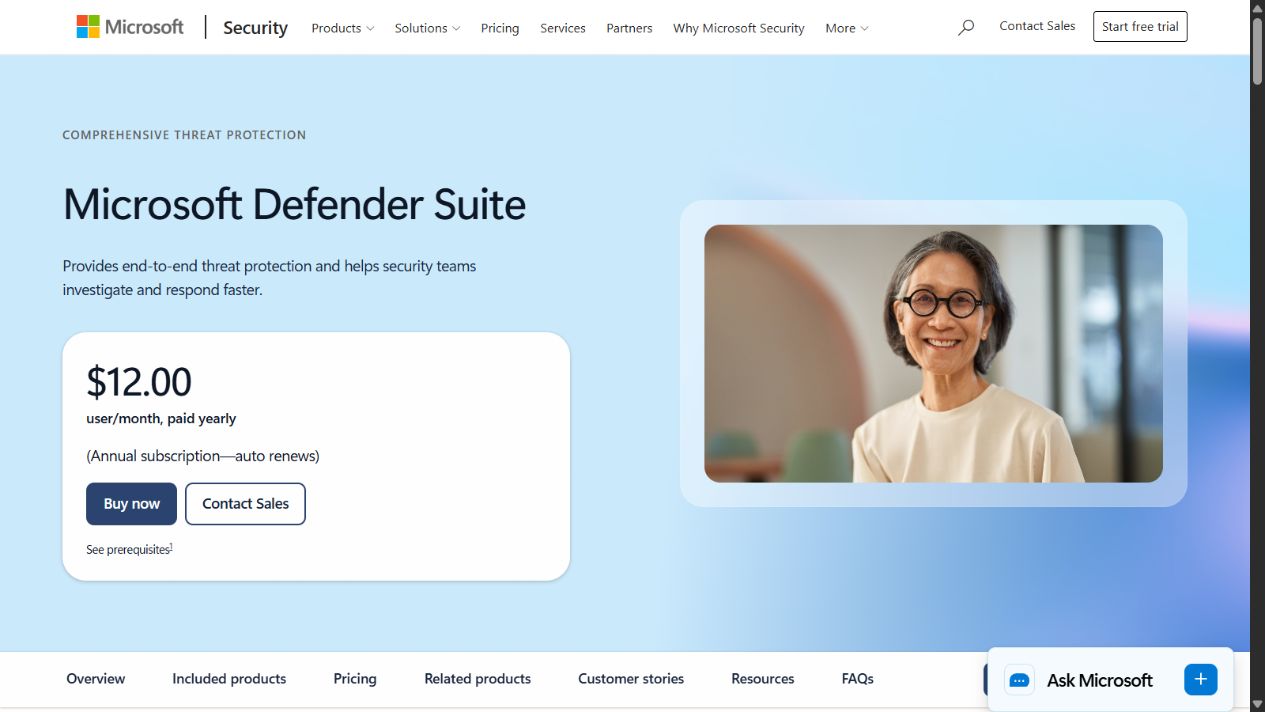
Microsoft Defender XDR product page captured August 30, 2026. Licences and portal capabilities can change.
Choose Microsoft Defender XDR when
- Microsoft 365 and Microsoft identity are enterprise standards.
- Endpoint, identity, email, collaboration, and cloud-app incidents should share context.
- Existing licences may include relevant Defender components.
- Microsoft Sentinel is already used or planned for broader SIEM and SOAR.
- Security and Microsoft platform teams can share deployment and governance ownership.
Check before buying
Map every user, endpoint, server, identity, mailbox, SaaS application, cloud workload, and data source to a licence and service. Confirm Defender for Endpoint, Identity, Office 365, Cloud Apps, Vulnerability Management, Defender for Cloud, and Sentinel scope. Do not infer entitlement from portal visibility.
Test non-Windows coverage, network dependencies, sensor health, identity prerequisites, email configuration, data connectors, retention, query, automation, and response permissions. In Sentinel, model ingest, analytics, retention, archive, search, automation, and incident peaks. Define when Defender XDR owns an incident and when Sentinel becomes the orchestration layer.
Sources: Microsoft Defender XDR , Defender XDR documentation , and SIEM and XDR overview .
2. CrowdStrike Falcon: best endpoint-led consolidated platform
CrowdStrike presents Falcon as an AI-native security platform using a common sensor, telemetry, intelligence, and platform across endpoint, identity, cloud, SaaS, AI, next-generation SIEM, exposure, and managed services. The product family can combine prevention, detection, investigation, response, threat intelligence, hunting, cloud security, identity protection, data, and expert operations depending on modules and services.
Falcon is a strong enterprise candidate when endpoint telemetry and adversary intelligence should anchor a consolidated security program. A common platform can reduce context switching, but consolidation should be measured against control coverage and operational quality. Buying more modules does not eliminate the need to define data sources, detections, response authority, integration boundaries, and fallback procedures.
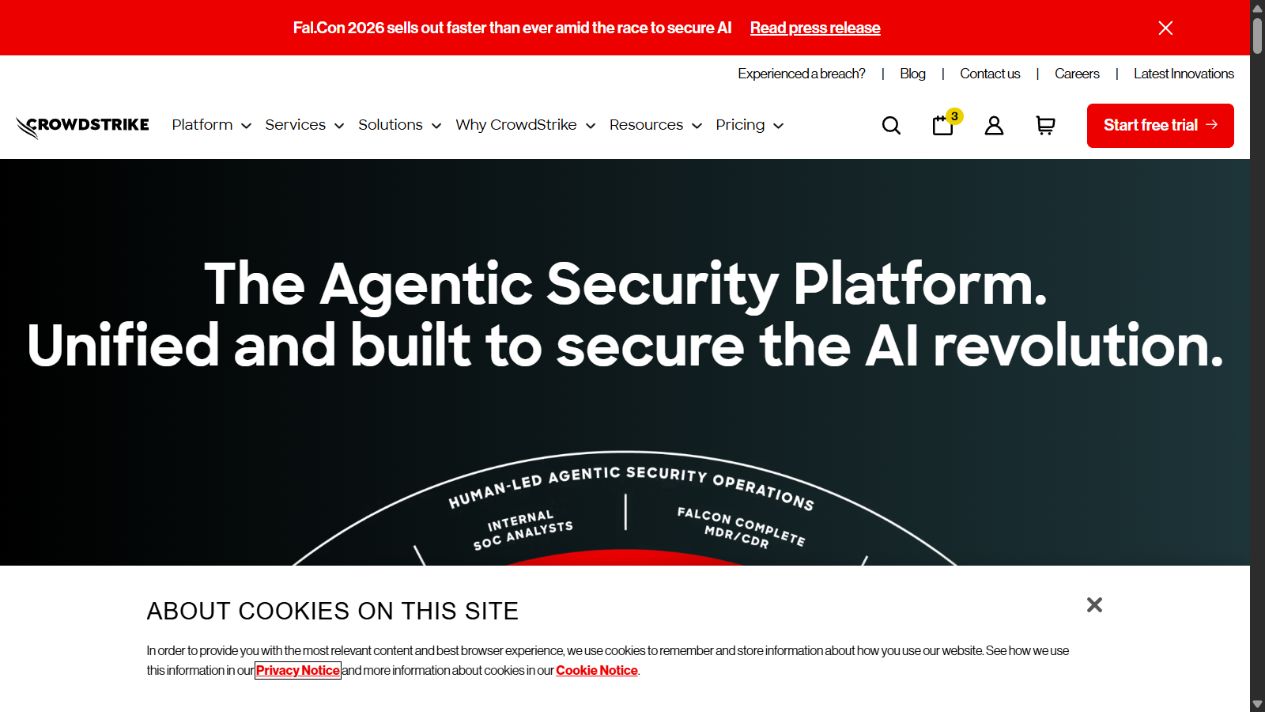
CrowdStrike Falcon platform page captured August 30, 2026. Modules, services, packages, and commercial terms can change.
Choose CrowdStrike when
- Endpoint prevention and detection form the primary security-operations foundation.
- The organization wants identity, cloud, SIEM, exposure, or managed services on a connected platform.
- Threat intelligence and managed detection or hunting are strategic requirements.
- A common sensor and console can replace overlapping tools without reducing required controls.
- The team can govern module growth and test response actions across the estate.
Check before buying
Build a module-level inventory for workstations, servers, virtual desktops, cloud workloads, containers, identities, data, SaaS, and managed services. Separate endpoint bundle prices from full enterprise architecture. Include storage, data ingest, retention, threat intelligence, identity, cloud, SIEM, exposure, support, incident response, and professional services.
Pilot sensor compatibility, performance, update control, network behavior, offline protection, containment, rollback, evidence access, APIs, and integrations. Test high-availability and recovery for security tooling itself. A platform outage or faulty policy can affect a large estate, so staged deployment and rollback are security controls.
Sources: CrowdStrike Falcon platform and Falcon Enterprise pricing .
3. Palo Alto Networks Cortex XSIAM: best for SOC transformation
Palo Alto Networks positions Cortex XSIAM as a security-operations platform built around unified data, analytics, AI, automation, SIEM, XDR, and broader SOC capabilities. Its public material emphasizes replacing siloed tools and manual processes with correlated incidents, detection content, investigation, and response on one data foundation.
XSIAM is most relevant when the enterprise intends to redesign security operations rather than add another console. It can consolidate data, detections, cases, analytics, endpoint context, automation, and adjacent capabilities. That scope raises the implementation bar. Migrating a SIEM is a data and operating-model program involving sources, parsers, retention, detections, threat models, use cases, workflows, evidence, integrations, analysts, and compliance reporting.
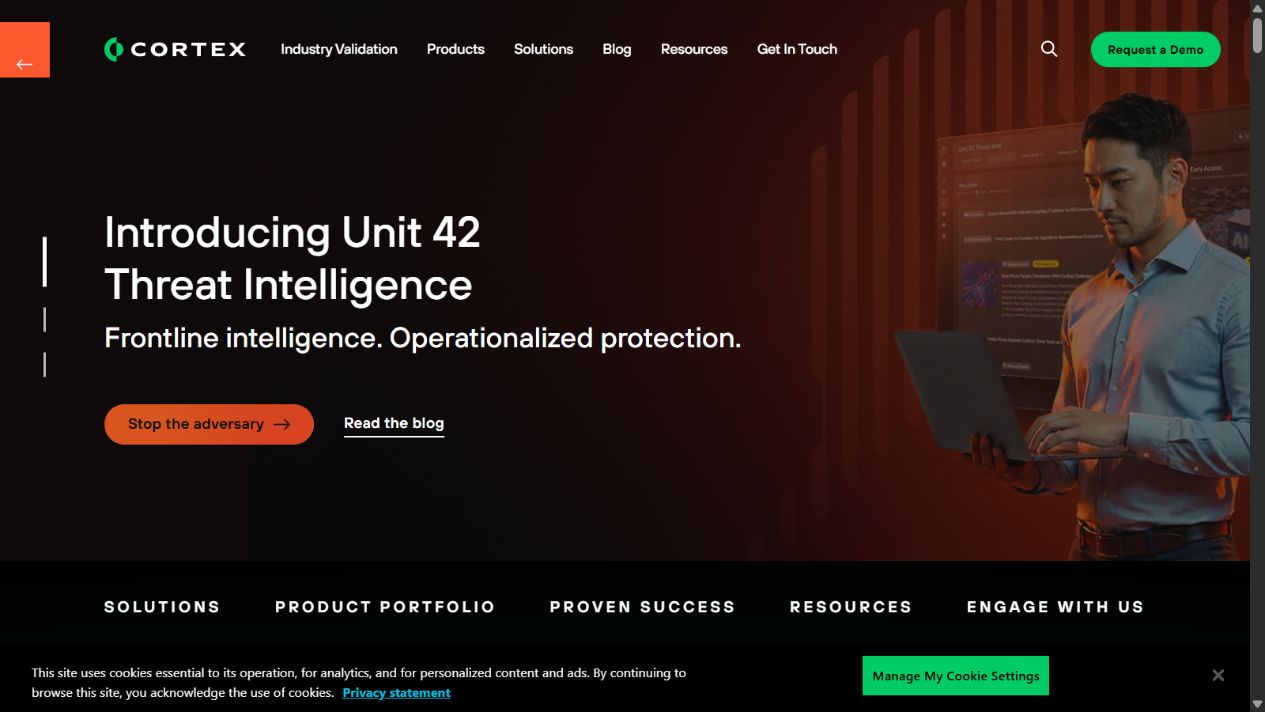
Cortex XSIAM product page captured August 30, 2026. Validate current packaging and custom commercial terms.
Choose Cortex XSIAM when
- The organization is prepared to modernize SIEM and SOC workflows together.
- Palo Alto Networks endpoint, network, cloud, or threat-intelligence context is strategically relevant.
- Unified telemetry, detection, investigation, automation, and response can replace fragmented workflows.
- Security engineering can migrate and govern detections and data pipelines.
- Executive sponsorship exists for process and role change, not just a technology purchase.
Check before buying
Inventory every source, daily and peak volume, retention class, parser, field, detection, dashboard, report, case, playbook, integration, and regulatory requirement. Classify data that can be filtered, routed, tiered, federated, or retired. Preserve raw evidence where policy requires it.
Run old and new systems in parallel for representative threats and business cycles. Compare detection coverage, missing data, false positives, investigation time, automation safety, analyst workflow, and evidence quality. Define rollback and dual-operation cost. Do not switch off legacy controls because a migration milestone says “connected.”
Source: Cortex XSIAM .
4. SentinelOne Singularity: best for autonomous endpoint-led security
SentinelOne describes Singularity as a unified platform across endpoint, cloud, identity, AI security, security operations, data, and managed services. Official pages describe shared telemetry, behavioral detection, incident correlation, automated response, endpoint remediation, AI SIEM, and integrations with third-party tools.
Singularity is a strong candidate when autonomous endpoint protection and response should anchor the platform. Endpoint and identity context can support fast containment, while connected data and SIEM capabilities extend the investigation surface. Automation is useful only when actions are authorized, reversible, observable, and tested. A rapid incorrect containment can disrupt business as effectively as a slow response.
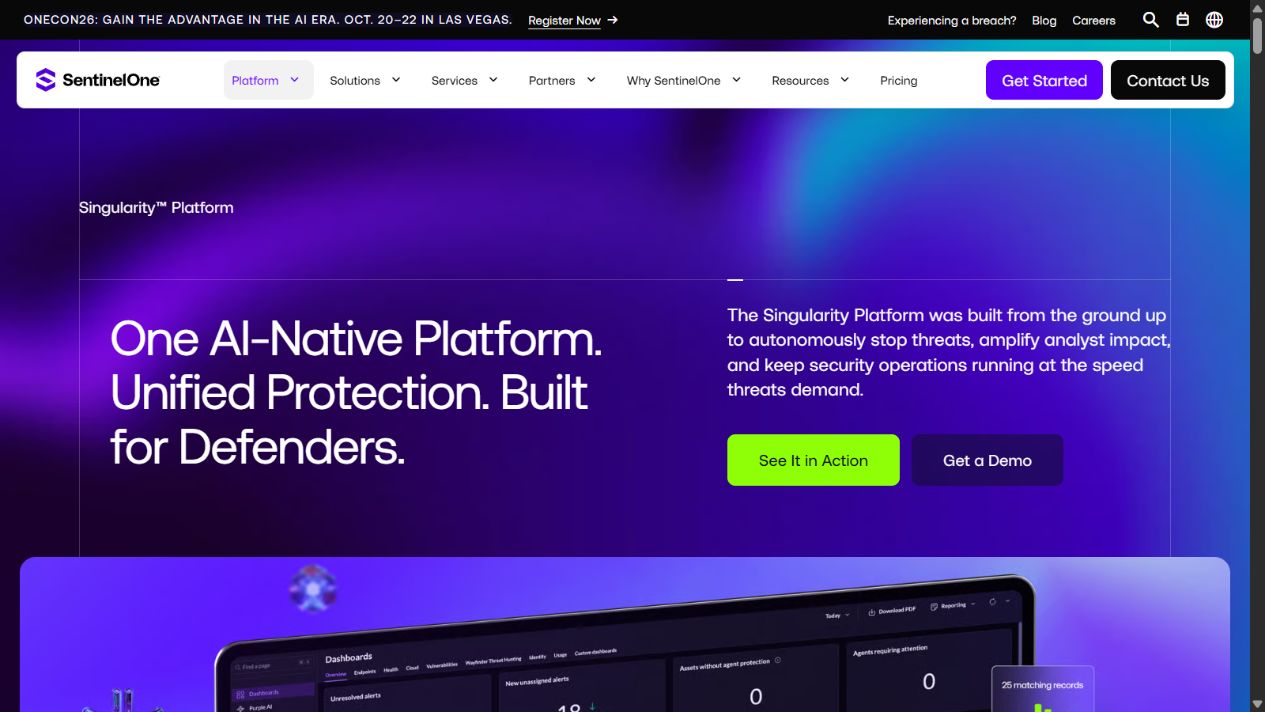
SentinelOne Singularity platform page captured August 30, 2026. Capabilities and packages can change.
Choose SentinelOne when
- Autonomous endpoint prevention, detection, containment, and remediation are high priorities.
- Endpoint, identity, cloud, data, and security-operations capabilities should share context.
- The enterprise needs deployment options including constrained or specialized environments where supported.
- Security teams want AI-assisted investigation with explicit human ownership.
- The buyer can validate third-party telemetry and hybrid platform operation.
Check before buying
Map endpoint, identity, cloud, mobile, data, SIEM, automation, managed service, retention, and support requirements to exact packages. Verify agent compatibility, update control, exclusions, network requirements, rollback behavior, offline operation, APIs, and regional services.
Test autonomous actions by asset class. A workstation, production server, domain controller, industrial endpoint, and executive device should not necessarily share the same response policy. Require approval or additional evidence for high-impact actions. Preserve event context and analyst decisions for audit and post-incident review.
Sources: SentinelOne Singularity platform , Singularity Endpoint , and Singularity AI SIEM .
5. Splunk Enterprise Security: best for data-intensive SIEM and TDIR
Splunk positions Enterprise Security as a threat detection, investigation, and response platform combining SIEM with threat intelligence, detection engineering, and plan-dependent SOAR, UEBA, and AI capabilities. Splunk’s platform can search and analyze data across hybrid, cloud, and on-premises environments, with cloud-managed and self-managed deployment choices and several pricing approaches.
Splunk remains a serious enterprise candidate when telemetry breadth, flexible search, custom detections, long-running security content, and data-platform integration matter. Its flexibility creates operational responsibility. Data onboarding, source quality, field normalization, detection tuning, content ownership, search performance, retention, and cost controls need continuous engineering.
Splunk Enterprise Security page captured August 30, 2026. Editions, deployment, AI availability, and pricing models can change.
Choose Splunk Enterprise Security when
- Security operations need broad telemetry across heterogeneous enterprise systems.
- Existing Splunk skills, data, searches, detections, dashboards, and integrations are strategic assets.
- SIEM, detection engineering, UEBA, SOAR, threat intelligence, and flexible analytics need one workflow.
- Cloud, self-managed, on-premises, or constrained deployment requirements matter.
- A security data engineering function can govern pipelines, content, performance, and cost.
Check before buying
Measure source volume, event size, peaks, search workload, retention, archive, rehydration, federation, and export. Compare ingest, workload, activity, storage, and deployment choices using real data. Security incidents can create telemetry and search spikes; model those peaks rather than average business days.
Inventory every rule, correlation search, lookup, macro, data model, dashboard, report, playbook, integration, and owner. Remove obsolete content before migration. Test performance and detection quality after normalization changes. A SIEM that ingests everything but cannot produce trustworthy incidents is an expensive archive.
Sources: Splunk Enterprise Security , security pricing , and Splunk pricing .
How the platforms differ
The most useful distinction is architectural center:
- Microsoft Defender XDR centers on Microsoft-native protection domains and unified incidents, extended by Sentinel.
- CrowdStrike Falcon centers on endpoint-led telemetry, intelligence, protection, and consolidated modules.
- Cortex XSIAM centers on a unified SOC data and automation architecture.
- SentinelOne Singularity centers on autonomous endpoint-led protection connected to broader security domains.
- Splunk Enterprise Security centers on broad enterprise telemetry, SIEM, analytics, detection engineering, and TDIR.
An enterprise may combine them. Defender or CrowdStrike can feed Splunk. Cortex can ingest third-party sources. SentinelOne can operate with existing tools. The design goal is not maximum consolidation; it is explicit control coverage, reliable evidence, manageable data flow, safe response, and fewer blind handoffs.
Enterprise security requirements checklist
Asset and identity coverage
Create an authoritative inventory for users, service accounts, workloads, endpoints, servers, mobile devices, identities, directories, cloud accounts, containers, SaaS applications, network zones, data stores, and operational technology. Measure enrollment, sensor health, logging, ownership, and unsupported assets. A platform cannot protect assets it cannot see or correctly identify.
Detection engineering
Map threats to business assets and approved frameworks. For each detection, record purpose, data dependencies, logic, severity, expected false positives, owner, test, response, review date, and retirement. Version detections and test them like code. Vendor content is a starting point, not proof that the organization’s attack paths are covered.
Response safety
Classify actions by consequence: enrich, notify, disable token, isolate host, block indicator, quarantine file, disable account, revoke session, stop workload, or change network policy. Require stronger evidence and approval as impact increases. Test rollback, exceptions, unavailable integrations, duplicate actions, and attacker manipulation.
Security data governance
Define collection purpose, minimum fields, sensitive data, region, retention, access, masking, legal hold, export, deletion, and cost for each source. Security telemetry can contain personal data, message metadata, file paths, commands, URLs, content, credentials, and business secrets. Broad analyst access is not automatically justified.
Platform security
Protect the security platform itself with phishing-resistant authentication, least privilege, just-in-time administration, segregation, audit, service-account governance, API restrictions, network controls, secrets management, monitoring, backup, and incident procedures. A compromised security console can become a powerful response system for an attacker.
AI in security operations
AI can summarize incidents, generate queries, correlate signals, recommend actions, enrich context, and automate routine work. Evaluate it as a privileged security component. Require source evidence, confidence, clear uncertainty, bounded permissions, human approval for consequential action, complete logs, and rollback.
Test prompt injection in alerts, tickets, hostnames, filenames, logs, emails, web content, and threat-intelligence feeds. An attacker may deliberately place instructions in data that an AI assistant reads. Separate untrusted telemetry from system instructions and tool permissions. Never allow natural-language output alone to authorize containment or account changes.
Measure analyst outcomes: correct prioritization, missed evidence, time to validated decision, unsafe recommendations, reversals, and incident quality. “Queries generated” or “alerts summarized” are activity measures, not security outcomes.
Total-cost model
Build a three-year model including:
- users, endpoints, servers, workloads, containers, identities, cloud accounts, and modules;
- ingest, events, retention, archive, search, compute, federation, egress, and storage;
- threat intelligence, hunting, MDR, incident response, support, and success plans;
- sensors, gateways, collectors, integrations, APIs, data pipelines, and monitoring;
- implementation, migration, parallel operation, tuning, content conversion, testing, and training;
- security engineering, detection engineering, platform administration, analytics, SOC operations, and vendor management;
- incident peaks, acquisitions, regional expansion, data growth, renewal changes, and exit.
Compare matched control coverage. A cheap endpoint licence is not comparable with a full SIEM program. A unified platform may reduce tools but increase data or module commitments. Include the cost of missing coverage and the cost of operational complexity.
A practical evaluation plan
Phase 1: architecture and evidence
Define protected business services, threat scenarios, assets, identities, required controls, telemetry, retention, regulations, and response authority. Inventory current tools and gaps. Select representative environments and success criteria.
Phase 2: controlled deployment
Deploy to an isolated and representative pilot group. Validate compatibility, performance, sensor health, data quality, roles, integrations, incident creation, evidence, and reporting. Use staged rollout and tested rollback.
Phase 3: approved simulation
Run safe simulations mapped to relevant techniques. Include identity, endpoint, email, cloud, insider, persistence, lateral movement, exfiltration, and control failure where authorized. Measure prevention, detection, correlation, investigation, response, false positives, and missed telemetry.
Phase 4: operational stress
Test peak ingest, query, mass alerts, unavailable connectors, network loss, delayed data, duplicate events, compromised credentials, policy mistakes, and platform degradation. Exercise escalation, evidence preservation, vendor support, and incident communications.
Phase 5: commercial and exit
Finalize exact modules, usage, data, services, support, implementation, staffing, and three-year cost. Export events, detections, incidents, cases, playbooks, configurations, and audit records where possible. Document transition, deletion, and evidence obligations.
Final recommendation
Start with Microsoft Defender XDR when the estate is Microsoft-centered and native context can simplify cross-domain incidents. Start with CrowdStrike Falcon when endpoint-led protection, intelligence, managed services, and consolidation are strategic. Start with Cortex XSIAM when leadership is prepared to transform SIEM and the SOC operating model together. Start with SentinelOne Singularity when autonomous endpoint-led protection and connected security operations fit the architecture. Start with Splunk Enterprise Security when broad telemetry, flexible SIEM, detection engineering, and data-intensive TDIR are core requirements.
Choose the smallest governed architecture that meets verified control requirements. Platform consolidation is valuable only when it preserves coverage, improves evidence, enables safe response, and remains operable during failure.
Frequently asked questions
What is the best cybersecurity software for an enterprise team?
Microsoft Defender XDR fits Microsoft-centered estates, CrowdStrike Falcon fits endpoint-led consolidation, Cortex XSIAM fits SOC transformation, SentinelOne Singularity fits autonomous endpoint-led protection, and Splunk Enterprise Security fits data-intensive SIEM and TDIR. The correct choice depends on architecture and control coverage.
Can one cybersecurity platform protect an entire enterprise?
No. Enterprises need layered identity, endpoint, network, cloud, application, data, vulnerability, email, backup, resilience, governance, and response controls. Platforms can consolidate parts of that system but cannot remove the need for defense in depth.
What is the difference between XDR and SIEM?
XDR commonly correlates integrated security products across domains. SIEM analyzes broader enterprise telemetry. Modern platforms overlap, so compare actual sources, retention, detections, investigations, automation, and response rather than labels.
Which platform is best for Microsoft 365?
Microsoft Defender XDR is the natural shortlist candidate because it spans Microsoft endpoints, identities, email, collaboration, and cloud applications. Microsoft Sentinel can add broader SIEM and SOAR coverage. Licensing and deployment still need detailed validation.
How should an enterprise test security software?
Use controlled, approved simulations in isolated representative environments. Validate deployment, telemetry, detection, false positives, investigation, containment, rollback, integrations, evidence, reporting, performance, and failure modes without endangering production.
How should AI be evaluated in a security platform?
Test evidence, permissions, prompt injection, hallucination, data exposure, approval, autonomous actions, rollback, audit, and escalation. AI must remain accountable to analysts and documented response policy.
How should enterprises estimate platform cost?
Include assets, modules, identities, workloads, ingest, retention, compute, storage, managed services, implementation, migration, tuning, staffing, support, training, growth, incident peaks, and exit across at least three years.
Frequently asked questions
What is the best cybersecurity software for an enterprise team?
Microsoft Defender XDR is the strongest starting point for Microsoft-centered environments. CrowdStrike Falcon is a strong endpoint-led consolidated platform, Cortex XSIAM fits SOC transformation around unified data and automation, SentinelOne Singularity fits autonomous endpoint-led protection and security operations, and Splunk Enterprise Security fits data-intensive SIEM and TDIR programs.
Can one cybersecurity platform protect an entire enterprise?
No. These platforms can consolidate important controls, but enterprises still need identity, network, cloud, application, data, vulnerability, email, backup, resilience, governance, and incident-response capabilities. Define control ownership and coverage rather than treating a platform label as complete security.
What is the difference between XDR and SIEM?
XDR typically correlates and responds across integrated security domains such as endpoint, identity, email, and cloud. SIEM ingests and analyzes broader enterprise telemetry. Product boundaries increasingly overlap, so buyers should compare actual data sources, detections, investigations, automation, retention, and response actions.
Which enterprise cybersecurity platform is best for Microsoft 365?
Microsoft Defender XDR is the most natural shortlist candidate for Microsoft 365 and Microsoft identity environments because its official scope spans endpoints, identities, email, collaboration, and cloud apps. Microsoft Sentinel can extend SIEM and SOAR coverage across the wider estate.
How should an enterprise test security software?
Use an isolated test environment and representative approved simulations. Validate deployment, telemetry, detections, false positives, investigations, containment, rollback, integrations, identity, logging, reporting, performance, failure modes, and evidence preservation without risking production systems.
How should AI be evaluated in a security platform?
Test evidence, permissions, hallucination, prompt injection, data exposure, approval boundaries, autonomous actions, rollback, audit logs, and incident escalation. AI should accelerate accountable analysts, not obscure why a detection or response occurred.
How should enterprises estimate cybersecurity platform cost?
Include endpoints, identities, workloads, data ingest, retention, search, compute, cloud accounts, modules, integrations, managed services, implementation, migration, tuning, staffing, support, training, and exit. Model expected and incident-peak scenarios across at least three years.