Best Finance Software for Enterprise Teams
Compare leading finance platforms for enterprise accounting, close, consolidation, planning, controls, and global operations.
Direct answer
Oracle Fusion Cloud Financial Management is the strongest broad starting point for enterprises that need a governed global finance system across accounting, spend, cash, payments, receivables, revenue, assets, controls, and multiple entities. SAP S/4HANA Cloud is better when finance must be deeply connected to product, manufacturing, supply-chain, and operational processes. Workday Financial Management is particularly relevant to service-centric organizations that want finance, planning, projects, and workforce context on a common platform. NetSuite suits multi-entity organizations seeking a unified cloud ERP without the full transformation scope of the largest suites. Sage Intacct suits finance-led organizations that prioritize dimensional accounting, reporting, and a best-of-breed ecosystem.
There is no universal enterprise winner. Financial management software becomes infrastructure for statutory books, management reporting, cash, controls, procurement, revenue, projects, tax, planning, and executive decisions. The correct platform depends on where the enterprise operates, how it creates revenue, how many legal entities and ledgers it manages, which operational systems generate accounting, and how much process standardization it can sustain.
This shortlist uses official vendor sources checked on August 31, 2026. It does not claim hands-on implementation, benchmark close speed, verify customer ROI, or estimate a buyer’s price. Product labels and “best for” recommendations are editorial inferences. Every finalist needs a scripted demonstration, architecture review, security assessment, reference checks, implementation plan, and commercial model based on the buyer’s own requirements.
Enterprise finance software shortlist
| Platform | Best starting point | Main selection question | Public pricing signal |
|---|---|---|---|
| Oracle Fusion Cloud Financial Management | Global finance control and broad Oracle Cloud ERP adoption | Does Oracle’s unified finance and operations model fit the target architecture? | Sales-led; detailed service price material exists, but a buyer quote is required |
| SAP S/4HANA Cloud | Product-centric and operationally complex enterprises | Is the organization prepared to standardize end-to-end processes around SAP? | Quote-based subscription and implementation scope |
| Workday Financial Management | Service-centric enterprises and finance-workforce alignment | Does Workday cover required country, industry, revenue, and operational depth? | Contact sales |
| NetSuite Financial Management | Multi-entity cloud ERP with a more contained scope | Can standard NetSuite processes and OneWorld cover the enterprise without excessive customization? | Request a consultation and quote |
| Sage Intacct | Finance-led, dimensional accounting and best-of-breed ecosystems | Is the company within Intacct’s country, entity, transaction, and operational fit? | Request pricing |
How we selected the tools
We reviewed official product pages, feature documentation, security material, pricing signals, and global or multi-entity positioning. The shortlist is not a popularity ranking. We evaluated ten enterprise requirements:
- Core accounting: ledgers, payables, receivables, assets, cash, expenses, allocations, and period controls.
- Close and consolidation: entity close, intercompany, eliminations, currency translation, reporting standards, evidence, and audit.
- Global operation: countries, currencies, languages, tax, statutory reporting, banking, residency, and support.
- Revenue and projects: contracts, billing, recognition, project accounting, grants, subscriptions, and profitability.
- Planning and analytics: budgets, forecasts, scenarios, operational dimensions, dashboards, and data lineage.
- Controls and compliance: roles, segregation of duties, approvals, audit trails, monitoring, retention, and regulatory evidence.
- Architecture: APIs, events, integration platform, data model, extensibility, environments, identity, and observability.
- Administration: configuration ownership, releases, testing, support, partner ecosystem, and change management.
- Implementation: migration, redesign, localization, integrations, reporting, testing, training, and cutover risk.
- Economics: subscriptions, modules, infrastructure, partner fees, internal labor, support, upgrades, and exit cost.
Vendor capability is only the first gate. A platform can be functionally rich and still be a poor choice if the implementation model, country coverage, partner capacity, integration architecture, or operating cost does not fit the organization.
1. Oracle Fusion Cloud Financial Management: best broad global finance starting point
Oracle describes Fusion Cloud Financial Management as a governed finance system that unifies accounting, spend, cash, payments, receivables, revenue, assets, and leasing on a cloud foundation. The official product material emphasizes multi-entity, multi-currency, and multi-GAAP operation, embedded controls, workflows, AI-driven insights, and connection to the wider Oracle Fusion Cloud ERP and EPM portfolio.
That scope makes Oracle a credible starting point when the enterprise wants finance to sit within a broad cloud application suite. Oracle Financials covers core transactions and reporting, while adjacent Oracle offerings can address procurement, projects, expenses, risk, planning, close, master data, and other enterprise processes. The architectural benefit is potential consistency across data, roles, workflows, and reporting. The corresponding risk is program breadth: a transformation can expand far beyond replacing the general ledger.
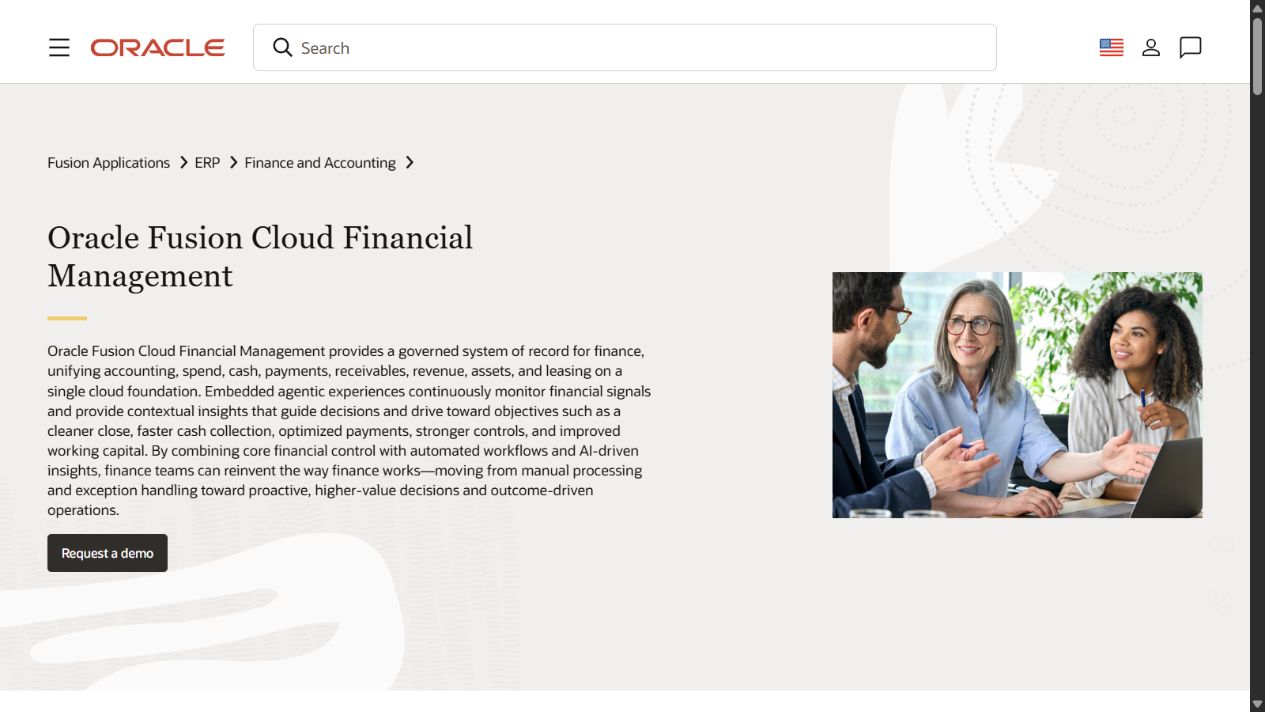
Oracle Financial Management page captured August 31, 2026. Features, agents, editions, pricing, and interfaces can change.
Why Oracle is shortlisted
- Broad official scope across financial accounting and related ERP processes.
- Global multi-entity, multi-currency, and accounting-standard positioning.
- Connection to Oracle EPM for planning, close, reporting, and master-data workflows.
- Role-based security and implementation documentation for Oracle ERP Cloud.
- Embedded controls, monitoring, workflows, analytics, and current AI-agent positioning.
Where Oracle requires caution
The platform’s breadth can create a large design and governance program. Buyers must decide which Oracle modules are systems of record, which legacy or specialist applications remain, and how master data, chart of accounts, projects, suppliers, customers, and reporting dimensions are governed. Excessive customization or duplicated extensions can undermine the benefit of a unified cloud model.
AI claims also require scenario-level validation. An agent that monitors ledgers or processes invoices must be tested against the buyer’s documents, languages, policies, exceptions, approval rules, and audit requirements. Define what the agent may recommend, what it may execute, what evidence it retains, and how a user reverses an incorrect action.
What to verify in a demo
Demonstrate entity setup, parallel ledgers, intercompany, foreign currency, allocations, payables, receivables, fixed assets, cash, revenue, period close, consolidation handoffs, audit evidence, and role restrictions using buyer-specific examples. Review integration patterns, API limits, environments, release testing, data extraction, backup responsibilities, support, residency, and pricing for every required service.
Sources: Oracle Financial Management , Oracle Finance and Accounting , and Oracle ERP Cloud security guide .
2. SAP S/4HANA Cloud: best for finance connected to complex operations
SAP presents S/4HANA Cloud as an ERP platform spanning finance, supply chain, projects, services, sales, and human-resource processes. Its finance material covers planning and analysis, accounting and close, receivables and payables, compliance and tax, treasury, cash, liquidity, payments, and financial risk. Public and private cloud options serve different standardization and extensibility needs.
SAP becomes especially relevant when financial events must remain tightly connected to manufacturing, inventory, logistics, assets, procurement, product costing, service, or complex order-to-cash processes. A product-centric enterprise may gain more from an integrated operational model than from selecting finance in isolation. Existing SAP landscapes, skills, partners, data, and integration investments can also influence the decision.
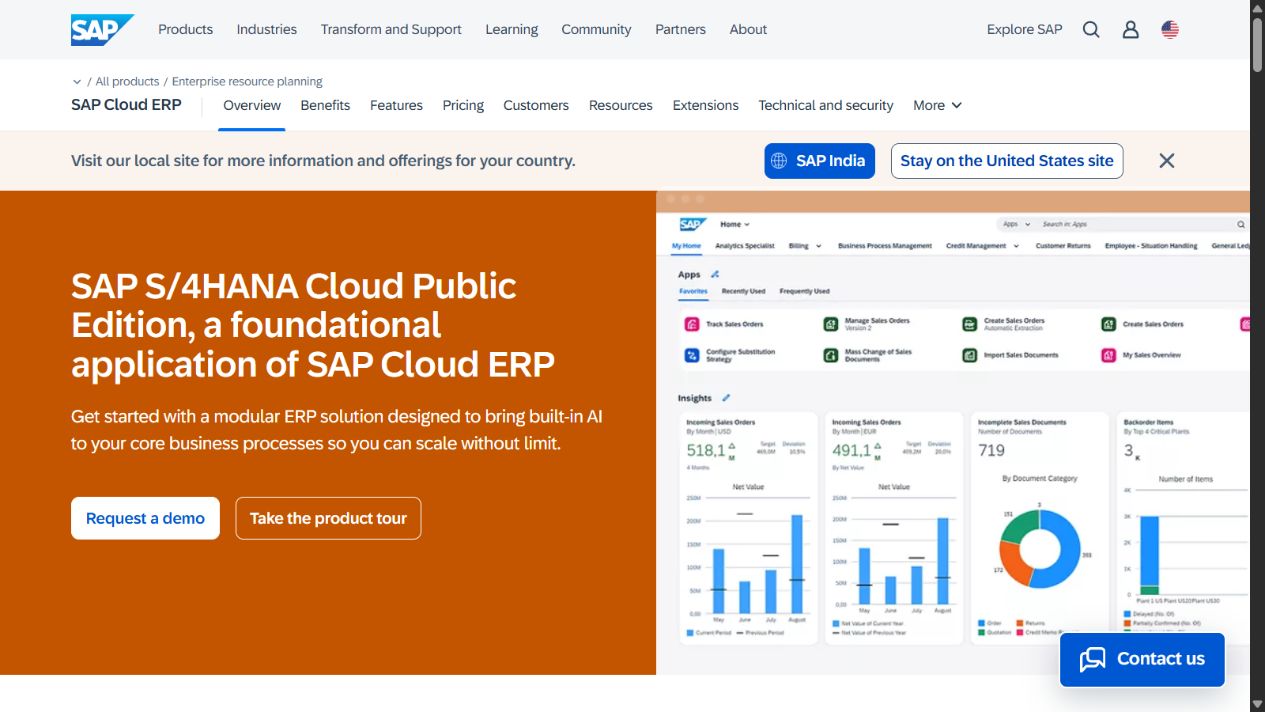
SAP S/4HANA Cloud page captured August 31, 2026. Product names, deployment choices, scope, pricing, and interfaces can change.
Why SAP is shortlisted
- Deep connection between finance and operational ERP processes.
- Official finance scope across accounting, close, receivables, payables, treasury, tax, compliance, planning, and analytics.
- Public and private cloud paths for different standardization and extensibility requirements.
- Large documentation, learning, partner, and integration ecosystem.
- Industry and end-to-end process orientation.
Where SAP requires caution
The selection is not simply “SAP or another accounting package.” It is often an operating-model decision. Public Edition encourages standardized cloud processes; Private Edition supports a different flexibility profile. Buyers should understand which path is being proposed, which requirements are standard, which require extensions, and how future releases will be adopted.
Migration from SAP ECC or a customized estate requires disciplined scope control. Recreating every historic customization can preserve complexity. Removing too much can break legitimate controls or local requirements. The program needs a design authority that can distinguish regulatory necessity, competitive process, convenience, and technical debt.
What to verify in a demo
Trace complete transactions from operational origin through accounting, tax, inventory or project impact, close, consolidation, and reporting. Demonstrate local country needs, parallel accounting, group reporting, intercompany, treasury, cash, controls, workflow, Fiori roles, extensions, APIs, data extraction, release management, and failure recovery. Price the selected cloud edition, modules, environments, integration services, implementation partner, and support.
Sources: SAP S/4HANA Cloud , SAP finance capabilities , and SAP finance documentation .
3. Workday Financial Management: best for service-centric enterprises
Workday Financial Management emphasizes a common data foundation, accounting, close, revenue, projects, expenses, grants, planning, reporting, risk, and global operations. Its official material highlights record-to-report, procure-to-pay, contract-to-cash, operational data transformed into accounting, multidimensional reporting, continuous auditing, and connection between financial, workforce, operational, and sales data.
This orientation fits service-centric organizations where people, projects, contracts, grants, and revenue are central economic drivers. A company already using Workday Human Capital Management may see value in shared organizational context and a common vendor platform, but that existing relationship should not replace a finance fit assessment.
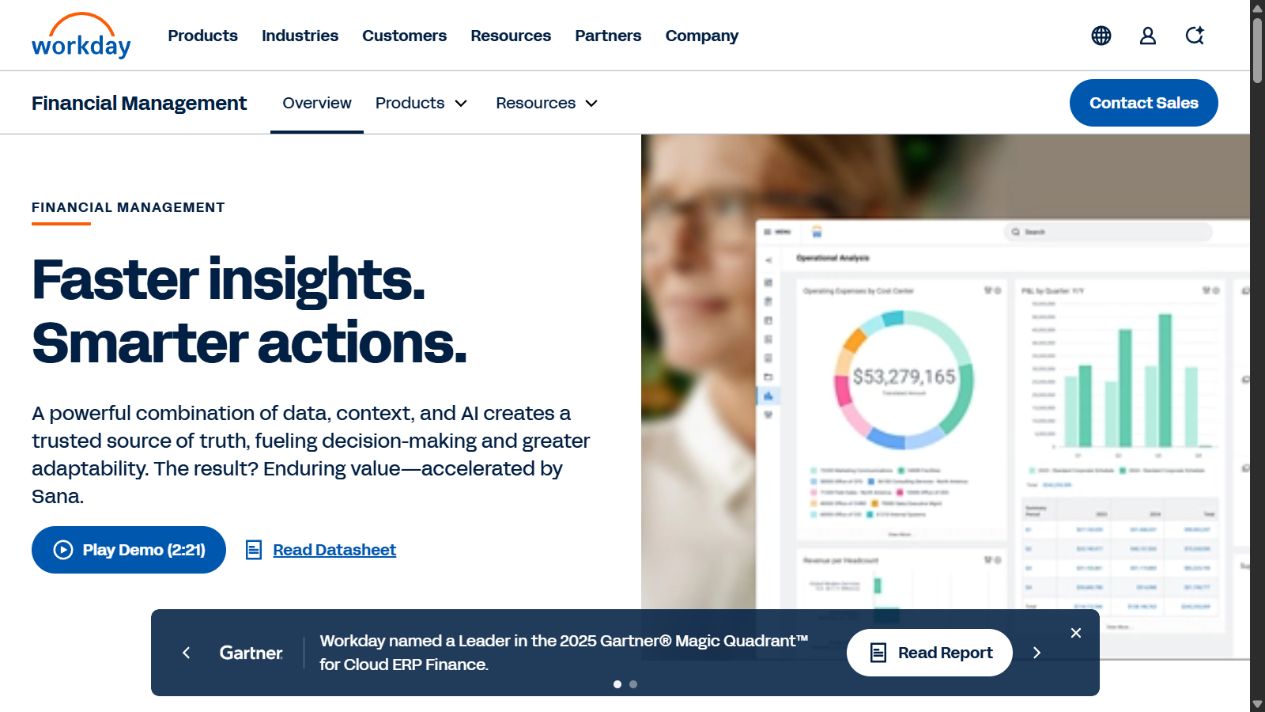
Workday Financial Management page captured August 31, 2026. Capabilities, agents, country scope, pricing, and interfaces can change.
Why Workday is shortlisted
- Finance and workforce context on the wider Workday platform.
- Accounting, close, revenue, projects, expenses, grants, planning, analytics, and controls positioning.
- Multidimensional reporting and operational-data accounting model.
- Continuous accounting and always-on audit orientation.
- Clear relevance to service-centric enterprise processes.
Where Workday requires caution
Enterprises must verify country, statutory, tax, banking, industry, asset, inventory, supply-chain, and complex operational requirements. Workday can be a strong financial system without being the correct operational ERP for every product-centric business. A proposal may therefore include Workday for finance and people alongside other systems for manufacturing, logistics, or specialist billing; the integration and reconciliation design then becomes critical.
The shared-platform argument also needs precision. Common finance and HR technology can simplify some data and planning workflows, but it can concentrate release, integration, identity, and vendor risk. Define ownership for organizational structures, workers, cost centers, projects, customers, suppliers, and reporting dimensions.
What to verify in a demo
Test complex accounting entries, allocations, consolidation, revenue, projects, grants where relevant, supplier invoices, expenses, cash, planning, reporting dimensions, audit, controls, and integrations. Confirm legal-entity and country support, data residency, identity, roles, segregation, evidence, environments, release testing, support, and export. Request references with a similar industry, country footprint, entity count, transaction profile, and application architecture.
Sources: Workday Financial Management , Workday accounting and finance , and financial analytics .
4. NetSuite Financial Management: best for a unified multi-entity cloud ERP with contained scope
NetSuite Financial Management sits within Oracle NetSuite’s cloud ERP suite. Official product material covers accounting, close, receivables, payables, cash, fixed assets, revenue, planning, reporting, risk, compliance, and connection to order, inventory, procurement, projects, and commerce workflows. NetSuite OneWorld addresses multi-subsidiary, multi-currency, tax, and global management requirements.
NetSuite is relevant to enterprises or large divisions that need a unified cloud suite but do not want the implementation profile of a top-tier global ERP program. It can also support subsidiaries in a two-tier ERP architecture while a larger corporate platform remains at headquarters. “Simpler” is relative: multi-entity design, integrations, revenue, inventory, tax, controls, and reporting can still create a substantial program.
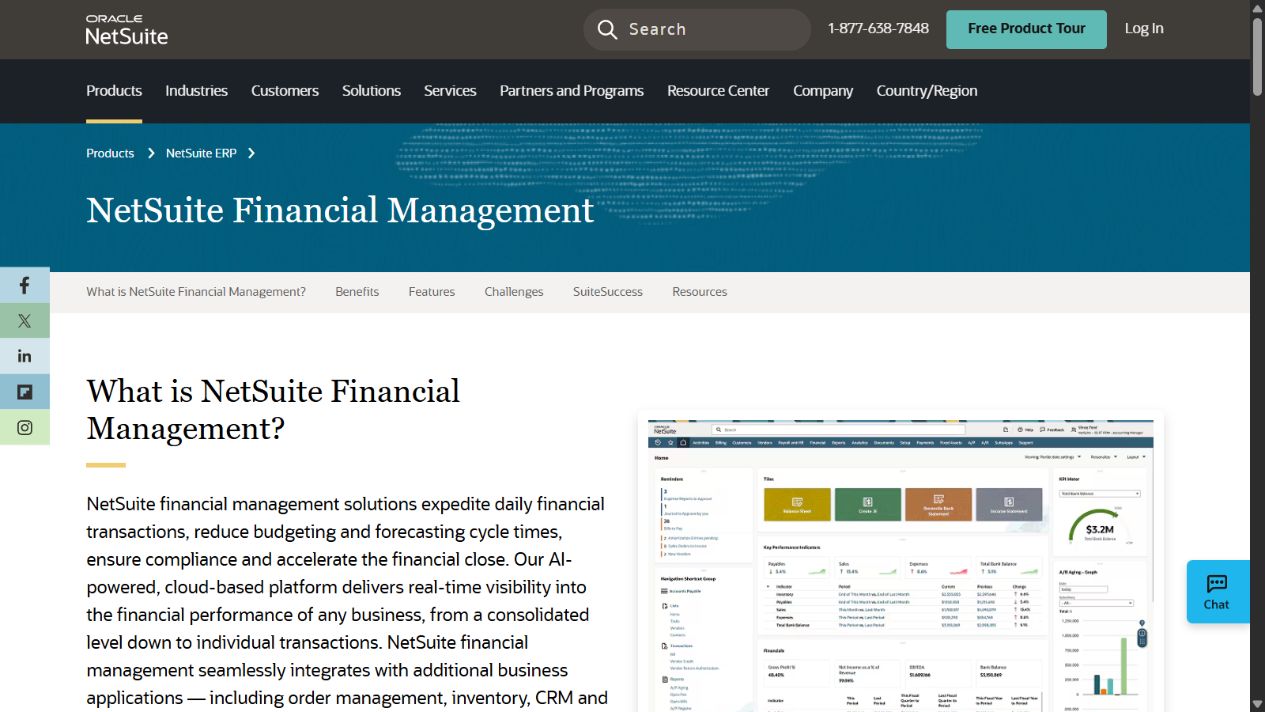
NetSuite Financial Management page captured August 31, 2026. Modules, editions, bundles, prices, and interfaces can change.
Why NetSuite is shortlisted
- Unified cloud ERP connecting finance with orders, inventory, procurement, projects, and related operations.
- OneWorld positioning for subsidiaries, currencies, taxes, and global management.
- Configurable dashboards, reporting, workflows, roles, and suite extensions.
- Potential fit for two-tier ERP and enterprise divisions.
- A more contained adoption path for some organizations than the largest suites.
Where NetSuite requires caution
Buyers must test scale and complexity rather than relying on company size labels. Transaction volume, entity count, close design, revenue arrangements, inventory, localization, reporting, integrations, and customization can push the platform in different ways. Confirm whether requirements are native, delivered through SuiteApps, custom scripts, partner solutions, or manual work.
Customization governance is particularly important. SuiteScript, workflows, forms, saved searches, integrations, and installed bundles can solve real needs but create dependencies and regression effort. Maintain an inventory with owner, purpose, version, test coverage, security impact, and retirement plan.
What to verify in a demo
Run multi-subsidiary transactions, intercompany, currency translation, consolidation, revenue, tax, inventory or project accounting, approvals, close, audit, and reporting. Review OneWorld country coverage, SuiteCloud development, API governance, integration throughput, sandbox strategy, release testing, support tiers, data extraction, and the complete subscription bill including modules and users.
Sources: NetSuite Financial Management , NetSuite ERP , and NetSuite OneWorld .
5. Sage Intacct: best for finance-led dimensional accounting and best-of-breed ecosystems
Sage Intacct is a cloud financial management platform centered on core accounting, payables, receivables, cash, order management, purchasing, reporting, dimensions, multi-entity operation, revenue, projects, planning, and integrations. Sage emphasizes real-time dashboards, dimensional reporting, automation, APIs, Salesforce integration, and extended capabilities.
The platform fits organizations that want finance depth without making one vendor responsible for every operational process. Dimensional accounting can support management reporting without an excessively long chart of accounts. A best-of-breed approach can preserve specialist CRM, payroll, industry, or operational systems while Intacct serves as the financial core.
Sage Intacct page captured August 31, 2026. Modules, AI features, country coverage, pricing, and interfaces can change.
Why Sage Intacct is shortlisted
- Finance-first core covering ledger, payables, receivables, cash, purchasing, orders, and reporting.
- Dimensional analysis and configurable dashboards.
- Multi-entity and global-capability modules for applicable organizations.
- API and integration orientation, including documented Salesforce connection.
- Extended modules for planning, revenue, projects, close, fixed assets, inventory, and other needs.
Where Sage Intacct requires caution
“Enterprise” covers a wide range. Intacct may fit a multi-entity services organization while being less suitable for a highly complex global manufacturer requiring one operational ERP. Verify localization, statutory reporting, tax, currencies, transaction volumes, consolidations, inventory, supply chain, revenue, projects, banking, and industry requirements for every country and business unit.
A best-of-breed design transfers responsibility to integration and data governance. Customer, supplier, employee, project, contract, product, and organizational data need clear ownership. Reconciliation, error handling, monitoring, retries, and cut-off behavior must be designed rather than assumed.
What to verify in a demo
Demonstrate dimensions, entity and intercompany accounting, consolidation, allocations, revenue, projects, purchasing, cash, close, reporting, controls, audit, and required integrations. Confirm modules, country support, API limits, identity, environments, release testing, retention, support, implementation partner, and pricing. Test reporting with the buyer’s real dimensional questions rather than a generic dashboard.
Sources: Sage Intacct , core financials , and product capabilities .
Comparison by enterprise requirement
Global and multi-entity finance
Oracle and SAP are natural finalists for large, complex global estates, while Workday documents global finance and consolidation capabilities with a service-centric orientation. NetSuite OneWorld and Sage Intacct can support multi-entity organizations but require careful country and complexity validation. Do not equate “multi-currency” with complete global readiness. Test local ledgers, statutory reports, tax, electronic invoicing, banking, payments, retention, audit, residency, and support in every operating country.
Product-centric versus service-centric operations
SAP is particularly relevant when finance depends on manufacturing, inventory, logistics, assets, and product costing. Oracle also spans broad ERP processes. Workday is compelling when workers, projects, contracts, grants, and services dominate. NetSuite can unify finance with inventory, order, projects, and commerce for a more contained scope. Sage Intacct is strongest when finance can remain the core of a connected best-of-breed architecture.
Planning, close, and reporting
All five vendors offer reporting and close-related capabilities, but the system boundary differs. Oracle often pairs ERP with EPM. SAP connects finance and operational planning within its portfolio. Workday emphasizes finance, planning, and operational context. NetSuite and Sage Intacct provide planning and reporting through native or adjacent modules. Buyers should map data movement, ownership, latency, reconciliation, write-back, workflow, versioning, and audit across the complete architecture.
Controls, security, and audit
Feature lists are insufficient. Build a role matrix for preparers, approvers, accountants, controllers, treasury, tax, auditors, administrators, integrations, and support. Test segregation of duties, privileged access, emergency access, workflow bypass, configuration changes, evidence retention, log export, service accounts, and partner access. Confirm which controls are native, configured, monitored externally, or procedural.
AI and automation
Every major vendor is adding AI or agent capabilities. Evaluate each named use case independently. Record the data used, model or service boundary, permissions, action scope, review step, explanation, evidence, failure mode, rollback, monitoring, and commercial unit. An impressive invoice or close demo does not prove performance across the buyer’s documents and exceptions.
Implementation risks buyers often underestimate
Data migration
Opening balances are not enough. Enterprises may need transaction history, open items, assets, leases, projects, contracts, revenue schedules, bank data, tax records, attachments, approvals, audit evidence, and reporting dimensions. Decide what migrates, what remains in an accessible archive, how it is reconciled, and who signs off.
Process ownership
Cloud ERP exposes disagreements about who owns suppliers, customers, projects, products, cost centers, entities, approvals, and close tasks. Assign process and data owners before design. A software implementation cannot resolve governance that the organization refuses to define.
Integration and cut-off
Document every source and destination, frequency, volume, ownership, authentication, transformation, error queue, retry, reconciliation, monitoring, and cut-off rule. A successful API response is not proof that accounting is complete. Finance needs control totals and exception ownership.
Reporting replication
Legacy reports often mix statutory necessity, management value, convenience, and obsolete logic. Inventory them, identify decisions they support, and rationalize before rebuilding. Validate totals, dimensions, currency, eliminations, drill-down, security, timing, and distribution.
Release management
SaaS shifts control of platform releases but not accountability for business outcomes. Maintain release notes, impact assessment, regression suites, environment refresh procedures, integration tests, role tests, reporting tests, cutover windows, and rollback or mitigation plans.
Pricing and total cost of ownership
Enterprise finance pricing is generally quote-based and highly configuration dependent. Ask each vendor and implementation partner to separate:
- Base subscriptions and named metrics.
- Finance, ERP, planning, close, procurement, expenses, revenue, projects, treasury, tax, risk, analytics, integration, and AI modules.
- Production and non-production environments.
- Storage, transactions, documents, integrations, API, and usage bands.
- Implementation, localization, migration, reports, extensions, testing, training, and cutover.
- Premium support, customer success, partners, and managed services.
- Annual increases, renewal protections, audit rights, overages, and termination assistance.
Build a five-year model with low, expected, and high scenarios. Include internal finance, IT, security, data, procurement, legal, audit, and change-management labor. Include the cost of keeping legacy systems during transition and the cost of extracting data at exit. A lower subscription can be overwhelmed by customization and reconciliation; a higher subscription can be wasteful when broad modules go unused.
How to run a defensible selection
- Define legal entities, countries, users, volumes, systems, deadlines, controls, and transformation goals.
- Convert requirements into scenarios with sample transactions, documents, roles, expected accounting, and reports.
- Require vendors to demonstrate those scenarios in the proposed edition, not a generic environment.
- Score native capability, configuration, extension, partner dependency, manual work, and roadmap separately.
- Complete architecture, security, privacy, legal, accessibility, and operational reviews before commercial commitment.
- Validate references with similar industry, geography, entity count, complexity, and implementation path.
- Compare five-year total cost and implementation risk, not licence price alone.
- Contract critical scope, service levels, data rights, support, security obligations, price protections, and exit assistance.
Final recommendation
Start with Oracle Fusion Cloud Financial Management when the enterprise needs a broad, governed global finance platform. Put SAP S/4HANA Cloud at the front of the process when finance must remain deeply connected to complex operational ERP. Prioritize Workday Financial Management for service-centric organizations seeking finance, planning, projects, and workforce context. Evaluate NetSuite for unified multi-entity cloud ERP with a more contained transformation boundary. Evaluate Sage Intacct when dimensional accounting and a connected best-of-breed finance architecture are the priority.
Do not issue an RFP until the organization can describe its target operating model and scripted scenarios. The best product is the one that meets statutory and control obligations, supports decision-ready reporting, integrates with the real application estate, and can be implemented and operated without creating more complexity than it removes.
Frequently asked questions
What is the best finance software for an enterprise?
Oracle is a broad global starting point; SAP is strong for finance tied to product and supply-chain operations; Workday fits many service-centric enterprises; NetSuite suits a contained multi-entity cloud ERP scope; Sage Intacct fits finance-led best-of-breed designs. Validate against your requirements.
How should an enterprise choose financial management software?
Use legal-entity, country, accounting, close, consolidation, treasury, revenue, project, control, reporting, integration, security, and operating-model scenarios. Require demonstrations and contractual confirmation for critical requirements.
Is cloud ERP the same as enterprise finance software?
No. Finance software can be a finance-led system, while ERP generally extends into procurement, projects, supply chain, manufacturing, HR, sales, or other operations. Define the intended system boundary first.
How much does enterprise finance software cost?
Most shortlisted vendors use quote-based pricing. Model subscriptions, modules, environments, implementation, migration, integrations, testing, support, internal labor, upgrades, and exit over at least five years.
How long does implementation take?
It depends on entities, countries, data, process standardization, integrations, customizations, reports, controls, testing, partner capacity, and change readiness. Treat generic timelines as unverified.
Which platform is best for global consolidation?
Oracle, SAP, and Workday are natural global-enterprise finalists; NetSuite OneWorld and Sage Intacct support multi-entity use cases. Detailed ledger, statutory, intercompany, currency, elimination, and reporting requirements determine fit.
Should finance and HR use the same platform?
Sometimes. A shared platform can simplify context and administration, but it can also concentrate vendor and release risk. Compare functional depth, data ownership, controls, integrations, reporting, and exit before consolidating.
Sources
- Oracle Fusion Cloud Financial Management
- Oracle Finance and Accounting
- Oracle ERP Cloud security guide
- SAP S/4HANA Cloud
- SAP Cloud ERP finance
- SAP finance documentation
- Workday Financial Management
- Workday accounting and finance
- Workday financial analytics
- NetSuite Financial Management
- NetSuite ERP
- NetSuite OneWorld
- Sage Intacct
- Sage Intacct core financials
- Sage Intacct product capabilities
Frequently asked questions
What is the best finance software for an enterprise?
Oracle Fusion Cloud Financial Management is a strong broad starting point for global financial control; SAP S/4HANA Cloud is compelling when finance must remain tightly connected to product and supply-chain operations; Workday Financial Management suits service-centric organizations that want finance and workforce context; NetSuite fits multi-entity organizations seeking a unified cloud ERP with less top-tier transformation scope; Sage Intacct fits finance-led organizations prioritizing dimensional accounting and a best-of-breed ecosystem.
How should an enterprise choose financial management software?
Start with legal entities, countries, ledgers, accounting standards, currencies, tax, close, consolidation, treasury, revenue, procurement, projects, controls, reporting, planning, integrations, security, data retention, and operating-model requirements. Validate each requirement in a scripted demonstration and contract rather than selecting from feature-list breadth.
Is cloud ERP the same as enterprise finance software?
Not exactly. Enterprise finance software can be a finance-led suite covering accounting, close, reporting, planning, spend, revenue, and controls. Cloud ERP usually extends further into procurement, projects, supply chain, manufacturing, HR, sales, or other operations. Buyers should define the required system boundary before comparing products.
How much does enterprise finance software cost?
The reviewed vendors generally require quotes or scope-specific pricing. Total cost includes subscriptions, modules, environments, implementation partners, integrations, migration, testing, controls, training, support, upgrades, internal staff, and ongoing change. Request a five-year model tied to named assumptions and volume bands.
How long does enterprise finance software implementation take?
There is no reliable universal duration. Timing depends on entity count, countries, data quality, process standardization, integrations, customizations, controls, reporting, testing, partner capacity, and change readiness. Require a phased plan with measurable entry and exit criteria rather than accepting a generic timeline.
Which enterprise finance platform is best for global consolidation?
Oracle, SAP, and Workday all document global finance and consolidation-related capabilities, while NetSuite OneWorld and Sage Intacct support multi-entity scenarios. The correct choice depends on ledger design, local statutory needs, ownership structures, intercompany volume, currencies, eliminations, reporting standards, and the wider application landscape.
Should finance and HR use the same platform?
A shared platform can simplify identity, organizational structures, planning, and reporting, especially with Workday or a broader ERP suite. It is not automatically better. Compare functional depth, data ownership, integration, controls, release coordination, user experience, and exit risk before consolidating platforms.