Best HR Software for Agencies
Compare the best HR software for agencies across people records, payroll, benefits, hiring, onboarding, performance, global teams, and workflow automation.
Direct answer
BambooHR is the strongest general HR-system starting point for many growing agencies. Gusto is best for smaller US agencies that want payroll-led HR administration. Rippling is best when employee records must drive payroll, identity, devices, applications, and automated workflows. Deel is best for agencies hiring employees and contractors across countries. HiBob is best for growing distributed agencies that prioritize employee experience, performance, compensation, and workforce planning.
These are not interchangeable products. An agency should choose according to workforce geography, employment model, payroll responsibility, benefits, security, equipment, performance process, reporting, and internal administration capacity.
This guide addresses the agency’s own workforce. It is not a ranking of staffing or recruitment-agency software used to manage client job orders, candidate submissions, placements, and commissions. A recruitment business may need both an internal HR platform and a specialist applicant tracking or staffing system.
The shortlist uses live search discovery and official vendor sources checked September 6, 2026. We did not run payroll, test legal compliance, administer benefits, migrate employee records, or measure support quality. Buyers must verify current plans, country coverage, implementation, and contracts.
Shortlist
| Software | Best for | Agency strength | Important limitation |
|---|---|---|---|
| BambooHR | General people operations | Connected records, hiring, onboarding, time, performance, compensation, reporting, and plan-dependent payroll | Payroll and benefits vary by location and package; pricing is quote-led |
| Gusto | US payroll-led agencies | Payroll, benefits, onboarding, time, and accessible small-business administration | Primarily US-oriented; deeper global and enterprise needs may require another system |
| Rippling | HR, IT, and workflow coordination | Employee data can drive permissions, devices, applications, payroll, and automation | Modular breadth increases implementation and ownership complexity |
| Deel | International workforce | Employees, contractors, EOR, payroll, and global HR workflows | Service responsibilities, country coverage, and cost vary by worker type and location |
| HiBob | Growing distributed teams | Core HR, talent, planning, compensation, analytics, payroll connectivity, and employee experience | Exact modules, payroll availability, and pricing require a current quote |
What HR software must do for an agency
Agencies have a fluid workforce. Employees, freelancers, specialists, interns, vendors, and temporary project teams may work across locations and client accounts. Hiring can accelerate after a client win and reverse when work changes. People need rapid access to collaboration, design, advertising, analytics, code, finance, and client systems. That makes HR operations closely connected to delivery, finance, and security.
A useful platform should maintain an authoritative record for each worker: identity, employment or engagement type, manager, team, location, start date, compensation, documents, time-off policy, equipment, system access, training, and end date. It should support repeatable joining, role change, leave, and departure workflows rather than leaving those events across messages and spreadsheets.
Payroll and benefits matter, but they are not the whole requirement. Agencies also need hiring approvals, onboarding tasks, handbook acknowledgment, time and attendance where relevant, performance conversations, compensation review, engagement, reporting, and controlled access. Global teams add contracts, local employment, payroll, currency, tax, benefits, data location, and legal responsibilities.
The HR platform does not need to perform every function directly. It does need a clear ownership model. Decide which system owns the worker record, payroll result, benefits election, time entry, performance record, equipment, account access, and project capacity. Integrations should move approved data without creating conflicting sources of truth.
How we selected the tools
We searched the current result landscape to understand agency buyer intent, then verified the shortlist through official product, platform, documentation, and pricing pages. The evaluation considered:
- employee and contractor records;
- hiring, approval, onboarding, and document workflows;
- payroll, benefits, time, and leave requirements;
- performance, feedback, compensation, and engagement;
- global employment and contractor operations;
- workflow automation, permissions, reporting, and integrations;
- identity, application, and device coordination;
- implementation complexity and internal ownership;
- plan, country, service, and pricing boundaries.
We excluded feature claims that could not be tied to an official source. We did not use customer-review counts as proof of product quality and did not infer legal compliance from marketing language.
1. BambooHR: best general HR starting point
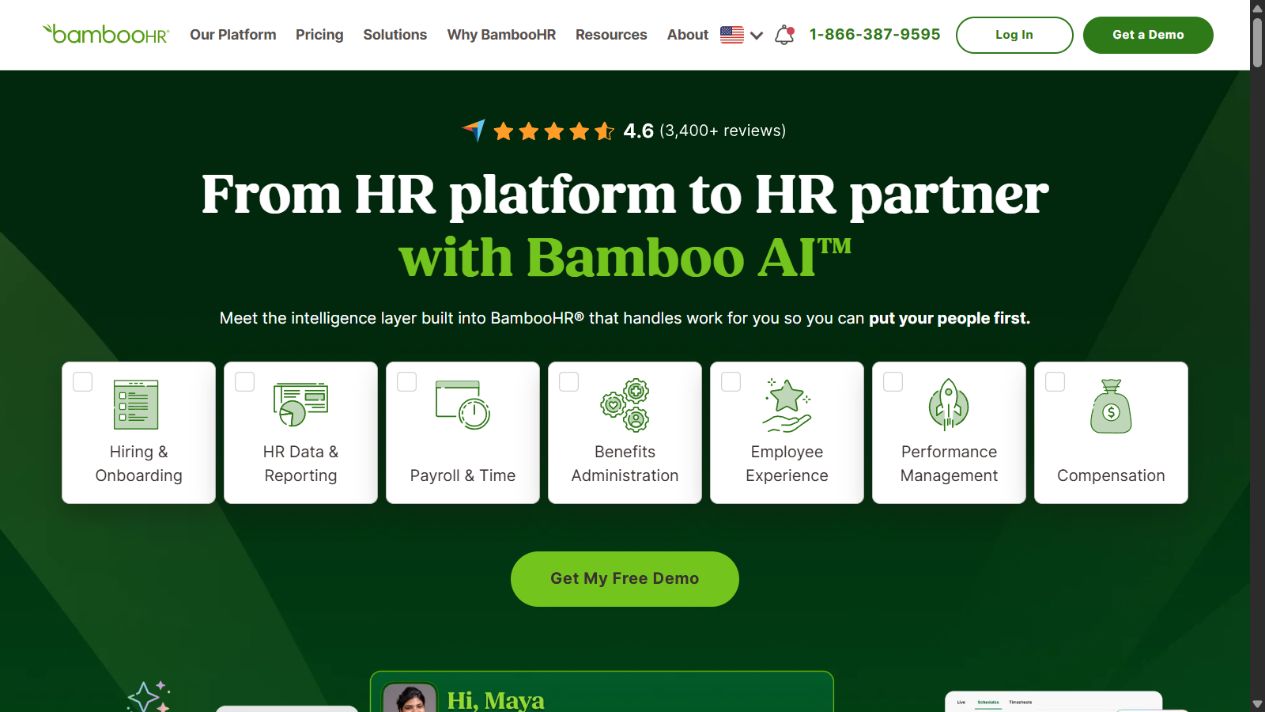
Official BambooHR homepage, captured August 29, 2026. The screenshot documents vendor positioning, not hands-on implementation quality.
BambooHR is a connected people platform for growing organizations. Its current platform pages document HR data and reporting, applicant tracking, onboarding, payroll, benefits administration, time and attendance, performance management, compensation, employee experience, compliance, and global employment. The products share a people-data foundation, with plan and location boundaries.
Why it fits agencies
BambooHR offers a balanced HRIS path for an agency moving beyond payroll plus spreadsheets. It can create one employee record and connect recurring lifecycle work around that record. Hiring and onboarding matter because agencies often bring people into client work quickly. Time off, performance, compensation, and reporting matter because managers need to understand availability, development, retention, and cost without maintaining parallel files.
The platform’s positioning is especially relevant for agencies with a lean operations team. The interface and connected app model aim to provide substantial HR capability without the administration associated with a large enterprise HCM suite. Marketplace integrations and an API can connect payroll, finance, productivity, and specialist tools that remain outside the platform.
Where to be careful
Verify which modules are included in Core, Pro, or add-on packages. Payroll, benefits, global employment, integrations, support, and implementation can differ by country and agreement. A feature appearing in the platform catalog does not mean it is available in the proposed package.
Define permissions carefully. HR records contain identity, compensation, performance, leave, benefits, and other sensitive data. Managers, finance, IT, and agency leadership should receive only the access required for their responsibilities. Test employee and manager self-service, reporting, approvals, offboarding, audit evidence, and data export.
Best fit
Choose BambooHR when the agency needs a usable system of record and broad people operations but does not require HR, IT, finance, and global employment to live in one highly configurable platform. Source: BambooHR platform and BambooHR pricing .
2. Gusto: best for US payroll-led small agencies
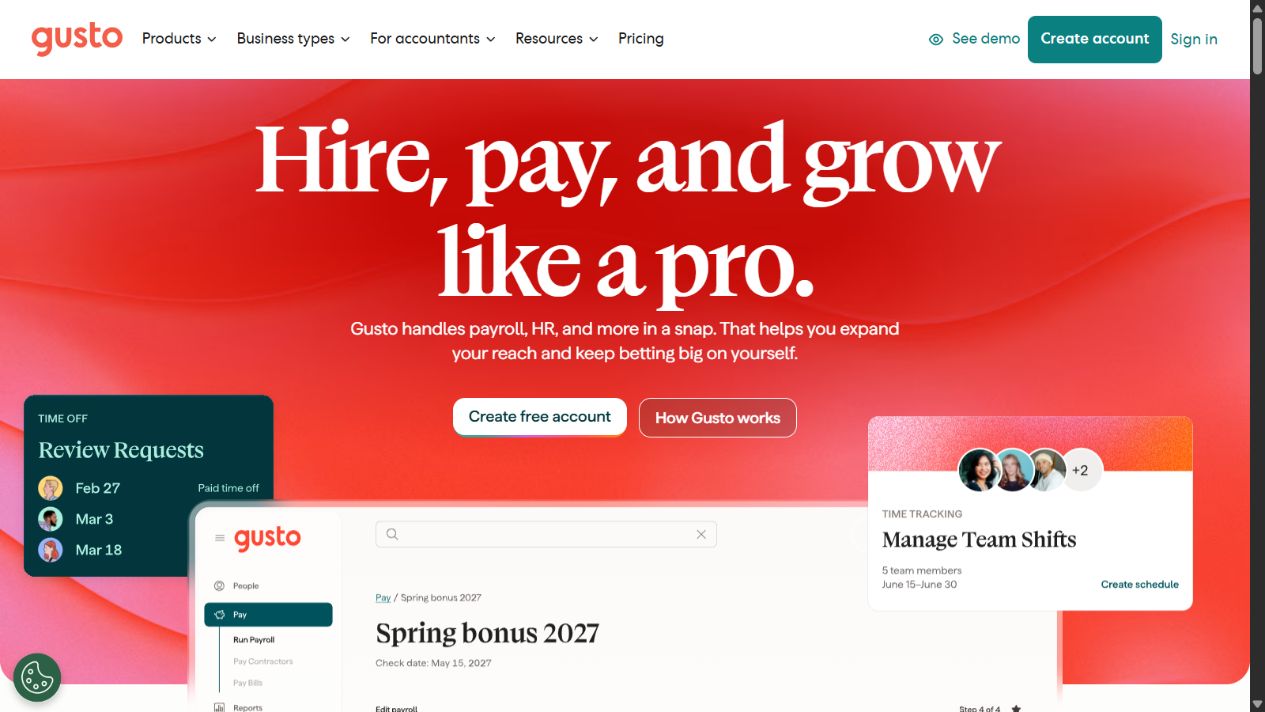
Official Gusto homepage, captured August 29, 2026. Payroll, benefits, services, and availability depend on the selected package and location.
Gusto is a small-business people platform centered on payroll and connected HR administration. Its official pages document full-service payroll, employee benefits, hiring and onboarding, time and attendance, talent management, reporting, workers’ compensation, and contractor workflows.
Why it fits agencies
Many small US agencies do not begin with a dedicated HR department. A founder, operations manager, finance lead, or external accountant may administer payroll, onboarding, time, and benefits. Gusto’s payroll-led model can keep those recurring obligations close together and give employees a consistent self-service experience.
The fit is strongest when US payroll is the operational center. New-hire details can flow into payroll, time records can support pay, and benefit deductions can remain connected. Hiring and onboarding tools reduce the need to assemble forms and tasks manually for every new employee. Contractor management can be useful where the agency engages legitimate independent contractors under an approved classification process.
Where to be careful
Do not treat contractor payment functionality as a classification decision. Worker classification depends on law and the actual relationship, not the selected button in payroll software. Obtain qualified guidance where needed.
Verify state registrations, payroll tax services, benefits availability, insurance, time rules, international needs, support model, integrations, and plan limits. An agency expanding outside the US or requiring deeper performance, compensation, workforce planning, access management, or global employment may outgrow a payroll-first structure.
Best fit
Choose Gusto when a smaller US agency wants accessible payroll, benefits, onboarding, time, and baseline HR tools in one environment. Source: Gusto , Gusto products , and Gusto pricing .
3. Rippling: best for connecting HR with IT and workflow
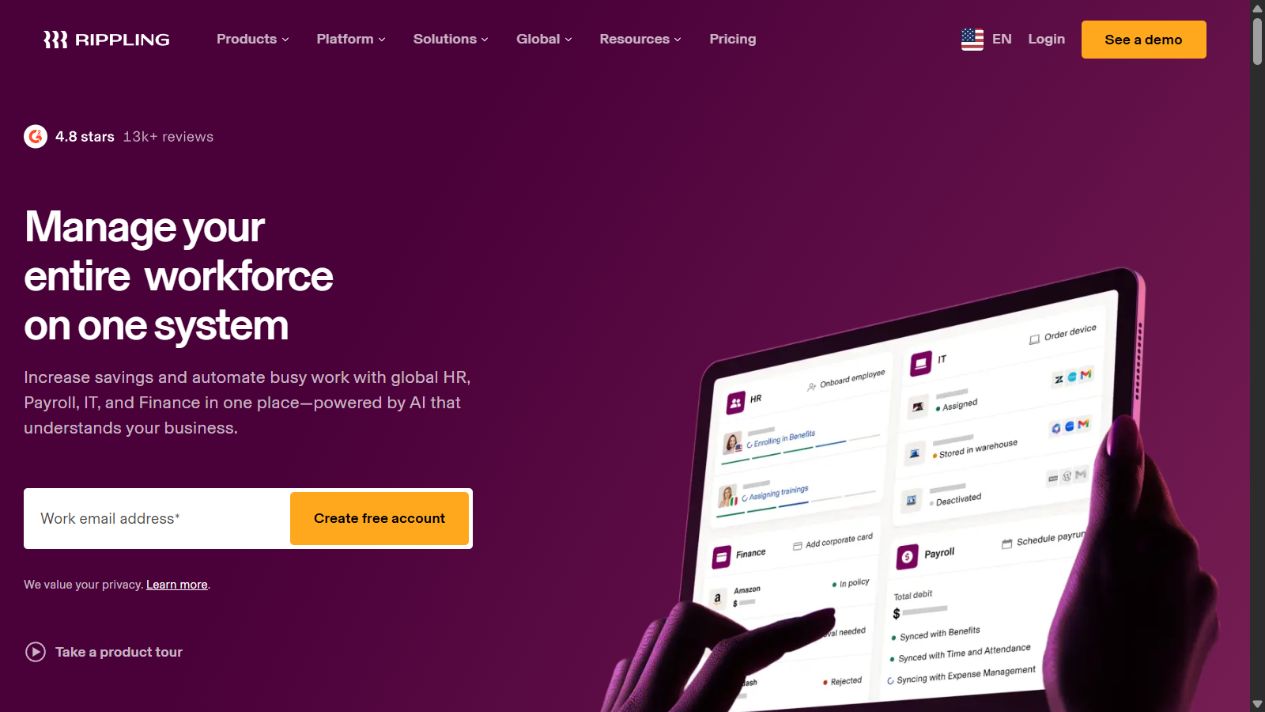
Official Rippling homepage, captured August 29, 2026. Modules and services are selected separately and should be verified in the proposal.
Rippling provides HR, payroll, IT, finance, and global workforce products on a shared platform. Its official catalog documents HRIS, recruiting, headcount planning, performance, learning, benefits, time, scheduling, payroll, global employees and contractors, workflow, permissions, identity, applications, devices, inventory, expenses, cards, and related services.
Why it fits agencies
Agency onboarding is not only an HR event. A new designer may need a laptop, email, collaboration tools, design software, file storage, project access, password-manager vaults, and selected client accounts. A departing contractor may need every path removed quickly. When employee attributes drive permissions and workflow, HR data can coordinate actions beyond the HR department.
Rippling is attractive when the agency wants a change in department, location, manager, employment status, or role to trigger consistent administration. Its workflow and permissions model can reduce manual tickets and improve evidence. Unified reporting can also connect people data with payroll, time, application, device, and finance records, depending on the purchased products.
Where to be careful
Breadth creates implementation responsibility. The agency must design data ownership, attribute quality, permissions, approval, exception handling, integrations, workflow failures, audit, and emergency access. A poorly designed automation can remove necessary access or grant too much. Start with controlled lifecycle workflows and test reversal.
Pricing is modular and proposal-dependent. Compare the full package rather than an attractive entry module. Identify which services are software, which involve a provider relationship, and which responsibilities remain with the agency. Confirm regional availability and support for every worker location.
Best fit
Choose Rippling when HR changes should coordinate identity, devices, applications, payroll, and operational workflow, and the agency has capacity to design and administer that system. Source: Rippling products and Rippling HCM .
4. Deel: best for international employees and contractors
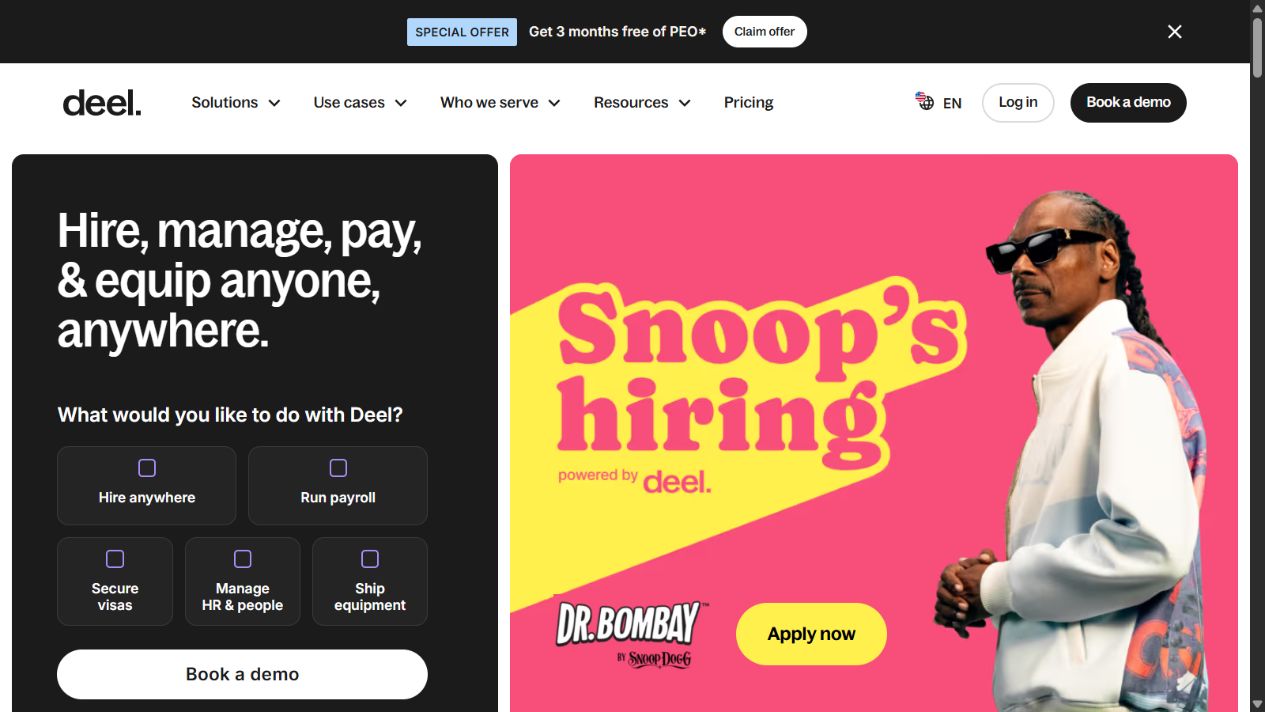
Official Deel homepage, captured August 29, 2026. Country, worker, payroll, EOR, contractor, and service availability must be checked directly.
Deel is a global people platform spanning HRIS, employees, contractors, employer-of-record services, payroll, compliance support, and related workforce operations. Its HRIS pages describe one system for direct employees, contractors, and EOR workers with records, permissions, workflows, documents, reporting, and self-service.
Why it fits agencies
Agencies can hire specialized talent wherever client needs arise. That flexibility creates administrative complexity: local entities, employment contracts, contractor agreements, payroll, invoicing, currency, tax, benefits, time off, intellectual property, equipment, and termination. Deel provides several product and service paths for coordinating those relationships.
The HRIS can hold different worker types in one environment. EOR services may support employment in a country where the agency lacks its own entity, while global payroll can serve entities the agency operates. Contractor products can support onboarding and payment. This can reduce the number of disconnected providers a distributed agency manages.
Where to be careful
Global employment is not one feature. Determine the legal employer, contracting party, payroll processor, benefits administrator, support owner, data controller or processor, currency path, exchange-rate treatment, invoice structure, termination process, and responsibility for local advice. Read the proposed service agreement and country terms.
Confirm whether each person should be an employee, EOR employee, or independent contractor. Software cannot eliminate misclassification risk. Compare service fees, deposits, payroll timelines, benefits, off-cycle events, expenses, equity, immigration, support escalation, and exit obligations.
Best fit
Choose Deel when international hiring and payment are central to the agency’s workforce model and consolidating employees, contractors, and EOR records has clear operational value. Source: Deel , Deel HRIS , and Deel pricing .
5. HiBob: best for growing distributed agency culture
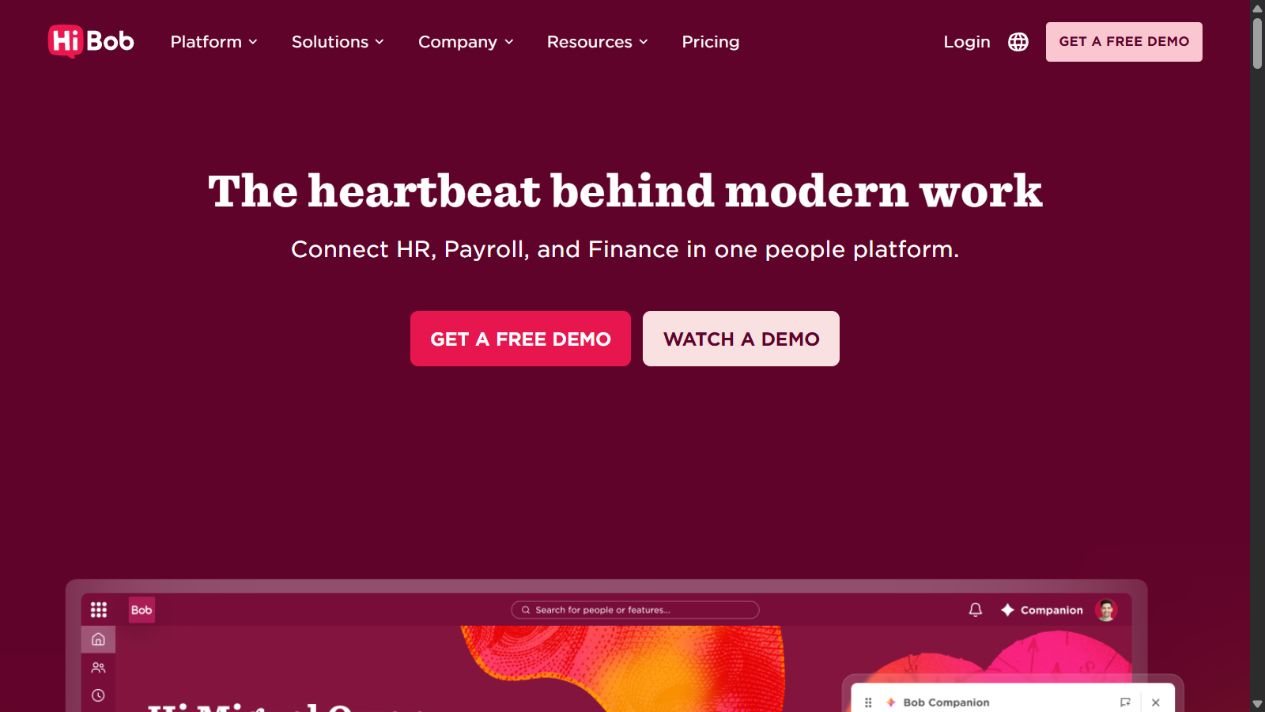
Official HiBob homepage, captured August 29, 2026. Verify modules, payroll, country coverage, integrations, and pricing for the proposed deployment.
HiBob’s Bob platform connects core HR, talent, payroll and benefits, workforce planning, compensation, analytics, and employee experience. Official pages document HR records, time, time off, onboarding, hiring, performance, learning, surveys, compensation, payroll connectivity, and planning.
Why it fits agencies
Growing agencies need more than employee storage. They need managers to run onboarding, goals, feedback, reviews, compensation, development, and workforce planning consistently across teams. Employee experience matters when people are distributed and client delivery pressure can weaken internal communication.
HiBob emphasizes an experience used by HR, managers, and employees. That orientation can help adoption where a technically capable system would otherwise become an HR-only database. Core records and workflows support administration, while talent, compensation, surveys, planning, and analytics provide a broader people-management layer.
Where to be careful
Confirm the exact modules in scope. Payroll products and connectivity vary by market. Map local payroll, benefits, time, finance, identity, recruiting, and learning integrations. Evaluate whether managers will actually use reviews, goals, compensation, and planning rather than continuing in documents.
Employee engagement features should not become surveillance or decoration. Define legitimate purposes, visibility, confidentiality, retention, and response ownership for survey and performance data. Train managers to use structured processes fairly and require qualified review for employment decisions.
Best fit
Choose HiBob when a growing or distributed agency needs connected core HR plus stronger manager, talent, planning, compensation, and employee-experience workflows. Source: HiBob platform and HiBob FAQ .
How to choose the right HR software
Start with the workforce model, not a product demonstration. Count employees, contractors, temporary workers, interns, EOR employees, entities, countries, states, currencies, payrolls, benefits programs, and managers. Forecast the next two years because a platform chosen for today’s headcount may need to support rapid client-driven hiring.
Map the lifecycle from approved role to departure. Record the owner, input, approval, system, deadline, output, and evidence for recruiting, offer, contract, background check, onboarding, payroll, benefits, equipment, access, time, leave, performance, compensation, change, and offboarding. Mark every manual handoff and duplicate entry.
Then identify the primary problem. Choose a balanced HRIS if records and lifecycle consistency are weak. Choose payroll-led software if US payroll and benefits dominate. Choose a workforce platform if access and devices must follow employee data. Choose a global specialist if cross-border hiring and payment create the most risk. Choose a talent-oriented HCM if manager adoption, performance, compensation, and planning are the main gaps.
Evaluation checklist
Connect people operations to client delivery
Agency HR data should support capacity decisions without exposing confidential employee records. Delivery leaders may need approved views of role, skills, location, availability, planned leave, allocation, and start or departure dates. They generally do not need access to compensation, benefits, medical, disciplinary, or unrelated performance information. Define a narrow reporting layer rather than granting project managers broad HR access.
Client access should follow the worker lifecycle. A new assignment may require named client accounts, training, confidentiality acknowledgment, equipment, and a documented access end date. A role change or departure should trigger removal from client platforms as well as internal systems. The HR platform may initiate that workflow, but identity, password, project, and client systems must return evidence that the action completed. Review exceptions instead of assuming an automation succeeded.
Use workforce planning to compare confirmed demand with available skills and realistic utilization. Do not turn every unallocated hour into a performance problem. Agencies need space for management, learning, sales support, internal operations, leave, and unexpected client work. A useful system makes assumptions visible and helps leaders plan hiring or contractor demand without presenting a forecast as certainty.
During a structured pilot, test:
- employee, contractor, manager, and administrator experiences;
- offer, onboarding, document, and approval workflows;
- payroll inputs, changes, corrections, reconciliation, and accounting export;
- time, leave, benefits, compensation, and performance processes;
- role-based permissions and restricted-field access;
- integration failures, retries, duplicates, and audit history;
- identity, application, device, and client-access offboarding;
- global worker and country-specific scenarios;
- standard and custom reports with trusted definitions;
- data import, export, retention, deletion, and provider exit;
- implementation ownership, support escalation, and total cost.
Use representative data without exposing unnecessary real employee information. Ask vendors to demonstrate exceptions, not only a perfect new-hire flow.
Implementation plan
Clean the worker register before migration. Resolve duplicate people, obsolete accounts, missing managers, inconsistent titles, incorrect locations, unsupported custom fields, and uncertain employment types. Decide which historical records must move and which remain in a controlled archive.
Configure roles by responsibility. HR, payroll, finance, IT, executives, managers, employees, contractors, and external advisers should not receive the same access. Test field-level and report-level visibility. Protect integrations and service accounts with named ownership and strong authentication.
Pilot one representative group. Run onboarding, a worker change, leave, payroll inputs, a performance event, reporting, and offboarding. Reconcile the first payroll and downstream accounting records. Document exceptions and train users according to their tasks.
Expand in phases, then retire old systems deliberately. Remove duplicate integrations, revoke obsolete access, retain required records, and confirm where employees should go for each process. Review permissions, workflows, plans, integrations, support, and country coverage at least quarterly.
Total cost of ownership
Include base subscriptions, per-worker charges, payroll, contractors, EOR services, benefits, implementation, data migration, integrations, API access, support, advisers, training, administration, custom reports, parallel systems, and exit costs. Global services can change cost more than the HRIS seat price.
Measure value through fewer payroll corrections, faster onboarding, complete records, timely access removal, reduced duplicate entry, shorter reporting cycles, manager adoption, employee self-service, and lower provider fragmentation. Do not count time saved unless the new process maintains or improves accuracy and control.
Final verdict
BambooHR, Gusto, Rippling, Deel, and HiBob represent five useful agency HR strategies. BambooHR is the balanced HRIS, Gusto is the US payroll-led choice, Rippling connects HR with IT and workflow, Deel handles global workforce complexity, and HiBob emphasizes connected talent and employee experience.
The strongest product is the one that fits the agency’s actual workforce, geography, operating model, and administration capacity. A smaller platform with clean data, clear ownership, reliable payroll, and tested offboarding is better than a broad suite nobody governs. Run a lifecycle-based pilot before signing a long contract.
Sources checked
Frequently asked questions
What is the best HR software for an agency?
BambooHR is a strong general people-system starting point, Gusto suits US payroll-led small agencies, Rippling fits agencies connecting HR with identity and devices, Deel is strongest for international employees and contractors, and HiBob suits growing distributed teams prioritizing employee experience and talent workflows.
Is this guide for recruitment agencies?
This guide covers software for managing an agency's own employees and contractors. A staffing or recruitment agency that places candidates for clients may also need a specialist applicant tracking, client relationship, job order, placement, and commission system.
Do agencies need an HRIS if they use payroll software?
Payroll software can calculate and record pay but may not provide a complete system for employee records, onboarding, documents, time off, performance, compensation, equipment, access, and offboarding. Map the full employee lifecycle before deciding whether payroll alone is sufficient.
Which HR software is best for an agency with contractors?
Deel is designed for global employee, contractor, EOR, and payroll workflows. Gusto also supports contractor administration for appropriate use cases, while Rippling can coordinate global workforce and access operations. Classification, tax, payment, and legal responsibilities still require qualified review.
Which HR software is best for a global agency?
Deel is the clearest global-employment specialist in this shortlist. Rippling and HiBob also document global HR capabilities, while BambooHR supports global employment and integrations. Verify country coverage, legal employer, payroll, benefits, currency, support, and data requirements.
How should an agency migrate to new HR software?
Clean employee and contractor records, define owners, configure roles, map payroll and benefits, test lifecycle workflows, migrate in phases, reconcile the first payroll and reports, and retain approved historical records under the required policy.
How much should an agency spend on HR software?
Compare the total cost of subscriptions, employees, contractors, payroll, benefits, global services, implementation, integrations, support, administration, and change management. Measure value through reduced errors, faster onboarding, reliable access removal, reporting, and manager adoption.