Best HR Software for Enterprise Teams
Compare Workday HCM, SAP SuccessFactors, Oracle Cloud HCM, UKG Pro, and Dayforce for complex enterprise HR operations.
Direct answer
Workday HCM is the strongest broad enterprise HR software starting point for organizations that want core HR, talent, workforce management, planning, analytics, and employee experience on a unified platform. SAP SuccessFactors is the strongest fit for an SAP-centered enterprise architecture. Oracle Fusion Cloud HCM is best suited to organizations standardizing HR, finance, and operations on Oracle Cloud. UKG Pro is a strong option for payroll and workforce-intensive employers. Dayforce is especially relevant when continuously calculated pay, time, scheduling, and frontline workforce operations are central.
There is no universal winner. Enterprise HR software is not simply an employee database with more users. It must represent legal employers, business units, positions, jobs, workers, contractors, managers, locations, unions, compensation, benefits, time, absence, payroll, skills, performance, recruiting, learning, security, and historical changes across countries. It must also exchange reliable data with finance, identity, procurement, IT, facilities, planning, and local providers.
This guide uses official vendor sources checked on August 31, 2026. We did not run production payrolls, conduct controlled usability tests, benchmark vendor AI, or validate customer outcome claims. The recommendations are editorial inferences from documented product scope. Enterprise buyers should verify exact modules, country availability, contractual protections, implementation partners, and configured behavior before making a decision.
Enterprise HR software shortlist
| Platform | Best-fit enterprise context | Main risk to investigate |
|---|---|---|
| Workday HCM | Unified global HCM, talent, planning, analytics, and employee experience | Complex transformation scope, country payroll coverage, add-ons, and partner dependence |
| SAP SuccessFactors | HR transformation connected to an established SAP landscape | Module consistency, integration design, migration, and implementation complexity |
| Oracle Fusion Cloud HCM | HCM integrated with Oracle ERP, planning, and cloud applications | Broad suite licensing, configuration depth, quarterly change, and specialist delivery needs |
| UKG Pro | Payroll, time, scheduling, labor operations, and employee experience | Country fit, acquired-product integration, device rules, and service model |
| Dayforce | Unified people, pay, time, scheduling, and workforce management | Geographic coverage, configuration ownership, payroll testing, and consumption scope |
The shortlist deliberately compares operating models rather than feature counts. All five vendors cover substantial portions of the employee lifecycle. The differentiating question is which platform should own workforce data and execution, which surrounding systems remain authoritative, and whether the enterprise can govern the implementation after the consulting team leaves.
How we selected the platforms
We reviewed official product overviews, documentation, security or trust resources, platform descriptions, and available commercial material. A product needed credible enterprise relevance across core HR, organizational structures, employee and manager self-service, talent or workforce processes, analytics, integration, administration, and governance. We prioritized platforms capable of supporting complex organizations rather than point solutions for a single HR function.
We assessed ten areas:
- Global worker data: legal employers, positions, jobs, contingent workers, effective dating, reorganizations, and localization.
- Payroll and workforce execution: pay, time, absence, scheduling, labor rules, approvals, retroactivity, and country coverage.
- Talent lifecycle: recruiting, onboarding, performance, goals, compensation, succession, skills, learning, and mobility.
- Employee experience: mobile access, self-service, cases, knowledge, journeys, communications, accessibility, and language.
- Planning and analytics: headcount, labor cost, skills, scenarios, operational reporting, history, and governed export.
- Security and privacy: identity, provisioning, roles, segregation, audit, retention, residency, and privileged administration.
- Integration and extensibility: APIs, events, middleware, marketplaces, custom applications, and finance or identity connections.
- Administration and release: configuration, environments, testing, migration, documentation, quarterly change, and rollback.
- Implementation ecosystem: partner capability, country experience, data migration, process design, training, and long-term support.
- Total cost and exit: subscriptions, modules, employees, payroll, interfaces, services, support, internal teams, and portability.
We did not treat analyst awards, customer logos, or vendor ROI studies as proof that a product will suit another organization. Those materials can indicate market presence, but selection should be based on verified requirements and scenario testing.
1. Workday HCM: best broad enterprise HCM starting point
Workday describes Human Capital Management as a unified suite spanning core HCM, workforce planning and analytics, talent management, workforce management, employee experience, engagement, and extensibility. Its official material also covers compensation, benefits, absence, recruiting, learning, skills, time, scheduling, payroll capabilities, contingent workforce visibility, help, journeys, and employee listening.
The architectural appeal is a shared data and security model across connected workforce processes. HR transactions, organizational changes, talent activity, planning, and reporting can operate with consistent effective-dated data instead of relying entirely on nightly synchronization between separate applications. Workday is particularly compelling when an organization wants HR and finance data to inform shared planning and management decisions.
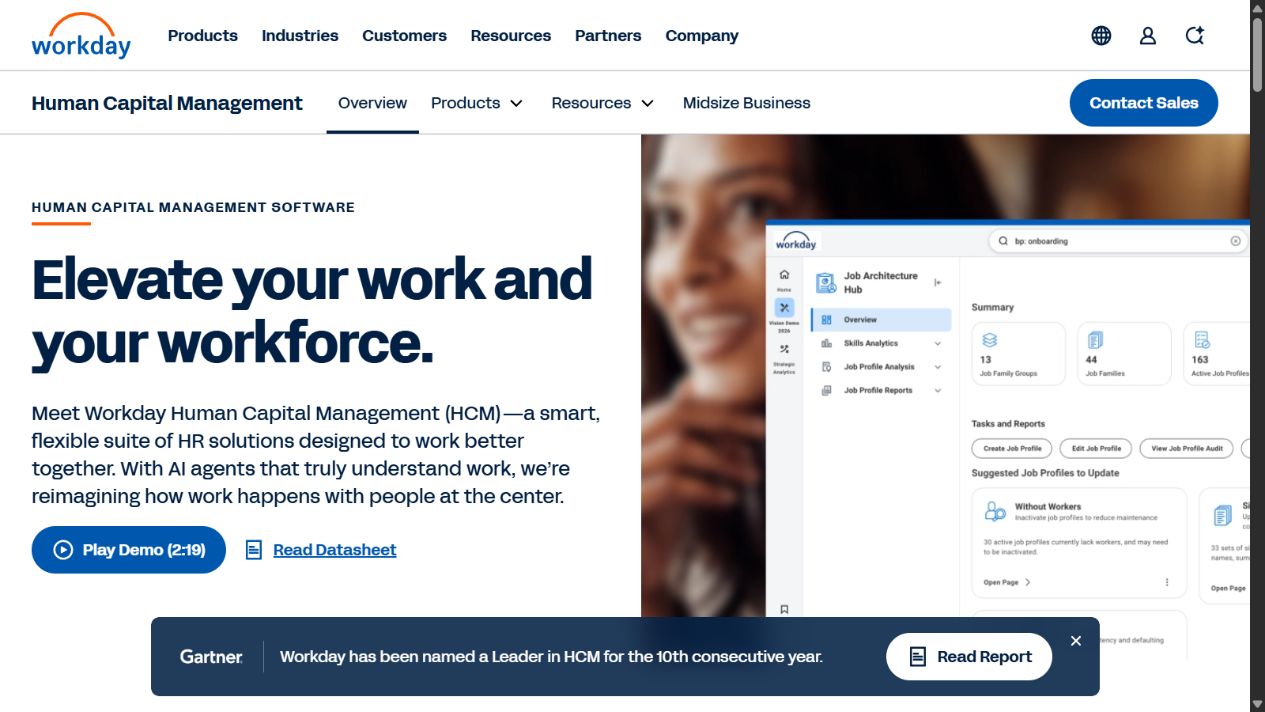
Workday HCM homepage captured August 31, 2026. Product packaging and availability can change.
Choose Workday when
- The enterprise wants a strategic HCM platform rather than a payroll-only replacement.
- Global core HR, talent, skills, workforce planning, analytics, and employee experience need a common foundation.
- Organizational change and effective-dated history must remain consistent across workflows and reports.
- The business can fund process redesign, data governance, integration, testing, and a permanent platform team.
- Workday Financial Management or Adaptive Planning is already important to the target architecture.
Check before buying
Country scope needs line-by-line verification. Confirm native payroll, partner payroll, benefits, time, absence, scheduling, language, data location, statutory reporting, and local support for every workforce population. A global core does not mean that every country has identical module depth.
Build the commercial model around the complete target architecture. Include core HCM, recruiting, learning, talent, compensation, planning, analytics, workforce management, employee experience, help, integrations, environments, support, and partner services. Clarify what is included, what is separately licensed, and how workers, contingent populations, transactions, or other metrics affect cost.
Workday configuration is powerful enough to become difficult to govern. Establish design authorities for organizations, security, business processes, calculated fields, reports, integrations, and releases. Require automated regression coverage for critical hire, transfer, termination, compensation, time, and payroll scenarios.
Sources: Workday HCM , Workday HRMS , and Workday HCM software guide .
2. SAP SuccessFactors: best for SAP-centered enterprises
SAP SuccessFactors HCM is SAP’s cloud human capital management portfolio. Official SAP material groups capabilities around core HR and payroll, talent management, workforce planning and analytics, employee experience, and HR service delivery. Its strategic value is strongest where workforce data and processes must connect with SAP finance, procurement, travel, operations, identity, and data services.
An SAP-centered enterprise can reduce architectural fragmentation by aligning employee and organizational data with the broader SAP estate. That does not make integration automatic. Enterprises may have a mix of SuccessFactors modules, SAP S/4HANA, legacy SAP HCM, local payrolls, acquired systems, and third-party talent products. The selection should therefore be treated as a target-architecture program, not a catalogue purchase.
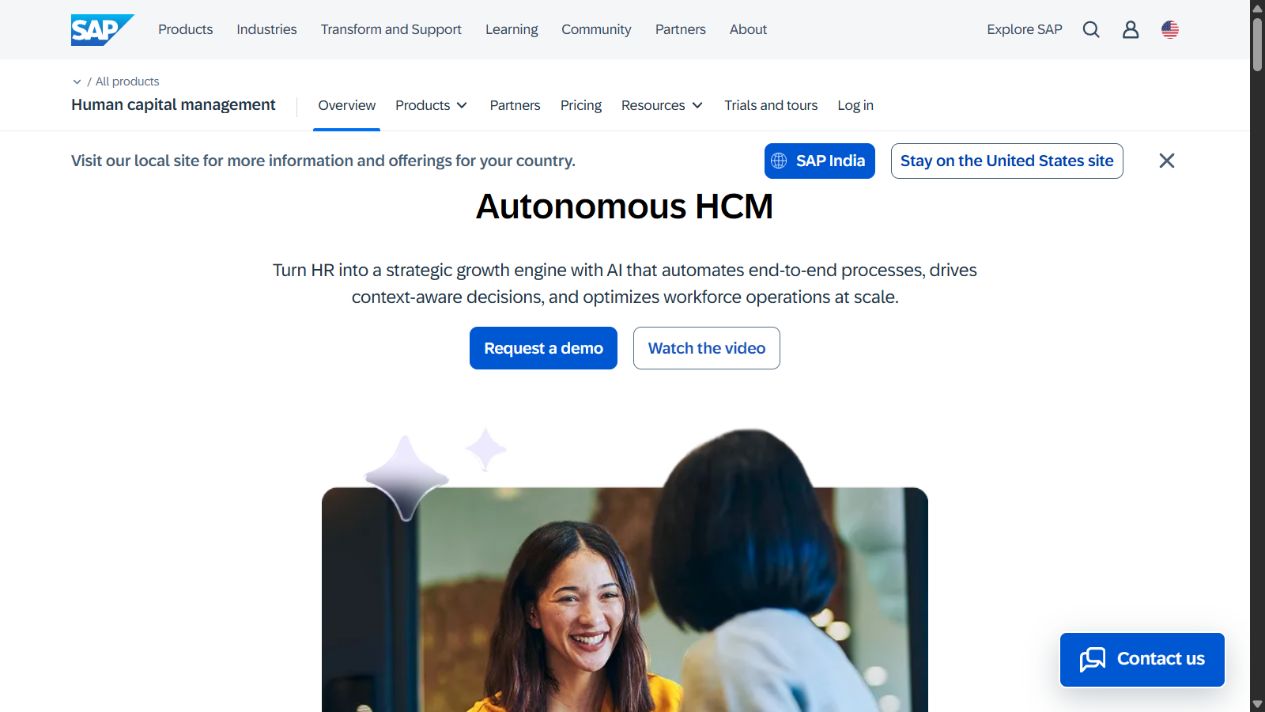
SAP SuccessFactors homepage captured August 31, 2026. Verify current editions and regional services.
Choose SAP SuccessFactors when
- SAP is already a strategic enterprise platform and HR data must connect to SAP business processes.
- The organization wants cloud HCM while managing a staged transition from legacy SAP HR or payroll.
- Core HR, talent, workforce analytics, learning, and employee experience require enterprise scale.
- The company has access to SAP architecture, integration, security, data, and country payroll expertise.
- A governed SAP roadmap is more valuable than choosing isolated best-of-breed HR applications.
Check before buying
Map every required process to a named SuccessFactors or adjacent SAP product. Confirm which system owns employee master data, positions, cost centers, time, payroll, learning, identity, expenses, and contingent labor. Test effective dates and error recovery across integrations; a successful happy-path interface is insufficient for retroactive changes and reorganizations.
Assess the user journey across modules. Products acquired or developed at different times can expose different administration and workflow patterns. A configured demonstration should cover employee, manager, recruiter, HR partner, payroll, auditor, and integration-support roles rather than showing only a polished home page.
Commercial evaluation should include subscriptions, environments, integration services, data and analytics products, implementation, migration, payroll interfaces, local partners, testing, training, and ongoing SAP release management. Verify support boundaries when several SAP and third-party providers participate in one business process.
Sources: SAP SuccessFactors HCM , SAP SuccessFactors solutions , and SAP Trust Center .
3. Oracle Fusion Cloud HCM: best for Oracle Cloud standardization
Oracle positions Fusion Cloud HCM as a connected suite for human resources, talent management, workforce management, payroll, analytics, and employee experience. Official product pages describe a unified HR foundation, recruiting, onboarding, learning, performance, compensation, benefits, time and labor, absence, workforce scheduling, HR help, digital assistance, and analytics.
Oracle HCM is most compelling when the enterprise is also standardizing finance, procurement, projects, supply chain, planning, or analytics on Oracle Fusion Cloud. Shared platform services and connected data can reduce some integration boundaries. The breadth can also expand the program: HR decisions may depend on finance configuration, identity, data governance, integration tooling, quarterly updates, and cross-suite release coordination.
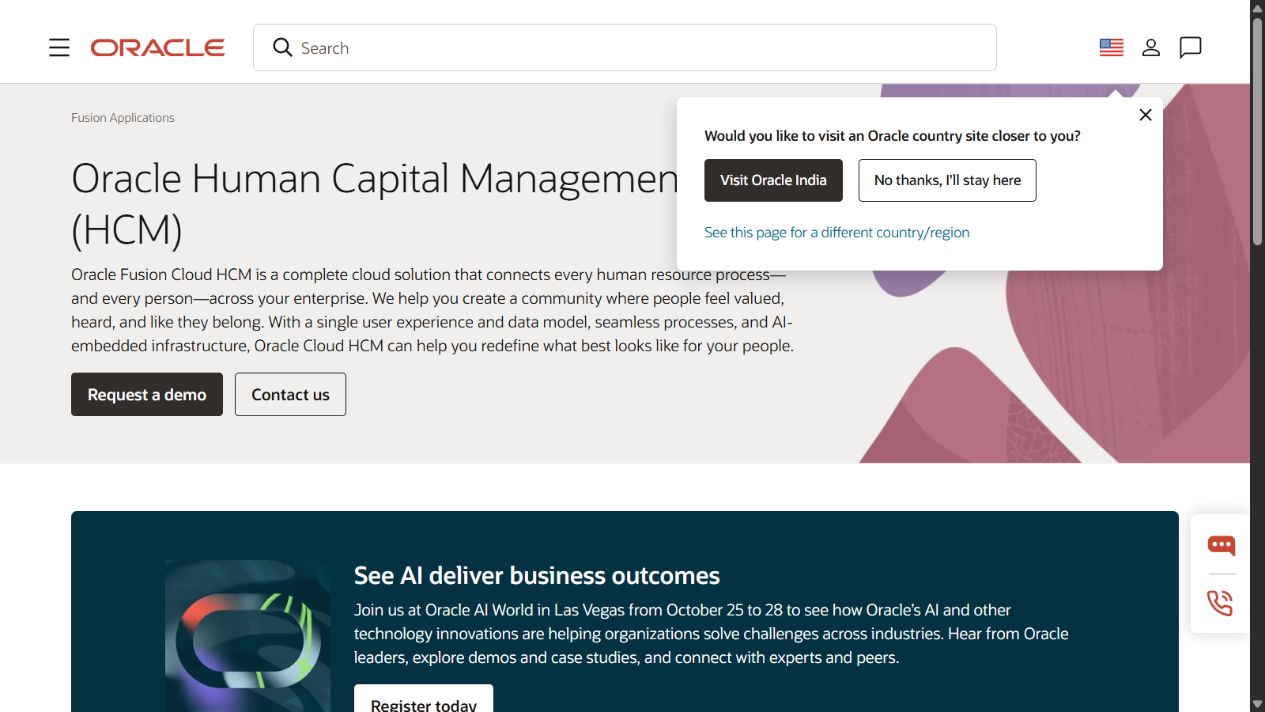
Oracle Cloud HCM homepage captured August 31, 2026. Confirm modules and country coverage in the proposal.
Choose Oracle Cloud HCM when
- Oracle Fusion Cloud is the target platform for HR and adjacent enterprise functions.
- The organization wants a broad HCM suite with connected finance and operational data.
- Global structures, security, workflows, analytics, and extensibility need enterprise-grade control.
- The implementation team understands Oracle configuration, integration, testing, and quarterly updates.
- Consolidating several Oracle and non-Oracle HR systems is a funded transformation objective.
Check before buying
Require a module and country matrix. Validate human resources, payroll, time, absence, scheduling, benefits, recruiting, learning, compensation, talent, help desk, analytics, and employee experience for each population. Pay particular attention to local statutory processing and the boundary between native payroll and partner services.
Quarterly cloud updates require disciplined change management. Identify optional and mandatory changes, preview environments, regression ownership, communications, and blackout periods. Test high-risk processes with realistic data, including retroactive pay, multiple assignments, global transfers, leaves, terminations, rehires, and reorganizations.
Model licences and delivery costs across the complete Oracle architecture. Include HCM modules, platform or integration services, analytics, environments, identity, support, implementation partners, data conversion, testing, and internal administrators. Suite alignment has value only when the enterprise can operate it coherently.
Sources: Oracle Fusion Cloud HCM , Oracle Human Resources , and Oracle Cloud security .
4. UKG Pro: best for payroll and workforce-intensive operations
UKG Pro brings together human capital management, payroll, talent, workforce management, employee experience, and analytics. UKG’s product direction is especially relevant to employers where hourly work, scheduling, time capture, attendance, labor rules, frontline access, and payroll execution are operationally critical rather than peripheral HR functions.
The practical buying case is not merely that UKG offers time and payroll. It is that workforce events can be connected from schedule and clock through pay and reporting. Retail, healthcare, manufacturing, hospitality, logistics, and other labor-intensive sectors may value this operating focus. The exact fit depends heavily on countries, union agreements, devices, pay rules, acquisitions, and the selected UKG components.
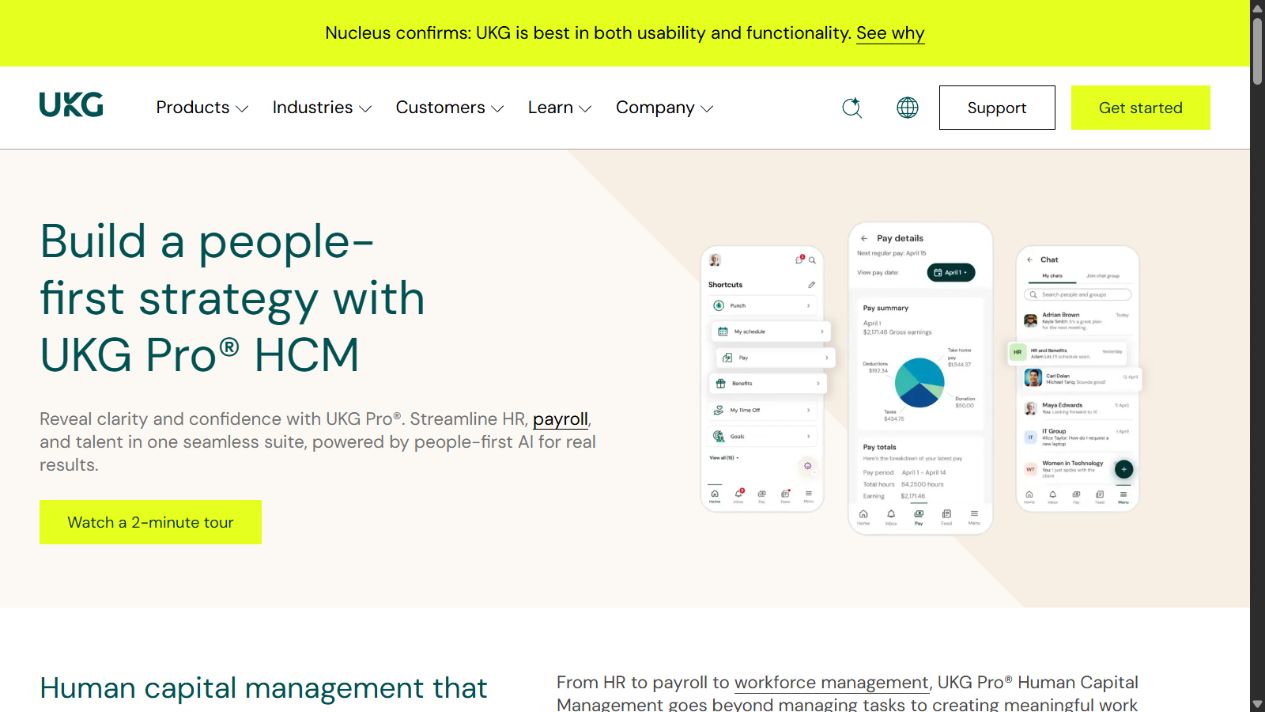
UKG Pro homepage captured August 31, 2026. Product scope should be confirmed for each country and workforce type.
Choose UKG Pro when
- Payroll, time, attendance, scheduling, labor forecasting, and frontline experience are primary requirements.
- The workforce includes complex hourly, union, shift, location, or premium-pay rules.
- HR leaders want core people data and talent capabilities connected to workforce execution.
- Mobile and device-based employee access must work for populations without desks or corporate email.
- The enterprise can run rigorous parallel payroll and workforce-rule testing.
Check before buying
Test real labor agreements and edge cases. Include overnight shifts, split shifts, on-call time, meal rules, premiums, multiple jobs, transfers, retroactivity, leave, corrections, terminations, and supervisor overrides. Confirm offline behavior, device security, biometric considerations, accessibility, and support for shared locations.
Clarify how the selected UKG products share data, identity, workflow, reporting, and administration. Product branding alone does not prove that every component behaves as one application. Ask the vendor and implementation partner to demonstrate end-to-end scenarios and failure recovery using the proposed architecture.
Define payroll accountability. Document who owns configuration, tax updates, interfaces, banking, reconciliation, controls, incident response, and year-end processing. Include implementation, managed services, devices, integrations, environments, support, and internal payroll capacity in the cost model.
Sources: UKG Pro , UKG workforce management, and UKG Trust Center.
5. Dayforce: best for unified pay and workforce management
Dayforce presents its platform around people, pay, time, talent, workforce management, analytics, and employee experience. A central product idea is continuous calculation: changes to time, benefits, or other inputs can update pay calculations during the pay period rather than waiting for a separate batch process. That model is attractive when payroll accuracy and workforce decisions depend on current operational data.
Dayforce is therefore most relevant to organizations with complex hourly workforces, scheduling, labor compliance, and multi-step payroll operations. It also offers broader HR and talent functions, but buyers should judge the suite through complete worker journeys rather than assuming equal depth in every module.
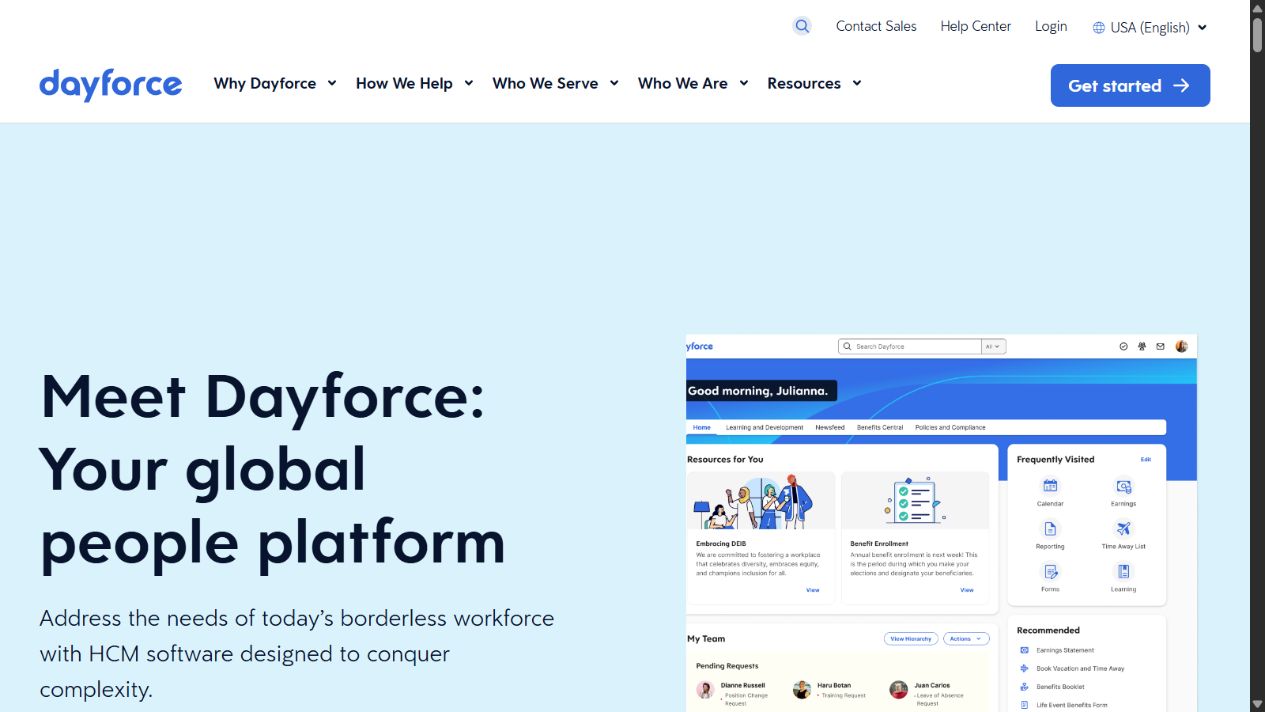
Dayforce homepage captured August 31, 2026. Country services and commercial packaging can change.
Choose Dayforce when
- The enterprise wants pay, time, scheduling, benefits, and workforce data closely connected.
- Continuous pay calculation could improve payroll visibility and reduce late-cycle surprises.
- Hourly and frontline workforce operations are strategically important.
- The target countries and employment rules match verified Dayforce capabilities and services.
- HR and payroll teams can govern configuration, testing, reconciliation, and release change together.
Check before buying
Do not infer global payroll coverage from general platform language. Verify each country, legal employer, pay group, currency, statutory report, bank process, tax requirement, language, and service dependency. Distinguish native capability from partner or managed-service arrangements.
Test the continuous calculation model with real retroactivity, corrections, premiums, benefits, leave, transfers, and terminations. Define reconciliation controls between gross-to-net results, finance postings, bank files, statutory outputs, and employee statements. Determine how quickly administrators can diagnose an unexpected result and reproduce the calculation history.
Review the full suite experience for employees, managers, schedulers, HR, talent teams, payroll, finance, and auditors. Model subscriptions, payroll services, workforce modules, devices, implementation, interfaces, testing, support, and internal operations over at least three years.
Sources: Dayforce platform , Dayforce payroll, and Dayforce trust.
How the platforms differ
The most useful distinction is the platform’s center of gravity:
- Workday centers a unified workforce data and process platform, with strong connections to planning and finance.
- SAP SuccessFactors centers cloud HCM within a broad SAP enterprise architecture.
- Oracle Cloud HCM centers HCM within the Oracle Fusion application and data estate.
- UKG Pro centers people processes around payroll and workforce operations, especially complex labor environments.
- Dayforce centers tightly connected pay, time, scheduling, and workforce execution with broader HCM capabilities.
These are not absolute boundaries. Each vendor is expanding through AI, analytics, workforce management, skills, and employee experience. The correct decision should be based on the target operating model and verified configuration, not the most ambitious roadmap presentation.
Enterprise requirements checklist
Global data and organization design
Document legal employers, business units, supervisory organizations, departments, cost centers, positions, jobs, grades, locations, unions, pay groups, worker types, assignments, and contingent labor. Define effective dating, historical correction, mergers, divestitures, reorganizations, global transfers, and data ownership. A weak foundational model will undermine every workflow and report built above it.
Payroll, time, and absence
Inventory every country and pay population. Include payroll engines, providers, calendars, currencies, taxes, benefits, garnishments, retroactivity, banking, statutory reports, general-ledger posting, time devices, scheduling, premiums, leave, and collective agreements. Require parallel payrolls and documented reconciliation thresholds before cutover.
Security, privacy, and segregation
Map joiner, mover, leaver, manager, HR, payroll, auditor, integration, and privileged-admin access. Test cross-country and cross-company restrictions, delegated authority, emergency access, field security, reports, exports, APIs, mobile devices, and support access. Review retention, deletion, legal hold, residency, subprocessors, incident terms, and audit evidence.
Integration and identity
List upstream and downstream systems, authoritative fields, event timing, volumes, dependencies, monitoring, retry behavior, reconciliation, and ownership. Cover identity, finance, planning, procurement, expenses, learning, recruiting, benefits, payroll, banks, government agencies, data warehouses, and local vendors. An interface is not complete until failures are visible and recoverable.
Reporting and analytics
Define statutory, operational, workforce, finance, DEI, talent, skills, and executive metrics before selecting dashboards. Verify historical snapshots, effective dates, security, calculated definitions, raw export, APIs, warehouse access, lineage, and reconciliation. Avoid allowing each region to create incompatible definitions for headcount, turnover, vacancy, or labor cost.
Total-cost model
An enterprise HCM budget should include more than subscriptions. Model:
- core HR, talent, recruiting, learning, compensation, benefits, analytics, planning, help, and employee experience modules;
- payroll countries, pay slips, tax services, managed services, time clocks, messaging, and workforce transactions;
- environments, integration middleware, data platforms, identity, security, archiving, and monitoring;
- implementation partners, process design, data cleanup, conversion, interfaces, testing, accessibility, and training;
- internal product owners, architects, administrators, payroll experts, integration engineers, analysts, security, and change teams;
- parallel systems during transition, contract exits, retention, migration, decommissioning, and audit support;
- acquisitions, divestitures, workforce growth, new countries, regulation changes, and renewal increases.
Use low, expected, and high scenarios over three to five years. A higher subscription can be economical if it retires fragmented systems and lowers integration risk. A cheaper proposal can become expensive if country gaps, custom interfaces, or weak administration require permanent manual controls.
A practical selection process
- Define outcomes. State which business, employee, payroll, compliance, and data problems must improve.
- Create the target architecture. Name authoritative systems and integration boundaries before product scoring.
- Build scenario scripts. Use real hires, transfers, reorganizations, schedules, leaves, pay corrections, and terminations.
- Request configured demonstrations. Do not accept generic vendor tours or roadmap-only promises.
- Validate countries and contracts. Record native, partner, planned, and unsupported capabilities separately.
- Assess delivery capacity. Evaluate the vendor, implementation partner, internal team, and post-launch ownership.
- Run security and data reviews. Include privileged access, reports, APIs, retention, residency, and support operations.
- Model total cost and exit. Include implementation, operations, growth, renewal, migration, and data portability.
- Pilot the highest-risk areas. Payroll, time, integrations, security, and organizational change usually deserve priority.
- Use evidence-based scoring. Link each score to a demonstrated scenario, document, contract term, or tested result.
Final recommendation
Start with Workday HCM when the objective is a broad global HCM transformation built on unified workforce data, talent, planning, analytics, and employee experience. Prioritize SAP SuccessFactors when HR must align closely with a strategic SAP landscape. Prioritize Oracle Fusion Cloud HCM when Oracle Cloud is the enterprise application standard. Put UKG Pro high on the shortlist for payroll and workforce-intensive operating environments. Evaluate Dayforce closely when pay, time, scheduling, and frontline workforce execution need a tightly connected model.
Do not select from a feature matrix alone. Enterprise HR failures usually come from unclear process ownership, weak data, country assumptions, integration gaps, insufficient testing, and underfunded change management. The strongest platform is the one whose verified capabilities fit the operating model and whose governance the enterprise can sustain for years.
Frequently asked questions
What is the best HR software for enterprise teams?
Workday HCM is the strongest broad starting point for enterprises seeking a unified global HR, talent, workforce, planning, and analytics platform. SAP SuccessFactors fits SAP-centered estates, Oracle Cloud HCM fits Oracle-centered enterprises, UKG Pro fits workforce and payroll-intensive operations, and Dayforce fits organizations prioritizing continuously calculated pay and workforce management.
How should an enterprise choose an HCM platform?
Define the global worker model, payroll countries, employment structures, security boundaries, integrations, reporting, talent processes, workforce-management needs, implementation capacity, and exit requirements before comparing configured demonstrations and pilots.
Is Workday suitable for global enterprises?
Workday documents global core HCM, talent, workforce management, planning, analytics, employee experience, payroll capabilities, and an extensible platform. Buyers must verify local payroll, benefits, compliance, integrations, data location, and partner delivery for every country in scope.
When is SAP SuccessFactors the better choice?
SAP SuccessFactors deserves priority when employee, organizational, financial, procurement, and operational processes already depend on SAP and the enterprise wants HR connected to that landscape. Integration value does not remove the need to assess module consistency, user experience, migration, and implementation governance.
Which enterprise HR platform is strongest for workforce management?
UKG Pro and Dayforce deserve close evaluation when time, attendance, scheduling, labor forecasting, pay, and frontline operations dominate the requirement. Workday, SAP, and Oracle also provide workforce capabilities, so buyers should test their actual country, union, rule, and device scenarios.
How long does an enterprise HCM implementation take?
A multi-country HCM transformation commonly takes many months and may be phased over more than a year. Scope, data quality, payroll countries, integrations, process redesign, change management, testing, and partner capacity matter more than a generic timeline.
Should enterprises replace every HR system with one suite?
Not automatically. A suite can simplify identity, data, workflow, and reporting, but specialist recruiting, learning, benefits, payroll, scheduling, or analytics systems may remain justified. Define authoritative systems and governed integration rather than pursuing consolidation as an end in itself.