Best Marketing Software for Enterprise Teams
Compare Adobe Experience Cloud, Salesforce Marketing Cloud, HubSpot Marketing Hub, Braze, and Iterable for enterprise marketing operations.
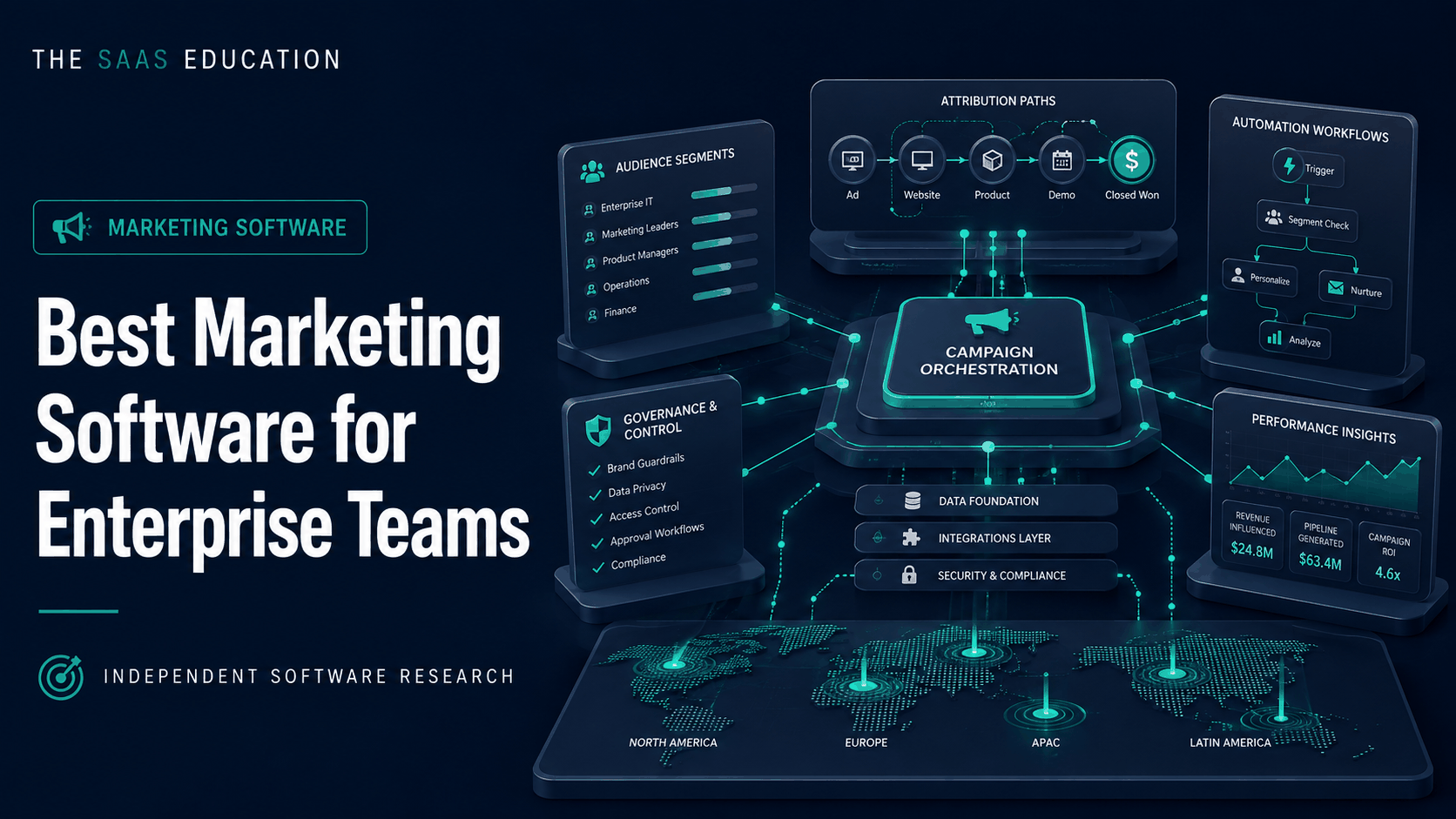
Direct answer
Adobe Experience Cloud is the strongest broad enterprise marketing software starting point when an organization needs content, customer data, journey orchestration, personalization, analytics, and digital experience capabilities across complex brands and regions. Salesforce Marketing Cloud is strongest when Salesforce customer data and workflows anchor the architecture. HubSpot Marketing Hub is the most approachable unified-suite option in this shortlist. Braze is strongest for real-time, mobile-first cross-channel engagement. Iterable is strongest for flexible lifecycle messaging and journey orchestration.
There is no universal winner. Enterprise marketing software sits between customer identity, consent, content, channels, commerce, sales, service, analytics, and finance. A global consumer brand operating apps and millions of event-driven messages has a different requirement from a B2B manufacturer coordinating accounts, leads, partners, and long sales cycles. A platform can be excellent in one architecture and unnecessarily complex in another.
This guide uses official sources checked on August 31, 2026. We did not run production campaigns, benchmark delivery, test vendor AI, validate customer claims, or audit implementation partners. The fit labels are editorial inferences from documented scope. Verify editions, countries, channels, limits, pricing metrics, and contractual protections for the exact proposed configuration.
Enterprise marketing shortlist
| Platform | Best-fit enterprise context | Primary risk to investigate |
|---|---|---|
| Adobe Experience Cloud | Large, content-intensive digital experience and personalization programs | Broad architecture, specialist skills, product packaging, implementation, and data governance |
| Salesforce Marketing Cloud | Marketing connected to Salesforce CRM, service, commerce, and customer data | Product-family boundaries, profiles and credits, implementation, and cross-cloud governance |
| HubSpot Marketing Hub | Unified marketer-facing CRM and marketing suite with lower operational friction | Enterprise segmentation, business units, limits, custom governance, and complex data models |
| Braze | Real-time mobile and cross-channel customer engagement | Event quality, message economics, content operations, and integration ownership |
| Iterable | Lifecycle marketing and cross-channel journey orchestration | Data contracts, regional requirements, operational governance, and surrounding-stack dependence |
These products overlap, but they begin from different assumptions. Adobe starts with digital experience and content at enterprise scale. Salesforce starts with customer relationships and a broad CRM platform. HubSpot emphasizes a connected front-office suite that marketers can operate directly. Braze starts with real-time customer engagement. Iterable starts with flexible lifecycle messaging. The target architecture should decide the shortlist before feature scoring begins.
How we selected the platforms
We reviewed official product pages, documentation, commercial material, security resources, and platform descriptions. Each product needed demonstrated enterprise relevance across customer data, segmentation, automation or journeys, multiple channels, personalization, analytics, integration, administration, and governance.
We evaluated ten areas:
- Identity and data: profiles, accounts, devices, events, anonymous users, transactions, consent, and data latency.
- Segmentation and decisioning: audiences, calculated attributes, predictive signals, eligibility, frequency, and suppression.
- Journey orchestration: triggers, schedules, branching, testing, approvals, goals, exceptions, and cross-channel coordination.
- Channels: email, web, app, push, SMS, messaging, advertising, forms, landing pages, and partner channels.
- Content operations: authoring, assets, templates, localization, brand governance, accessibility, and approvals.
- Personalization and AI: recommendations, decisioning, content assistance, agents, safeguards, evidence, and human control.
- Measurement: campaign reporting, attribution, experiments, journeys, raw data, warehouse export, and metric lineage.
- Enterprise governance: identity, roles, business units, regions, audit, retention, residency, and environment separation.
- Integration and extensibility: APIs, SDKs, events, connectors, marketplaces, data platforms, and failure recovery.
- Total cost and exit: profiles, sends, channels, credits, services, people, migration, portability, and renewal exposure.
We excluded customer outcome statistics from the recommendation. Vendor case studies can illustrate a workflow, but they cannot prove the result another enterprise will achieve.
1. Adobe Experience Cloud: best broad enterprise experience stack
Adobe Experience Cloud is a portfolio rather than a single marketing application. Adobe’s official product structure includes capabilities for customer data, journeys, campaign orchestration, content and assets, web experience, personalization, analytics, commerce, and work management. Products such as Adobe Experience Platform, Journey Optimizer, Marketo Engage, Experience Manager, Target, Analytics, and related services can form a broad digital experience architecture.
This breadth is the reason to shortlist Adobe and the reason to approach it carefully. Adobe is compelling when an enterprise must coordinate high-volume content, customer profiles, websites, applications, journeys, personalization, experimentation, and measurement across brands and regions. It is excessive when the need is mainly email automation and lead capture.
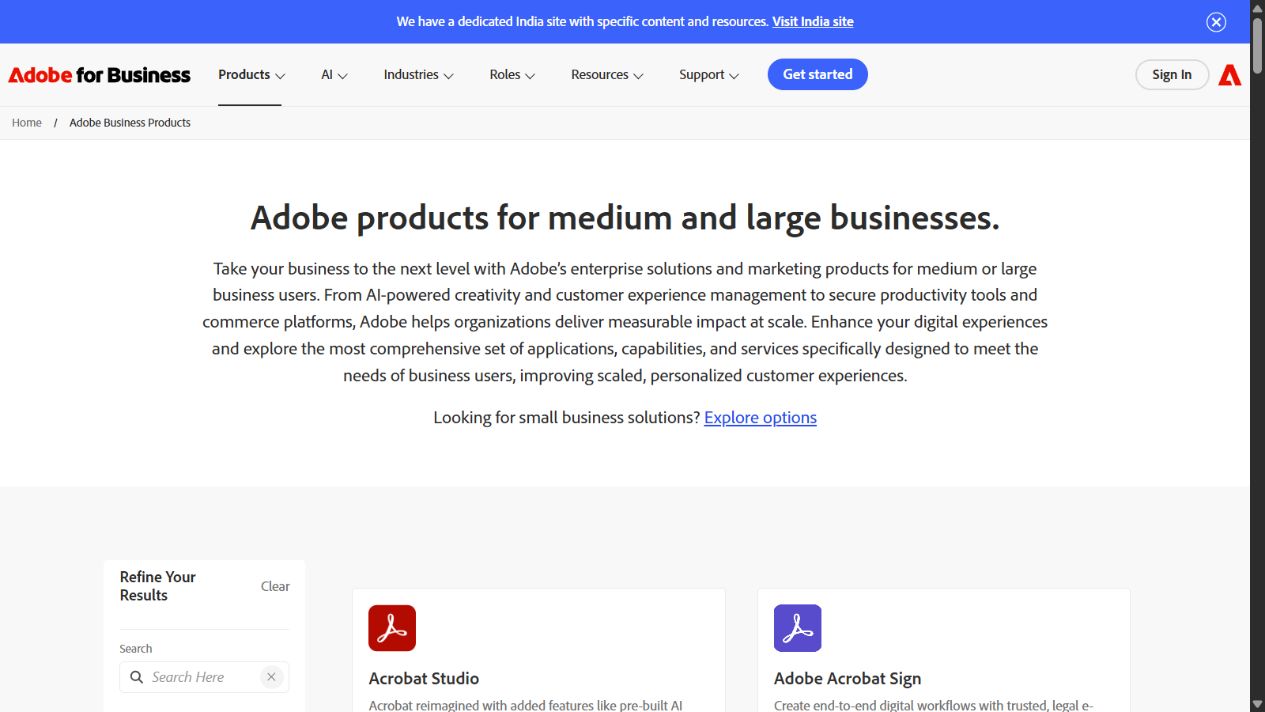
Adobe Experience Cloud homepage captured August 31, 2026. Verify current product names and packaging.
Choose Adobe when
- Digital content and experience delivery are strategic operating capabilities.
- The organization manages many brands, sites, applications, regions, assets, and approval workflows.
- Customer data, journeys, personalization, experimentation, analytics, and content need a coordinated architecture.
- Adobe creative, document, commerce, or analytics products already have strategic importance.
- The enterprise can sustain specialist architecture, engineering, data, content, privacy, and platform teams.
Check before buying
Define the exact product boundary. Do not buy an abstract Experience Cloud. Map each requirement to named products, editions, profile or event metrics, environments, integrations, services, and contracts. Clarify where the customer profile lives, where consent is enforced, which system selects content, and which platform owns measurement.
Content operations deserve equal weight with data architecture. Test asset creation, metadata, rights, localization, variants, approvals, accessibility, expiry, and reuse across channels. Personalization fails when content supply cannot support the number of audience and channel combinations promised by the strategy.
Model implementation and permanent operations. Include solution architecture, data engineering, tags or SDKs, content migration, taxonomy, analytics, privacy, testing, training, release management, and specialist support. A broad platform can reduce tool fragmentation while increasing the need for disciplined ownership.
Sources: Adobe business products , Adobe Experience Platform , and Adobe Trust Center .
2. Salesforce Marketing Cloud: best for Salesforce-centered customer operations
Salesforce’s marketing portfolio covers marketing automation, customer data, engagement, personalization, account engagement, intelligence, loyalty, advertising-related workflows, and other products. Official pages distinguish Marketing Cloud Next, Marketing Cloud Engagement, Account Engagement, Personalization, Intelligence, and Data 360-related capabilities. Those distinctions matter because similarly branded products can use different data objects, automation tools, and platform dependencies.
Salesforce is strongest when marketing must operate with sales, service, commerce, loyalty, and customer data on a governed Salesforce architecture. Shared customer context can improve handoffs and measurement. It can also create a large cross-cloud program involving identity, data, licences, integrations, administrators, and several product families.
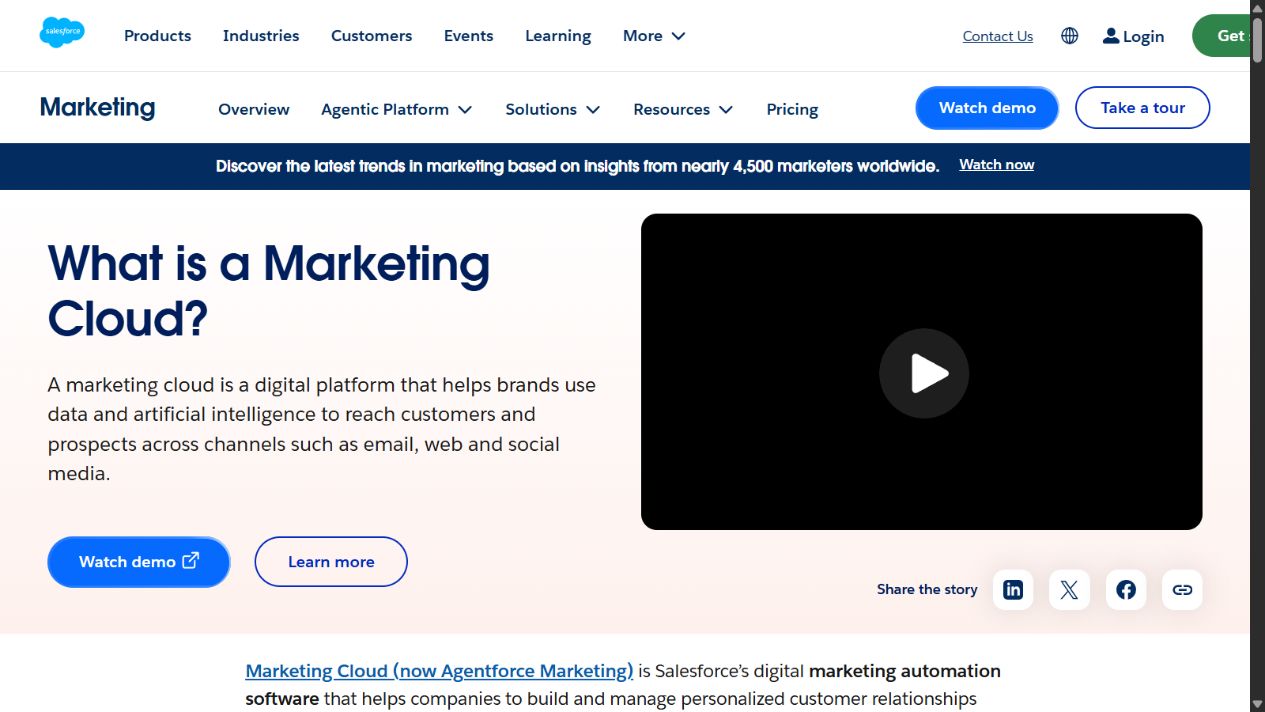
Salesforce marketing homepage captured August 31, 2026. Confirm the named product and edition in every proposal.
Choose Salesforce when
- Salesforce is already the strategic CRM or customer platform.
- Marketing needs direct connections to accounts, leads, opportunities, service, commerce, or loyalty.
- Customer data unification and activation are part of the target architecture.
- B2B and B2C teams require different but coordinated journey and campaign models.
- The enterprise has Salesforce architecture, data, administration, development, and release capability.
Check before buying
Identify the exact marketing product. Marketing Cloud Next, Engagement, and Account Engagement are not interchangeable labels. Require demonstrations and architecture diagrams for the proposed editions, data objects, segmentation, automation, content, channels, analytics, and integration paths.
Build a complete consumption model. Include users, profiles, email sends, SMS, WhatsApp, Data 360 profiles, Agentforce or flex credits, business units, personalization, intelligence, storage, support, and integration. Public list prices rarely represent a complete global enterprise deployment.
Test consent and suppression across clouds. A customer who opts out in one channel, brand, country, or system must be handled correctly everywhere. Define authoritative consent records, update latency, conflict resolution, audit evidence, and failure operations before campaign migration.
Sources: Salesforce marketing products , Marketing Cloud , and Salesforce marketing documentation .
3. HubSpot Marketing Hub: best unified marketer-facing suite
HubSpot Marketing Hub combines marketing automation with the wider HubSpot customer platform. Official material covers email, forms, landing pages, campaigns, automation, lead management, content, social, advertising-related tools, reporting, customer journeys, and AI-assisted features, with depth and limits varying by edition. Enterprise packaging adds controls and capabilities intended for larger teams.
HubSpot’s appeal is operational coherence. Marketing, CRM, sales, service, content, and operations tools can share records and a familiar interface. Teams may reach value faster than with a heavily assembled enterprise stack. The tradeoff is that sophisticated global organizations must verify whether HubSpot’s data model, business-unit separation, permissions, regional needs, volume limits, and specialist channel depth match the target state.
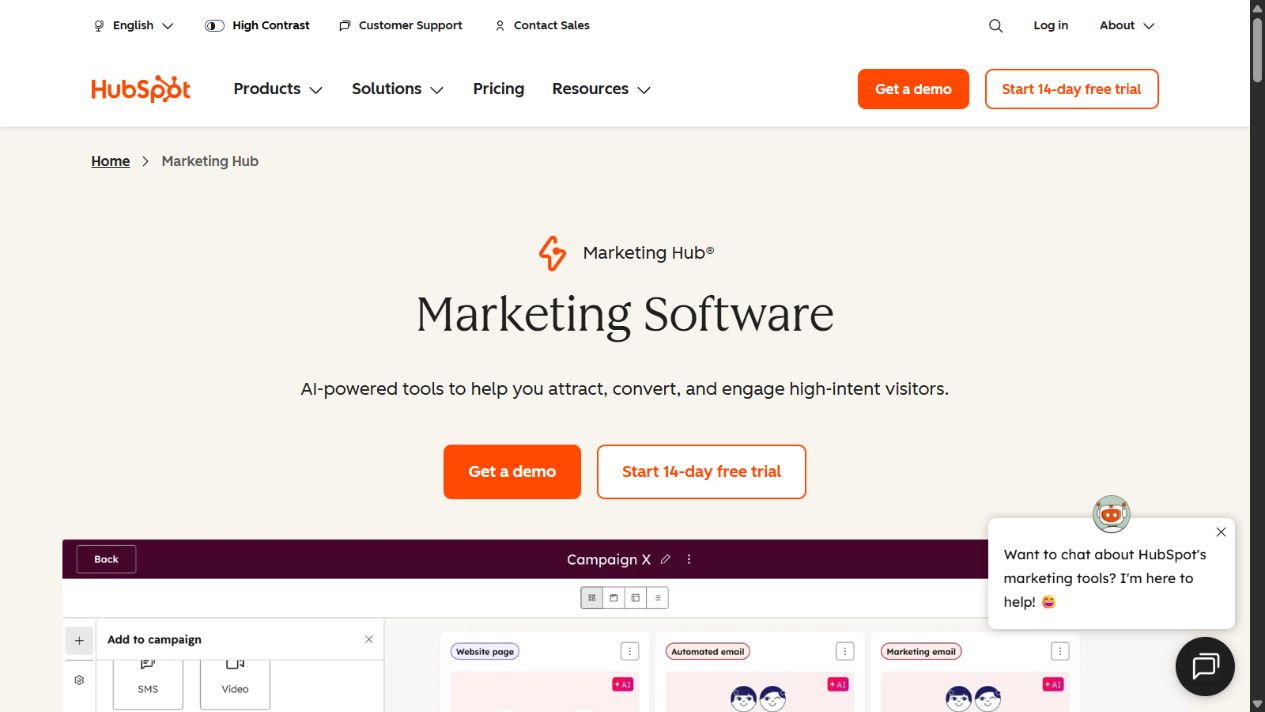
HubSpot Marketing Hub homepage captured August 31, 2026. Prices and included limits can change.
Choose HubSpot when
- Marketing wants a connected suite that business users can operate without a large specialist platform team.
- CRM, website, forms, email, automation, campaigns, and reporting should share one environment.
- The enterprise values adoption, speed, and interface consistency more than maximum specialist depth.
- Divisions can work within a governed shared data and permissions model.
- The proposed contact, send, domain, team, business-unit, and reporting limits fit projected growth.
Check before buying
Model contacts and limits carefully. Determine which records count for billing, how marketing status is managed, what happens during seasonal peaks, and how divisions share or separate databases. Include seats, contacts, sends, domains, business units, premium features, onboarding, support, and surrounding tools.
Test governance with real roles. Cover global administrators, regional teams, agencies, contractors, sales, operations, legal, and analysts. Verify record access, exports, workflows, lists, templates, subscriptions, domains, campaigns, and reporting. A simple interface does not eliminate enterprise access risk.
Assess data complexity and extensibility. Use representative accounts, contacts, custom objects, products, subscriptions, partners, and transactions. Confirm integration throughput, history, error recovery, warehouse export, and ownership when HubSpot is not the system of record.
Sources: HubSpot Marketing Hub , HubSpot marketing pricing , and HubSpot Trust Center .
4. Braze: best for real-time cross-channel engagement
Braze describes its platform around a data platform, Canvas journey orchestration, cross-channel messaging, and BrazeAI. It is designed to ingest customer data and events, create segments, coordinate journeys, and deliver experiences across digital touchpoints. This makes Braze particularly relevant to app-centered, subscription, commerce, travel, media, gaming, and other businesses where customer behavior should trigger timely communication.
Braze is not a replacement for every marketing system. It typically depends on reliable product events, customer data, content, analytics, consent, and operational integrations. Its value is strongest when the enterprise can provide that foundation and needs responsive engagement rather than a complete web CMS, CRM, or advertising suite.
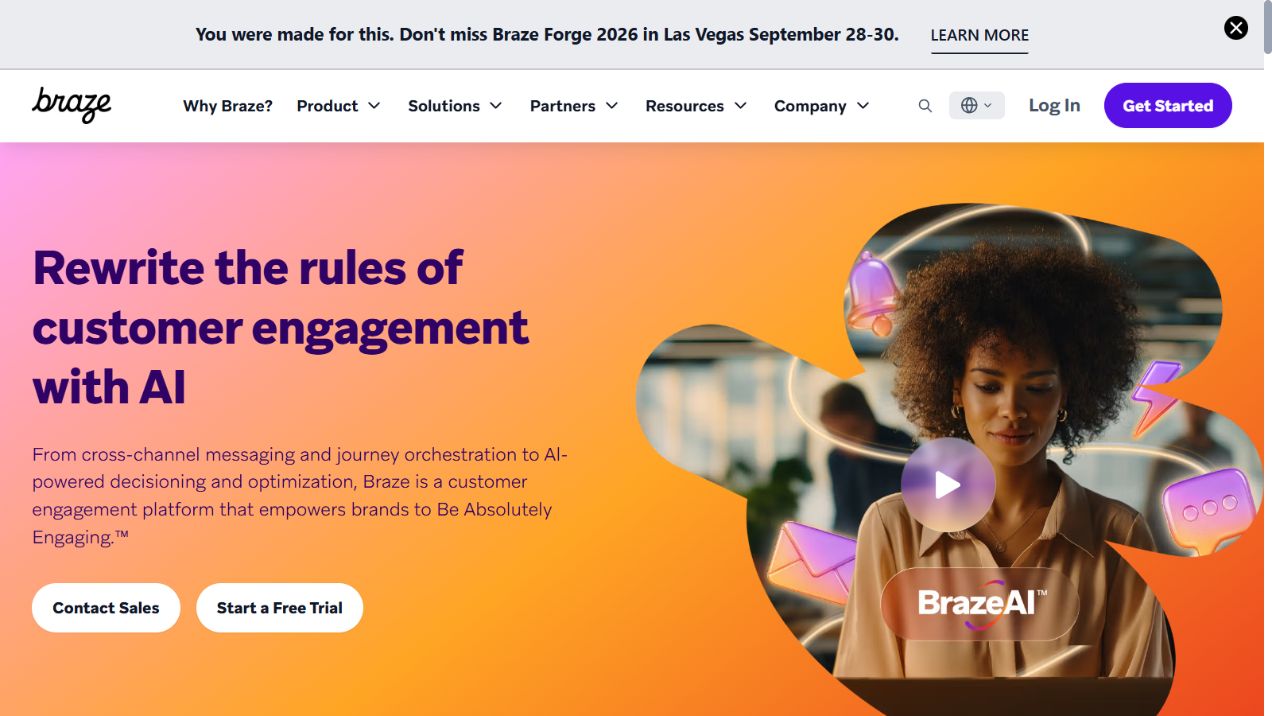
Braze homepage captured August 31, 2026. Validate channels, regions, throughput, and contracted limits.
Choose Braze when
- Mobile app and digital-product behavior drive lifecycle engagement.
- Teams need real-time segments, triggers, experimentation, and cross-channel journeys.
- Email, push, in-app messages, SMS, web, and related channels must coordinate around customer events.
- A data platform or warehouse can provide governed identities, attributes, events, and consent.
- Engineering, product, marketing, analytics, and privacy teams can share ownership.
Check before buying
Audit event quality before evaluating the interface. Define schemas, identity keys, anonymous-to-known transitions, timestamps, duplicates, late events, deletions, consent, and retention. Journey quality cannot exceed the data contract underneath it.
Model messages, active users or profiles, data points, channels, premium services, support, and data movement using real volumes. Include seasonal peaks, experimentation, transactional traffic, re-entry, retries, and regional growth. Confirm rate limits and deliverability responsibilities.
Test operational safety: frequency caps, global and channel suppression, quiet hours, time zones, approval, preview, test audiences, emergency stop, rollback, and incident response. Real-time activation increases the consequence of a bad segment or template.
Sources: Braze , Braze platform overview , and Braze security.
5. Iterable: best for flexible lifecycle orchestration
Iterable is a cross-channel customer communication and lifecycle marketing platform. Official product material emphasizes journey orchestration, audience segmentation, experimentation, messaging, personalization, data activation, and AI-supported workflows. It is relevant when growth and lifecycle teams need to coordinate customer communication across channels while connecting to a broader data and analytics stack.
Iterable can provide more focused lifecycle tooling than a very broad experience suite. The tradeoff is architectural dependence: customer data, identity, consent, content, analytics, and systems of record still need explicit ownership. Teams should assess how much configuration marketers can safely control and where engineering support remains necessary.
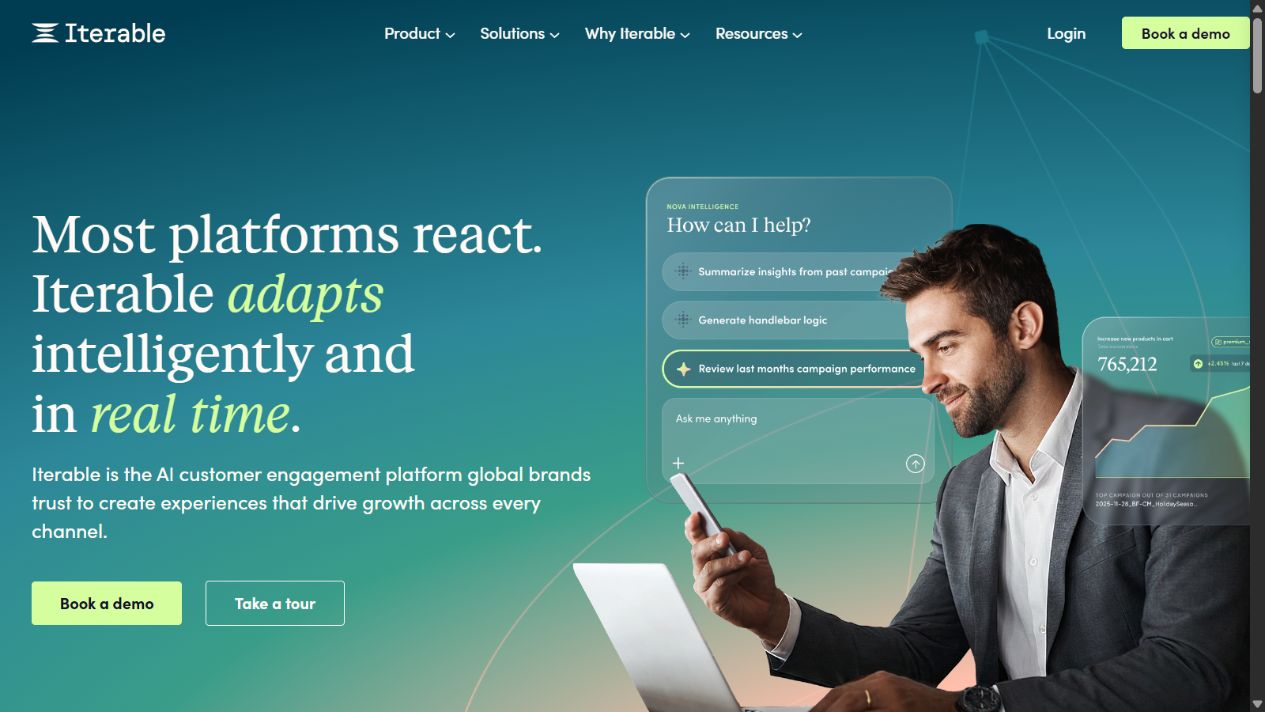
Iterable homepage captured August 31, 2026. Product scope and commercial metrics require current confirmation.
Choose Iterable when
- Lifecycle marketing and customer journeys are the primary requirement.
- Teams need event-triggered, scheduled, and cross-channel messaging with experimentation.
- The enterprise has a composable data, warehouse, or product-event architecture.
- Marketers need flexibility without adopting a complete digital experience suite.
- Growth, product, engineering, analytics, and compliance teams can define shared data contracts.
Check before buying
Validate identities, events, catalog or content data, consent, and channel addresses with representative edge cases. Test anonymous users, shared addresses, account relationships, multiple devices, deletions, reactivation, late events, and profile merges.
Review environment and release controls. Determine how templates, journeys, data feeds, experiments, and settings move from development to production; how changes are approved; and how a faulty campaign is stopped or rolled back. Include agencies and contractors in the permission model.
Request a configured commercial model covering users, profiles, events, messages, channels, data, premium capabilities, support, implementation, and growth. Confirm export and deletion paths so the organization can preserve history and change platforms later.
Sources: Iterable , Iterable platform, and Iterable trust center .
How the platforms differ architecturally
- Adobe Experience Cloud can become the digital experience, content, data, personalization, and analytics backbone.
- Salesforce Marketing Cloud can connect marketing to a Salesforce-centered customer and operational platform.
- HubSpot Marketing Hub can provide a more unified marketer-facing front-office suite with comparatively lower operational friction.
- Braze can own real-time digital customer engagement and journey execution.
- Iterable can own lifecycle messaging and orchestration within a composable data stack.
An enterprise may use more than one. Adobe may manage content and web experience while Braze manages app engagement. Salesforce may own CRM and customer data while another platform handles specialist messaging. The goal is not artificial consolidation. It is explicit ownership, governed identity, reliable consent, and measurable handoffs.
Enterprise requirements checklist
Identity, consent, and data contracts
Define people, accounts, households, devices, anonymous users, subscriptions, products, orders, and relationships. Name the authoritative identifier and merge rules. Document consent by purpose, channel, brand, country, and legal basis. Specify data sources, latency, history, deletion, and error recovery.
Content supply chain
Inventory email, web, app, push, SMS, messaging, advertising, landing-page, and sales content. Define templates, components, metadata, brand controls, accessibility, localization, approval, rights, expiry, and archival. Personalization should not create more variants than teams can review and maintain.
Journey operations
Map entry, eligibility, branching, waiting, re-entry, goals, exits, frequency, quiet hours, suppression, failures, and emergency stops. Test time zones, daylight-saving changes, duplicate events, delayed data, and channel outages. Every journey needs an owner and retirement date.
Security and privacy
Evaluate SSO, provisioning, roles, business units, sandboxes, audit, encryption, retention, deletion, residency, subprocessors, certifications, incident terms, and support access. Verify contract scope instead of assuming a trust-page badge applies to every product and region.
Measurement
Define delivery, engagement, conversion, incrementality, revenue, cost, retention, and customer-experience metrics. Document attribution limits. Validate raw exports, warehouse integration, identity reconciliation, bot filtering, test populations, and historical changes.
Total-cost model
Enterprise marketing cost includes:
- users, contacts, profiles, active users, accounts, events, API calls, and storage;
- email sends, push, SMS, WhatsApp, in-app, web, advertising audiences, and premium channels;
- AI credits, decisioning, personalization, analytics, experiments, and data activation;
- websites, content management, digital assets, translation, rights, accessibility, and approvals;
- implementation, integration, identity resolution, consent migration, data cleanup, and testing;
- environments, deliverability, domains, certificates, monitoring, support, and professional services;
- permanent platform, campaign, data, content, engineering, privacy, analytics, and operations teams;
- parallel systems, contract exits, historical export, retention, decommissioning, and retraining.
Model expected and peak volumes over three years. Include acquisition, new regions, message growth, and additional brands. A platform that appears expensive can reduce overlap; a low entry price can become costly when profile growth, channels, integrations, and manual controls expand.
Practical selection process
- Define business outcomes and customer journeys before selecting products.
- Create a target architecture naming systems of record and activation owners.
- Establish identity, consent, event, and content standards.
- Build configured demo scripts using representative data and exceptions.
- Test one high-value and one high-risk journey end to end.
- Validate security, privacy, accessibility, deliverability, and regional requirements.
- Measure administrator work, campaign lead time, failures, and recovery.
- Model full consumption, services, internal labor, renewal, and exit.
- Score only demonstrated, documented, contracted, or tested capabilities.
- Fund permanent ownership before committing to implementation.
Decision matrix and migration safeguards
Use a weighted decision matrix that reflects the operating model rather than a generic feature checklist. Give the greatest weight to identity and consent integrity, required channels, content workflow, journey safety, measurable outcomes, security, regional support, administration, and total cost. Score each requirement as demonstrated, documented, contracted, tested, or unavailable. A polished demonstration should not receive the same confidence as a workflow proven with representative data and permissions.
Migration planning should begin before contract signature. Inventory active journeys, templates, segments, suppression lists, consent records, domains, sender reputation, event schemas, integrations, reports, historical data, and regulatory evidence. Decide what must be migrated, archived, rebuilt, or retired. Run old and new platforms in parallel only where the control and measurement benefit justifies the additional complexity.
Require launch and rollback criteria for every migrated journey. Confirm data reconciliation, audience counts, test sends, accessibility, localization, links, tracking, frequency controls, approvals, emergency stops, monitoring, and ownership. Preserve exports and decision records so future teams can understand why the architecture was selected and how to exit it without losing essential customer history.
Final recommendation
Start with Adobe Experience Cloud when content, data, personalization, analytics, and digital experience are a strategic enterprise platform. Prioritize Salesforce Marketing Cloud when Salesforce anchors customer relationships and workflows. Choose HubSpot Marketing Hub when operational unity and marketer adoption matter more than maximum specialist depth. Put Braze high on the shortlist for real-time mobile and digital engagement. Evaluate Iterable for flexible lifecycle orchestration in a composable data architecture.
The strongest choice is not the suite with the longest feature catalogue. It is the platform whose identity, consent, content, journey, channel, measurement, and governance model the enterprise can operate safely at real volume.
Frequently asked questions
What is the best marketing software for an enterprise team?
Adobe Experience Cloud is the strongest broad starting point for content, data, journeys, personalization, analytics, and experience operations at large enterprises. Salesforce Marketing Cloud fits Salesforce-centered customer operations, HubSpot Marketing Hub fits teams prioritizing a more unified marketer-facing suite, Braze fits real-time cross-channel customer engagement, and Iterable fits lifecycle messaging orchestration.
How should an enterprise choose marketing software?
Define customer identities, consent, channels, data latency, journey types, content operations, personalization, analytics, regions, security, integration, message volumes, implementation ownership, and exit requirements before comparing configured demonstrations and pilots.
Is one enterprise marketing suite better than several specialist tools?
Not automatically. A suite can simplify identity, governance, workflow, and procurement, while specialist tools may provide better depth or speed for particular channels. Choose an explicit target architecture rather than maximizing either consolidation or tool count.
Which platform is best for mobile-first customer engagement?
Braze deserves priority for app- and mobile-centered engagement because its official platform scope emphasizes real-time data, journey orchestration, and cross-channel messaging. Iterable is also relevant for lifecycle messaging. Validate actual channels, regions, throughput, data latency, and operational controls.
Which enterprise marketing software is easiest to use?
Ease depends on the configured stack, user role, data model, governance, and workflow. HubSpot often presents a more unified marketer-facing environment, but enterprises must still test permissions, business units, limits, integrations, reporting, and change control.
What costs are commonly missed in enterprise marketing platforms?
Profiles, contacts, message sends, data storage and activation, AI credits, premium channels, implementation, integration, content migration, analytics, sandboxes, support, deliverability, compliance operations, and permanent administration are frequently omitted from entry-price comparisons.
How long should an enterprise marketing-platform pilot run?
A focused pilot commonly needs six to ten weeks. It should test identity, consent, segmentation, content approval, orchestration, channel delivery, suppression, measurement, security, accessibility, failure recovery, and cost with representative data and volumes.