Best Marketing Software with AI Features
Compare five marketing tools with documented AI features. Check customer context, campaign review, beta availability, usage scope and purchase requirements.
The best marketing software with AI features depends on the work you want AI to perform. Shortlist HubSpot Marketing Hub for campaigns connected to customer records, ActiveCampaign for campaign and automation assistance, Mailchimp for email creation and audience analysis, Jasper for brand-informed content production, and Semrush Content Toolkit for content drafting, optimization and repurposing. These are different buying decisions, rather than five interchangeable campaign platforms.
Research scope and limitations
- Research type
- Official-source documentation review and editorial analysis
- Sources reviewed
- 13
- Hands-on tested
- No
- Last verified
- November 12, 2026
- Limitations
- Official public-source review, not an authenticated account test or performance benchmark. Numeric Descript pricing is dated official information; personalized rates and account-specific entitlements require confirmation. Proposed tests and verdicts are editorial analysis.
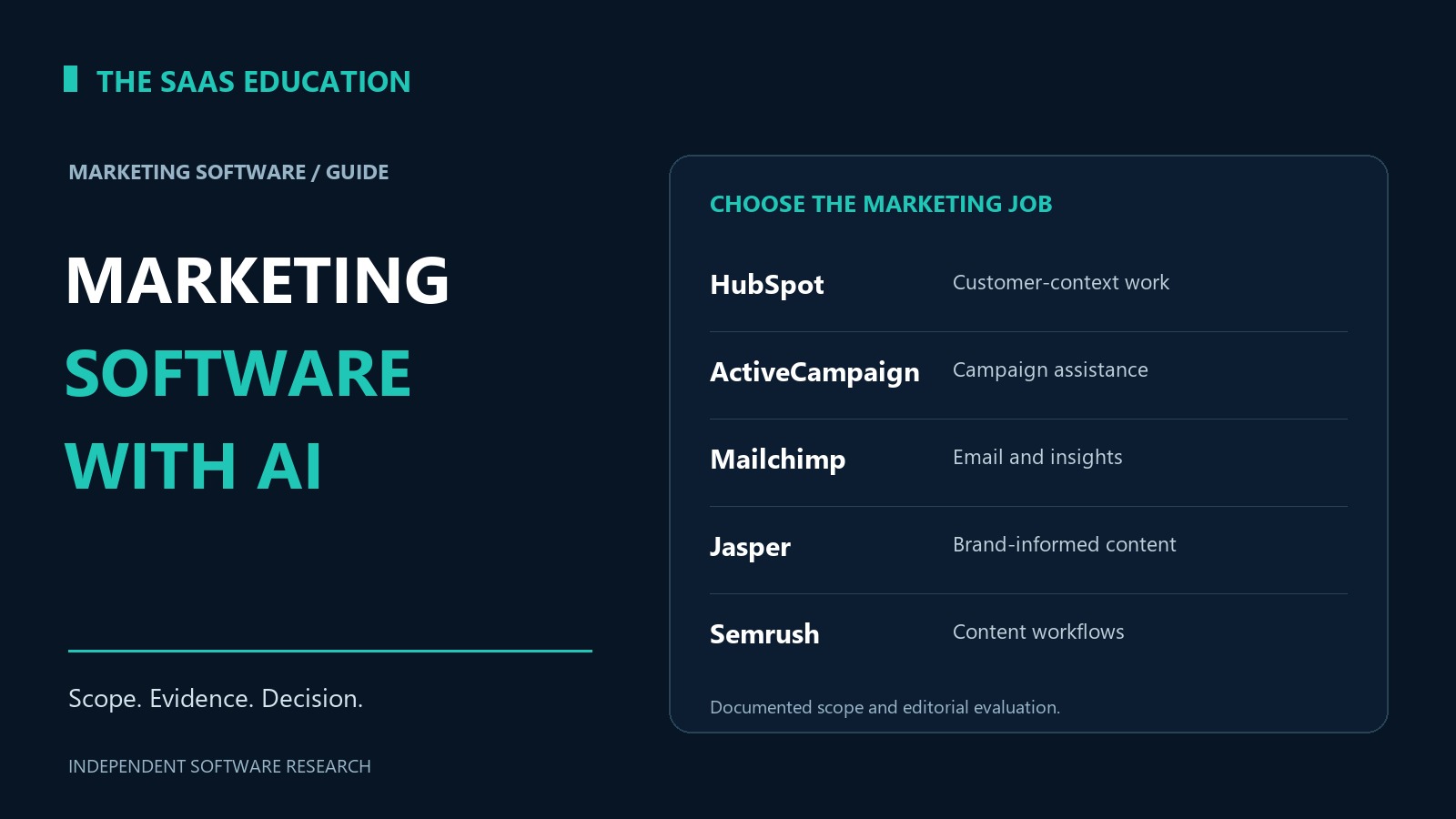
Table of contents
Direct answer
The best marketing software with AI features depends on the work you want AI to perform. Shortlist HubSpot Marketing Hub for campaigns connected to customer records, ActiveCampaign for campaign and automation assistance, Mailchimp for email creation and audience analysis, Jasper for brand-informed content production, and Semrush Content Toolkit for content drafting, optimization and repurposing. These are different buying decisions, rather than five interchangeable campaign platforms.
Choose the product that improves an accepted marketing deliverable while keeping the audience, message and release decision under clear ownership. Producing more variations is useful only if the team can approve, distribute and learn from them. An AI-generated campaign is not automatically ready to send, and a confident explanation of results is not proof of commercial impact.
This guide reviews official public product, documentation and pricing pages checked on November 12, 2026. We did not operate authenticated accounts, send campaigns, benchmark output quality or verify vendor performance statistics. Product facts are attributed below. Fit labels, proposed tests and verdicts are editorial analysis. Exact rates, regional access and account entitlements require a current proposal.
Marketing AI shortlist at a glance
| Product | AI work to evaluate | Context to prepare | Acceptance question |
|---|---|---|---|
| HubSpot Marketing Hub | Campaign work informed by customer records | Approved CRM fields, audience and campaign brief | Does the proposed message use customer context correctly? |
| ActiveCampaign | Campaign creation, automation assistance and insights | Campaign purpose, prior work and explicit journey rules | Can an operator inspect the proposed action before release? |
| Mailchimp | Email writing and audience or campaign analysis | Brand guidance, audience definition and eligible account access | Are recommendations relevant and available in the quoted account? |
| Jasper | Content work informed by brand and product knowledge | Current brand guidance, approved facts and audience context | Is the final asset accurate and usable across the intended channels? |
| Semrush Content Toolkit | Drafting, optimizing and repurposing content | Defined search intent, approved source material and distribution brief | Does the output answer the reader’s task without inventing evidence? |
The order follows the marketing workflow from customer context to content delivery. It is not a measured ranking. If you first need to choose channels or a system of record, start with our marketing software guide . This shortlist addresses the narrower question of where documented AI capabilities can fit within that system.
How we selected and compared the tools
Each product has current official evidence of an AI capability relevant to marketing and a different place in the campaign process. We compared the input it needs, the work it proposes, the decisions that remain with the marketer and the packaging questions that can change the purchase. General chat assistants and broad design tools are outside this shortlist’s scope.
Separate three kinds of work before looking at a demo. Creation proposes words, assets or a plan. Analysis proposes an explanation or next step from available information. Execution changes a record, starts a journey or releases a message. A product may connect these activities, but your approval requirements should still distinguish them.
For example, a useful draft for a renewal campaign must describe the correct service, honor the approved offer and address the intended customer group. Those checks are different from deciding which contacts may receive the campaign. A polished message cannot repair an incorrect audience or a missing suppression rule.
Our first-party data tools guide explains the underlying data responsibilities. Before adding an AI layer, write down which source owns contact details, communication preferences, customer status and approved product information. If two systems disagree, the evaluation should expose that disagreement rather than let generated language conceal it.
1. HubSpot Marketing Hub: for AI work connected to customer context
HubSpot’s Marketing Hub page describes marketing automation within its customer platform, including AI-powered email and a Nurture Agent using CRM data and behavior. Its Marketing Studio page , labeled beta, presents campaign work in an AI workspace connected to business context and performance information. These are documented capabilities, not evidence that every HubSpot edition includes the full workflow.
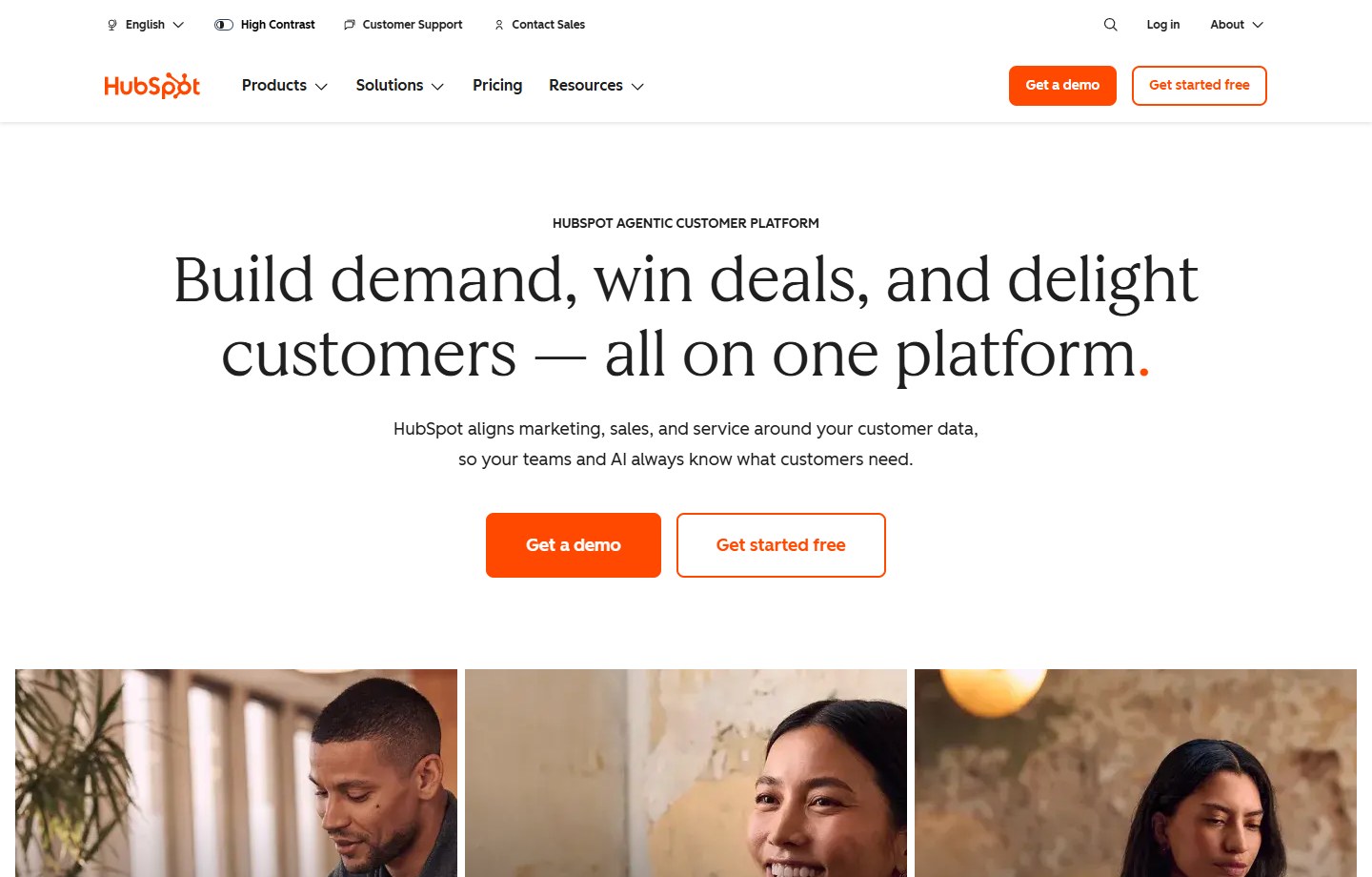
Source: HubSpot official public page , captured November 12, 2026. Vendor presentation; no account test or performance result is implied.
The practical reason to investigate HubSpot is the relationship between a campaign and the customer record behind it. Consider a hypothetical B2B company with prospects, active customers and renewal conversations. It wants messages that reflect those relationships without assigning every audience the same introductory sequence. A CRM-connected evaluation can examine whether the proposed content uses the right context and respects the team’s own communication rules.
Potential strengths: the documented customer-platform approach gives a marketing team a reason to evaluate customer context and campaign work together. It may reduce some manual briefing if the necessary information is already maintained accurately. That is a conditional operating benefit; this review does not establish a time saving or data-quality improvement.
Limitations: a larger shared context also creates more decisions about which records and fields are appropriate inputs. An old customer status or an ambiguous product name can produce a plausible but inappropriate message. Buying AI access does not remove the work of maintaining that context or deciding which content needs specialist approval.
Pricing checks: use HubSpot’s marketing pricing to identify the proposed edition, contact scope and required capabilities. Marketing Studio’s page also identifies certain agents within Breeze Assistant as credit-consuming features. Ask for a written mapping of the specific AI actions in your pilot to their current entitlement and consumption treatment. Do not assume free CRM access covers them.
Suggested test and verdict: create a fictional prospect and an existing customer with deliberately different approved briefs. Have the evaluator produce a proposed campaign for each, then explain the context used. Compare the outputs with your brief before considering execution. Shortlist HubSpot when shared customer context is the core requirement and someone owns its accuracy. Choose a narrower content tool when you only need asset creation and do not intend to adopt the surrounding customer platform.
2. ActiveCampaign: for campaign and automation assistance
ActiveCampaign’s Active Intelligence documentation describes assistance with campaign creation, automation building and insight analysis. The documentation says the interface is aware of the work in progress and can use account campaign information in its responses. We did not test the quality of its campaign suggestions or verify a particular account’s complete feature access.
The buying question is whether assistance makes an automation easier to inspect and maintain. A journey can look reasonable in a diagram while behaving incorrectly when a contact enters twice, changes status or completes the intended action sooner than expected. Ask the operator to explain both the happy path and the conditions that stop further communication.
For a hypothetical webinar follow-up, write three approved outcomes: send a resource to eligible attendees, notify the responsible colleague about a qualified inquiry, and exclude contacts who should not receive further marketing. Then ask for a proposed workflow. Those outcomes are your test requirements; they are not claims that ActiveCampaign automatically implements them in a particular way.
Potential strengths: the documented combination of campaign, automation and insight assistance makes ActiveCampaign relevant when the recurring problem spans creation and lifecycle operations. It gives the team a way to evaluate whether conversational assistance can clarify the next action without moving every planning discussion into a separate tool.
Limitations: AI-generated journey logic still needs an accountable owner. Operators must understand entry rules, waiting periods, exits and exception handling. If a colleague cannot explain the generated workflow after the conversation ends, apparent ease during the demo may become ongoing dependence on prompts and trial-and-error changes.
Pricing checks: compare the exact proposal against ActiveCampaign’s current pricing . Specify your audience, required channels, automation scope and operator access. Ask which proposed AI functions are generally available, whether usage limits apply and what happens when consumption or audience volume increases. This guide does not quote a universal starting price because that would not establish the cost of your configuration.
Suggested test and verdict: ask a second operator to review the proposed webinar journey without reading the original chat. They should identify who enters, what changes, when communication ends and how to suspend the workflow. Investigate ActiveCampaign when AI assistance must support a lifecycle process that humans can still understand and control. A business seeking occasional promotional copy may not need that broader operating scope.
3. Mailchimp: for email work with explicit availability checks
Mailchimp’s AI tools page describes content creation and analytics assistance under its current Intuit Intelligence positioning. Important qualifications appear on the same page: Intuit Intelligence is a beta available to certain Premium, Standard and Legacy users, while Analytics AI is listed for Standard and Premium paid plans. Those statements do not establish access for every account with a similar plan name.
That availability distinction belongs near the buying decision. A demo may show a useful way to interpret campaign activity, but a team should verify that its own account can perform the required task before planning work around it. Product naming can also change. Confirm the feature and its current access conditions rather than relying on an old reference to an assistant brand.
Potential strengths: Mailchimp merits evaluation when email remains the primary campaign deliverable and the team wants assistance within that process. Bringing a proposed message and a proposed explanation of campaign results into the same evaluation can reveal whether the team has enough audience and offer context to use either well.
Limitations: suggested copy needs factual and editorial review, while analytics recommendations need an independently understood question. “What performed best?” is underspecified if campaigns used different audiences, offers or measurement periods. A persuasive answer may omit those differences. Evaluate whether the operator can distinguish an observed result from a suggested explanation and a proposed follow-up.
Pricing checks: review Mailchimp’s marketing plans using the actual audience and intended send volume. Get confirmation of the exact AI features available to the account, their plan conditions and any beta restrictions. Do not treat a feature announced for selected users as a purchasing commitment for a different account.
Suggested test and verdict: use an approved, non-sensitive email brief containing a real limitation, such as a service available only to an explicitly defined customer group. Check whether the proposed copy preserves that restriction. Separately, ask the evaluator to explain a campaign result and identify the inputs supporting the answer. Mailchimp belongs on the shortlist when the job is email-centered and access is confirmed. If the principal need is broader CRM orchestration or search-content production, evaluate the corresponding specialist in this list instead.
4. Jasper: for brand-informed marketing content production
Jasper’s current platform page describes marketing agents and content workflows. Its Jasper IQ documentation page positions brand guidance, product information and audience context as inputs for generation. The documented proposition is a marketing-specific context layer, rather than simply a blank prompt box. This review does not validate its brand consistency or accuracy in practice.
The strongest evaluation is a campaign with several related assets that must remain consistent without sounding identical. A hypothetical software launch might need a landing-page introduction, a customer email and a short social announcement. Provide an approved source brief, product limitations, audience definitions and words the brand avoids. Ask for each asset from that same controlled context.
Potential strengths: a documented place for brand and product knowledge is relevant to teams repeatedly reconstructing the same brief. Jasper is worth investigating when the expensive part of content production is maintaining consistency across contributors and formats. The benefit must appear in accepted assets and review effort, rather than the number of drafts generated.
Limitations: stored context needs maintenance. If a discontinued offer remains in the source material, consistently repeating it is still a failure. Brand fit is also narrower than correctness: approved tone does not establish that a claim is supportable, a comparison is fair or an offer is available. Preserve the source and release review separately.
Pricing checks: use Jasper’s current pricing to map the proposed plan to the required people, brands and workflow features. Confirm exactly which context and agent capabilities the proposal includes. Do not assume that a broad homepage description establishes every self-service plan entitlement, or that buying Jasper replaces the tool that distributes the final campaign.
Suggested test and verdict: introduce a revised product fact after the initial sample, then ask for the affected assets to be updated. Check both the new text and the old statement’s removal. This tests the workflow you need; no successful outcome is implied here. Shortlist Jasper when brand and product context are the content bottleneck. For a more general tool-neutral evaluation of writing quality, use our AI writing tools selection guide and the Jasper versus ChatGPT comparison .
5. Semrush Content Toolkit: for content drafting and optimization
Semrush’s Content Toolkit documentation lists an AI Article Generator, Content Optimizer, Content Repurposing, Topic Finder and SEO Brief Generator. Its Content workspace page identifies the same content-oriented workflow. These tools make Semrush relevant to a marketer moving from a topic or existing article toward a revised draft and related distribution material.
This is a different job from managing a customer journey. A content team may already have email delivery and a CRM but lack a consistent process for creating briefs, evaluating drafts and adapting approved material. For that team, the useful comparison is against its existing research and editing process, rather than an all-in-one campaign platform.
Potential strengths: connected content tasks provide a practical evaluation path from idea to revision to repurposing. A team can investigate whether its editor receives a more actionable draft and whether adaptations preserve the meaning of the approved article. This is a workflow hypothesis, not an independently measured quality improvement.
Limitations: an optimization recommendation is not a guarantee of search ranking, AI citation or qualified traffic. The proposed article still needs a distinct reader task and reliable evidence. A draft that covers common subtopics can remain unhelpful if it repeats existing coverage or invents product details. The editor should be able to reject an unnecessary article instead of treating generation as a publishing obligation.
Pricing checks: follow the Toolkit’s current plan links and Semrush’s pricing navigation . Specify the Content Toolkit capabilities you require rather than assuming a different SEO or AI-search package includes them. Confirm generation, optimization, repurposing, user and publishing scope for the current proposal. This review does not establish account-specific quotas or a universal paid rate.
Suggested test and verdict: take one approved article with a clearly documented limitation. Ask for a revised introduction and an email adaptation. Review whether both preserve that limitation and avoid introducing unsupported claims. Shortlist Semrush Content Toolkit when a content workflow is the actual gap. Use the marketing attribution evaluation guide separately when the unanswered problem is measurement; content generation does not resolve attribution design.
Compare cost against accepted work
Keep the software quote and the operating calculation separate. The quote should identify products, users, audience or contact scope, required AI access, allowances, add-ons, implementation and contract terms. The operating calculation should include briefing, corrections, approval, distribution and maintenance. A low subscription price does not reveal whether the team can use the output safely.
A practical comparison is total pilot effort divided by accepted deliverables. Define acceptance before the demonstration: correct facts, approved audience, suitable format, understandable action and named signoff. Count rejected drafts and correction time as part of the effort. This is a suggested internal method, not a vendor benchmark or a claim that one product wins.
Avoid counting one draft as several deliverables merely because it appears in several formats. An email, article and social post have different purposes and review requirements. If the social adaptation adds an unsupported promise, it has not become acceptable simply because the original article was approved. The value appears when each output meets its own brief.
Run one campaign through a controlled evaluation
Choose an ordinary campaign that represents recurring work. Create a brief with an approved offer, a defined audience, reliable source material, a channel and a release owner. Use synthetic contact information during early evaluation. Keep customer or confidential material out until the organization has approved the relevant data handling.
Then maintain one acceptance record with five entries:
- Context: which approved facts and audience information were provided?
- Proposal: what text, analysis or workflow did the product suggest?
- Authority: what may the operator or tool change at this point?
- Review: which factual, audience and operational checks were completed?
- Release: which exact deliverable was accepted, by whom, and for what destination?
Include an exception, not just a clean example. Change an offer restriction, correct a product fact or remove an audience group before release. The point is to discover how the proposed process handles revisions without leaving an outdated message in another asset or journey. Do not activate a production campaign merely to complete an evaluation exercise.
Use our marketing automation planning guide for entry, exit and suppression design. Close the evaluation with the people who maintain customer information, approve content and operate the campaign. If nobody owns a critical handoff, revise the operating process before buying another layer of automation.
Which marketing software with AI features should you choose?
Start with the missing decision in your current workflow. Investigate HubSpot for customer-context campaign work, ActiveCampaign for lifecycle assistance, Mailchimp for email-centered creation and analysis, Jasper for brand-informed production, or Semrush Content Toolkit for content drafting and optimization. Keep the shortlist to the products serving that specific gap.
The right purchase produces usable, approved work at a sustainable operating cost. Require a demonstration of your own acceptance criteria, confirm the quoted access and retain control over release. More autonomous language on a product page does not change who is responsible for the message your audience receives.
Explore the Marketing Software research category for related buying decisions once the AI task is clear.
FAQs
Which AI marketing tool is best for a team already using a CRM?
Investigate whether the CRM’s documented AI features address the missing campaign task before adding another platform. HubSpot is relevant when customer-context campaign work is the requirement, but fit depends on accurate records, the proposed edition and a satisfactory evaluation. An existing CRM relationship alone does not prove its AI is the right purchase.
Can AI-generated marketing campaigns be published without review?
This guide recommends retaining a defined release owner. Review the offer, supporting facts, audience, channel, exclusions and final assets before publication. A system’s ability to propose or execute an action does not establish your organization’s authorization for it. Requirements should be explicit before any live campaign is enabled.
Does a paid Mailchimp plan guarantee access to all its AI features?
No. The current official AI page distinguishes selected-user Intuit Intelligence beta access from Analytics AI availability on specified paid plans. Confirm the exact feature in your own account and proposal. Similar plan names, older announcements or a demonstration in another account are insufficient evidence of your entitlement.
Should we buy Jasper or Semrush Content Toolkit for content marketing?
Evaluate Jasper when consistent brand and product context across marketing assets is the central problem. Evaluate Semrush Content Toolkit when drafting, optimization and repurposing within a content workflow are the gap. Compare accepted outputs using the same approved brief, but assess each product against its documented scope rather than assuming identical functions.
How should we measure value from AI marketing software?
Track accepted deliverables, correction effort, review effort and the complete proposed cost. Define acceptance before the pilot and preserve rejected outputs in the calculation. Campaign performance needs its own measurement design; draft volume, a vendor claim or a generated explanation of results does not independently demonstrate revenue impact.