Best Project Management Software for Enterprise Teams
Compare Asana, monday work management, Smartsheet, Wrike, and Planview Portfolios for enterprise projects, portfolios, resources, governance, and delivery.
Direct answer
Asana is the best broad project-management starting point for enterprises that need approachable cross-functional execution connected to goals, portfolios, workflows, and reporting. monday work management is best for flexible no-code work design. Smartsheet is best for spreadsheet-familiar program operations. Wrike is best for governed work delivery with structured intake, resources, budgets, and automation. Planview Portfolios is best for mature PMOs that need investment planning, scenarios, capacity, financial governance, and strategy-to-execution oversight.
The right choice depends on the operating problem. A team-work platform can improve ownership and delivery without providing the investment modelling of a strategic portfolio system. Conversely, a powerful PPM platform can fail if occasional contributors cannot update work reliably. Enterprise buyers should select the lightest operating model that still satisfies portfolio, security, resource, financial, and audit requirements.
This guide combines a live review of current search results with official sources checked on September 3, 2026. We did not run a controlled deployment, so recommendations describe documented fit and buying priorities rather than hands-on performance.
Enterprise project-management shortlist
| Tool | Best fit | Strongest layer | Main buying question |
|---|---|---|---|
| Asana | Cross-functional enterprises | Goals, portfolios, projects, workflows, and adoption | Can a shared work model connect departments without duplicating specialist systems? |
| monday work management | Configurable operations | No-code workflows, dashboards, resources, and portfolio visibility | Can flexibility be governed through templates, permissions, fields, and ownership? |
| Smartsheet | Spreadsheet-familiar programs | Sheets, reports, dashboards, automation, and repeatable delivery | Will the user and premium-capability model remain predictable as usage expands? |
| Wrike | Complex work delivery | Intake, execution, resources, budgets, reporting, and governance | Can teams absorb the configuration depth and administration required for consistency? |
| Planview Portfolios | Mature enterprise PMOs | Strategy, investments, scenarios, capacity, financials, and portfolios | Is the organization ready for the process and data discipline a strategic portfolio platform needs? |
What ranking pages often miss
First-page results usually compare task views, collaboration, integrations, reporting, security, ease of use, and price. Those are useful, but enterprise failure often begins outside the feature list. An implementation must define who owns the work model, which system owns each data object, how identities and guests are governed, how portfolio data stays trustworthy, and how changes reach thousands of users.
The category is also unusually broad. Collaborative work management helps teams plan and execute. Project portfolio management helps leaders choose, fund, sequence, and stop investments. Professional-services automation, agile planning, construction scheduling, product portfolio management, and IT service management solve adjacent problems. Treating all of them as interchangeable produces an attractive shortlist but a weak procurement decision.
Our comparison therefore focuses on five credible options with different centres of gravity. It does not assume one product should replace ERP financials, engineering delivery, service management, CRM, document repositories, or specialist scheduling. The goal is a coherent operating architecture, not the maximum number of workflows inside one licence.
How we selected the tools
We evaluated each platform against twelve enterprise requirements:
- Work structure: goals, portfolios, programs, projects, milestones, tasks, dependencies, requests, approvals, and status.
- Portfolio decisions: prioritization, scenarios, roadmaps, benefits, risks, investment categories, and strategic alignment.
- Resource management: roles, skills, demand, capacity, allocation, utilization, time, and what-if planning.
- Financial governance: budgets, forecasts, actuals, rates, capital and operating classifications, benefits, and ERP boundaries.
- Workflow control: forms, templates, rules, automations, approvals, exceptions, service levels, and change governance.
- Reporting: operational views, executive dashboards, portfolio rollups, data freshness, definitions, drill-down, and exports.
- Administration: organizations, business units, workspaces, roles, permissions, guests, audit, provisioning, and offboarding.
- Security and compliance: SSO, SCIM, encryption, logs, retention, regions, certifications, APIs, and incident processes.
- Integration: CRM, ERP, HR, identity, collaboration, development, BI, storage, API limits, monitoring, and reconciliation.
- AI governance: permissions, data treatment, grounding, actions, auditability, human review, limits, and commercial terms.
- Adoption: usability, mobile experience, accessibility, templates, training, support, champions, and local flexibility.
- Economics and resilience: licences, modules, services, administration, migration, continuity, export, recovery, renewal, and exit.
1. Asana: best broad enterprise starting point
Asana connects goals, portfolios, projects, tasks, workflows, forms, reporting, and administration in a work-management platform designed for cross-functional coordination. Its official enterprise page emphasizes connecting strategy, planning, and execution, as well as enterprise security and administrative controls.
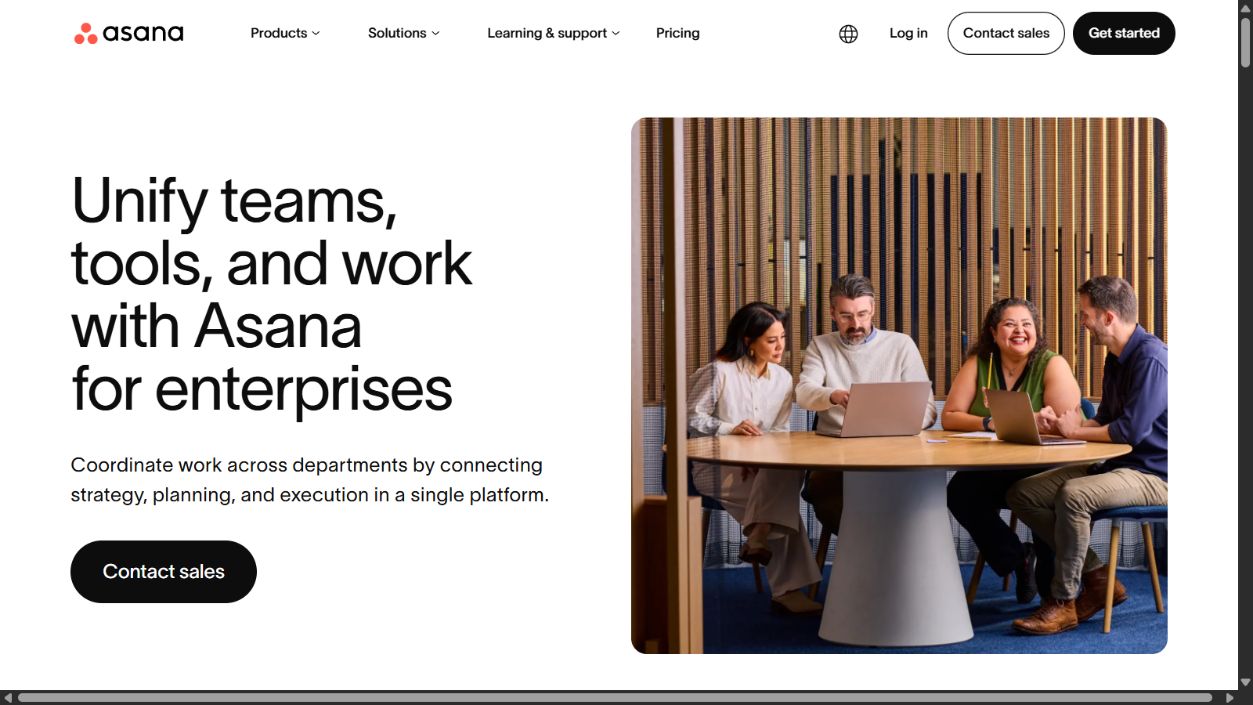
Asana enterprise homepage captured September 3, 2026. Confirm edition rights, services, AI usage, integrations, and contractual controls in the proposal.
Asana is our broad starting point because its work model can be structured without making every contributor behave like a portfolio analyst. Teams can standardize intake and execution while leaders connect work to portfolios and goals. That balance is useful when the central problem is unclear ownership, fragmented status, inconsistent handoffs, and too much manual reporting.
Choose Asana when
- Cross-functional projects need visible owners, milestones, dependencies, approvals, and status.
- Goals and portfolios should connect strategy with team execution.
- Forms, templates, rules, and reporting can standardize recurring work.
- Adoption across business teams matters as much as specialist PMO depth.
- Existing development, service, CRM, and finance systems will remain authoritative where appropriate.
Check before buying
Define the work taxonomy first. Agree on the difference between a goal, portfolio, program, project, milestone, task, request, approval, risk, and decision. Set required fields and status definitions. If every department creates its own interpretation, executive reporting will aggregate labels rather than comparable information.
Test permissions through realistic reorganization, guest, contractor, confidential-project, and offboarding scenarios. Validate SSO, provisioning, service identities, audit access, integrations, exports, retention, and administrative delegation in the proposed edition. Do not infer a control from its availability elsewhere in the product family.
Prevent duplicate work systems. Decide whether Jira, service management, CRM, ERP, product planning, or local operational tools own particular records. Integrations need an owner, direction, conflict rule, retry process, reconciliation report, and shutdown plan.
Sources: Asana Enterprise , Asana pricing , and Asana Help Center .
2. monday work management: best for flexible no-code operations
monday work management uses configurable boards, views, dashboards, forms, automations, integrations, portfolios, and resource capabilities to support projects and operational workflows. Official enterprise material presents connected strategy and execution, standardized processes, resource management, risk visibility, administration, security, and services.
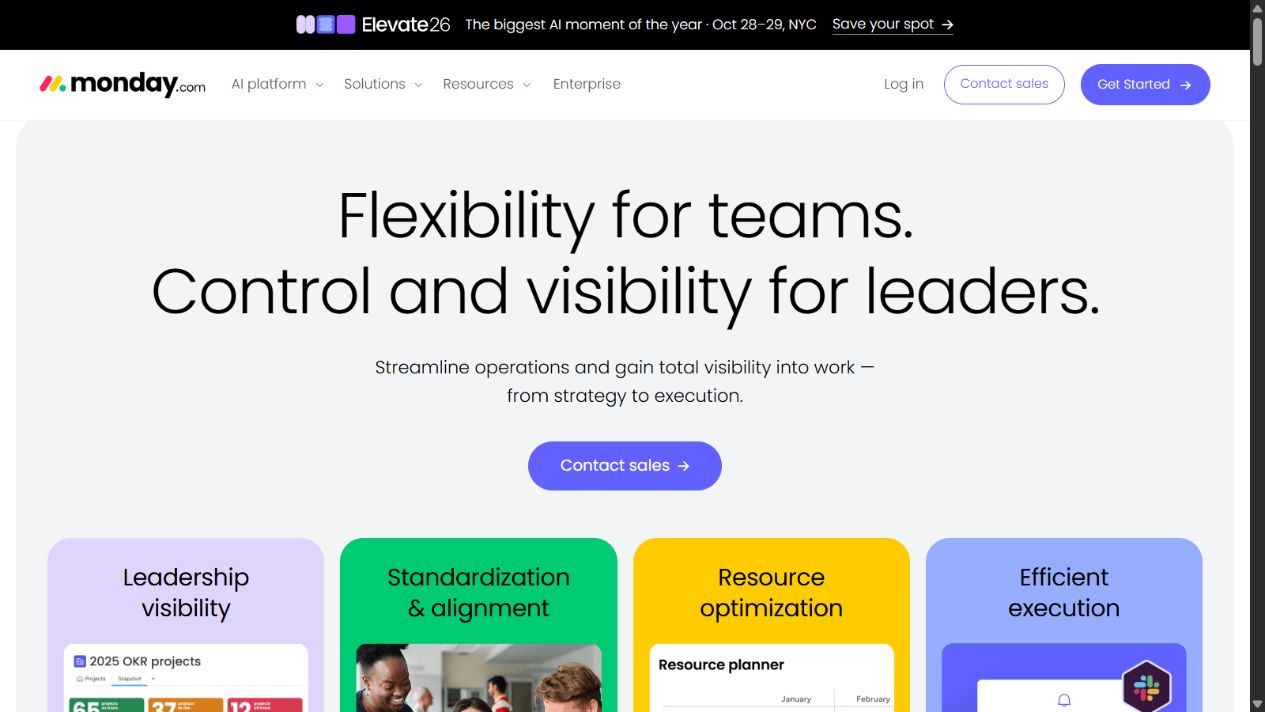
monday work management enterprise homepage captured September 3, 2026. Validate product entitlements, automation limits, user classes, support, and services.
monday work management fits enterprises that want business teams to shape their own workflows without waiting for a custom application. Its visual, configurable model can support marketing, operations, PMO, HR, and other functions while dashboards and portfolio capabilities create shared visibility.
Choose monday work management when
- Different departments need adaptable workflows on a common platform.
- No-code configuration and visual adoption are major selection criteria.
- Portfolio dashboards, dependencies, resource planning, forms, and automations fit the required operating model.
- Central teams can publish managed patterns while permitting bounded local variation.
- The enterprise wants execution flexibility without beginning with a heavyweight PPM transformation.
Check before buying
Flexibility is both the advantage and the governance risk. Establish workspace and board naming, ownership, templates, column definitions, status values, permissions, automations, integrations, dashboards, archival, and deletion. Create a design-review path for workflows that become business critical.
Test portfolio rollups when source boards differ. Determine which fields must be standardized, what happens when a template changes, how missing updates appear, and who resolves inconsistent data. Executive dashboards should disclose freshness and completeness instead of implying precision.
Model commercial usage with real workflows. Include user types, multiple monday products, automation and integration actions, storage, dashboards, applications, AI, implementation, managed services, support, sandbox or test needs, and renewal assumptions.
Sources: monday work management for enterprise , monday.com Enterprise , and official work-management documentation .
3. Smartsheet: best for spreadsheet-familiar program delivery
Smartsheet combines sheets, forms, reports, dashboards, automation, workspaces, integrations, resource capabilities, and portfolio solutions. Its official enterprise material describes a scalable platform for collaborative workflows, portfolio oversight, centralized administration, security, premium support, training, and professional services.
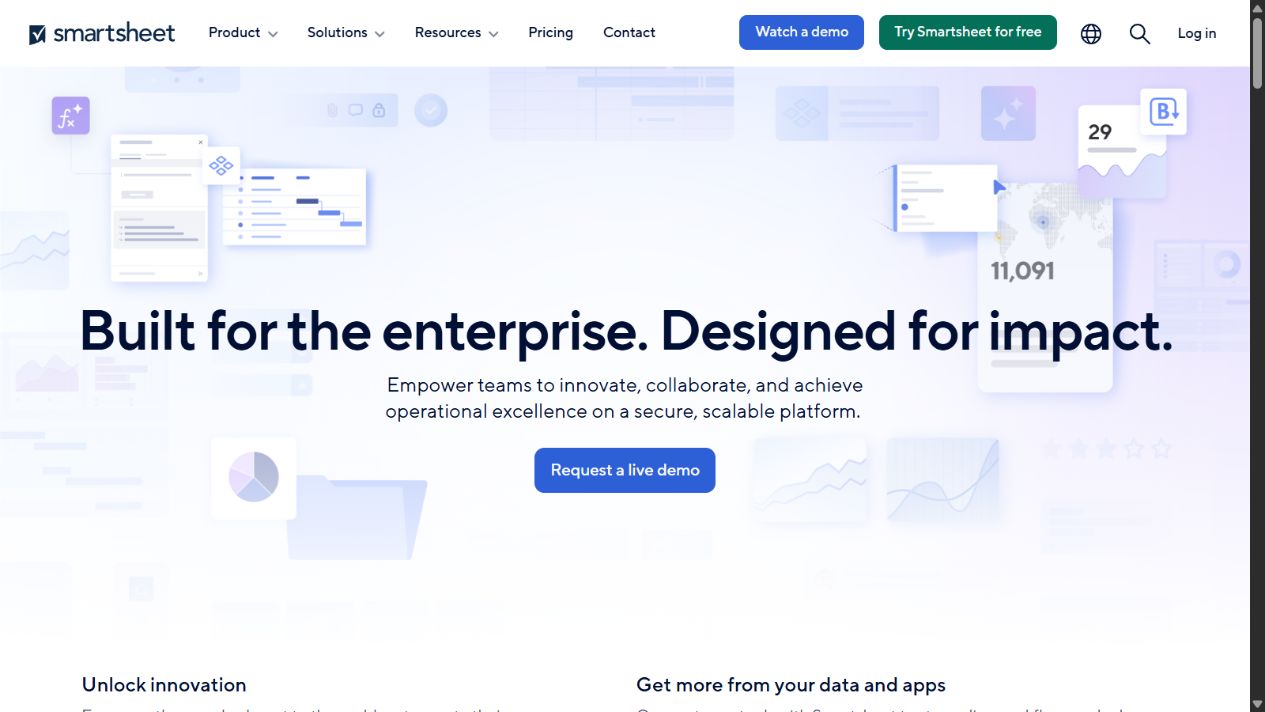
Smartsheet enterprise homepage captured September 3, 2026. Confirm the current user model, premium applications, connectors, services, and pricing.
Smartsheet is compelling when teams already think in grids but need stronger automation, reporting, dashboards, forms, permissions, and repeatability than ordinary spreadsheets provide. It can offer a familiar path from local tracking to governed program delivery, especially where PMOs need to standardize similar projects at scale.
Choose Smartsheet when
- Spreadsheet-familiar teams need a structured collaborative work platform.
- Forms, reports, dashboards, and automation are central to program operations.
- Repeatable project provisioning and portfolio reporting justify premium portfolio capabilities.
- Business users need configurable solutions while IT maintains administration and security boundaries.
- The enterprise values fast operational adoption more than an analyst-heavy portfolio interface.
Check before buying
Do not reproduce spreadsheet disorder in a cloud platform. Define authoritative sheets, workspace ownership, templates, naming, column types, contacts, formulas, references, reports, dashboards, automation ownership, and archival. Identify which calculations belong in Smartsheet and which belong in finance or analytics systems.
Validate scale using realistic rows, cross-sheet references, reports, dashboards, attachments, workflows, APIs, connectors, and concurrent updates. Test how errors propagate and how administrators discover broken references, failed automation, stale owners, or unmanaged copies.
Understand the complete commercial architecture. The value may depend on premium applications, connectors, resource capabilities, support, training, professional services, and the current paid-user model. Run expected growth and occasional-contributor scenarios rather than multiplying one public price by headcount.
Sources: Smartsheet Enterprise , Smartsheet pricing , and Smartsheet Help and Learning .
4. Wrike: best for governed work delivery
Wrike positions its enterprise platform around structured workflows, request management, projects, goals, resource and budget planning, reporting, automation, integrations, roles, permissions, audit trails, and governed AI. This makes it a strong candidate for organizations coordinating complex delivery across creative, marketing, operations, professional-services, and other work-intensive teams.
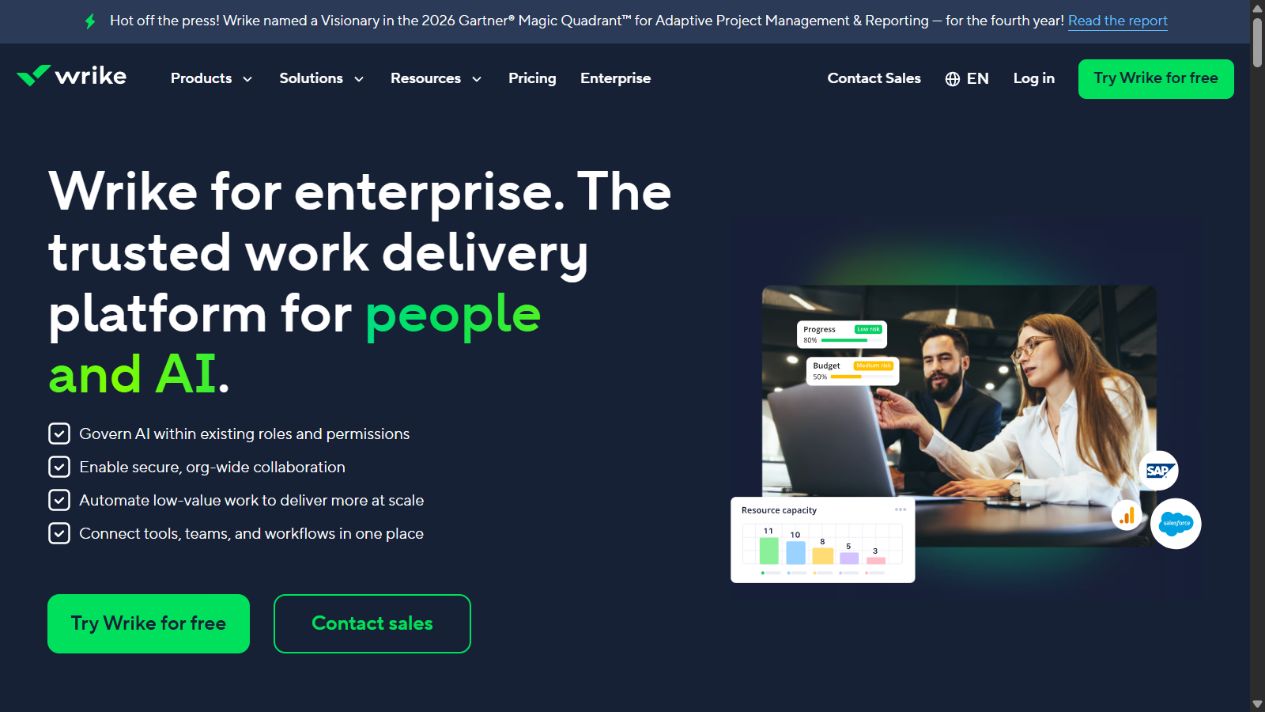
Wrike enterprise homepage captured September 3, 2026. Validate editions, user types, financial features, AI controls, services, and integrations.
Wrike fits when the problem begins before project creation. Dynamic requests, routing, structured workflows, resource decisions, budgets, delivery visibility, and reporting can form one controlled path from demand to completion. It is more operationally opinionated than a blank spreadsheet while remaining configurable across teams.
Choose Wrike when
- Work enters through repeatable requests that require routing, prioritization, and service expectations.
- Teams need connected intake, planning, execution, capacity, budgets, and reporting.
- Governance must cover people and AI actions through roles, permissions, and auditability.
- Multiple departments need shared delivery standards with controlled configuration.
- The enterprise can support platform ownership, workflow design, administration, and enablement.
Check before buying
Prototype the hardest workflow, not the cleanest demonstration. Include conditional intake, missing information, reassignment, approval rejection, dependency changes, resource conflicts, budget variance, late work, external collaborators, and executive reporting. Observe how much configuration and administrator intervention are required.
Clarify financial boundaries. If Wrike holds planned effort, rates, budgets, or project financial data, document how those values reconcile with ERP, time, payroll, procurement, and billing systems. Decide which platform is authoritative and how period close or corrections flow.
Treat AI and automation as governed production changes. Define builders, approvers, test environments, monitoring, exception queues, rollback, logs, data access, and human accountability. An automation that silently routes work incorrectly can damage portfolio data faster than a manual process.
Sources: Wrike Enterprise , Wrike pricing , and Wrike Help Center .
5. Planview Portfolios: best for strategic portfolio management
Planview Portfolios is oriented toward connecting strategy, investments, demand, programs, projects, products, resources, financials, scenarios, roadmaps, and outcomes. Its centre of gravity is portfolio decision-making rather than lightweight team task management.
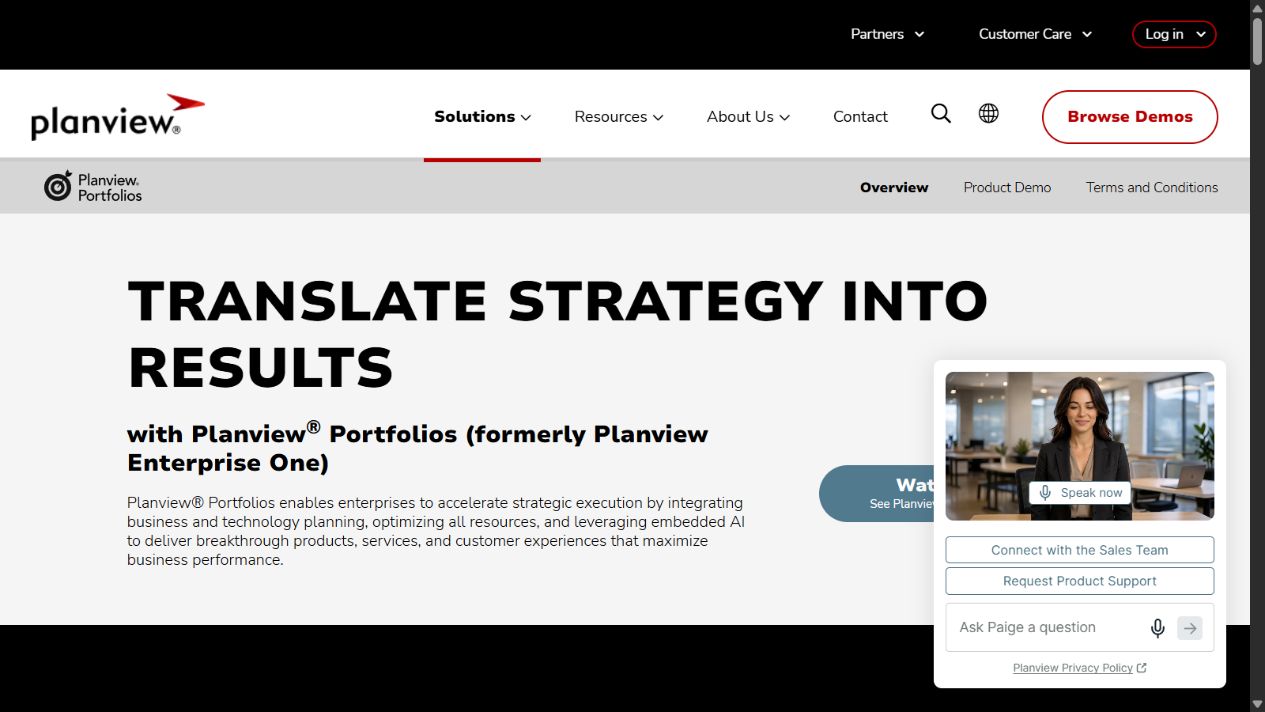
Planview Portfolios homepage captured September 3, 2026. Confirm modules, data model, implementation scope, integrations, services, and commercial terms.
Planview deserves priority when executives and a mature PMO need to decide which investments should start, continue, change, or stop. Scenario and capacity thinking can connect ambition with constrained people and funding. That is a different requirement from making individual task lists easier to use.
Choose Planview Portfolios when
- Strategy-to-execution and investment governance are the primary problems.
- Portfolio leaders need prioritization, scenarios, roadmaps, resource capacity, financial planning, and benefits oversight.
- The organization manages complex portfolios across business and technology work.
- Existing delivery tools may feed a strategic portfolio layer rather than being replaced.
- The PMO has the authority and maturity to standardize decision data and governance cadences.
Check before buying
Start with decisions and data, not screens. Define investment categories, strategic objectives, scoring, mandatory work, funding types, capacity pools, roles, rates, risks, dependencies, benefits, outcomes, tolerances, and review cadence. A sophisticated platform cannot correct ambiguous governance by itself.
Map the integration architecture early. Portfolio data may originate in ERP, HR, time, agile, project, product, service, architecture, and analytics systems. For every field, specify ownership, granularity, refresh, transformation, reconciliation, correction, history, and access.
Plan implementation as an operating-model change. Include portfolio governance design, data cleanup, migration, integrations, configuration, reporting, role design, training, communications, services, administration, release management, and adoption. Phase the rollout around decisions that become measurably better, not the number of configured modules.
Sources: Planview Portfolios , Planview contact , and Planview Customer Success Center .
Side-by-side buying analysis
Collaborative execution versus portfolio governance
Asana and monday work management are strongest when broad participation and cross-functional execution are central. Smartsheet provides a familiar operational model for program teams. Wrike adds depth around governed intake and work delivery. Planview Portfolios starts higher in the decision stack with investments, scenarios, capacity, and financial alignment.
An enterprise may use more than one layer. The strategic portfolio platform can own investment decisions while a work-management platform owns execution. That architecture is valid only when identifiers, status, financials, capacity, and change rules are explicit. Two platforms independently calculating the same status or budget create reconciliation work and political disagreement.
Resource management
Ask what a “resource” means in each platform. Team workload, named-person allocation, role-based demand, skills, time entry, utilization, financial rates, and scenario capacity are different capabilities. Demonstrate a scarce-role conflict across multiple portfolios, a delayed hire, contractor substitution, part-time availability, leave, and priority change.
Do not optimize utilization alone. Enterprise delivery also needs flow, resilience, learning, operational work, and contingency. A dashboard showing everyone at full capacity may indicate a fragile plan rather than efficiency.
Reporting and data trust
Every executive metric needs a definition, owner, source, refresh rule, completeness indicator, and drill-down path. Test whether portfolio status still looks healthy when projects omit updates. Require exception reports for stale dates, missing owners, overdue approvals, invalid dependencies, unstaffed work, and inconsistent classifications.
The strongest interface cannot compensate for weak update behaviour. Include data-quality work in role expectations and governance meetings. Automate collection where reliable, but preserve accountability for interpretation and decisions.
Security, administration, and AI
Build a control matrix using the exact proposed edition. Test SSO, provisioning, deprovisioning, groups, roles, delegated administration, guests, confidential work, audit, APIs, service accounts, exports, retention, regions, backup assumptions, and incident access. Marketing phrases such as “enterprise-grade” are starting points for diligence, not evidence of contract coverage.
For AI, document what data is used, how permissions are inherited, whether customer data trains models, which providers or subprocessors participate, where processing occurs, what actions can be taken, what is logged, how outputs are reviewed, and how usage is priced. The useful question is not whether AI exists; it is whether a specific governed workflow becomes better.
A practical enterprise pilot
Run an eight-to-twelve-week pilot with a cross-functional program, a repeatable operational workflow, and a portfolio reporting need. Include everyday contributors, project managers, executives, administrators, security, finance, integration owners, accessibility users, and external collaborators where relevant.
Use production-like complexity: dependencies, confidential work, resource conflicts, incomplete requests, approvals, changes, late tasks, budget updates, mobile access, imports, exports, API failures, and employee departure. Keep a decision log so a polished demonstration does not outweigh evidence.
Measure baseline and pilot results for update completion, cycle time, missed handoffs, reporting effort, portfolio data completeness, meeting load, search time, administrator effort, integration failures, support requests, active usage, and user confidence. Define go, revise, and stop thresholds before the pilot begins.
Total cost of ownership
Build a three-year model covering subscriptions, user types, modules, premium applications, AI, automation, integrations, storage, sandboxes, support, implementation, migration, data cleanup, contractors, training, internal administrators, reporting, security review, duplicate licences, renewal assumptions, and exit work.
Compare operating cost as well as licence cost. A cheaper platform that requires extensive manual reporting or repeated local configuration may cost more. A more capable platform can also be poor value if governance maturity is insufficient and teams continue using spreadsheets beside it.
Require commercial clarity on counting rules, inactive users, contractors, guests, minimum commitments, overages, service limits, support response, price protection, renewal notice, data export, deletion, transition assistance, and acquisition or product-change protections. Procurement should preserve the ability to leave.
Implementation roadmap
Phase 1: define the operating model
Document decisions, roles, work objects, status definitions, portfolio hierarchy, financial boundaries, resource concepts, governance forums, data ownership, system boundaries, success measures, and non-negotiable controls. Remove unnecessary process before automating it.
Phase 2: design and pilot
Configure the minimum viable taxonomy, templates, permissions, reports, dashboards, and integrations. Pilot real work, gather evidence, and revise. Test accessibility, mobile, exceptions, failures, audit, export, and recovery rather than only the happy path.
Phase 3: migrate and roll out in waves
Classify existing data into migrate, archive, reference, and delete. Assign business owners to validate migrated work. Roll out by coherent workflow or business unit, with training tied to role-based tasks. Maintain a controlled exception process instead of permitting permanent parallel systems.
Phase 4: govern and improve
Review adoption, data quality, cycle time, portfolio outcomes, administration, integration health, security events, automation failures, AI usage, costs, and redundant tools. Retire obsolete templates and licences. Revisit the architecture when strategy, organization, regulations, or product terms change.
Final recommendation
Start with Asana when the enterprise needs a broadly adoptable cross-functional work layer. Choose monday work management when configurable no-code operations and visual flexibility are decisive. Choose Smartsheet when spreadsheet-familiar program teams need scalable automation and portfolio reporting. Choose Wrike when governed intake, execution, resources, budgets, and automation define the delivery problem. Choose Planview Portfolios when a mature PMO needs strategic investment and capacity decisions more than another task manager.
Do not select from a feature checklist alone. Define the operating layer, pilot the hardest workflows, prove data quality and adoption, model total cost, and preserve an exit path. The best enterprise project-management platform is the one that improves decisions and delivery without creating a second unmanaged version of the organization.
Frequently asked questions
What is the best project management software for enterprise teams?
Asana is the strongest broad starting point for cross-functional execution. monday work management, Smartsheet, Wrike, and Planview Portfolios become stronger choices as flexibility, spreadsheet familiarity, governed delivery, or strategic portfolio depth becomes the dominant requirement.
What is the difference between enterprise project management and PPM software?
Enterprise project management coordinates delivery across teams and projects. PPM adds prioritization, investment governance, scenarios, resource capacity, financial planning, and strategic alignment. Buyers should decide which layer is actually missing.
Can one platform serve every enterprise department?
Usually not as the only system of record. A shared work platform can coordinate departments while engineering, service, CRM, ERP, product, finance, and document systems retain specialist records. Architecture and integration ownership determine whether the combination works.
How should we pilot enterprise project management software?
Use representative workflows and users, including exceptions and failure cases. Measure adoption, data completeness, cycle time, reporting effort, administration, integrations, accessibility, permissions, and decision quality against a documented baseline.
Which platform is best for a mature PMO?
Planview Portfolios deserves priority when investment planning, scenarios, financial governance, capacity, and strategy-to-execution are central. The other shortlisted tools may fit better when collaborative delivery and broad contributor adoption dominate.
What costs should be included beyond licences?
Include modules, AI, automation, integrations, storage, support, services, migration, data cleanup, administrators, training, contractors, reporting, security work, duplicate tools, renewals, and exit. Model at least three years with realistic growth.
How long should implementation take?
Duration depends on scope and maturity rather than a universal benchmark. Use staged waves with explicit outcomes and exit criteria. A focused pilot can begin quickly, but enterprise-wide standardization, migration, integrations, and behaviour change require deliberate governance.
Sources
Frequently asked questions
What is the best project management software for enterprise teams?
Asana is the strongest broad starting point for cross-functional enterprise work. monday work management fits organizations prioritizing flexible no-code workflows, Smartsheet fits spreadsheet-familiar program delivery, Wrike fits governed work delivery with intake and resource depth, and Planview Portfolios fits mature strategic portfolio management.
What is the difference between enterprise project management and PPM software?
Enterprise project management coordinates delivery across many teams and projects. Project portfolio management adds investment prioritization, scenarios, capacity, financial governance, strategic alignment, and portfolio-level decisions. Some platforms cover both, but their depth differs materially.
Can one enterprise project management tool serve every department?
It can provide a shared work layer, but it rarely replaces every specialist system. Engineering, service, CRM, ERP, product, finance, and capital-project systems may remain authoritative. Define ownership and integrations before consolidating tools.
How should an enterprise run a project-management software pilot?
Pilot representative workflows with real roles, permissions, dependencies, reports, integrations, guest access, portfolio rollups, capacity decisions, mobile use, accessibility, and failure scenarios. Measure adoption, data quality, cycle time, reporting effort, and governance workload.
Which enterprise project management platform is best for a PMO?
Planview Portfolios deserves priority for mature strategy-to-execution and investment governance. Smartsheet, Wrike, monday work management, and Asana may be better when adoption and collaborative execution matter more than deep portfolio financial planning.
What costs are commonly missed in enterprise project management software?
Implementation, migration, integrations, premium modules, automation, AI, support, training, administrators, contractors, reporting, data cleanup, duplicate licences, renewal increases, and exit work are often omitted from the headline subscription estimate.
How long does an enterprise project management implementation take?
There is no universal duration. Scope, integrations, data quality, security review, process standardization, migration, training, and change management matter more than seat count. A staged rollout with measurable exit criteria is safer than a company-wide launch date.