Best Sales Software for Enterprise Teams
Compare five enterprise sales platforms for pipeline management, automation, forecasting, governance, integrations, and revenue operations.
Direct answer
Salesforce Sales Cloud is the best broad starting point for enterprises that need a highly extensible customer and opportunity system with a large ecosystem. Microsoft Dynamics 365 Sales is best for organizations deeply invested in Microsoft 365, Power Platform, Azure, and Dynamics. HubSpot Sales Hub is best for an approachable connected customer platform where adoption and marketing alignment matter. SAP Sales Cloud is best for SAP-centered enterprises with complex sales processes. Oracle Fusion Cloud Sales is best for organizations aligning selling with Oracle finance, quoting, order management, billing, and renewals.
There is no universal winner. Enterprise sales software is an operating system for revenue work, not merely a contact database. Its suitability depends on business model, account structure, territory design, product complexity, channel sales, data residency, existing systems, implementation capacity, and how managers actually run forecasts.
This guide combines a live review of current search results with official sources checked on September 3, 2026. We did not conduct a controlled implementation or performance benchmark. The recommendations describe documented capabilities, architectural fit, and procurement questions rather than hands-on conclusions.
Enterprise sales software shortlist
| Platform | Best fit | Main strength | Main buying question |
|---|---|---|---|
| Salesforce Sales Cloud | Broad, extensible enterprise CRM | Ecosystem, customization, sales operations, and platform reach | Can the organization govern customization and control total operating cost? |
| Microsoft Dynamics 365 Sales | Microsoft-centered enterprises | Microsoft 365, Power Platform, Copilot, and business application alignment | Will the integrated architecture remain understandable and supportable? |
| HubSpot Sales Hub | Adoption-focused connected teams | Accessible workflows and connected marketing, sales, and service context | Does the required enterprise depth fit the packaging and data model? |
| SAP Sales Cloud | SAP-centered complex selling | Enterprise process alignment and SAP application context | Can the implementation deliver seller usability without excessive complexity? |
| Oracle Fusion Cloud Sales | Oracle-centered revenue operations | Sales, quoting, order, billing, renewal, and finance alignment | Is Fusion standardization more valuable than a larger independent CRM ecosystem? |
Sales software is a stack, not one category
Search results often place CRM suites beside prospecting databases, engagement sequencers, enablement platforms, call-analysis tools, proposal software, and pipeline analytics. All can improve sales work, but they do different jobs.
The CRM normally owns accounts, contacts, opportunities, activities, pipeline stages, and forecast submissions. Sales engagement coordinates calls, emails, cadences, and tasks. Enablement distributes approved content and supports coaching. Conversation intelligence records and analyses interactions where law and consent allow. CPQ configures products, prices, discounts, approvals, and quotes. Revenue intelligence reconciles activity, pipeline, and forecast signals. Territory, quota, incentive, data, and partner-management products add further layers.
An enterprise should first decide which platform owns each object and process. Buying every attractive feature inside one suite can create lock-in and poor usability. Assembling many specialist tools can create duplicate records, conflicting automation, consent risk, and unreliable reporting. The right architecture has a clear system of record, bounded supporting tools, governed integrations, and accountable owners.
How we selected the platforms
We assessed the shortlisted products against enterprise requirements rather than counting features:
- Customer data model: accounts, contacts, hierarchies, households, partners, opportunities, products, activities, and custom objects.
- Sales execution: lead qualification, routing, sequences, tasks, collaboration, mobile work, approvals, proposals, and handoffs.
- Pipeline and forecasting: stages, categories, inspection, judgment, scenarios, rollups, history, overrides, and forecast accountability.
- Complex selling: territories, overlays, teams, channels, multiple currencies, product structures, pricing, approvals, and renewals.
- Revenue operations: workflow design, data quality, duplicate control, attribution boundaries, reporting, audit, and change management.
- Integration: email, calendar, marketing, service, ERP, identity, data warehouse, collaboration, APIs, events, limits, and monitoring.
- Administration: roles, permission sets, environments, releases, testing, provisioning, retention, logs, backup, and recovery.
- Security and compliance: identity controls, encryption, auditability, regions, certifications, consent, legal holds, and incident processes.
- AI governance: grounding, permissions, model and subprocessors, data use, actions, evaluation, monitoring, and human review.
- Adoption: seller effort, manager workflows, mobile experience, accessibility, training, support, and resistance to shadow systems.
- Economics: licences, add-ons, credits, storage, environments, implementation, administrators, integrations, renewal, and exit.
- Strategic fit: existing vendor estate, internal skills, acquisition plans, global operations, architecture, and tolerance for change.
1. Salesforce Sales Cloud: best broad enterprise CRM starting point
Salesforce Sales Cloud is the strongest broad starting point when an enterprise needs a configurable customer platform, mature partner ecosystem, extensive marketplace, and room to support several selling models. Its official materials emphasize account and opportunity management, sales engagement, forecasting, automation, analytics, and AI capabilities, with packaging varying by edition and add-on.
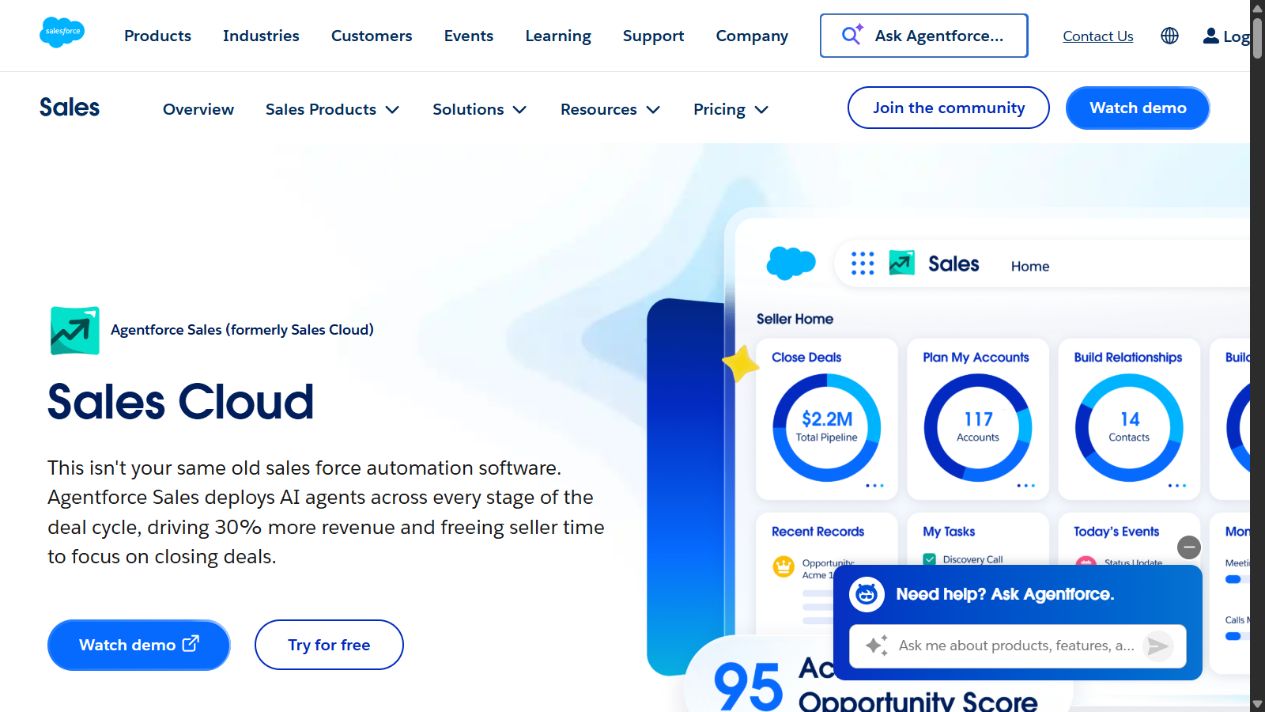
Salesforce Sales Cloud homepage captured August 30, 2026. Confirm edition rights, AI usage, storage, environments, support, and contract terms in the proposal.
Its central advantage is extensibility. Enterprises can represent complex accounts, products, channels, approvals, and processes while connecting a broad set of partner applications. That flexibility also creates its central risk: an uncontrolled implementation can accumulate custom fields, overlapping automations, inconsistent definitions, expensive add-ons, and releases that are difficult to test.
Choose Salesforce when: CRM is a strategic platform, multiple business units need a shared but configurable foundation, and the company can fund strong product ownership, architecture, administration, testing, and adoption.
Check before buying: which features are included in the proposed edition; whether sales engagement, revenue intelligence, CPQ, planning, partner functions, sandboxes, support, data tools, and AI require separate products; how API and storage limits work; and how contractual price protection changes over time.
For the pilot, test one representative end-to-end motion rather than an isolated demo. Include lead capture, routing, account hierarchy, opportunity teams, product selection, discount approval, forecast submission, customer handoff, ERP synchronization, reporting, reassignment, deletion, and recovery. Inspect the experience for a seller, manager, operations analyst, administrator, auditor, and integration owner.
Salesforce is not automatically the best answer merely because talent and integrations are widely available. Its value depends on disciplined platform governance. Establish a data dictionary, automation ownership, release process, environment strategy, integration monitoring, archive rules, and a method for retiring unused customization before scale turns flexibility into operational debt.
Source: Salesforce Sales Cloud .
2. Microsoft Dynamics 365 Sales: best for Microsoft-centered organizations
Microsoft Dynamics 365 Sales deserves priority when sellers and managers already work heavily in Microsoft 365 and the organization uses Azure, Entra ID, Teams, Power BI, Power Platform, or other Dynamics applications. The strategic attraction is not one feature; it is the possibility of connecting customer work, collaboration, automation, analytics, identity, and business applications within a familiar vendor estate.
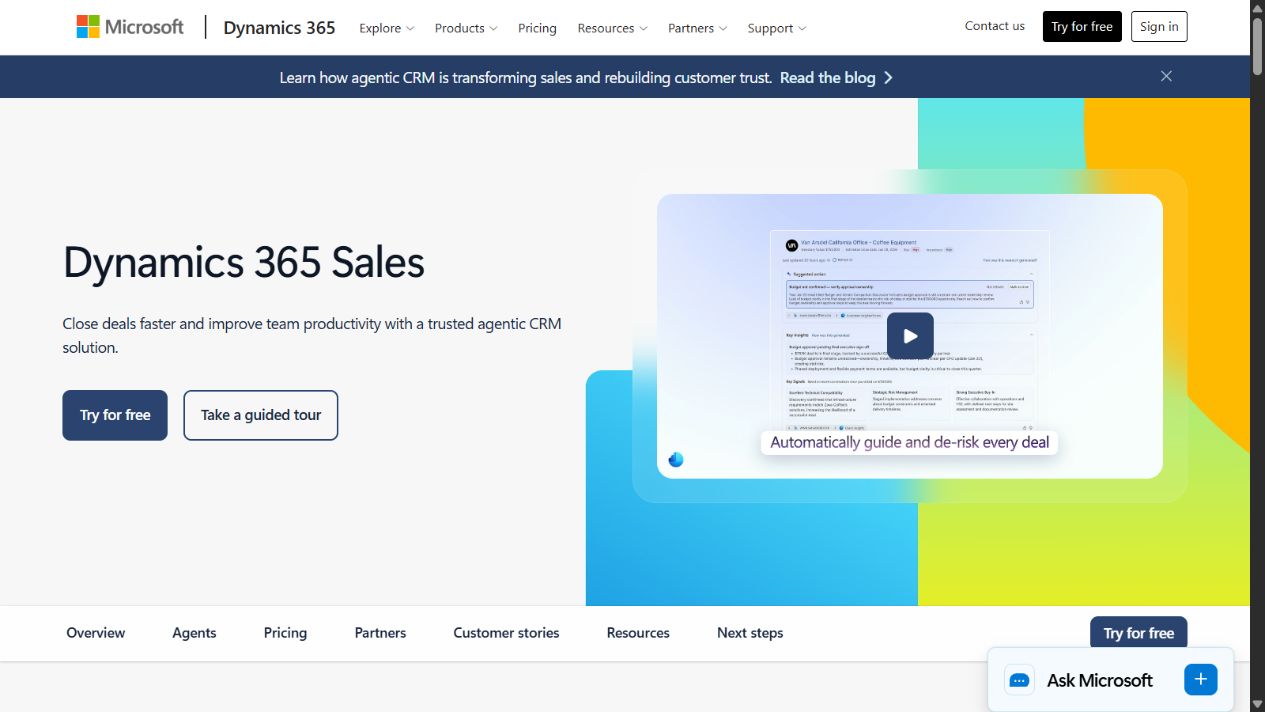
Microsoft Dynamics 365 Sales homepage captured August 30, 2026. Verify licensing dependencies, Copilot entitlements, storage, Power Platform capacity, and integration scope.
That alignment can reduce context switching. It can also obscure complexity because Dynamics applications, Microsoft 365 services, Dataverse, Power Platform capacity, Azure components, connectors, and partner solutions may have distinct licensing and administration. A cohesive demonstration does not prove a simple operating model.
Choose Dynamics 365 Sales when: Microsoft is a deliberate enterprise platform, identity and collaboration integration matter, internal teams understand the ecosystem, and the organization wants sales processes connected to adjacent Dynamics or Power Platform workflows.
Check before buying: the exact licences required for sellers, managers, occasional users, service accounts, external participants, environments, storage, analytics, automation, and AI. Define which team owns Dataverse design, Power Platform governance, connector approval, data-loss-prevention policies, and production support.
The pilot should test Outlook and Teams experiences without assuming they eliminate CRM data entry. Measure whether activity capture is accurate, lawful, permission-aware, and useful. Test offline and mobile work, duplicate management, territory changes, forecasting, record sharing, Power BI definitions, integration failures, and the consequences of moving a user between roles.
Microsoft-centered fit is valuable only if architecture remains legible. Document every system boundary and avoid creating important logic in personal flows or undocumented low-code applications. Govern environments, solutions, connectors, service identities, and deployment pipelines as production software.
Source: Microsoft Dynamics 365 Sales .
3. HubSpot Sales Hub: best for approachable connected growth teams
HubSpot Sales Hub is a strong candidate when the enterprise values rapid adoption, an approachable user experience, and connected marketing, sales, service, content, and operations context. Its official product pages describe prospecting, pipeline management, sales automation, reporting, forecasting, coaching, and AI-assisted capabilities, with availability determined by tier and product combination.
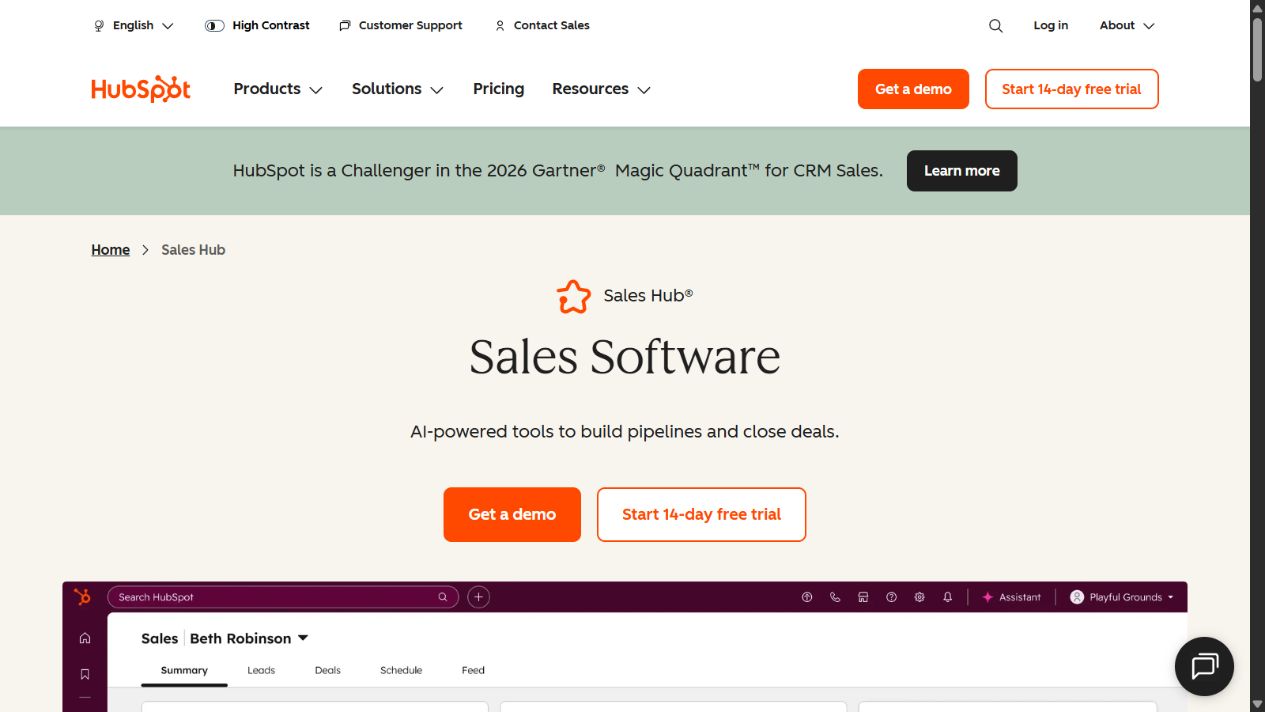
HubSpot Sales Hub homepage captured September 3, 2026. Confirm tier, seat types, limits, hubs, credits, onboarding, and data requirements.
HubSpot can be compelling for an enterprise business unit moving from fragmented tools or a difficult legacy CRM. A connected customer platform can help marketing and sales share lifecycle definitions and handoffs. However, ease at the beginning should not substitute for testing the most complex future process.
Choose HubSpot when: usability and time to adoption are high priorities, go-to-market teams benefit from a connected platform, and the required account, permission, territory, product, forecasting, integration, and governance model fits the enterprise plan.
Check before buying: how contacts, marketing contacts, seats, calling, sequences, workflows, reporting, sandboxes, custom objects, permissions, teams, business units, API usage, and AI credits are packaged. Model growth over several years rather than pricing the initial database and seller count.
The pilot should include high-volume imports, duplicate scenarios, consent changes, account hierarchies, multiple pipelines, international teams, complex permissions, custom reporting, marketing attribution boundaries, service handoffs, integrations, and data export. Confirm that administrators can diagnose automation and synchronization failures without relying on hidden workarounds.
HubSpot’s relative approachability can improve data quality because users may update records more consistently. That benefit must be measured, not assumed. Compare completion rates, stage accuracy, activity quality, manager inspection time, forecast variance, and support tickets against the current baseline.
Source: HubSpot Sales Hub .
4. SAP Sales Cloud: best for SAP-centered enterprise processes
SAP Sales Cloud is most relevant when selling must align closely with an SAP-centered landscape, complex product and customer structures, enterprise processes, and downstream operational data. Its official positioning covers sales automation, customer and pipeline management, forecasting, guided selling, analytics, mobile work, and AI-supported tasks within SAP’s customer-experience portfolio.
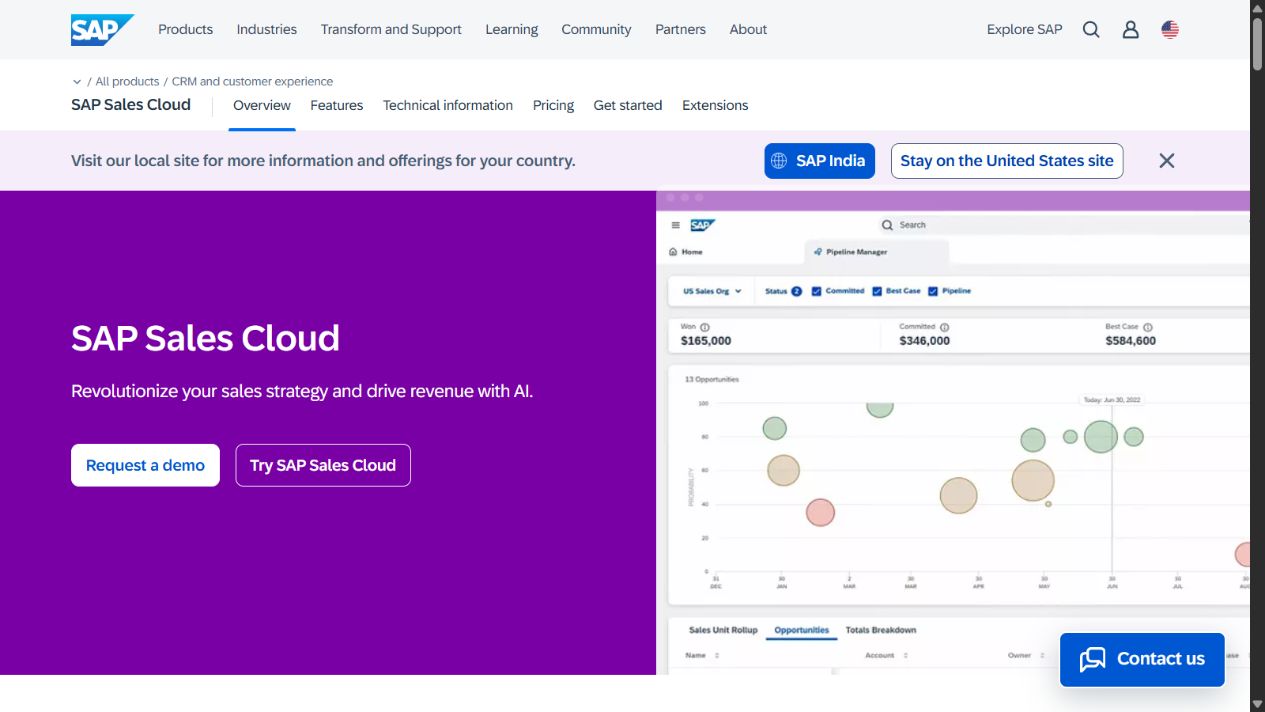
SAP Sales Cloud homepage captured August 30, 2026. Confirm the proposed version, modules, integration services, regions, AI terms, and implementation responsibilities.
The platform’s case is strongest when CRM cannot be evaluated independently from product, pricing, availability, order, service, and finance processes. Shared vendor context may simplify some integration and governance decisions. It does not remove the need to design those processes or reconcile different data models.
Choose SAP Sales Cloud when: SAP is strategically important, the sales motion depends on complex enterprise and operational information, and the organization has the implementation capability to balance process control with seller usability.
Check before buying: which SAP Sales Cloud generation and capabilities are proposed, what is native versus separately licensed, how integration with the relevant SAP and non-SAP systems works, what mobile and offline scenarios are supported, and who owns master-data quality and failed transactions.
Pilot the hardest scenarios: global account hierarchies, product configuration, pricing exceptions, channel relationships, multiple currencies, reorganizations, territory overlays, quote and order handoffs, returns, renewals, and regional access restrictions. Observe how many screens and corrections a seller needs, not only whether the process is technically possible.
SAP-centered alignment should not justify copying every legacy process into the new system. Use implementation as an opportunity to simplify stages, fields, approvals, and reports. Preserve complexity only when it protects a genuine commercial, legal, operational, or customer requirement.
Source: SAP Sales Cloud .
5. Oracle Fusion Cloud Sales: best for Oracle-centered quote-to-cash alignment
Oracle Fusion Cloud Sales is a credible shortlist choice for enterprises connecting selling with Oracle quoting, subscription, order-management, billing, renewal, service, and finance processes. Its official page presents sales automation and customer engagement within Oracle Fusion Cloud Customer Experience, with emphasis on account intelligence, forecasting, guided actions, and alignment across revenue operations.
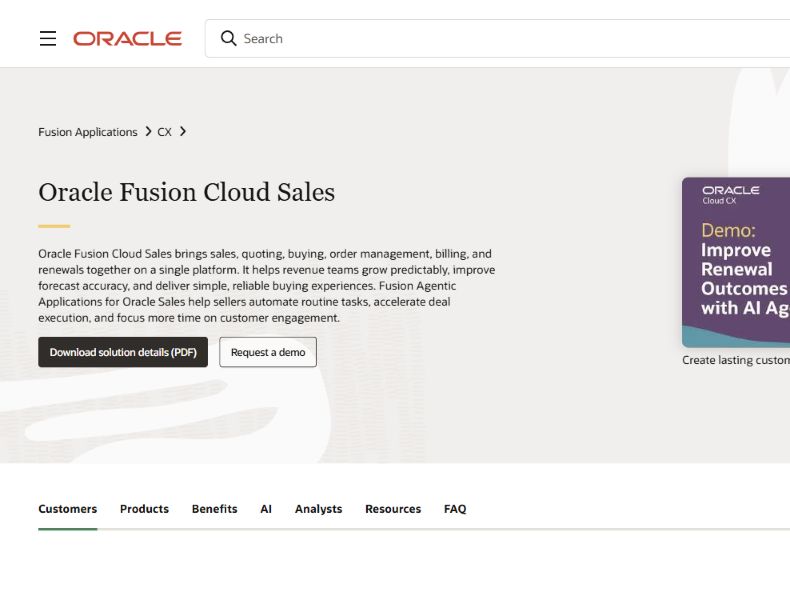
Oracle Fusion Cloud Sales homepage captured September 3, 2026. Confirm scope, integrations, AI features, environments, service levels, and commercial terms.
Oracle’s strongest argument is architectural alignment for an organization already standardizing on Fusion applications. Connected sales and back-office processes can reduce reconciliation and expose operational context. The tradeoff is that enterprise application breadth can demand substantial design, migration, testing, and change-management effort.
Choose Oracle Fusion Cloud Sales when: Oracle Fusion is strategic, quote-to-cash and finance alignment outweighs marketplace breadth, and the organization can implement a governed cross-functional process rather than treating CRM as a sales-only tool.
Check before buying: the precise products and modules in scope, integration requirements for non-Oracle systems, industry and regional needs, data migration, environment strategy, reporting ownership, AI entitlements, release testing, support model, and how occasional users are licensed.
The pilot should trace a customer from account creation through opportunity, product and price decisions, approval, quote, order, billing, renewal, forecast, and finance reporting. Include amendments, cancellations, hierarchy changes, credit issues, synchronization failures, and user-access changes. Those exceptions reveal more than a polished happy-path demonstration.
Fusion alignment is not automatically a reason to accept poor seller experience. Track clicks, elapsed time, data completeness, correction rates, mobile usability, and manager visibility. A connected architecture creates value only when people maintain the data needed to run it.
Source: Oracle Fusion Cloud Sales .
How to choose the right enterprise sales platform
Start with operating-model decisions
Define customer and account ownership, lead acceptance, opportunity stages, forecast categories, territory logic, product ownership, discount authority, handoffs, renewal responsibility, and exception management before scoring products. Software cannot resolve unresolved organizational authority; it often makes the conflict more expensive.
Create a small set of measurable outcomes such as lower lead-response time, improved stage accuracy, reduced manual forecast preparation, fewer duplicate accounts, faster quote approval, or better renewal visibility. Avoid goals such as “enable AI” or “create a 360-degree view” unless they connect to a decision and an accountable user.
Protect the customer-data foundation
Inventory sources for identities, accounts, contacts, consent, products, prices, activities, opportunities, orders, invoices, usage, service cases, and renewals. Decide which system is authoritative and how conflicts are resolved. Assign owners for definitions, quality thresholds, matching rules, enrichment, retention, deletion, and access.
Poor data is not fixed by migration. Moving duplicate, stale, unowned records into a new platform can make automated errors happen faster. Establish acceptance thresholds, quarantine rules, reconciliation reports, and rollback plans. Sample migrated records with business users, not only technical scripts.
Evaluate forecasting as governance
Forecasting quality depends on definitions and management behavior as much as algorithms. Test whether stage, category, amount, close date, probability, product, currency, and hierarchy meanings are consistent. Inspect overrides, history, submissions, judgment, scenarios, and explanations. Managers should be able to challenge a number and trace its origin.
AI forecasts and risk signals can add useful evidence, but they should not hide data gaps or remove accountability. Determine what inputs drive predictions, how changing territories affect history, how model output is monitored, and when a human can override recommendations.
Test integrations under failure
A diagram showing CRM connected to email, marketing, ERP, service, identity, data, and collaboration systems is not evidence of resilience. During the pilot, expire credentials, introduce duplicate events, delay a downstream system, reject a record, change a schema, and replay a message. Verify alerts, ownership, retry behavior, reconciliation, and recovery.
Document API limits, batch windows, event guarantees, connector dependencies, service accounts, secrets, monitoring, data transformations, and support boundaries. A vendor-supported connector can still require internal ownership when records fail or business rules change.
Govern AI as an enterprise capability
Create an approved use-case register for summaries, drafting, research, scoring, coaching, forecasting, and automated actions. For each use case, document data sources, grounding, permissions, model provider, subprocessors, retention, regional processing, evaluation, audit evidence, human review, and prohibited decisions.
Test for hallucinated account facts, outdated prices, cross-account leakage, inappropriate sensitive-data inference, prompt injection through connected content, biased prioritization, and actions taken with excessive permission. AI-generated text should be labelled and reviewed where mistakes could affect customers, contracts, employment, credit, or regulated activity.
Enterprise pilot scorecard
Score the platform with evidence from representative scenarios:
| Area | Evidence to collect |
|---|---|
| Seller adoption | Task completion, time, clicks, mobile success, data completeness, and qualitative friction |
| Manager workflow | Pipeline inspection, coaching, forecast preparation, changes, explanations, and exception handling |
| Revenue operations | Routing accuracy, deduplication, automation maintainability, reporting effort, and audit trail |
| Architecture | Synchronization accuracy, latency, limits, monitoring, failure recovery, and ownership |
| Security | Least privilege, role changes, external access, logs, retention, export, deletion, and incident evidence |
| AI | Grounding, accuracy, permissions, traceability, human review, limits, and cost per useful outcome |
| Economics | Three-year licences, usage, modules, services, staffing, integrations, support, renewal, and exit |
| Resilience | Backup, restore, continuity, vendor outage procedures, manual fallback, and recovery testing |
Use pass/fail criteria for critical controls and weighted scoring for preferences. Do not allow an impressive AI demo to compensate for a failed permission, data-residency, or financial-control requirement.
Total cost and contract diligence
Build a three-to-five-year cost model using realistic growth in sellers, managers, operations users, occasional users, records, storage, automation, API traffic, environments, integrations, and AI usage. Include implementation partners, internal staff, migration, testing, training, support, data providers, telephony, archiving, backup, and business interruption.
Ask vendors to identify every assumption in the proposal. Record which capabilities were demonstrated, which edition delivered them, which roadmap items are not contractual, and which services are required. Negotiate renewal protections, audit terms, data export, deletion assistance, service levels, security notification, subprocessor changes, and transition support.
The lowest subscription quote is not necessarily the lowest-cost platform. Administrative burden, weak adoption, brittle integration, manual reconciliation, and failed forecasting consume expensive time. Conversely, buying the broadest suite “for the future” can leave the enterprise paying for unused modules while core workflows remain poorly designed.
Final recommendation
Start with Salesforce Sales Cloud when extensibility, ecosystem, and broad CRM capability are the main priorities. Put Microsoft Dynamics 365 Sales first when Microsoft platform alignment is strategically valuable. Prefer HubSpot Sales Hub when adoption and connected go-to-market workflows matter more than maximum process complexity. Prioritize SAP Sales Cloud for SAP-centered complex sales operations, and Oracle Fusion Cloud Sales for Oracle-centered revenue and quote-to-cash alignment.
The product decision is only one part of the result. Enterprise sales transformation succeeds when customer data has owners, workflows have clear authority, sellers receive a usable experience, managers enforce definitions, integrations fail visibly, AI remains governed, and the operating team can maintain the platform after consultants leave.
Choose the platform that best fits that operating model, then require a representative pilot and contractual evidence before committing to scale.
Frequently asked questions
What is the best sales software for enterprise teams?
Salesforce Sales Cloud is the strongest broad starting point for enterprises needing an extensible CRM ecosystem. Microsoft Dynamics 365 Sales fits Microsoft-centered organizations, HubSpot Sales Hub fits teams prioritizing adoption and connected marketing, SAP Sales Cloud fits SAP-centered processes, and Oracle Fusion Cloud Sales fits Oracle-centered quote-to-cash operations.
Is enterprise sales software the same as CRM?
Not exactly. CRM is usually the system of record for accounts, contacts, opportunities, activities, and forecasts. Sales engagement, enablement, conversation intelligence, CPQ, commissions, data providers, and planning tools may connect to it as separate layers.
Should an enterprise replace its CRM or add specialist sales tools?
Replace the CRM only when the core data model, governance, reporting, usability, or strategic platform fit is genuinely inadequate. Add specialist tools when a bounded workflow can improve without creating duplicate data, conflicting automation, weak consent controls, or fragmented reporting.
How should an enterprise pilot sales software?
Use representative sellers, managers, operations staff, administrators, security teams, and adjacent functions. Test real lead-to-cash scenarios, permissions, territories, integrations, mobile use, forecasting, automation, AI controls, data quality, reporting, failure recovery, and adoption effort.
What sales-software costs are commonly overlooked?
Implementation, data migration, integrations, premium modules, AI and usage credits, sandboxes, storage, support, administrators, consultants, training, data providers, duplicate licences, renewal increases, and exit work can exceed the headline seat price.
How important is seller adoption when selecting enterprise CRM?
It is critical because forecasts, automation, routing, customer context, and AI depend on timely and accurate activity data. A technically powerful platform delivers weak results when sellers work around it or managers maintain shadow spreadsheets.
Can AI choose the best next action for every sales opportunity?
AI can summarize context, identify patterns, draft messages, and recommend actions, but enterprises should verify grounding, permissions, data treatment, bias, auditability, regional rules, and human accountability before relying on it for consequential decisions.