Best Sales Software for Startups
Compare five sales software options for startups across CRM, pipeline, prospecting, outreach, automation, reporting, administration, and growth fit.
Direct answer
The best sales software for a startup is the smallest dependable system that matches the company’s current sales motion and can survive the next stage of growth. HubSpot Sales Hub is the broadest starting point for a startup that wants CRM, pipeline, meetings, email, reporting, and a wider customer platform. Pipedrive is a strong fit when a visual deal pipeline and next actions are the operating center. Close is built for calling-led inside sales. Attio suits a startup that wants a flexible relationship data model and modern workspace. Apollo is the most relevant option in this shortlist when prospect data and outbound execution are central.
There is no universal winner. A founder-led product company with ten active opportunities should not buy as though it already operates a fifty-person revenue organization. An outbound startup should not select a CRM that handles accounts neatly but leaves prospecting, sequencing, calling, and deliverability scattered across disconnected tools. The right system reduces missed follow-ups and improves decision quality without demanding an administrator the company does not have.
This guide uses official vendor pages and documentation checked on August 30, 2026. It does not claim controlled hands-on testing. Product facts are sourced; recommendations about fit are editorial judgments that should be tested with the startup’s own data and workflow.
The shortlist at a glance
| Product | Best fit in this guide | Main strength | Main buying risk |
|---|---|---|---|
| HubSpot Sales Hub | Broad startup customer platform | CRM, sales workflow, and wider HubSpot ecosystem | Packaging and cost can expand with requirements |
| Pipedrive | Deal-focused sales teams | Visual pipeline and activity discipline | Broader marketing, service, or data needs may require integrations |
| Close | Calling-led inside sales | Communication and rep execution around CRM records | Poor fit when calling and outbound activity are not central |
| Attio | Flexible, data-conscious startups | Customizable relationship model and collaborative workspace | Flexibility requires deliberate schema and governance |
| Apollo | Prospecting-led outbound | B2B data, engagement, and execution in one platform | Data, credits, deliverability, and compliance need active governance |
How we selected the tools
We looked for products with a current official sales or CRM offering, a credible startup use case, public product information, and a sufficiently distinct operating model. This is a focused shortlist, not a claim that only five products deserve evaluation. Salesforce, Zoho CRM, Freshsales, Copper, monday CRM, and other established tools may be better for a particular ecosystem, complexity level, or budget.
The same criteria were applied to every shortlisted product:
- Sales-motion fit: founder-led, inbound, outbound, relationship selling, product-led assisted sales, or a mixed model.
- System-of-record quality: contacts, companies, opportunities, activities, ownership, history, and export.
- Daily execution: email, meetings, tasks, calls, sequences, and clear next actions.
- Reporting: dependable pipeline, conversion, activity, forecast, and source visibility.
- Administration: setup, permissions, customization, duplicate control, automation, and maintenance.
- Growth path: the effect of more users, records, territories, products, workflows, and integrations.
- Risk: privacy, security, outreach compliance, data quality, deliverability, lock-in, and total cost.
We did not use review-site scores as proof of product quality, and we did not rank vendors by unverified market-share or performance claims. Pricing changes quickly, so the final decision should use a dated vendor quote and a complete first-year cost model.
1. HubSpot Sales Hub: best broad startup starting point
HubSpot describes Sales Hub as sales software connected to its customer platform and Smart CRM. Its official material covers lead and deal management, meeting scheduling, email, calling, automation, forecasting, reporting, conversation intelligence, and other capabilities that vary by edition. The wider HubSpot ecosystem also includes marketing, service, content, commerce, and operations products.
That breadth is useful for a startup that wants one customer record to support acquisition, sales, onboarding, and service as the organization grows. A founder can begin with a relatively simple pipeline and later add teams or workflows without immediately replacing the core platform. The familiar interface and large integration ecosystem can also reduce adoption friction.
The same breadth creates the main risk. A startup may evaluate the entry experience, then discover that the automation, permissions, reporting, governance, or other hubs required by the mature process sit in different packages. The correct comparison is not a free or entry plan against a competitor’s advanced plan. Map every required capability to its current edition, required seats, onboarding, limits, and add-ons.
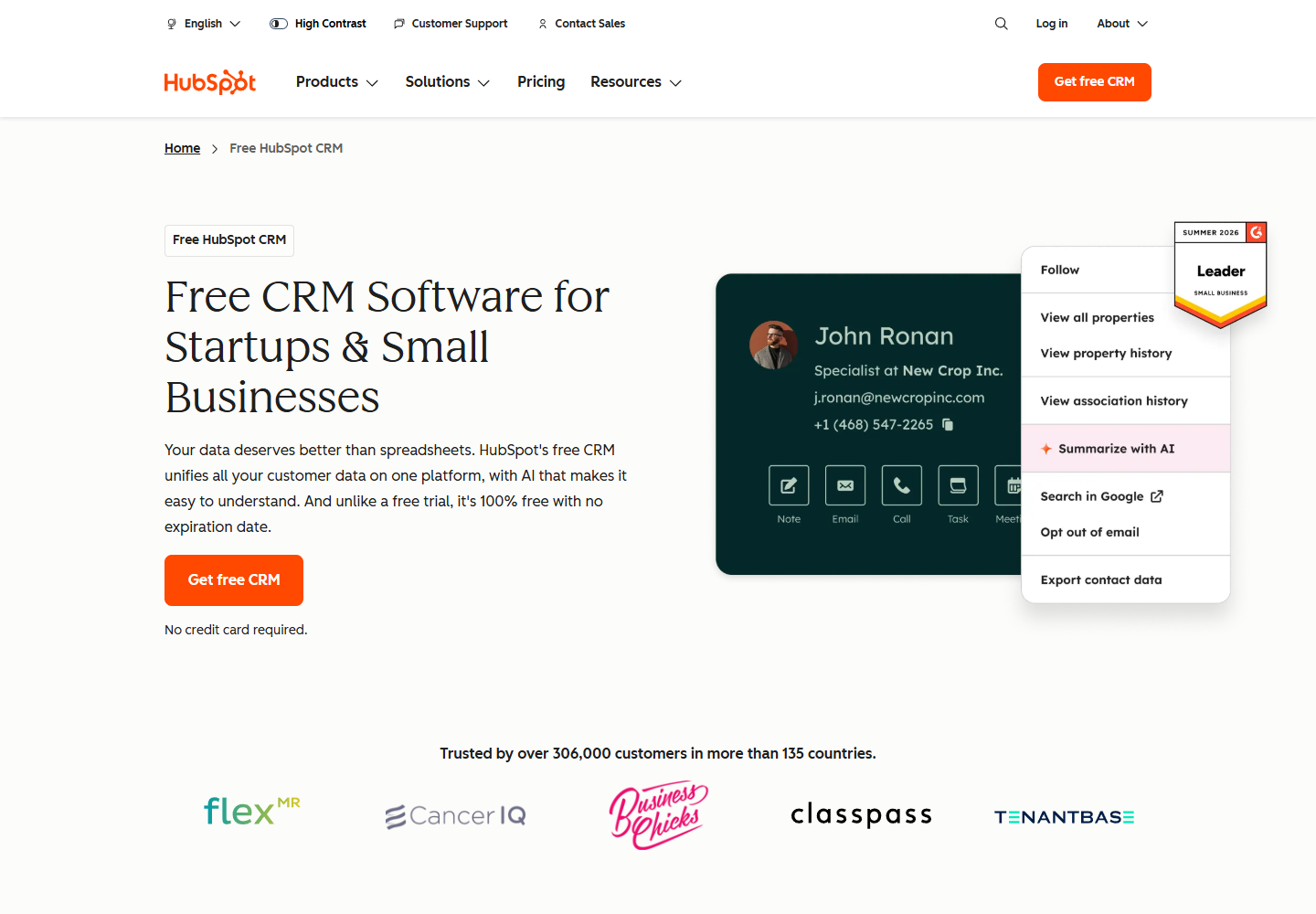
HubSpot’s official CRM product page, captured August 24, 2026. Source: HubSpot Sales Hub .
Choose HubSpot when: the startup wants an accessible CRM now and sees value in a connected marketing, sales, and service ecosystem later.
Check before buying: required editions, seats, onboarding, automation limits, custom objects or data needs, permissions, reporting, communication allowances, and the combined cost of any additional hubs.
Pilot task: create the actual lifecycle and deal stages, connect one approved inbox and calendar, route a representative lead, build a founder pipeline report, and export the resulting records.
Official sources: Sales Hub , Sales Hub pricing , and HubSpot Trust Center .
2. Pipedrive: best for a focused visual pipeline
Pipedrive positions its product around sales CRM and pipeline management. Its official pages emphasize visual pipelines, activities, contacts, communication, automation, insights, and integrations. This deal-centered orientation can be a good match for a startup whose main operating problem is simple: opportunities exist, but ownership, stage, next action, and follow-up are not consistently visible.
The strongest reason to shortlist Pipedrive is focus. A small sales team can define stages, move deals, schedule activities, and examine pipeline health without first designing a broad customer platform. This matters when adoption is more valuable than theoretical configurability. If founders and reps cannot see what to do next, a complex CRM can become an expensive archive.
Focus also defines the evaluation boundary. A startup should identify whether marketing automation, product usage data, customer success, support, complex account hierarchies, quoting, or advanced territory controls are equally important. If so, test the full integration architecture and the ownership of data between systems. A clean pipeline is not enough when essential context remains fragmented.
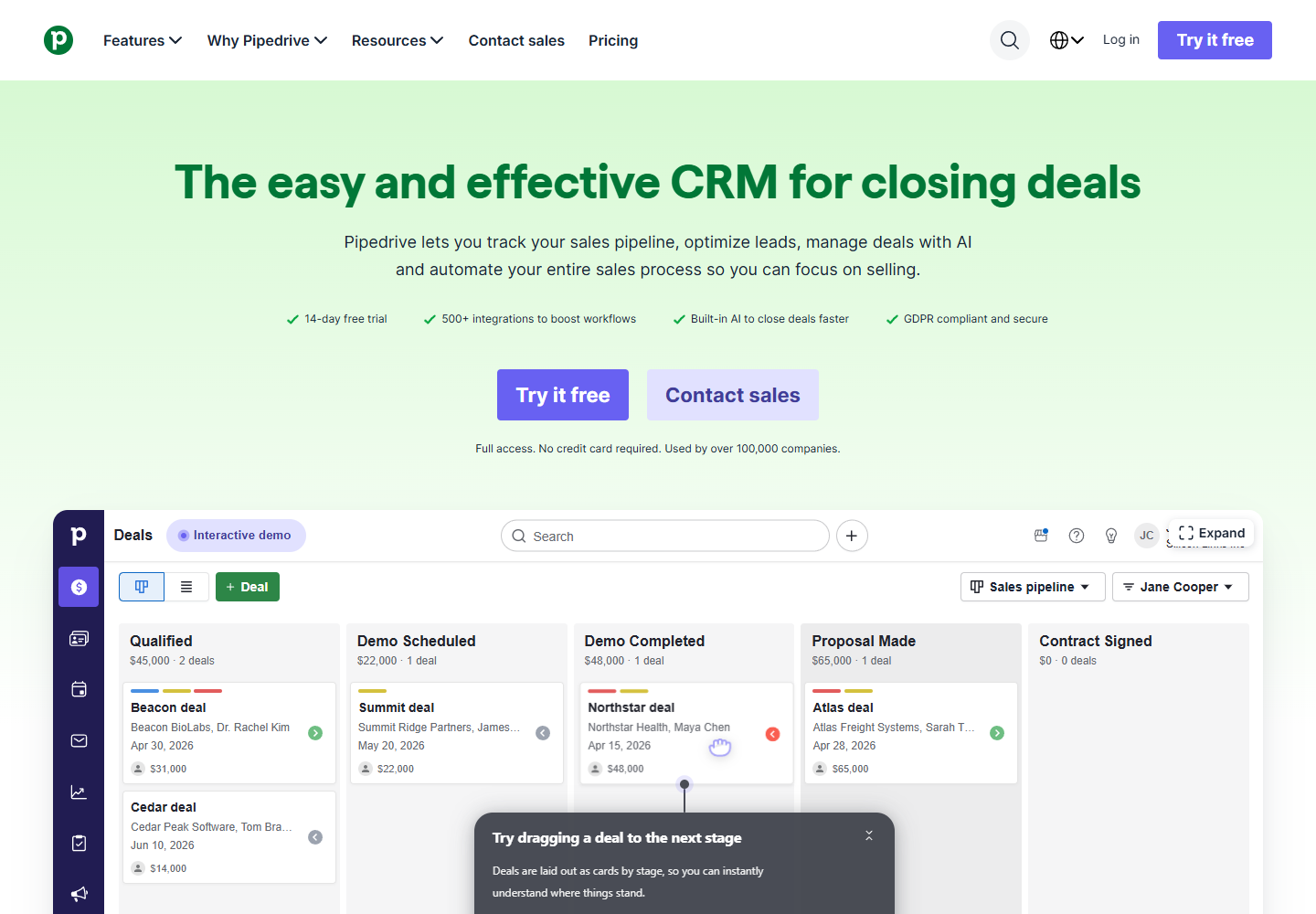
Pipedrive’s official homepage, captured August 24, 2026. Source: Pipedrive .
Choose Pipedrive when: the startup wants a sales-led, deal-focused system with visible stages and activities.
Check before buying: email synchronization, calling, lead capture, automation, reporting, permissions, add-ons, API limits, and how marketing or service tools will connect.
Pilot task: reproduce the real opportunity stages, import sample organizations and people, assign next activities, record loss reasons, and build the weekly conversion report.
Official sources: Pipedrive , Pipedrive pricing , and Pipedrive Trust Center .
3. Close: best for calling-led inside sales
Close presents itself as a CRM for growing sales teams, with calling, email, SMS, pipeline, tasks, workflows, reporting, and sales communication organized around lead records. The product belongs on a startup shortlist when representatives spend much of the day contacting prospects and the company wants communication execution close to the CRM rather than distributed across several tabs.
For an inside-sales startup, this can reduce operational distance between a record and the next conversation. Managers can evaluate activity and pipeline in the same environment, while reps avoid treating the CRM as an after-the-fact data-entry obligation. The value depends on whether the startup’s approved channels and selling process actually match that model.
Do not choose Close merely because the interface demonstrates calling efficiently. Test phone number availability, call and SMS coverage, recording and consent rules, email connection, communication costs, workflow limits, reporting, support, and regional requirements. If the sales motion is primarily product-led, partner-led, enterprise relationship selling, or asynchronous inbound qualification, a calling-centered workspace may be unnecessary.
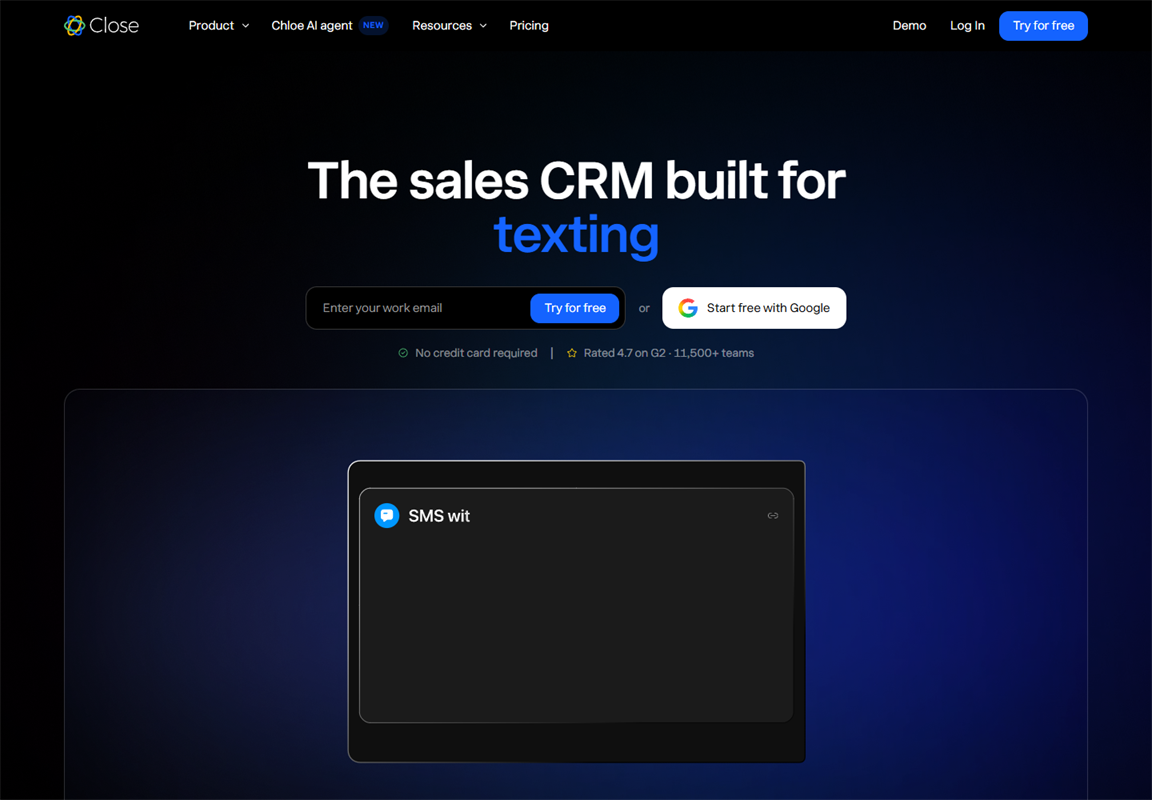
Close’s official homepage, captured August 24, 2026. Source: Close .
Choose Close when: calls, emails, and structured follow-up are the daily center of an inside-sales workflow.
Check before buying: calling and SMS coverage, usage charges, recording consent, email deliverability, workflow limits, roles, reporting, integrations, and data export.
Pilot task: connect a test mailbox and permitted number, run a small approved cadence, disposition calls, create follow-up tasks, and inspect the manager report.
Official sources: Close CRM , Close pricing , and Close security .
4. Attio: best for a flexible relationship data model
Attio describes its platform as an AI-native CRM that teams can build, extend, and adapt. Its official material emphasizes flexible records, lists, views, workflows, reporting, collaboration, enrichment, and integrations. This makes Attio relevant for a startup whose relationships do not fit a conventional lead-contact-company-deal model or whose product and go-to-market process are evolving quickly.
Flexibility can be strategically useful. A startup may need to track investors, partners, product users, workspaces, accounts, champions, opportunities, and community relationships without forcing all of them into one rigid pipeline. A configurable workspace can help the CRM reflect the business rather than the other way around.
But flexibility transfers design responsibility to the buyer. Someone must define objects, fields, ownership, required data, lifecycle rules, permissions, deduplication, automation, and reporting. Without that discipline, a modern blank canvas can become as inconsistent as the spreadsheets it replaces. The evaluation should include who will own the schema after launch and how changes will be governed.
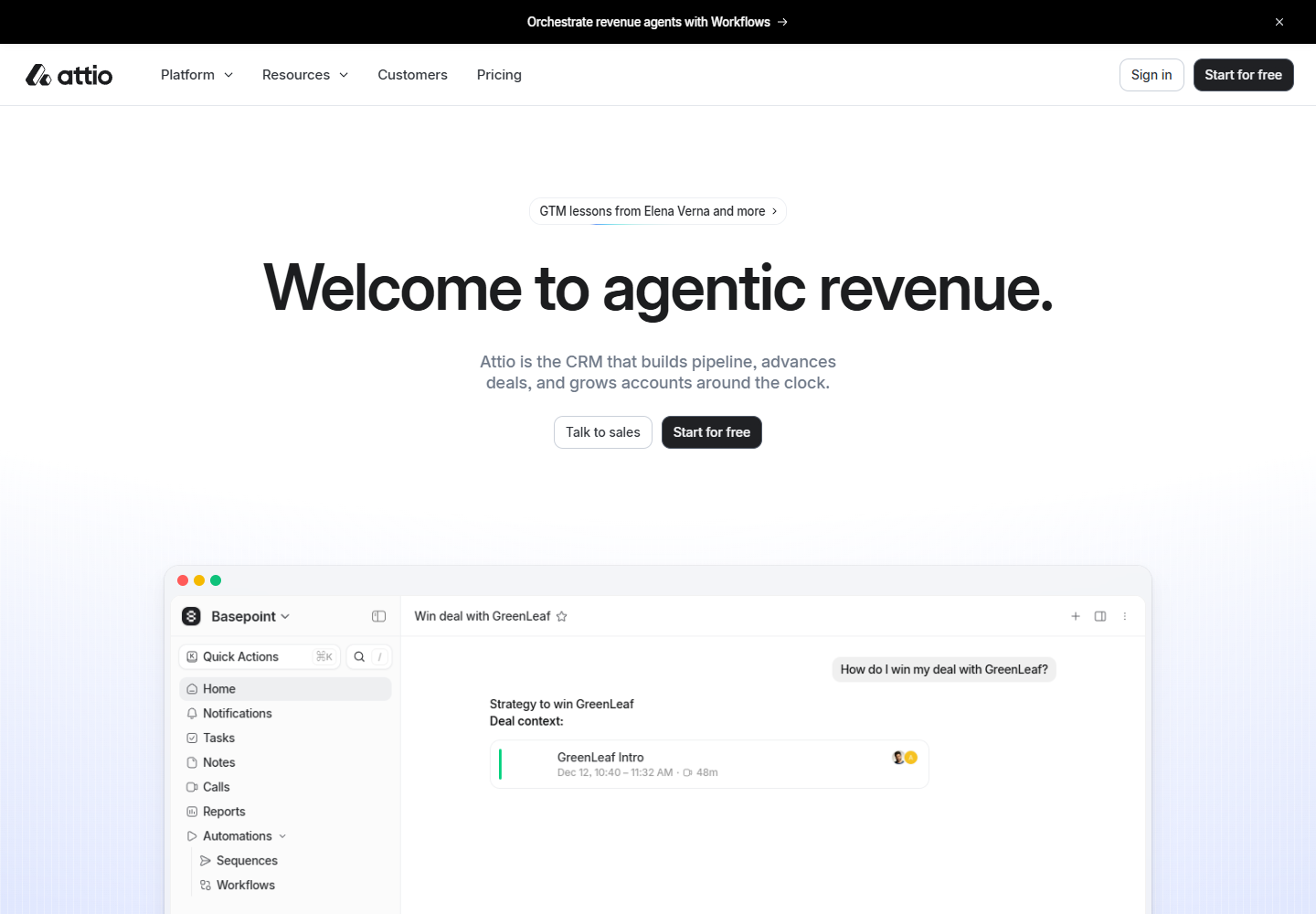
Attio’s official homepage, captured August 24, 2026. Source: Attio .
Choose Attio when: the startup values a flexible relationship model and has clear ownership of CRM design.
Check before buying: object and record limits, enrichment, workflow capacity, email and calendar behavior, permissions, reporting, integrations, API access, export, and administration effort.
Pilot task: model one nonstandard relationship, import representative records, create role-specific views, automate one handoff, and prove that the resulting report answers a real management question.
Official sources: Attio , Attio pricing , and Attio security .
5. Apollo: best for prospecting-led outbound
Apollo describes itself as an AI sales platform combining data, prospecting, engagement, enrichment, and execution workflows. Its official homepage presents outbound, inbound, data enrichment, and deal execution capabilities, while its pricing and product materials distinguish plan-dependent access, credits, limits, and features.
Apollo is the most relevant choice in this shortlist when a startup’s immediate problem is building targeted pipeline rather than only managing opportunities already created. Combining prospect discovery and outreach can reduce handoffs between a data provider, sequencing product, dialer, enrichment service, and CRM. That consolidation can be valuable for a small revenue team, but it does not eliminate the need for a defined system of record.
The primary risks are data governance, outreach compliance, deliverability, credit economics, and workflow sprawl. A database record is not proof that a person should be contacted. The startup must define lawful purpose, permitted regions and channels, suppression rules, opt-outs, domain protection, personalization standards, and human accountability. It should also understand where Apollo records end and the core CRM begins.
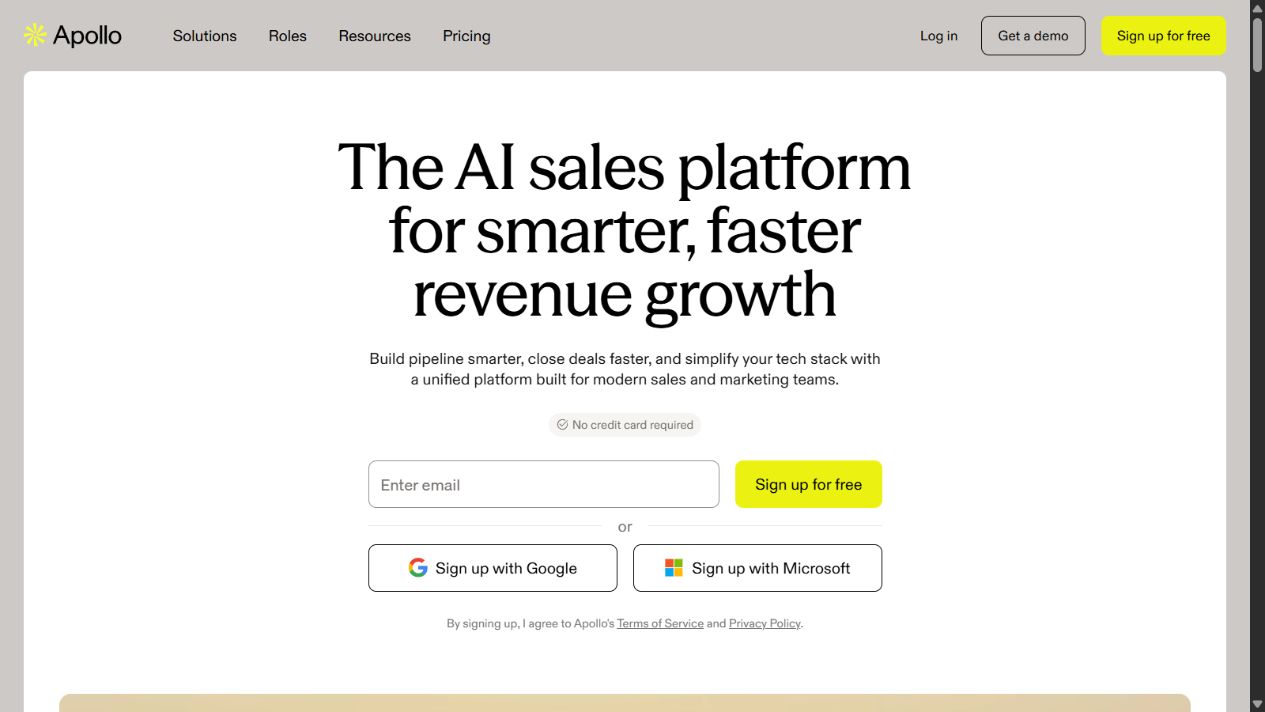
Apollo’s official homepage, captured August 30, 2026. Source: Apollo .
Choose Apollo when: prospect research, enrichment, and outbound engagement are central to the startup’s go-to-market motion.
Check before buying: data coverage, verification, credits, export, sequencing, mailbox controls, calling, deliverability protections, privacy obligations, integrations, and the source-of-truth design.
Pilot task: define a narrow permitted segment, verify a sample manually, run a low-volume approved sequence, measure replies and data errors, process an opt-out, and confirm CRM synchronization.
Official sources: Apollo , Apollo pricing , and Apollo Trust Center .
How the five products differ
These tools overlap, but they begin from different operating assumptions. HubSpot starts with a connected customer platform. Pipedrive starts with the opportunity pipeline. Close starts with rep communication and execution. Attio starts with a flexible relationship model. Apollo starts with prospect data and outbound activity.
That distinction is more useful than counting features. A startup should first identify its bottleneck:
- If customer information is fragmented across acquisition, sales, and service, evaluate HubSpot.
- If deals exist but stages and next actions are inconsistent, evaluate Pipedrive.
- If inside-sales reps lose time moving between CRM, phone, email, and tasks, evaluate Close.
- If the company has unusual relationship structures and can govern a custom data model, evaluate Attio.
- If the team lacks a repeatable way to identify and contact relevant prospects, evaluate Apollo.
The final architecture may include more than one tool. If so, assign ownership for every important field and process. For example, the CRM may own accounts, contacts, opportunity stage, owner, and forecast; the prospecting platform may own discovery and pre-qualification activity; the product database may own usage; the support system may own cases. Synchronization should not allow lower-confidence enrichment to overwrite verified customer data silently.
A startup buying framework
1. Write the sales motion before configuring software
Document how a potential customer moves from first signal to qualified opportunity, decision, close, onboarding, renewal, or loss. Define entry and exit criteria for every stage. If the process cannot be explained without naming a tool, the team is likely automating an unclear workflow.
2. Define the minimum customer data model
List required records and fields, their owners, validation rules, and retention expectations. Avoid collecting data merely because the CRM permits another field. Every required field creates work and every sensitive field creates risk.
3. Separate system of record from execution tools
Decide where authoritative contacts, companies, opportunities, activities, consent, and customer status live. Connected applications can assist execution, but a startup still needs one dependable answer when leadership asks about pipeline or a customer asks about their data.
4. Test a real workflow, not a polished demo
Use representative records and the actual stages, channels, reports, integrations, and permissions. Ask each vendor to demonstrate the same scenario. Record workarounds and manual steps. A capability that exists only through an expensive edition or fragile integration should not receive full credit.
5. Model total first-year cost
Include licenses, minimum seats, add-ons, data credits, calling or messaging, onboarding, migration, integration services, training, administration, security review, and exit work. Estimate the cost at current headcount and a realistic growth case. Promotional pricing should not be treated as the permanent baseline.
6. Review trust and compliance before importing data
Read the vendor’s current privacy, security, subprocessors, retention, export, and deletion information. Confirm contractual requirements with qualified legal and security professionals where necessary. Outreach tools require additional attention to source data, consent, suppression, local law, and email-domain reputation.
A practical 14-day pilot
Use a controlled pilot with a small group rather than importing every record on day one.
Days 1–2: define success criteria, roles, stages, required fields, approved data, and baseline metrics.
Days 3–5: import a representative sample, configure the minimum pipeline, connect approved services, and assign permissions.
Days 6–9: run normal work. Create leads, schedule activities, communicate through approved channels, update stages, record losses, and complete one handoff.
Days 10–11: build the management report, inspect duplicates and missing fields, test mobile use, and export the data.
Days 12–13: review security, privacy, administration, integrations, cost, support, and failure recovery.
Day 14: score every product against the same weighted rubric and record the reason for the decision.
A sensible scorecard gives more weight to workflow fit, adoption, data quality, reporting, governance, and total cost than to the number of features shown in a demo.
Common startup mistakes
What to document before signing
A startup should leave the evaluation with a short operating record, not only a preferred vendor. Document the selected plan, required seats, approved integrations, data classes, system owner, administrator, renewal date, export procedure, and the assumptions behind the cost model. Record which capabilities were demonstrated, which were only described by sales, and which remain dependent on a future integration or upgrade.
Create a simple responsibility map. Sales leadership should own stage definitions and forecast rules. Operations should own schema, automation, duplicates, and reporting. Security or the responsible technical lead should own access review, integrations, secrets, and incident escalation. Marketing or outbound owners should govern lawful targeting, suppression, opt-outs, and domain reputation. Finance should know the renewal exposure and usage-based charges. In a very small startup, one person may hold several roles, but the responsibilities should still be explicit.
Define a quarterly health review with a few observable measures: percentage of active opportunities with a next action, stale opportunities, duplicate rate, required-field completion, lead-response time, stage conversion, forecast variance, integration failures, unused seats, and cost per active user. These measures reveal whether the software is improving execution or merely collecting more data.
Finally, define an exit trigger. Examples include adoption below an agreed threshold, persistent reporting distrust, administration exceeding available capacity, required controls remaining unavailable, or first-year cost exceeding the approved case. A documented exit trigger prevents a temporary implementation from becoming permanent only because migration feels inconvenient.
Buying for the imagined company
Founders often select the platform used by a much larger organization. That can create unused configuration, slow adoption, and high administration before the startup has a repeatable motion. Buy for the next credible stage, not the final org chart.
Treating activity as progress
Emails, calls, tasks, and AI-generated notes are not pipeline quality. Define qualification and stage criteria. Reports should distinguish effort from evidence that an opportunity is progressing.
Automating dirty data
Automation spreads duplicates, invalid ownership, stale stages, and unverified enrichment faster. Clean the minimum data model first, then automate a small, observable workflow.
Ignoring exit and portability
Test export before buying. Confirm that contacts, companies, opportunities, activities, notes, attachments, consent status, and custom data can be retrieved in a usable form. A startup should know how it will leave before it becomes dependent.
Letting every tool become a system of record
When the CRM, prospecting platform, spreadsheet, billing system, and product database all claim authority, reports become reconciliation exercises. Define source ownership and conflict rules explicitly.
Final recommendation
Start with the sales motion and operating constraint. Choose HubSpot for a broad connected customer platform, Pipedrive for disciplined visual pipeline management, Close for calling-led inside sales, Attio for a flexible relationship model, or Apollo for prospecting-led outbound.
Do not sign a long commitment based on a homepage, feature matrix, or one successful demo. Run the same representative pilot in the strongest two candidates, calculate the complete first-year cost, review data and outreach risks, and record the decision criteria. The best startup sales software is not the system with the most future possibilities. It is the system the present team can use consistently, govern responsibly, and evolve without losing dependable customer context.
Sources
Frequently asked questions
What is the best sales software for a startup?
HubSpot is the broadest starting point for many startups, Pipedrive is strong for a focused visual pipeline, Close fits calling-led inside sales, Attio suits teams that want a flexible relationship data model, and Apollo fits prospecting-led outbound. The best choice depends on the startup's motion, data, channels, and operating capacity.
Should a startup choose a free CRM?
A free CRM can be useful for validating a workflow, but it should not be selected only because the initial subscription is zero. Test record limits, required seats, automation, reporting, integrations, export, support, and the expected paid upgrade before committing data.
Does a startup need separate CRM and prospecting software?
Not always. An early startup may use one platform for both, but specialized prospecting can become useful when data sourcing, enrichment, sequencing, deliverability, and calling are central. Keep one defined system of record even when several execution tools are connected.
How should a startup test sales software?
Import representative records, create the real pipeline, connect an approved mailbox, assign tasks, run one permitted outreach sequence, build the founder or manager report, test permissions, and export the data. Use the same test and scoring rubric for every vendor.
How much should a startup budget for sales software?
Budget for required seats, plan upgrades, communication usage, data or credits, implementation, integrations, migration, training, administration, security review, and exit work. Compare the complete first-year cost instead of one advertised monthly price.
When should a startup replace spreadsheets with a CRM?
Move when leads are being missed, ownership is unclear, follow-ups are inconsistent, reporting requires manual reconciliation, or more than one person needs dependable customer context. Do not wait until a chaotic spreadsheet has become the unofficial system of record.
Can AI choose or manage a startup's sales pipeline?
AI can assist with research, summaries, drafting, prioritization, and automation, but founders must define qualification, approved data, outreach rules, stage criteria, review controls, and accountability. AI output should not silently become authoritative CRM data.