Best Sales Software with a Free Plan
Compare five sales tools with ongoing free plans, verified participant and contact limits, and a practical process for reliable follow-up.
The best sales software with a free plan is the option that preserves a reliable next action for every qualified opportunity within your real team and contact limits. HubSpot, Zoho CRM, Capsule, EngageBay and Flowlu offer documented free entry points. Evaluate the full lead-to-follow-up workflow before choosing from contact allowances or a long feature list.
Research scope and limitations
- Research type
- Official-source documentation review and editorial analysis
- Sources reviewed
- 9
- Hands-on tested
- No
- Last verified
- November 5, 2026
- Limitations
- No authenticated account or performance benchmark. Examples and fit recommendations are editorial analysis. Paid prices and unlisted account entitlements not verified.

Table of contents
The best sales software with a free plan is the option that preserves a reliable next action for every qualified opportunity within your real team and contact limits. HubSpot, Zoho CRM, Capsule, EngageBay and Flowlu offer documented free entry points. Evaluate the full lead-to-follow-up workflow before choosing from contact allowances or a long feature list.
This guide uses official sources checked November 5, 2026. It compares scoped ongoing free offers rather than paid trials. We have not run authenticated sales accounts, measured conversion improvements or tested email deliverability. Product facts are sourced; fit recommendations, sample processes and acceptance exercises are editorial analysis. Paid prices and unlisted plan entitlements are not established here.
The scope is a small sales operation that needs to capture an opportunity, assign ownership, record the last interaction and identify the next action. This differs from selecting a general contact database. A contact can remain accurate while the opportunity stalls because no one knows who should follow up. The practical shortlist should expose that failure before migration.
Best sales software with a free plan: shortlist by operating fit
Start with a real sales motion. A founder selling a consulting engagement needs a different setup from a team coordinating product demonstrations. Write down the necessary stages and the evidence that moves an opportunity forward. “Interested” is less useful than “discovery completed and decision date confirmed,” because the latter tells the next person what has actually happened.
The table summarizes current scoped evidence. It is not a complete specification for automation, reporting, integrations or email limits. Verify every essential capability using the current plan documentation and actual account before approval. A product’s broader marketing site can describe functionality that belongs to a different edition from its free offer.
| Candidate | Documented free scope | Editorial reason to evaluate | First operating question |
|---|---|---|---|
| HubSpot | Up to two users and 1,000 contacts, no expiration | Small team establishing a shared sales record | Can both operators maintain the next action? |
| Zoho CRM | Free for three users, including administrator | A three-person sales operation | Does the full participant count fit? |
| Capsule | Two users and up to 250 contacts | A tightly scoped relationship pipeline | Can the small active book remain focused? |
| EngageBay | All-in-One free tier lists 250 contacts | Evaluate a combined customer-workflow offer | Which required actions are actually free? |
| Flowlu | A free workspace for two users | Evaluate continuity between sales and follow-through | Can the handoff remain clear? |
The order is a grouping of approaches, not a performance rank. No score in this article claims that a product produces more revenue or closes deals faster. A useful recommendation connects a documented boundary with a particular workflow and a test. If the account cannot satisfy that test, the candidate is unsuitable regardless of how generous another allowance appears.
HubSpot: consider a two-person sales record
HubSpot’s current free CRM page lists up to two users and 1,000 contacts with no expiration date. Its free-tools page distinguishes the underlying CRM and lighter versions of tools from paid products. This guide does not treat the full Sales Hub feature catalogue as a free entitlement.
The editorial fit is a founder and one sales or operations partner who need a shared record. Their immediate problem may be missed follow-ups rather than sophisticated forecasting. The pilot should establish whether both people can identify the latest interaction, the accountable owner and the next promised action. A larger contact allowance is useful only if the records remain operationally meaningful.
Use a synthetic opportunity such as a prospect requesting a software demonstration. Record the source of the request, a company identifier, the owner’s name and the agreed next step. Then have the second operator continue the interaction from the stored record. If the second person needs to ask for background in a private message, identify what the process failed to capture.
The documented capacity pro is a dated free entry point with a contact allowance that can accommodate a bounded small operation. The con is the two-user boundary. A manager, assistant or additional salesperson can change the plan requirement even before the database reaches its contact ceiling. Count essential operators rather than assuming the entire organization can share two logins.
Do not use one shared credential to work around a user limit. Separate accountability matters when a promise, ownership change or deletion needs investigation. If the team needs another participant, compare the actual access options and paid offer with alternatives. A nominally free system that obscures who acted can create a more expensive operating problem than the subscription it avoids.
The buying trigger should come from a verified need: more operators, a required workflow step or a capability not included in the actual account. Keep marketing email, sales communication and database capacity as separate questions. An allowance for storing contacts does not establish permission to contact them, a sending entitlement or a guarantee that messages will reach the intended recipient.
Zoho CRM: count the administrator within the team
Zoho CRM’s pricing page identifies a free edition for three users. The official specifications clarify that this count includes the super administrator. Do not plan for three salespeople plus a separate administrator on the basis of a three-user statement.
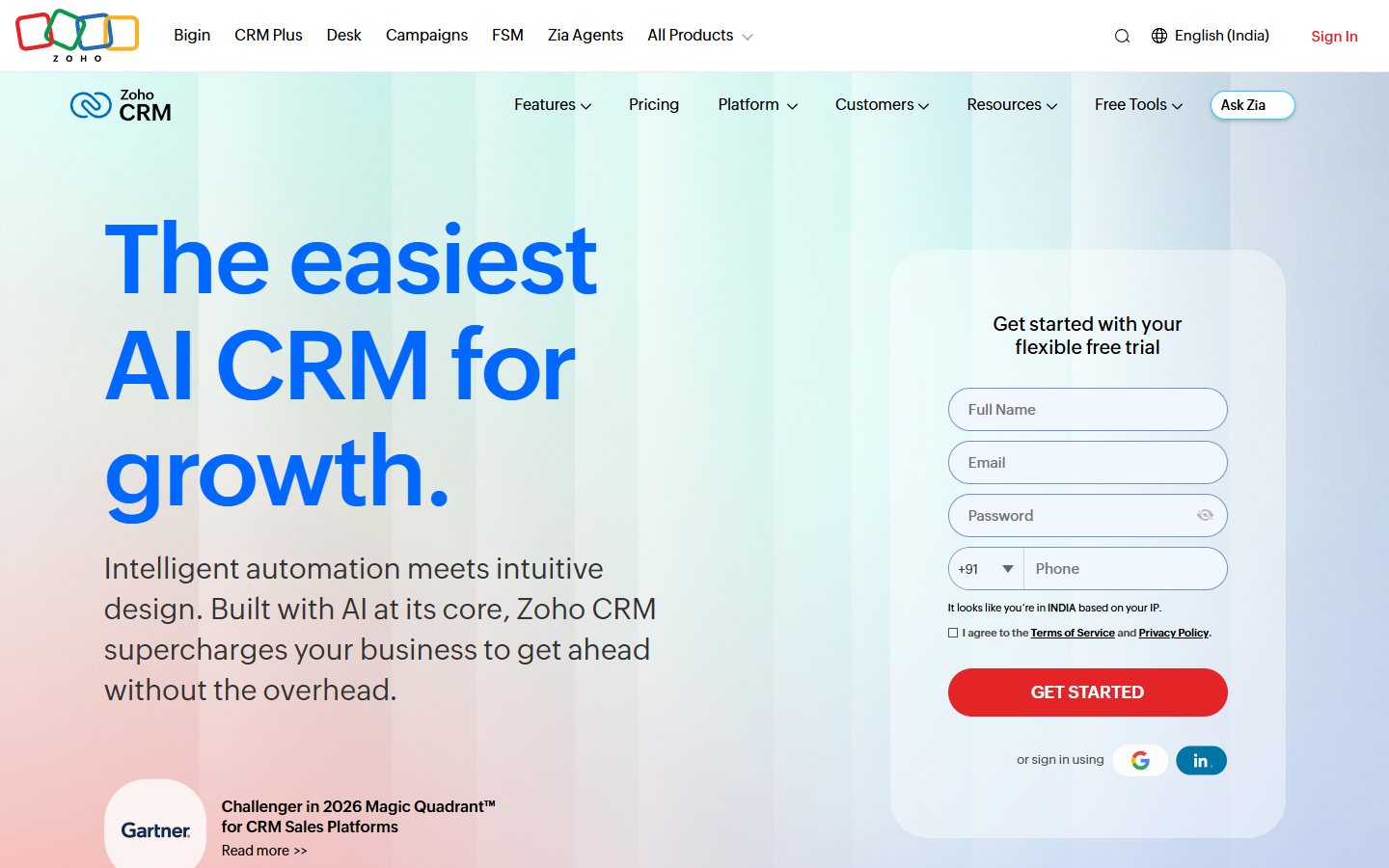
The editorial fit is a small operation in which the complete account ownership structure fits those three seats. For example, two sales operators and an operations owner may need access. Before setup, decide who administers the account, who owns records and who takes over when someone is away. Those responsibilities should not be discovered during the first missed handoff.
Pilot one opportunity through qualification, a meeting and a clear outcome. Keep the stage definitions narrow enough that two operators would classify the same evidence similarly. A stage named “proposal sent” should mean the proposal was actually sent, with the relevant record available. It should not mean that someone intends to write it later. This is process design, not a claim about a proprietary feature.
The potential pro is a documented free participant allowance that may fit a three-person operating model. The limitation is that headcount fit alone does not prove functionality fit. Verify every necessary field, activity, import, export and access requirement in the account. This guide makes no blanket assertion that paid automation, advanced analytics or every integration is included.
Test an ownership change. Assign the sample opportunity to another operator and ask them to identify the last commitment and the next action. Check whether the record contains enough context to continue respectfully without asking the prospect to repeat everything. A sales system creates value when continuity survives a handoff, not merely when it stores a complete address book.
Review the upgrade decision against an actual constraint. If a fourth person must work in the system, document that requirement. If the team needs a verified additional feature, describe the action it enables. Avoid selecting a higher edition from vague expectations about future scale; begin with the process and compare the offer that solves the demonstrated need.
Capsule: keep a small relationship book deliberate
Capsule’s free CRM page describes a free offer for two users and up to 250 contacts. Its setup guidance corroborates the small free edition. These facts establish a bounded entry point. They do not establish that the free edition includes every capability described across Capsule’s broader product pages.
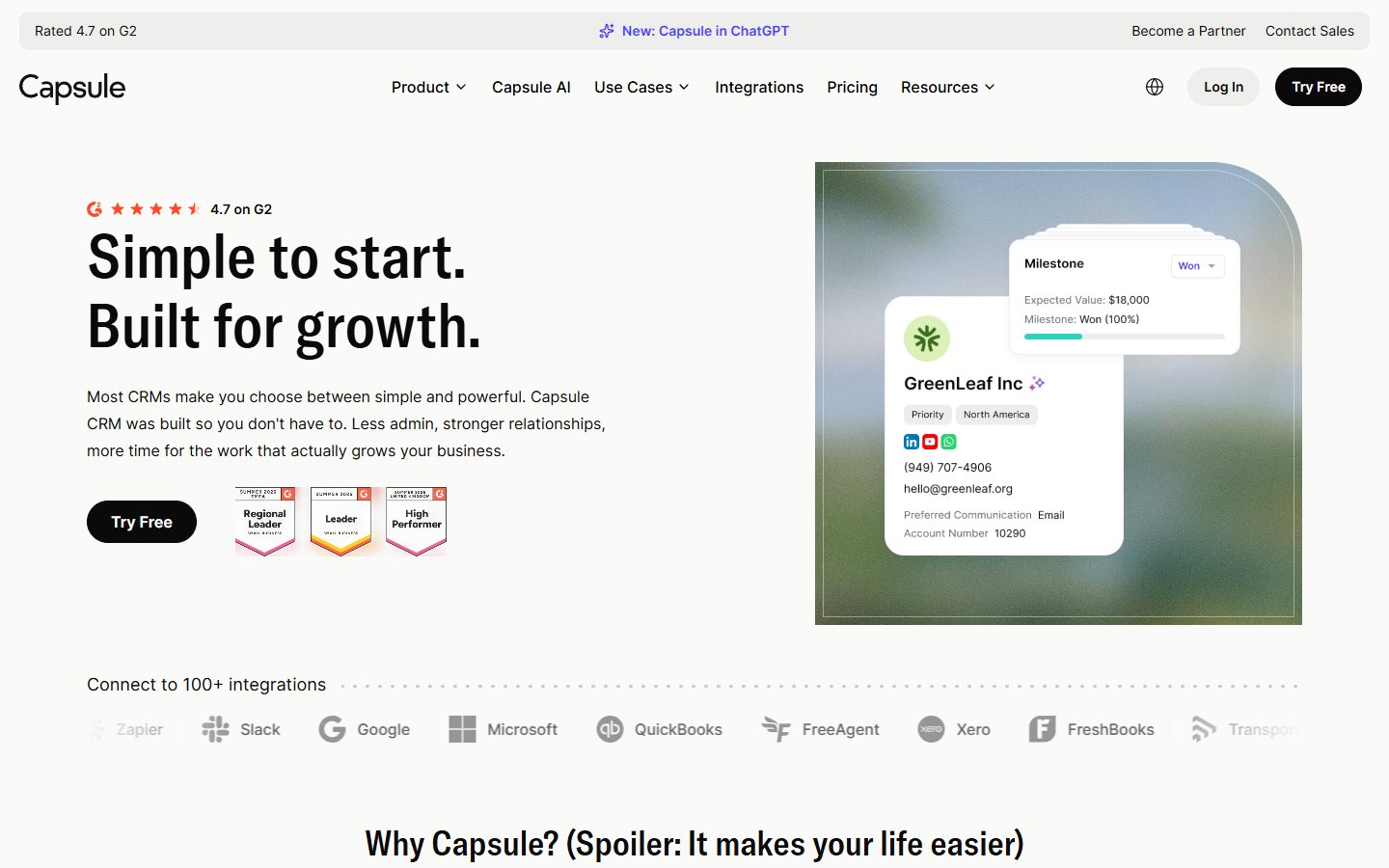
The editorial fit is a small active relationship book where deliberate follow-up matters more than importing every historical contact. Consider a boutique service firm handling a modest number of live conversations. Before migration, define which records are active, which are reference-only and which should remain in an authorized archive. Do not delete useful history merely to make a plan appear to fit.
Use a sample opportunity involving several conversations over time. Record what the prospect needs, what your team promised and the next decision date. Then ask the other operator to prepare the next interaction from that record. The acceptance condition is continuity and accuracy. A record full of notes can still fail if the important next action is buried in an undated paragraph.
The potential pro is a clear small-scale boundary that encourages a focused pilot. The con is that contact growth can become decisive even when only two people use the software. Plan the data model before importing: a company, person and duplicate entry may be treated differently by a product. Verify counting rules rather than estimating capacity from the number of rows in an unclean spreadsheet.
Run a duplicate-handling exercise with permitted sample data. Use two slightly different versions of one person’s name and inspect how the team identifies the relationship. This is a proposed acceptance test, not a claim that a particular automatic deduplication feature exists in Free. The operator needs a reliable process even if the product does not automate every part of it.
Set an exit threshold before the active book approaches the allowance. Compare the actual upgrade with another suitable option, including the effort required to preserve notes and relationships. A free plan is a useful starting point when its boundary is understood. It becomes a false economy when the team keeps critical sales context elsewhere because the main record can no longer accommodate the work.
EngageBay: verify the combined offer at the action level
EngageBay’s All-in-One pricing page lists a free tier with 250 contacts. This guide verifies that scoped entry point. It does not infer a user allowance, unlimited email, every automation or all paid sales capabilities from the All-in-One label. Product packaging needs to be checked at the exact edition and account level.
The editorial reason to evaluate it is a team considering whether several customer-facing activities can share one operating record. The pilot should begin with the sales requirement rather than the appeal of consolidation. List the actions you need: capture the lead, record qualification, assign the owner, schedule the next interaction and preserve the outcome. Confirm the plan treatment of each one independently.
Use a handoff from an initial inquiry to a qualified opportunity. Identify which information must travel with it, including source, consent context where relevant and the original question. Ask the receiving operator to explain why the opportunity belongs in the pipeline. A combined suite is not useful if movement between activities causes context to disappear or ownership to become ambiguous.
The potential pro is an opportunity to evaluate a combined workflow from a documented free starting point. The con is the risk of assuming that nearby functions share the same allowance or edition treatment. Keep a plan worksheet beside the workflow. If an essential action is visible only through a trial, mark the permanent entitlement unknown until verified.
Do not start by connecting a large live mailing list. Use synthetic or appropriately authorized records and verify the process first. Data access, permission to communicate and technical sending capacity are separate requirements. This guide makes no deliverability claim and no assertion that storing a contact establishes a lawful or appropriate basis for every outreach campaign.
The buying trigger should be a named capacity or functionality requirement, supported by current official evidence. If consolidation saves a manual handoff, record the observed work before estimating its value. Do not claim a revenue improvement from the existence of a feature. The team should be able to explain which operating failure the purchase prevents and who owns the resulting process.
Flowlu: examine the sales-to-delivery handoff
Flowlu’s pricing page describes a free two-user workspace, and its subscription guidance distinguishes a free plan from paid subscriptions and trials. This guide does not establish that every advertised CRM, finance or project capability is included without restriction in that workspace.
The editorial reason to shortlist Flowlu is a small team evaluating continuity after an opportunity becomes work. A consultant and an operations partner may need to turn an accepted proposal into a clear delivery handoff. The pilot must verify the actual required steps. A broad product category does not prove that the free edition implements your desired sales-to-project transition automatically.
Create a synthetic won opportunity with an approved scope, delivery owner and first milestone. Ask the second person to begin the delivery process from the available record. Check whether the scope, promises and unresolved questions remain visible. If information must be copied manually, document that step and assess whether the team can maintain it reliably at its actual volume.
The potential strength is evaluating related operational work within a bounded free workspace. The limitation is the two-user capacity and the need to confirm exact plan scope. A small team can still have many reviewers, subcontractors or administrators. Do not assume their access is free or appropriate without checking the current product definitions and the actual workspace configuration.
Test a lost opportunity too. Record the reason accurately and distinguish a closed outcome from a future follow-up. A system should help the team avoid repeatedly pursuing a prospect who clearly declined, while preserving appropriate context for any legitimate later interaction. This is a proposed process standard, not a claim that a specific automated policy exists in the product.
Choose an upgrade or alternative from the observed handoff constraint. If a required transition needs paid functionality, compare that cost with the manual process and another candidate. Keep internal effort separate from vendor charges. A two-user free workspace can be useful, but it should not become an excuse to leave delivery staff working from an incomplete parallel record.
Evaluate the next-action contract
For every live opportunity, require five answers: where it came from, who owns it, what happened most recently, what happens next and when the next action is due. These answers form a simple operating contract. The software must make them accessible to the next authorized person. A large database without this continuity can still produce an unreliable pipeline.
Use one accepted example and one incomplete example. In the incomplete record, omit the next action or leave ownership ambiguous. Ask the operator to identify the gap. This reveals whether the team has a review process, not just a form with many fields. A product does not create accountability merely because it permits someone to enter an owner’s name.
Define stage evidence before building reports. If one person marks an opportunity qualified after a form submission and another waits for a completed discovery call, the resulting report mixes different meanings. Agree on the business event, then select the simplest fields and process that preserve it. A paid forecasting feature will not repair inconsistent stage definitions by itself.
Import only after the pilot works
Clean the source data in a separate authorized copy. Identify duplicates, missing ownership and historical records that should not enter the active pipeline. Preserve the original source. Decide how people, companies and opportunities relate before importing. A spreadsheet row is not automatically the same unit as a vendor’s contact, company or deal allowance.
Import a small sample and reconcile it. Check record counts, relationships, dates and notes. Ask the second operator to find the latest commitment for several sample opportunities. If an important field disappears or the dates become ambiguous, resolve the mapping before moving the full dataset. A successful upload notification is not evidence that the migrated sales record remains useful.
Establish an exit path at the same time. Verify what can be retrieved and what requires a separate preservation step. Keep the migration owner accountable for the record, including attachments or links stored elsewhere. Do not remove the original operational source until the new process is accepted and the team knows how to recover information it may need later.
Choose from constraints, not promises of growth
The purchasing decision should identify the requirement that free scope cannot satisfy: another essential operator, a larger active book, a verified permission or a necessary recurring action. Compare the actual paid offer with alternatives and the cost of operating the current workaround. Label estimates as estimates. This guide reports no measured conversion improvement, time saving or guaranteed financial return.
For broader context, use the Sales Software evaluation guide , CRM Software guide , workflow automation guide and Customer Support guide . Browse the Sales Software category for related decisions. A good free sales setup ends each working day with a visible owner and next action, not merely a larger collection of stored names.
Frequently asked questions
Which free sales software should a new team choose?
Start with the complete participant count, active contact book and required next-action process. The five candidates in this guide have documented free entry points, but their scope differs. Run a small representative pilot and verify the exact account. This is a task-based shortlist, not a measured ranking of sales performance.
Does a free CRM include unlimited sales automation?
Do not assume so. Database access, email, automation, reporting and integrations can have separate edition treatment. Check each required action against current official evidence and the actual account. A capability advertised on a broader product page is not proof that it is included permanently in the free edition.
Does Zoho CRM’s free user count exclude the administrator?
No. The official specifications checked for this guide say the three-user free allowance includes the super administrator. Count everyone who needs to operate the account. If the organization requires a separate administrator plus three salespeople, evaluate the actual access options rather than planning from an incorrect participant count.
Should I import all historical contacts immediately?
No. First test the workflow and a small sample import. Reconcile relationships, dates, notes and counting rules. Keep historical information in an appropriate authorized archive when it does not belong in the active pipeline. Preserve the original source until the new operating record is accepted and the exit process is understood.
When is a paid sales plan justified?
When a demonstrated requirement exceeds the usable free scope and the actual paid offer resolves it at an acceptable total cost. Name the requirement and include administration, migration and review effort. Avoid predicting revenue gains from a feature list. The team should know which operating failure the purchase prevents and who owns the result.