Best SEO Software for Enterprise Teams
Compare Conductor, Semrush Enterprise, Botify, seoClarity, and BrightEdge for enterprise SEO, AEO, technical governance, content, and reporting.
Direct answer
Conductor is the best broad enterprise SEO starting point for organizations that want research, content, technical monitoring, workflow, reporting, and AI-search visibility in one coordinated operating layer. Semrush Enterprise is best for global brands managing visibility across many markets. Botify is best for large, technically complex websites where crawling, rendering, and indexation are the central risks. seoClarity is best for data-intensive SEO operations that want configurable research, automation, and reporting. BrightEdge is best for executive visibility and content-performance programs.
The best choice depends less on the longest feature list than on the constraint limiting organic growth. A retailer with millions of URLs has a different problem from a multinational brand coordinating local markets. A platform cannot compensate for missing engineering capacity, unclear content ownership, inconsistent analytics, or executives who treat every rank movement as revenue.
This guide combines a live review of current search results with official sources checked on September 3, 2026. We did not run a controlled implementation. Recommendations describe documented fit, selection questions, and operating risks rather than measured product performance.
Enterprise SEO software shortlist
| Platform | Best fit | Strongest layer | Main buying question |
|---|---|---|---|
| Conductor | Broad enterprise SEO and AEO programs | Coordinated research, content, monitoring, workflow, and visibility | Can it become the shared operating layer without duplicating specialist systems? |
| Semrush Enterprise | Multinational brands | Global visibility, competitive research, data, and automation | Does the proposal cover every required market, data source, user, and workflow? |
| Botify | Large technical websites | Crawling, rendering, indexation, and scalable optimization | Can engineering teams act on its findings and govern any automated changes? |
| seoClarity | Data-intensive SEO organizations | Research, content, technical analysis, automation, and reporting | Can teams standardize configuration and turn platform breadth into repeatable decisions? |
| BrightEdge | Executive-led search and content programs | Recommendations, content performance, and enterprise reporting | Will its measurement model connect visibility with defensible business outcomes? |
What ranking pages often miss
First-page roundups commonly compare keyword research, rank tracking, competitor analysis, technical audits, content optimization, reporting, integrations, and price. These categories help build a shortlist, but enterprise success usually depends on less visible operating decisions.
The buyer must define which system owns keywords, URLs, content briefs, recommendations, tasks, releases, conversion data, revenue, and executive metrics. Without that map, teams copy data between an SEO platform, analytics, Search Console, project management, content systems, spreadsheets, and a warehouse. Numbers diverge and meetings become debates about whose dashboard is correct.
Enterprise scale also changes the meaning of a feature. “Rank tracking” may require thousands of keyword-market-device combinations with stable tagging and historical retention. “Site audit” may mean rendering JavaScript, processing logs, handling faceted navigation, and segmenting millions of URLs. “Content optimization” may cross languages, legal review, brand rules, accessibility, and regulated claims. “AI visibility” may vary by answer engine, prompt set, location, and day.
Our shortlist therefore represents five credible but different operating centers. It does not assume one platform should replace web analytics, Search Console, a content management system, a data warehouse, digital-experience monitoring, ticketing, or specialist crawling. The goal is a clear architecture and accountable workflow, not maximum consolidation.
How we selected the tools
We evaluated each platform against twelve enterprise requirements:
- Search intelligence: keywords, topics, competitors, demand, SERP features, markets, devices, and historical data.
- AI-answer visibility: prompts, citations, mentions, sentiment, sources, answer engines, evidence retention, and trend consistency.
- Technical depth: crawling, rendering, logs, indexation, canonicals, internal links, structured data, templates, and monitoring.
- Content operations: briefs, recommendations, optimization, inventories, governance, approvals, localization, and refresh workflows.
- Measurement: rankings, traffic, conversions, revenue connections, forecast assumptions, attribution limits, and executive reporting.
- Workflow: ownership, prioritization, tasks, approvals, alerts, service levels, exceptions, and remediation verification.
- Administration: organizations, brands, sites, markets, roles, permissions, SSO, provisioning, audit, and offboarding.
- Integration: analytics, Search Console, CMS, warehouse, BI, project systems, APIs, exports, limits, and reconciliation.
- Data quality: freshness, coverage, sampling, definitions, missing data, duplicates, versioning, retention, and lineage.
- AI governance: grounding, permissions, data treatment, review, reproducibility, hallucination risk, and acceptable use.
- Adoption and services: usability, training, implementation, support, consulting, documentation, and internal ownership.
- Economics and resilience: modules, usage, services, administration, remediation, renewal, continuity, export, and exit.
1. Conductor: best broad enterprise SEO and AEO starting point
Conductor positions its platform around enterprise SEO and AEO intelligence, content creation and optimization, website monitoring, and agent-assisted workflows. The official homepage presents a unified environment intended to connect search insight with action across teams.
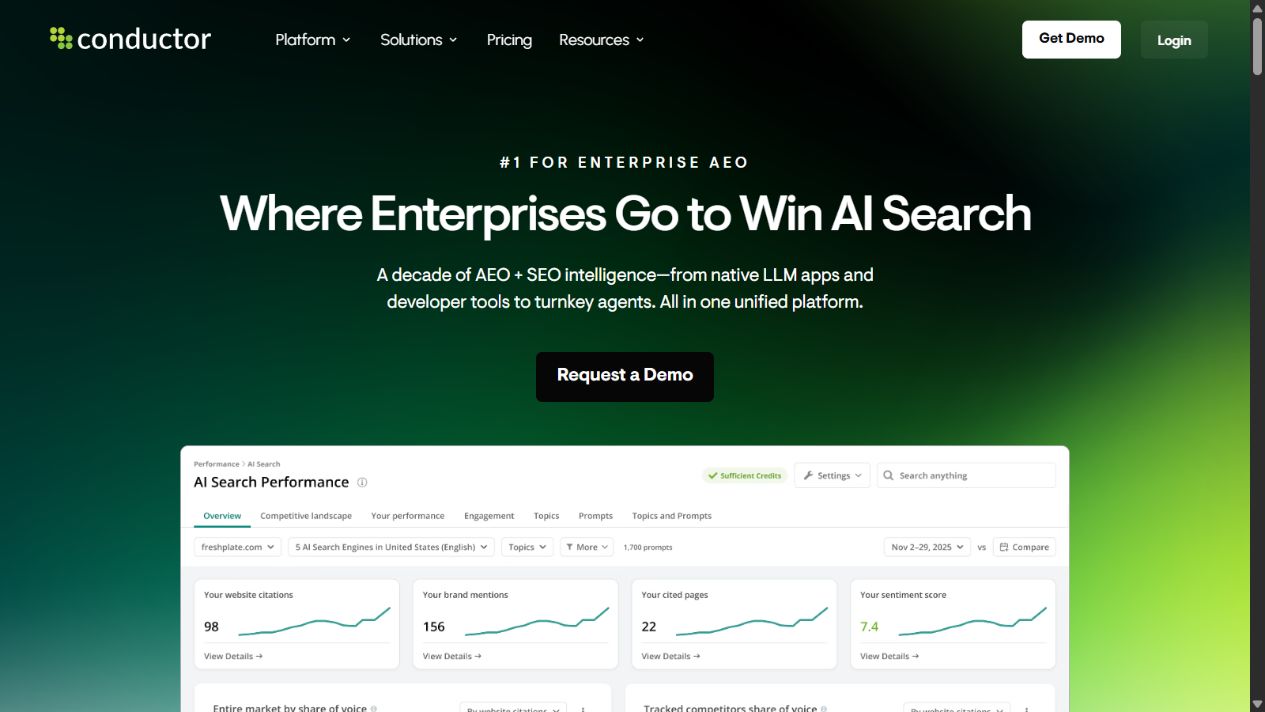
Conductor homepage captured September 3, 2026. Confirm products, tracked markets, data limits, services, AI allowances, and contractual controls in the proposal.
Conductor is our broad starting point because its documented scope can support the full operating cycle: understand demand, identify visibility gaps, guide content, monitor a site, coordinate work, and communicate results. That breadth suits organizations where SEO is distributed among central teams, business units, writers, digital experience, engineering, agencies, and executives.
Choose Conductor when
- One shared operating layer must connect research, content, technical monitoring, and reporting.
- Business users need understandable recommendations while specialists retain deeper evidence.
- Traditional search and AI-answer visibility need to be evaluated together.
- Multiple teams require permissions, shared workflows, and governed definitions.
- Implementation services and adoption support matter alongside software.
Check before buying
Map every proposed module to a named workflow, owner, user population, and success measure. A broad suite can reduce switching, but unused breadth still creates subscription, training, and administrative cost. Ask which capabilities are native, separately licensed, usage-metered, partner-delivered, or dependent on another data source.
Test the data at the level your teams actually use. Compare a representative sample of rankings, URLs, technical findings, citations, and traffic connections with source systems. Record time zones, market settings, devices, update frequency, rounding, and attribution definitions. A polished dashboard should not become authoritative before reconciliation.
Pilot a recommendation from discovery through implementation and verification. Measure whether owners understand the evidence, whether tickets preserve context, whether releases can be tracked, and whether the platform confirms the intended outcome. The operational loop matters more than the number of recommendations generated.
Sources: Conductor , Conductor pricing , and Conductor Support .
2. Semrush Enterprise: best for global brand visibility
Semrush Enterprise presents a platform for global brands seeking visibility wherever search happens, including traditional and AI-mediated discovery. Its enterprise positioning emphasizes data, automation, collaboration, and coordinated work across large programs.
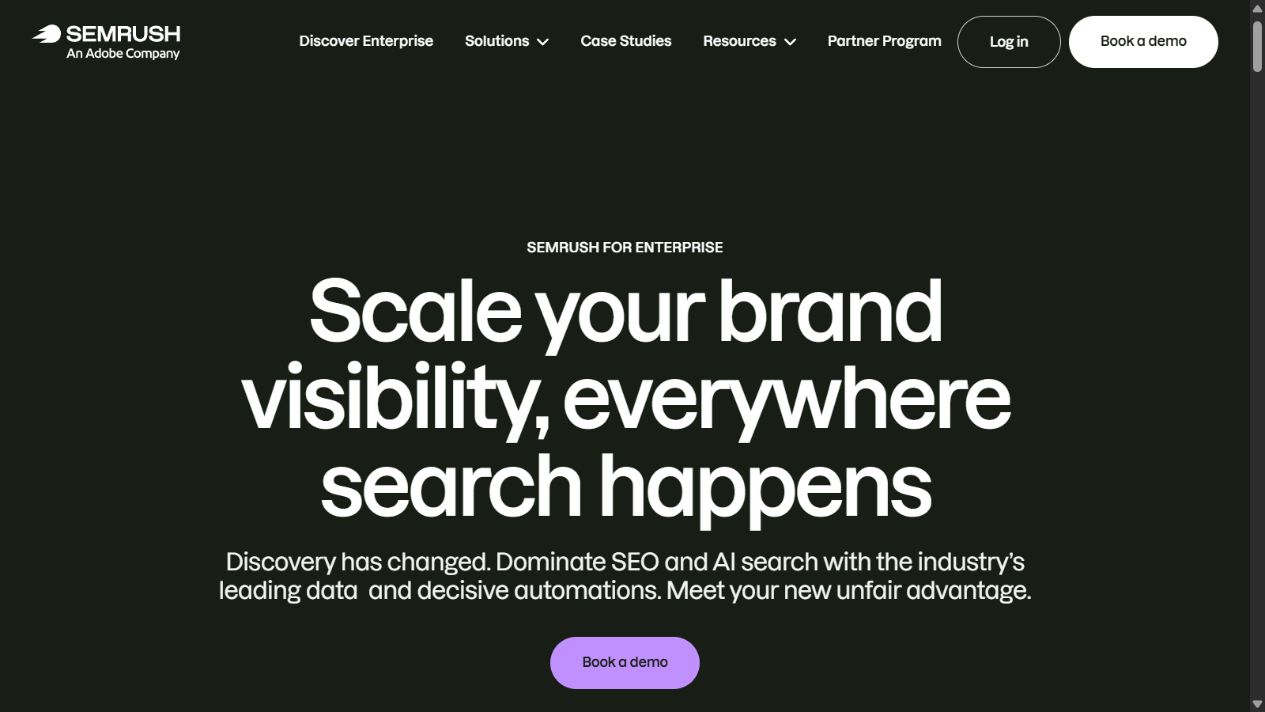
Semrush Enterprise homepage captured September 3, 2026. Verify enterprise entitlements rather than assuming features or limits from another Semrush plan.
Semrush Enterprise fits multinational organizations that must compare brands, markets, languages, competitors, and channels without leaving every regional team to construct its own research stack. Its value is not merely access to data; it is the possibility of standardizing how a global program defines and communicates visibility.
Choose Semrush Enterprise when
- A global brand needs consistent research and reporting across many markets.
- Competitive visibility is a central planning input.
- Teams want enterprise data, automation, and collaboration around search.
- Regional flexibility must coexist with central taxonomy and governance.
- Traditional and AI-search discovery need a shared executive narrative.
Check before buying
Separate the enterprise proposal from familiarity with the wider Semrush product family. Document exactly which datasets, products, APIs, projects, markets, users, exports, historical periods, and AI-search capabilities are included. Brand recognition does not eliminate edition boundaries.
Create a global measurement dictionary before configuration. Define brand and non-brand queries, market ownership, language, device, competitor sets, SERP features, AI prompt groups, conversion events, and reporting periods. Without common definitions, a global dashboard can aggregate incompatible local programs.
Test exports and warehouse workflows early. Enterprise teams often need to combine search visibility with analytics, commerce, CRM, media, and product data. Validate identifiers, pagination, limits, update schedules, failed jobs, backfills, and the right to retain exported data after termination.
Sources: Semrush Enterprise , Semrush Enterprise contact, and Semrush Knowledge Base .
3. Botify: best for technically complex websites
Botify focuses on making large websites discoverable and understandable to search and AI systems. Its positioning is especially relevant when crawling, rendering, indexation, internal architecture, and scalable technical optimization determine whether valuable content can be found.
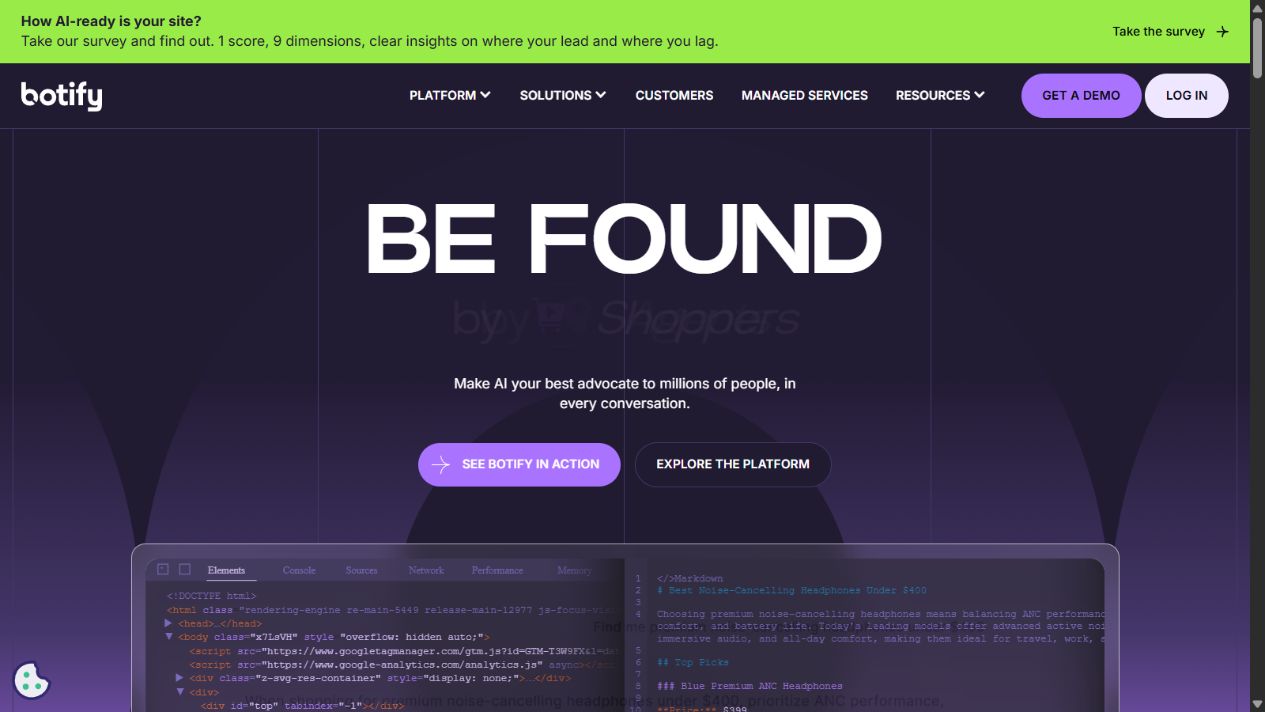
Botify homepage captured September 3, 2026. Confirm crawl scale, log-data scope, modules, activation rights, services, and support.
Botify is the strongest specialist fit in this shortlist for very large or technically demanding sites. Ecommerce catalogs, marketplaces, publishers, travel inventories, and international sites can produce more crawl and indexation problems than a conventional audit process can prioritize manually.
Choose Botify when
- The site contains large, dynamic, international, or frequently changing URL inventories.
- Rendering, crawl allocation, indexation, canonicals, or internal linking are material risks.
- Technical SEO teams need segmentation and evidence at scale.
- Search findings must connect closely with engineering remediation.
- Controlled automation could reduce the delay between diagnosis and action.
Check before buying
Technical insight has value only when teams can ship changes. During the pilot, take several high-priority findings through triage, engineering review, testing, release, monitoring, and outcome verification. Track lead time and blocked work. If remediation capacity is the bottleneck, purchasing more diagnostics may increase the backlog rather than performance.
Treat automated optimization as production change. Define approved change types, environments, permissions, review requirements, monitoring, rollback, incident ownership, and exclusions. Validate effects on accessibility, security, analytics, personalization, caching, localization, and legal content.
Model scale using real URL counts, rendering needs, log volumes, update frequency, segments, sites, and peak events. Ask what happens when allowances are exceeded and how new acquisitions, domains, or markets affect price and implementation.
Sources: Botify , Botify contact , and Botify Support .
4. seoClarity: best for data-intensive SEO operations
seoClarity describes a unified SEO and AEO platform spanning search intelligence, content, technical analysis, reporting, workflow, and automation. That breadth makes it relevant to mature teams that want a configurable operational system rather than a narrow point tool.
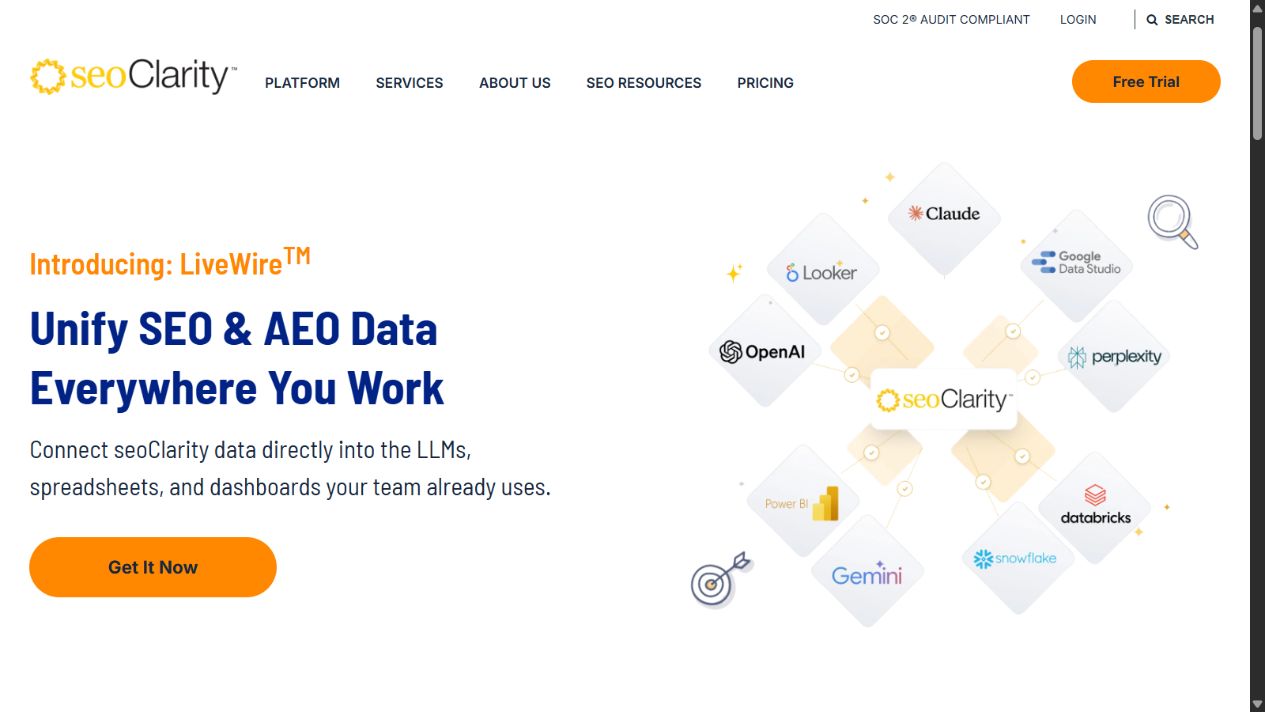
seoClarity homepage captured September 3, 2026. Confirm data scope, crawl and keyword allowances, AI-search coverage, services, and integrations.
seoClarity fits organizations with analysts and operators capable of using substantial data while maintaining standards. It can support research, content decisions, technical prioritization, and reporting, but the organization must prevent each team from building incompatible configurations.
Choose seoClarity when
- Search programs need extensive data and configurable analysis.
- Research, content, technical work, automation, and reporting should share context.
- Internal specialists can own taxonomy, configuration, and enablement.
- Teams need to segment performance across large sites or business structures.
- AI-search analysis must sit alongside established SEO operations.
Check before buying
Assign a platform owner and governance group. Control tags, segments, competitors, dashboards, alerts, templates, access, and change requests. Flexibility becomes a liability when two teams use the same label for different concepts or recreate the same report with different filters.
Evaluate usability by role, not with one expert demo. Ask analysts, writers, SEO managers, technical specialists, regional users, and executives to complete realistic tasks. Measure completion, interpretation errors, support dependence, and whether each role sees an appropriate level of detail.
Test AI-generated outputs with evidence-based review. Require source links, preserve prompts and versions where possible, sample factual accuracy, and prohibit publication without accountable human approval. Speed is useful only when review effort and error risk remain acceptable.
Sources: seoClarity , seoClarity pricing , and seoClarity resources .
5. BrightEdge: best for executive visibility and content performance
BrightEdge positions its platform around unified SEO and AEO, with visibility across Google and AI answer experiences, content performance, recommendations, and enterprise reporting. It is a credible fit when leadership communication and coordinated content decisions are central requirements.
BrightEdge homepage captured September 3, 2026. Validate sites, markets, data, AI coverage, onboarding, services, and reporting definitions.
BrightEdge is strongest where an enterprise wants search evidence translated into prioritized action and executive communication. A common SEO failure is not lack of data but the inability to explain which opportunities matter, who owns them, and how work connects with business outcomes.
Choose BrightEdge when
- Executives need a consistent view of organic and AI-search visibility.
- Search and content teams need shared recommendations and performance context.
- Enterprise reporting and stakeholder communication are major selection criteria.
- The program requires established onboarding and services.
- Traditional SEO must evolve without abandoning historical measurement.
Check before buying
Interrogate every business-impact number. Document whether a figure is observed, attributed, modelled, or forecast. Review baselines, click assumptions, conversion rates, seasonality, branded demand, paid activity, and confidence. Forecasts can support prioritization, but they are not realized revenue.
Ask executives to use pilot dashboards without vendor narration. They should understand definitions, dates, comparisons, exclusions, and uncertainty. A dashboard that requires an analyst to reinterpret it at every meeting is not yet an executive product.
Validate content recommendations against brand, subject-matter, legal, accessibility, and conversion requirements. Optimization scores should inform judgment rather than force uniform writing or encourage pages created only to satisfy a tool.
Sources: BrightEdge , BrightEdge demo , and BrightEdge resources .
How the five platforms differ
Conductor and seoClarity offer broad operating coverage, but buyers may prefer Conductor for a shared cross-functional layer and seoClarity for a data-intensive configurable practice. Semrush Enterprise stands out for global visibility and competitive research. Botify has the clearest technical center of gravity. BrightEdge deserves attention where executive reporting and content performance drive the program.
Those distinctions are starting hypotheses, not substitutes for a pilot. Enterprise products evolve, proposals differ, and implementation determines practical fit. Score the exact editions and services offered to your organization.
Build an enterprise SEO software scorecard
Use weighted requirements instead of a generic feature checklist. Give each requirement an owner, evidence request, test, weight, and minimum threshold. A useful scorecard separates documented availability from pilot performance and contractual commitment.
Suggested scorecard categories
| Category | Example evidence | Pilot measure |
|---|---|---|
| Search and AI visibility | Market, engine, prompt, keyword, history, and citation documentation | Coverage and repeatability on an agreed test set |
| Technical SEO | Crawl, render, log, indexation, segmentation, and monitoring evidence | Detection quality and remediation lead time |
| Content operations | Brief, recommendation, inventory, workflow, and governance demonstration | Time saved without increased review errors |
| Data and reporting | Definitions, lineage, export, API, refresh, and retention documentation | Reconciliation against source systems |
| Administration | SSO, provisioning, roles, audit, brand, market, and offboarding controls | Successful role and lifecycle scenarios |
| Services and adoption | Implementation plan, training, support, escalation, and success model | Task completion and support dependence by role |
| Economics | Itemized software, usage, services, growth, renewal, and exit terms | Three-year total cost under expected and high-growth scenarios |
Require vendors to mark unavailable, roadmap, partner-delivered, custom, and separately licensed items plainly. A roadmap statement is not an implemented control. A demo is not proof that the offered edition supports production scale.
Run a controlled pilot
Select representative complexity: one large site, one regional site, multiple templates, branded and non-branded demand, several competitors, a technical issue, a content workflow, and a set of AI prompts. Include real users from SEO, content, engineering, analytics, and leadership.
Start with baseline evidence. Record current data coverage, reporting effort, remediation lead time, content cycle time, stakeholder satisfaction, and known quality problems. Otherwise, the pilot may feel impressive without demonstrating improvement.
Test failures as deliberately as successful paths. Remove a user, change a role, exceed an allowance, break an integration, rename a segment, delay a data feed, and challenge a recommendation. Observe alerts, recovery, audit evidence, and support response.
End with a written decision. Summarize passed requirements, exceptions, unresolved risks, implementation dependencies, total cost, contractual protections, and measurable outcomes expected during the first year. Do not let an enthusiastic demonstration quietly become procurement approval.
Model total cost and contract risk
The subscription is only one cost. Include discovery, configuration, taxonomy, integrations, migration, data validation, security review, training, internal administration, vendor services, agency work, content production, and engineering remediation. Add expansion for domains, markets, keywords, crawls, users, APIs, AI modules, and acquisitions.
Model at least three years under expected and high-growth scenarios. Examine renewal caps, minimum terms, overages, service credits, support levels, data retention, export rights, deletion, subcontractors, regions, incident obligations, termination assistance, and transition periods.
Ask for an itemized order form. Terms such as “enterprise,” “unlimited,” and “AI included” require definitions. Record fair-use clauses, throttling, file or row limits, refresh rates, historical depth, and which capabilities can be changed during the term.
Govern SEO and AEO measurement
Traditional search metrics are already imperfect. Rank varies by location, device, personalization, SERP composition, and time. AI-answer visibility adds model versions, prompt wording, retrieval behavior, citations, and nondeterministic output. Treat both as sampled measurements.
Maintain a controlled prompt and keyword set with owner, intent, market, language, audience, and review frequency. Preserve raw answers or evidence where lawful. Track mention, citation, linked source, position, accuracy, and sentiment separately rather than compressing every signal into one unexplained score.
Connect visibility to qualified outcomes cautiously. Use analytics, Search Console, conversion systems, CRM, and warehouse data according to their strengths. Distinguish correlation from attribution. Report uncertainty and data gaps rather than inventing precision.
Final recommendation
Start with Conductor when the enterprise needs one broad SEO and AEO operating layer. Prioritize Semrush Enterprise for multinational visibility and competitive intelligence, Botify for large-site technical discoverability, seoClarity for configurable data-intensive operations, and BrightEdge for executive reporting and content performance.
Do not select from a feature grid alone. Define the operating problem, architecture, owners, measurement dictionary, pilot evidence, remediation capacity, total cost, and exit plan first. The best enterprise SEO software is the platform your organization can govern, trust, act on, and measure after the sales demonstration ends.
Frequently asked questions
What is the best SEO software for enterprise teams?
Conductor is our broad starting point, while Semrush Enterprise, Botify, seoClarity, and BrightEdge fit different global, technical, data, and reporting priorities. The final decision should follow a controlled pilot of the exact proposal.
Do enterprise teams need both SEO and AEO software?
Not always. One platform may cover both, but AI-search measurement remains less standardized. Validate engine coverage, prompt methodology, evidence, exports, history, and how claims connect with business outcomes.
How should an enterprise test an SEO platform?
Use representative sites, markets, roles, workflows, and failure cases. Compare data with source systems and take recommendations through implementation and verification. Score documented, tested, and contracted capabilities separately.
What costs are often missed?
Common omissions include implementation, services, integrations, training, internal administration, additional usage, AI modules, content work, engineering remediation, renewal increases, and migration away from the platform.
Can enterprise SEO software fix problems automatically?
Some tools can automate selected tasks, but production changes still need governance, testing, monitoring, rollback, and accountable owners. Automation does not remove engineering, accessibility, security, or legal responsibilities.
How reliable are AI-search visibility metrics?
They are useful for directional trends when measured consistently, but they are not a complete census. Results vary by model, prompt, context, location, and time, so preserve evidence and disclose limitations.
Should the SEO platform replace analytics or the data warehouse?
Usually no. Use it as an operational and diagnostic layer while analytics, Search Console, CRM, commerce, and warehouse systems retain defined authority. Establish identifiers and reconciliation rules before executive reporting.
Frequently asked questions
What is the best SEO software for enterprise teams?
Conductor is the strongest broad starting point for enterprises seeking one coordinated SEO and AEO operating layer. Semrush Enterprise fits multinational visibility programs, Botify fits technically complex websites, seoClarity fits data-intensive SEO operations, and BrightEdge fits executive reporting and content-performance programs.
Do enterprise teams need both SEO and AEO software?
Not necessarily as separate products. Buyers should determine whether one platform can measure traditional search and AI-answer visibility with adequate evidence, markets, workflow, and exports. AEO metrics remain less standardized, so retain independent analytics and validation.
How should an enterprise test an SEO platform?
Run a time-boxed pilot on representative sites, markets, templates, and teams. Test crawl and rank data, recommendations, permissions, workflows, integrations, exports, AI citations, reporting, remediation handoffs, and support against written success measures.
What costs are often missed in enterprise SEO software?
Implementation, data migration, integrations, services, training, administrators, extra domains or markets, crawl and keyword allowances, API access, AI-search modules, content production, engineering remediation, renewal increases, and exit work are commonly missed.
Can enterprise SEO software fix technical SEO problems automatically?
Some platforms can automate selected optimizations or accelerate recommendations, but accountability remains with the organization. Engineering review, release controls, rollback, accessibility, security, legal requirements, and measurement still apply.
How reliable are AI-search visibility metrics?
They are directional rather than absolute. Answers can vary by model, prompt, location, personalization, retrieval source, and time. Compare consistent prompt sets and trends, preserve raw evidence, and connect visibility with qualified business outcomes.
Should an enterprise replace its analytics or data warehouse with an SEO platform?
Usually no. The SEO platform can be an operational and diagnostic layer, while analytics, Search Console, commerce, CRM, and warehouse systems remain authoritative for their respective data. Define ownership and reconciliation rules explicitly.