Best SEO Software for Startups
Compare five SEO software options for startups across research, technical auditing, rank tracking, reporting, AI visibility, workflow fit, and total cost.
Direct answer
The best SEO software for a startup is the smallest trustworthy stack that answers its next important search decisions. Semrush is the broadest option in this shortlist for teams that want keyword, competitor, backlink, rank-tracking, technical, reporting, and newer visibility workflows in one platform. Ahrefs is a strong choice for search, content, competitor, and backlink research. SE Ranking fits a startup that wants a configurable multi-workflow platform with tracking and reporting. Screaming Frog SEO Spider is the specialist choice for detailed technical crawling. Mangools is the focused option for keyword research, search-result analysis, rank tracking, and related research without automatically buying a larger suite.
Every startup with a website that depends on Google should also configure Google Search Console. It provides verified-property information about Google Search performance, indexing, sitemaps, and URL inspection. It is not included as one of the five commercial recommendations because it serves a different role: first-party search information rather than a broad third-party competitor database or specialist crawler.
No platform has complete or identical market data. Third-party keyword volume, traffic, difficulty, authority, backlink, and visibility numbers depend on the vendor’s database and methodology. The right product is therefore the one whose data coverage and workflow help the startup make repeatable decisions, not the one that displays the largest number.
This guide uses official vendor sources checked on August 30, 2026. It does not claim hands-on testing or independent traffic measurement. Product facts are sourced; fit recommendations are editorial inferences to validate with the startup’s own market, website, and workflow.
Before shortlisting products, review our SEO Software evaluation guide , SEO stack audit process , and technical SEO audit-tool framework . These establish the decisions, evidence classes, and implementation capacity the software should support.
The five options at a glance
| Product | Best fit in this guide | Main job | Main buying risk |
|---|---|---|---|
| Semrush | Startups wanting one broad visibility platform | Research, competitors, tracking, auditing, reporting, and additional marketing workflows | Paying for breadth the team will not use |
| Ahrefs | Search-led and link-aware content teams | Keyword, competitor, content, backlink, rank, and site research | Treating estimated metrics as verified business results |
| SE Ranking | Startups wanting configurable SEO operations | Tracking, research, auditing, reporting, and visibility workflows | Choosing a plan before modelling limits and update frequency |
| Screaming Frog SEO Spider | Technical or programmatic websites | Detailed desktop crawling and onsite analysis | Producing issue lists without the expertise to validate priorities |
| Mangools | Lean teams focused on research and tracking | Keywords, SERPs, rankings, links, and site metrics | Requiring extra products for technical auditing or broader reporting |
How we selected the shortlist
We selected tools with current official product pages, a clear SEO use case for a startup, and enough public information to evaluate the operating model. We intentionally mixed broad platforms and specialist software. A startup does not need one vendor to perform every possible SEO task; it needs dependable coverage for the tasks it owns now.
The criteria were:
- Decision coverage: keyword and topic research, competitor analysis, rank tracking, technical auditing, reporting, or emerging AI visibility.
- Data context: whether the information is first-party, estimated, crawled, imported, or generated from a defined query set.
- Startup operability: setup effort, clarity, reporting, exports, and the expertise required to turn findings into work.
- Limits: projects, users, tracked terms, locations, update frequency, reports, crawled pages, exports, history, and API access.
- Actionability: whether the output changes prioritization rather than merely adding dashboards.
- Growth path: fit when the site, markets, content inventory, team, or agency relationships expand.
- Risk and cost: overlap, contract period, add-ons, data handling, administration, and exit.
We did not rank products using affiliate economics, customer-review averages, or vendor performance claims. Exact prices are intentionally not the basis of the recommendation because plan names, regions, promotions, usage systems, and limits change. Buyers should verify a dated official quote.
1. Semrush: best broad visibility platform
Semrush’s official site presents a broad marketing and visibility platform. Its current product material covers SEO research, competitive analysis, keywords, backlinks, rank tracking, site auditing, reporting, local workflows, content and advertising capabilities, and newer tools related to visibility in AI answers. The exact capabilities and limits vary by product and plan.
For a startup, Semrush is most attractive when one small growth team owns several connected questions: what people search for, which competitors are visible, what technical issues deserve investigation, whether priority pages are gaining rankings, and how results should be reported. Consolidating those workflows can reduce spreadsheet reconciliation and multiple subscriptions.
Breadth is also the reason to be cautious. A founder may approve an all-in-one platform, then discover that the team uses only a keyword report once a month. Before buying, list the recurring tasks, markets, websites, people, tracked terms, crawled pages, reports, and exports. Map each requirement to the current package and any add-on.
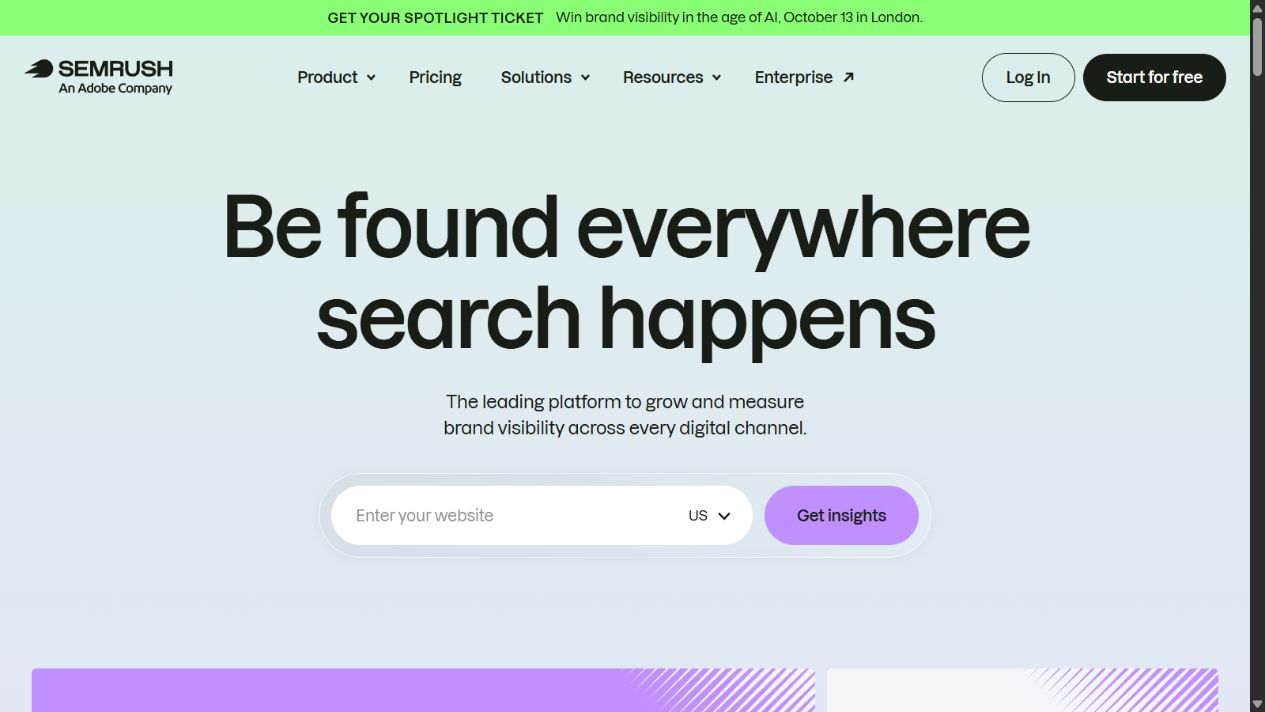
Semrush’s official homepage, captured August 29, 2026. Source: Semrush .
Choose Semrush when: the same startup team owns broad search research, competitive monitoring, tracking, technical review, and stakeholder reporting.
Check before buying: projects, users, tracked keywords, databases, location and device coverage, crawl limits, reports, exports, historical data, AI modules, local features, add-ons, and renewal pricing.
Pilot task: configure the startup’s real market, five competitors, fifty priority queries, one bounded crawl, and one founder report. Record which output creates a decision and which remains unused.
Official sources: Semrush , Semrush pricing , and Semrush Trust Center.
2. Ahrefs: best for search and backlink research
Ahrefs describes its platform around search, competitor, content, backlink, rank-tracking, site-audit, and brand or visibility workflows. Its proprietary web index and search databases support research across websites and markets, subject to current product access and limits. This makes it relevant to content-led startups and teams for whom link discovery and competitor analysis are recurring work.
Ahrefs is strongest when the team asks directional questions consistently: which sites and pages attract search visibility, which topics appear to have demand, how a competitor’s content footprint is structured, and where relevant links are discovered. The product can help develop hypotheses; it cannot verify a competitor’s revenue, conversions, or internal analytics.
The critical buying discipline is to preserve the distinction between estimate and fact. A third-party traffic estimate or keyword metric comes from Ahrefs’ own database and method. Compare trends inside the platform and validate the startup’s outcomes using Search Console, analytics, qualified leads, and revenue data.
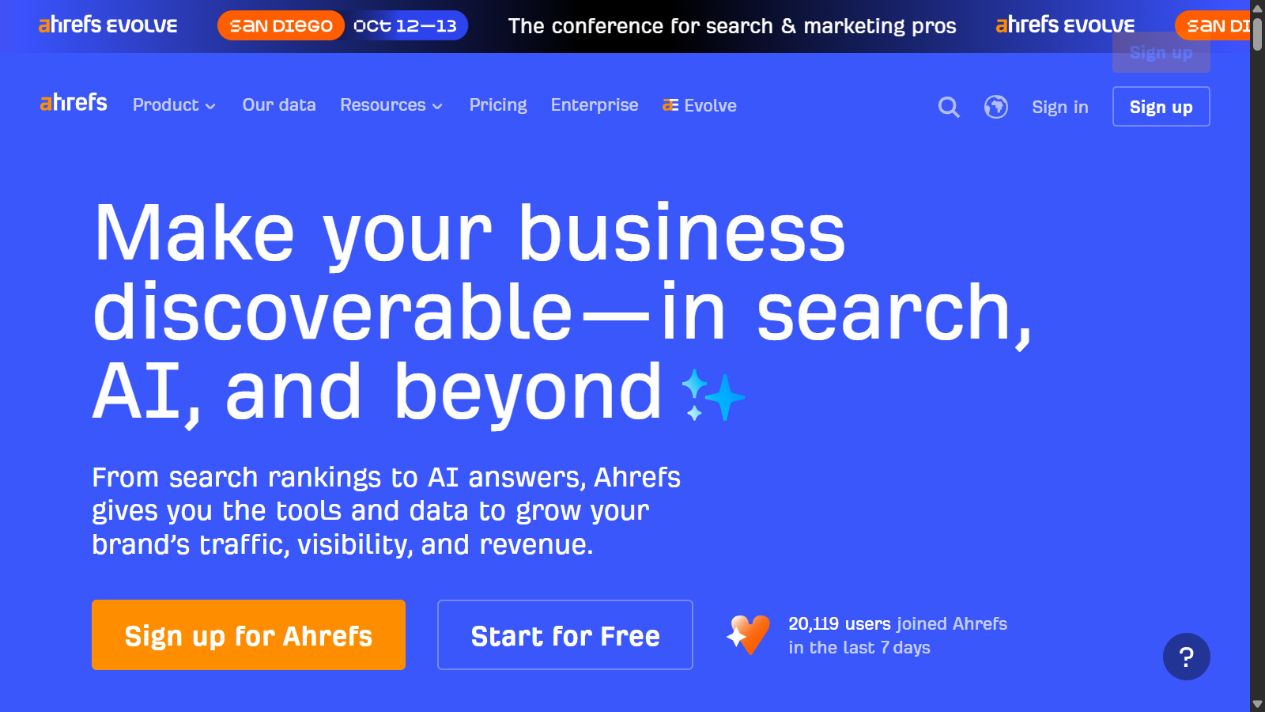
Ahrefs’ official homepage, captured August 30, 2026. Source: Ahrefs .
Choose Ahrefs when: search, content, competitor, and backlink research are central to the startup’s growth model.
Check before buying: projects, users, credits or usage limits, country coverage, historical data, rank tracking, site audit, exports, API access, and how often the team will use link data.
Pilot task: research the same seed topic and competitor set used in another finalist, inspect the source and definition of each metric, crawl a bounded site, and export a repeatable opportunity report.
Official sources: Ahrefs , Ahrefs pricing , and Ahrefs data .
3. SE Ranking: best configurable multi-workflow platform
SE Ranking’s official site presents tools for rank tracking, website auditing, keyword and competitor research, backlinks, reporting, local marketing, and visibility across search and newer answer environments. Its plan structure makes it a relevant finalist for a startup that needs several recurring SEO workflows but wants to model usage more precisely.
The value proposition depends on configuration. A startup may care about daily tracking in one market, weekly tracking in several markets, a small number of projects, agency-style reports, or frequent technical crawls. Those are materially different workloads. The team should calculate the expected keywords, search engines, devices, locations, update frequency, websites, users, audits, and reports before comparing plans.
SE Ranking can fit an operations-minded growth team that wants one workspace for monitoring and reporting. The risk is assuming that similar feature labels imply identical data or depth across platforms. Test the target country, niche, competitors, and website rather than relying on a generic checklist.
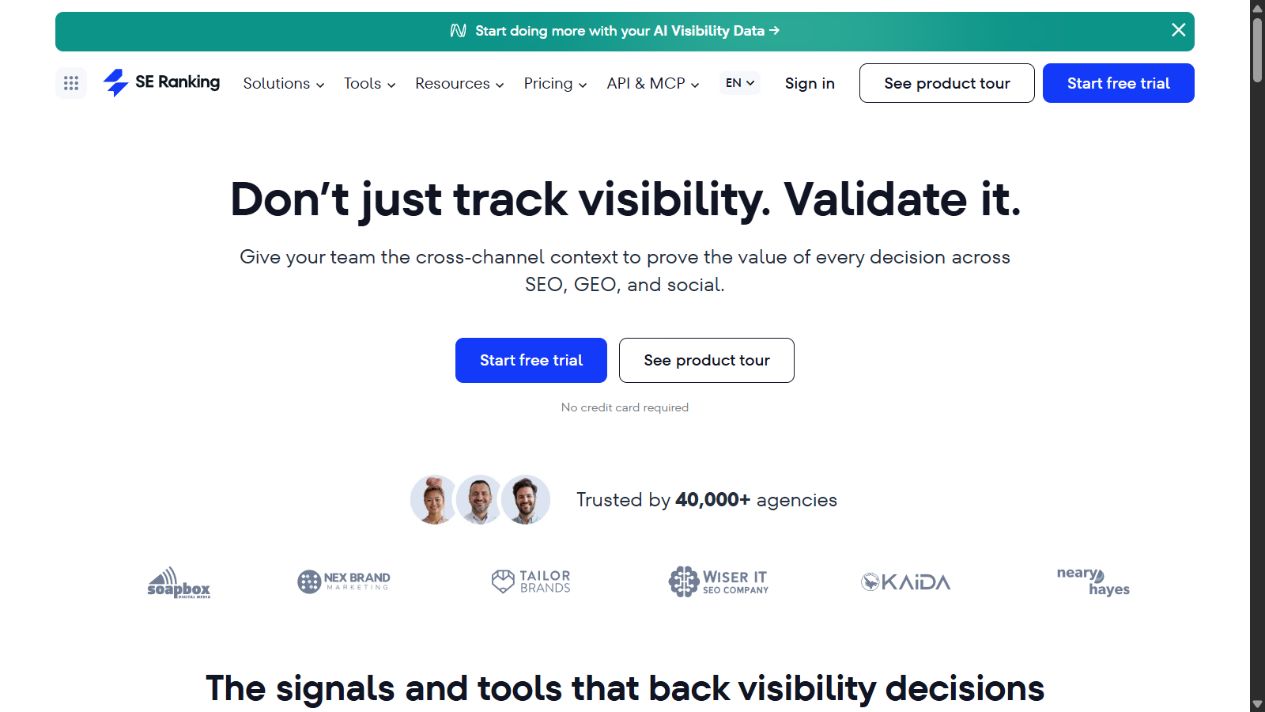
SE Ranking’s official homepage, captured August 30, 2026. Source: SE Ranking .
Choose SE Ranking when: the startup wants research, tracking, auditing, and reporting in a configurable platform with a clearly modelled workload.
Check before buying: tracking frequency, keyword and project limits, countries, devices, users, audit pages, reports, exports, competitor data, historical access, API, AI visibility features, and add-ons.
Pilot task: configure the actual tracking scope and generate the report leadership would review. Compare observed consumption with the selected plan rather than estimating from a sales page alone.
Official sources: SE Ranking , SE Ranking pricing , and SE Ranking Trust Center .
4. Screaming Frog SEO Spider: best specialist technical crawler
Screaming Frog describes SEO Spider as a desktop website crawler for onsite SEO analysis. Its official page covers finding broken links, reviewing redirects, analysing page titles and metadata, identifying duplicate content, generating sitemaps, extracting data, integrating supported services, and performing more advanced crawls under the licensed version.
This specialist orientation matters for a startup with a technically complex site, programmatic pages, migration work, international structures, rendering concerns, or frequent releases. A detailed crawl can expose patterns that a broad platform summarizes or samples. It also gives the operator substantial control over scope and configuration.
The tradeoff is expertise. A crawler does not know the business intent behind every URL. An apparent duplicate may be deliberate; a blocked resource may be harmless; a redirect may be necessary; a title rule may not apply to every template. The person running the tool must distinguish evidence from recommendations and connect findings to templates, analytics, indexation, and release history.
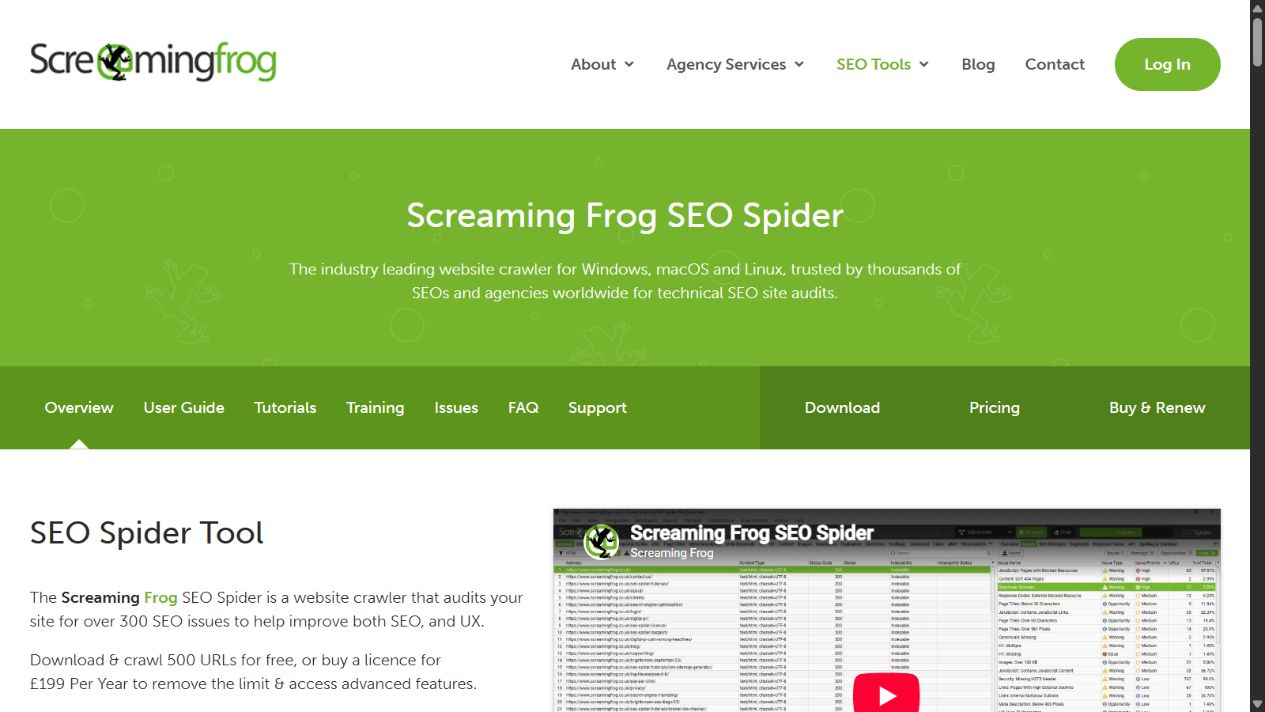
Screaming Frog SEO Spider’s official product page, captured August 30, 2026. Source: Screaming Frog SEO Spider .
Choose Screaming Frog when: the startup needs detailed technical crawling and has someone capable of configuring and interpreting the output.
Check before buying: free and licensed limits, operating-system support, local computer resources, storage, JavaScript rendering, scheduling, integrations, crawl configuration, export, and team process.
Pilot task: define one technical question, establish crawl boundaries, run the crawl, manually validate a sample of findings, identify the affected template, and estimate engineering impact before filing work.
Official sources: SEO Spider , SEO Spider pricing , and SEO Spider user guide .
5. Mangools: best focused keyword and tracking toolkit
Mangools presents a suite of tools for keyword research, search-result analysis, rank tracking, backlink analysis, and site or authority metrics. Its focused interface can suit a lean startup whose recurring needs are topic discovery, SERP inspection, tracking a bounded keyword set, and lightweight competitor research.
The advantage is scope discipline. A startup may not need advertising research, local listing management, large technical crawls, extensive reporting, or a broad marketing platform. A narrower toolkit can reduce cost and learning time when the team knows exactly which jobs it owns.
Scope discipline can turn into stack fragmentation if the startup later needs technical crawling, large-scale reporting, automation, multi-market data, or deeper competitor workflows. Include the price and administrative cost of required companion products when comparing Mangools with a broader platform.
Mangools’ official homepage, captured August 30, 2026. Source: Mangools .
Choose Mangools when: keyword research, SERP review, and rank tracking are the central jobs and a focused toolkit is preferable.
Check before buying: keyword lookups, tracked terms, locations, devices, refresh frequency, competitor lookups, link data, exports, users, history, and the need for a separate crawler or reporting system.
Pilot task: research a real topic cluster, inspect ten result pages, configure the priority tracking set, and produce a decision-ready summary without manual data cleanup.
Official sources: Mangools , Mangools pricing , and Mangools tools.
Which startup should choose which tool?
The shortlist makes more sense when mapped to an operating constraint:
- Choose Semrush when one team owns a broad visibility and competitor workflow and will use enough modules to justify consolidation.
- Choose Ahrefs when search, content, competitor, and backlink research drive the strategy and directional web-index data is valuable.
- Choose SE Ranking when tracking, auditing, research, and stakeholder reporting need a configurable operating platform.
- Choose Screaming Frog when the website itself is technically complex and detailed crawling is a recurring engineering input.
- Choose Mangools when the startup wants focused keyword, SERP, and rank workflows without a broad suite.
These products are not mutually exclusive, but overlap must be intentional. A common startup stack is Search Console plus one broad research platform and, when justified, one specialist crawler. Two broad suites often produce competing dashboards without creating two sets of decisions.
Start with the search operating model
Before opening a trial, document the search program in plain language. Identify the target audience, countries, languages, devices, products, website sections, conversion events, content owners, development capacity, and reporting audience. Decide whether SEO is primarily a content acquisition channel, a technical distribution problem, a local discovery channel, a product-led education system, or a combination.
Then list the decisions the software must support. Examples include:
- Which existing pages are losing qualified search demand?
- Which topic clusters deserve new or improved coverage?
- Which competitors are gaining visibility for the same audience?
- Which technical patterns affect indexation, rendering, or internal discovery?
- Which rankings should be monitored by country and device?
- Which changes produced measurable first-party outcomes?
If the team cannot name the decision, a dashboard will not create one.
Understand the data before trusting the dashboard
SEO software combines several data classes. Search Console and analytics provide first-party or property-linked information under their own definitions and limitations. A crawler observes URLs and responses from a configured crawl. A third-party platform estimates keywords, links, traffic, difficulty, or visibility from proprietary databases and models. AI visibility tools may monitor a selected set of prompts, engines, dates, and geographies.
These numbers should not be mixed without labels. Create a measurement dictionary that records the metric name, vendor, definition, source type, market, device, date range, update schedule, and owner. When a vendor changes a database or methodology, annotate the trend rather than interpreting the discontinuity as a market event.
Use third-party data to discover and compare patterns. Use first-party performance and business outcomes to evaluate the startup’s results. A competitor traffic estimate is not verified revenue, and a keyword difficulty score is not a promise that a page will rank.
A 30-day evaluation workflow
Days 1–2: define the test
Write five recurring decisions and a fixed sample: one website, five competitors, fifty tracked queries, one country, one device, one topic cluster, and a bounded technical crawl. Record the baseline process and time before introducing software.
Week 1: test discovery
Compare keyword, topic, competitor, content, and backlink workflows. Inspect whether the target market is represented and whether metric definitions are accessible. Record missing data and contradictions instead of hiding them.
Week 2: test monitoring
Configure the same rank scope, alerts, dashboards, and report. Confirm location, device, update frequency, and history. Ask a founder or non-specialist stakeholder to interpret the report without verbal rescue.
Week 3: test technical work
Crawl the same bounded site. Validate high-priority findings manually and identify whether the issue is page-specific, template-based, environmental, or intentional. Measure the work required to move from alert to engineering ticket.
Week 4: test actionability and administration
Choose three decisions and document how the software changed prioritization. Export the data, remove a test user, inspect permissions and retention information, review usage against limits, and calculate the annual cost at the observed rate.
Score every finalist on the same weighted rubric. Give workflow fit, data coverage, actionability, governance, and total cost more weight than the number of features in a demonstration.
Build the full annual cost
The visible subscription is not the full stack. Include users, projects, tracked keywords, countries, devices, update frequency, reports, crawl pages, exports, API use, historical data, AI visibility modules, local features, and add-ons. Include Search Console administration, analytics, a specialist crawler, reporting work, and any agency access where relevant.
Account for internal time. Measure how long it takes to investigate a traffic decline, audit a release, research a cluster, validate a technical finding, and prepare a decision-ready report. A lower subscription that adds several hours of manual cleanup may cost more than a higher plan.
Model normal renewal pricing and realistic growth. Do not make the recommendation from a temporary promotion or an initial keyword set the startup will outgrow in two months. Define an owner and a review date before signing.
Governance and security checklist
SEO tools can receive domains, keywords, competitor lists, analytics connections, Search Console access, cloud storage connections, and employee information. Apply least privilege. Separate administrator from ordinary users, use supported identity controls, review connected properties, remove former users, and document who can export data.
Review the vendor’s current privacy, security, subprocessors, retention, deletion, and support material. Confirm contractual needs with qualified professionals. Do not connect every data source simply because an integration exists; connect only what the approved workflow requires.
For crawlers, define safe rate limits, authentication handling, staging rules, excluded areas, and ownership. A poorly configured crawl can create unnecessary load or expose sensitive URLs in exports. Store reports according to the startup’s data policy.
Common mistakes
Buying before defining decisions
A feature-rich trial can create urgency without proving value. Start with recurring decisions and compare the same workload.
Treating estimates as facts
Third-party traffic, difficulty, authority, backlink, and visibility metrics are modelled. Preserve the vendor and method and validate real outcomes with first-party data.
Keeping overlapping suites
Two broad platforms may use different databases but still support the same operational decision. Keep both only when the difference has a documented owner and value.
Turning every crawl warning into a ticket
Crawler output requires context. Validate impact, scope, template, intent, and evidence before asking developers to change production.
Tracking too many keywords
A giant tracking list can consume limits and hide priorities. Track a governed set tied to products, audiences, markets, and decisions, then review it regularly.
Reporting without action thresholds
A dashboard without an owner, threshold, and next action is decoration. Every recurring report should state what decision it informs.
Final recommendation
Most startups should begin with Google Search Console, first-party analytics, and one primary SEO product aligned with the recurring workflow. Choose Semrush for broad visibility operations, Ahrefs for search and backlink-led research, SE Ranking for configurable tracking and reporting, Screaming Frog for detailed technical crawling, or Mangools for focused keyword and rank workflows.
Do not select from a generic feature matrix. Run the same market, competitor, keyword, crawl, and report test in the strongest two finalists. Document data definitions, verify plan limits, calculate the full annual stack, and assign owners for measurement and renewal. The best SEO software for a startup is the product that helps a small team make better search decisions consistently without turning estimates into certainty or dashboards into strategy.
Sources
Frequently asked questions
What is the best SEO software for a startup?
Semrush is the broadest option in this shortlist, Ahrefs is strong for search and backlink research, SE Ranking suits teams wanting a configurable multi-workflow platform, Screaming Frog is the specialist technical crawler, and Mangools offers a more focused keyword and tracking toolkit. Start with Search Console and buy only for a recurring gap.
Can a startup do SEO with free tools?
Yes. Google Search Console and first-party analytics can support essential performance and indexing work. Paid software becomes justified when competitor research, keyword databases, recurring rank tracking, technical crawling, reporting, or collaboration saves enough time or improves an important decision.
How many SEO tools does a startup need?
Most startups should begin with Search Console plus one primary research platform. Add a specialist crawler when technical auditing is recurring. Avoid maintaining multiple broad suites unless each has a documented, non-overlapping job and owner.
Why do SEO tools report different keyword and traffic numbers?
Vendors use different crawlers, databases, keyword sets, locations, update schedules, and estimation models. Treat third-party numbers as directional, compare trends inside the same platform, and validate the startup's actual performance with Search Console and analytics.
Should a startup track AI search visibility?
Track it only when the target audience uses relevant AI answer systems and the team can connect observations to decisions. AI visibility data is evolving, so document the vendor, query set, date, geography, and method instead of treating a single score as definitive.
When should a startup replace its SEO software?
Reassess when the tool no longer covers the target market, limits repeatedly block work, reports are not trusted, required technical analysis is missing, administration outweighs value, or overlapping subscriptions cannot be justified before renewal.
How should a startup test SEO software?
Use the same domain, competitors, country, device, keyword set, crawl scope, and reporting question in every finalist. Record data coverage, definitions, limits, setup time, export quality, actionable findings, and full annual cost before deciding.