Bolt.new Pricing: Plans, Costs, and Value
Understand Bolt.new pricing, usage-based cost drivers, plan selection, hidden implementation costs, and questions to verify before choosing a plan.
Direct answer
Bolt.new pricing is best evaluated as a combination of plan access, AI token consumption, cloud usage, and the human effort needed to turn generated output into dependable software. A low subscription price can still produce an expensive project when prompts are repeatedly regenerated, the application needs substantial security work, or the team lacks someone who can inspect and maintain the code.
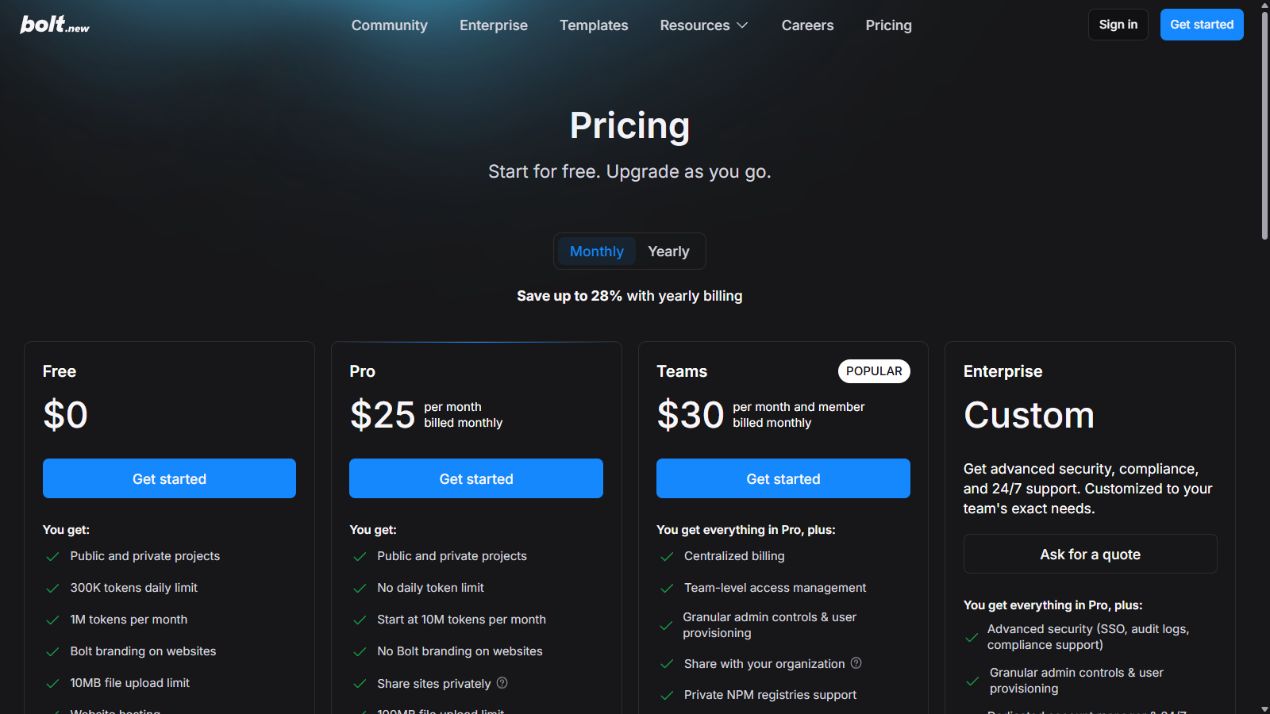
Bolt publishes a free starting option and paid plans for individual and team use. Exact prices, allowances, and promotions are volatile, so this guide does not freeze a number that may be wrong when you buy. We checked Bolt’s official pricing and support pages on August 24, 2026. Use the official order page for the final amount, currency, taxes, and contractual terms.
Bolt.new pricing at a glance
| Cost area | What to verify | Why it matters |
|---|---|---|
| Plan fee | Billing cadence, seats, included capabilities | Establishes the predictable base cost |
| AI usage | Included tokens, refresh timing, overage or upgrade path | Complex iterations can consume allowances quickly |
| Hosting | Bandwidth, storage, deployments, domains, databases | A prototype and a live service have different demand |
| Team use | Seat rules, project sharing, administration | Collaboration may require a different plan |
| External services | Model APIs, email, payments, analytics, databases | Third-party charges are not necessarily included |
| Production work | Security, QA, accessibility, monitoring, maintenance | Generated code is not automatically production-ready |
How Bolt’s pricing model works
Bolt combines access to its application-building workspace with usage allowances. The AI agent consumes tokens while reading project context, generating code, and responding to instructions. A simple landing page and a multi-step application with authentication, data, and integrations do not create the same usage profile.
The plan label alone therefore does not tell a buyer how much useful work the team will complete. Two teams on the same plan can have very different results: one may write precise requirements and accept small edits, while another repeatedly asks the agent to rebuild broad parts of the application.
Hosting is another layer. Official Bolt material describes Bolt Cloud, publishing, custom domains, and supporting services. Buyers should verify which allowances are included and what happens when a project exceeds them. A public prototype with occasional visitors is not comparable to a customer-facing application with persistent data and operational requirements.
Free plan: useful for learning, not proof of production cost
The free option is most useful for understanding the interface and testing a contained idea. It can answer practical questions: Can the user express requirements clearly? Does the generated structure resemble the intended workflow? Can someone inspect and correct the code?
It cannot establish the final cost of a production project. A realistic pilot should include representative screens, data states, error handling, permissions, and at least one integration. If the test avoids the difficult parts, its token use and engineering effort will understate the real requirement.
Use the free tier for exploration, then document what remains before estimating a paid rollout.
Individual paid plans: match allowance to iteration behavior
An individual paid plan can suit a founder, designer, product manager, or developer who builds prototypes regularly. The key selection question is not simply how many projects the person wants. It is how much context and regeneration each project requires.
A disciplined user can reduce waste by defining acceptance criteria, requesting narrow changes, committing stable versions, and resolving one issue at a time. Vague prompts such as “make the whole app better” create less predictable consumption and make regressions harder to trace.
Before selecting a plan, run a representative pilot and record:
- tokens consumed by the initial build;
- tokens consumed by corrections;
- manual coding time;
- deployment and configuration work;
- defects found after the interface appeared complete;
- expected number of similar projects each month.
That evidence is more useful than estimating from the number of prompts.
Team plans: collaboration and governance affect value
Team pricing should be evaluated against shared ownership, not just multiplied seats. Confirm how projects are shared, who can manage membership, whether private work is supported, and how usage is visible and controlled.
The operational question is whether the plan reduces coordination cost. A shared workspace can help when product, design, and engineering collaborate around the same prototype. It creates less value if each person generates isolated projects that later require consolidation.
Teams also need policies for approved data, dependencies, deployment targets, and review. Without them, faster generation can increase the volume of unreviewed software rather than accelerate dependable delivery.
Costs not captured by the Bolt subscription
External APIs and services
An application may depend on payment processing, transactional email, analytics, model APIs, databases, authentication, maps, or other services. These providers can charge separately. Confirm who owns each account, how credentials are stored, and what happens when a service limit is reached.
Security and privacy review
Applications that collect personal, financial, employee, health, or customer data require a more demanding review. Budget for threat modelling, access controls, secrets management, logging, retention, incident handling, and compliance assessment where applicable.
Testing and accessibility
A generated interface can look complete while failing keyboard navigation, mobile layouts, error states, browser compatibility, or data validation. Include functional, accessibility, performance, and regression testing in the cost model.
Maintenance and ownership
Dependencies change, APIs fail, and requirements evolve. Someone must understand the code, monitor the service, apply updates, and recover from defects. If nobody accepts that responsibility, the project is not inexpensive; it is under-owned.
Migration and exit
Ask how the team will export code, preserve data, replace infrastructure, and transfer domains if requirements outgrow the current setup. Exit work belongs in the buying decision even when it is not an immediate expense.
Scenario-based cost planning
A founder validating an idea
The founder may need one individual plan for a contained prototype. The subscription can be a small part of the value calculation if it replaces days of setup. The boundary should be explicit: validate the workflow, do not collect sensitive live data, and obtain technical review before launch.
A product team producing internal prototypes
The team should model seats, monthly project volume, average token consumption, and engineering review. Value comes from faster learning and clearer requirements, not from counting generated screens.
A business launching a customer-facing service
The subscription is only one line item. Add architecture, security, privacy, QA, monitoring, support, backups, third-party services, and ongoing maintenance. Compare the total with a conventional development path and a hybrid approach where Bolt accelerates prototyping but engineers own production.
Questions to ask before buying
- What exact token allowance applies, and when does it reset?
- Which actions consume tokens most heavily?
- What hosting, bandwidth, storage, domain, and database allowances are included?
- Are external model or service charges separate?
- What collaboration and administration controls require a team plan?
- Can code and data be exported in a usable form?
- What support is available when deployment fails?
- Which security and compliance responsibilities remain with the customer?
- How are plan changes, cancellations, and unused allowances handled?
- What taxes, currency conversion, or contractual minimums apply?
Build a defensible monthly budget
A useful budget separates predictable and variable costs. Put the plan fee and known seats in the predictable column. Put tokens, hosting growth, third-party services, and engineering intervention in the variable column. Then add a contingency for the first production cycle, when hidden requirements are most likely to appear.
Start with one representative project rather than an idealized demo. Record the project size, number of screens, data objects, integrations, user roles, and deployment environment. Track token consumption at the end of each meaningful milestone. This creates a baseline that can be compared with future projects.
Do not treat every token as equally productive. Label usage as initial generation, accepted iteration, discarded iteration, debugging, or rework caused by an earlier instruction. A team that knows where consumption goes can improve its specifications and prompts. A team that sees only the monthly total cannot distinguish productive demand from avoidable churn.
Convert technical review into an explicit budget line. Estimate the hours needed to inspect dependencies, authentication, authorization, data handling, errors, accessibility, performance, deployment configuration, and monitoring. If the application is business-critical, include an independent security review and recovery testing.
Finally, model three demand levels:
- Expected: the normal number and complexity of projects;
- High: a busy month with more iterations and deployment traffic;
- Failure: a project requires substantial regeneration or manual repair.
The plan is financially resilient only when the business understands all three outcomes.
Procurement and governance checklist
Confirm ownership
Document who owns the Bolt workspace, generated repository, domain, database, third-party accounts, and deployment credentials. Company work should not depend on an employee’s personal account. Confirm how ownership transfers when a person leaves or a supplier changes.
Define approved use
Specify which projects may use Bolt and which require another development path. Marketing prototypes and internal demonstrations have a different risk profile from payment, healthcare, identity, or customer-data systems. A written boundary prevents a successful low-risk experiment from becoming an unreviewed high-risk deployment.
Control sensitive data
Do not paste secrets, private customer records, proprietary source code, or regulated data into a project without an approved policy and verified contractual basis. Review Bolt’s current privacy, security, and data-handling terms with the appropriate owner. Product pages alone do not establish compliance for a particular organization.
Establish release approval
Decide who can publish, connect a domain, change environment variables, and approve a production release. Require a checklist covering tests, security, accessibility, monitoring, backups, and rollback. Fast deployment is useful only when release authority remains controlled.
Retain an exit path
Periodically confirm that the team can access the source, understand the dependency list, recover required data, and deploy outside the current workflow if necessary. An exit test is more credible than a contractual assumption that migration will be easy.
Signals that the current plan is too small
A plan may be too small when normal, well-scoped work repeatedly reaches its allowance; team members delay necessary corrections to preserve tokens; shared projects require awkward account workarounds; or production usage is approaching hosting limits. Upgrade only after confirming that the pressure comes from valuable work rather than unclear prompts or abandoned experiments.
The opposite problem also matters. A plan may be too large when allowances remain unused, projects do not reach a validated outcome, or the team pays for collaboration controls it has not adopted. Review usage and completed outcomes together each month.
Compare Bolt with the real alternatives
The relevant alternative may be a conventional development environment, a developer using an AI coding assistant, a no-code platform, an agency, or postponing the project. Compare total effort and risk, not marketing labels.
A conventional workflow may require more setup but give engineers clearer control over architecture and operations. A no-code platform may offer stronger guardrails for a narrow workflow but less code flexibility. An agency may cost more upfront while providing accountable delivery. Bolt’s advantage is strongest when rapid generation and visible iteration remove meaningful delay without hiding unacceptable production risk.
How to decide whether Bolt.new is good value
Measure outcomes that matter: time to a testable workflow, percentage of generated work retained, defects found during review, engineering hours needed for production, and time saved during later iterations.
Bolt can be good value when it compresses the path from idea to a useful prototype and the team has the expertise to review what it creates. It is poor value when users consume allowances through broad regeneration, generated projects are abandoned, or production hardening exceeds the effort saved.
The right plan is the smallest one that supports a representative workflow with enough headroom for correction. Upgrade from evidence, not optimism.
Final guidance
Treat Bolt.new pricing as project economics rather than a subscription comparison. Verify the live plan terms, run a representative pilot, and include AI usage, hosting, external services, security, testing, maintenance, and exit costs. A fast prototype is valuable, but it is not the same as a low-cost production system.
FAQs
Does Bolt.new have a free plan?
Bolt publishes a free starting option with limits. Verify the current token, project, hosting, and feature allowances on its official pricing page.
What makes Bolt.new costs increase?
Large project context, repeated regeneration, team seats, cloud usage, third-party services, and production hardening are the main cost drivers.
Is hosting included with Bolt.new?
Official Bolt material describes hosting through Bolt Cloud. Confirm the current allowances and overage or upgrade rules for the selected plan.
Can I estimate cost from the monthly fee alone?
No. Include usage, integrations, engineering review, security, testing, monitoring, and maintenance.
Is Bolt.new cheaper than hiring a developer?
That depends on scope and risk. Bolt may reduce prototyping effort, but it does not remove the need for qualified production ownership.
Official sources
Frequently asked questions
Does Bolt.new have a free plan?
Bolt publishes a free starting option with usage limits. Check the current pricing page because included tokens, hosting allowances, and feature access can change.
What makes Bolt.new costs increase?
The main drivers are AI token consumption, project complexity, repeated regeneration, team seats, hosting usage, domains, databases, and the engineering work required to harden a generated application.
Is hosting included with Bolt.new?
Bolt's official material describes hosting through Bolt Cloud under applicable allowances. Confirm bandwidth, storage, domain, database, and overage terms for the selected plan.
Can a business estimate Bolt.new cost from the subscription alone?
No. A realistic estimate should include the subscription, usage, hosting, integrations, security review, testing, maintenance, and migration or rollback work.
Did The SaaS Education test Bolt.new billing?
No. This guide uses official pricing and support material checked on August 24, 2026 and does not claim a hands-on billing test.