Bolt.new vs ChatGPT: Which Is Better?
Compare Bolt.new and ChatGPT for app building, coding help, deployment, collaboration, pricing, and business workflow fit.
Direct answer
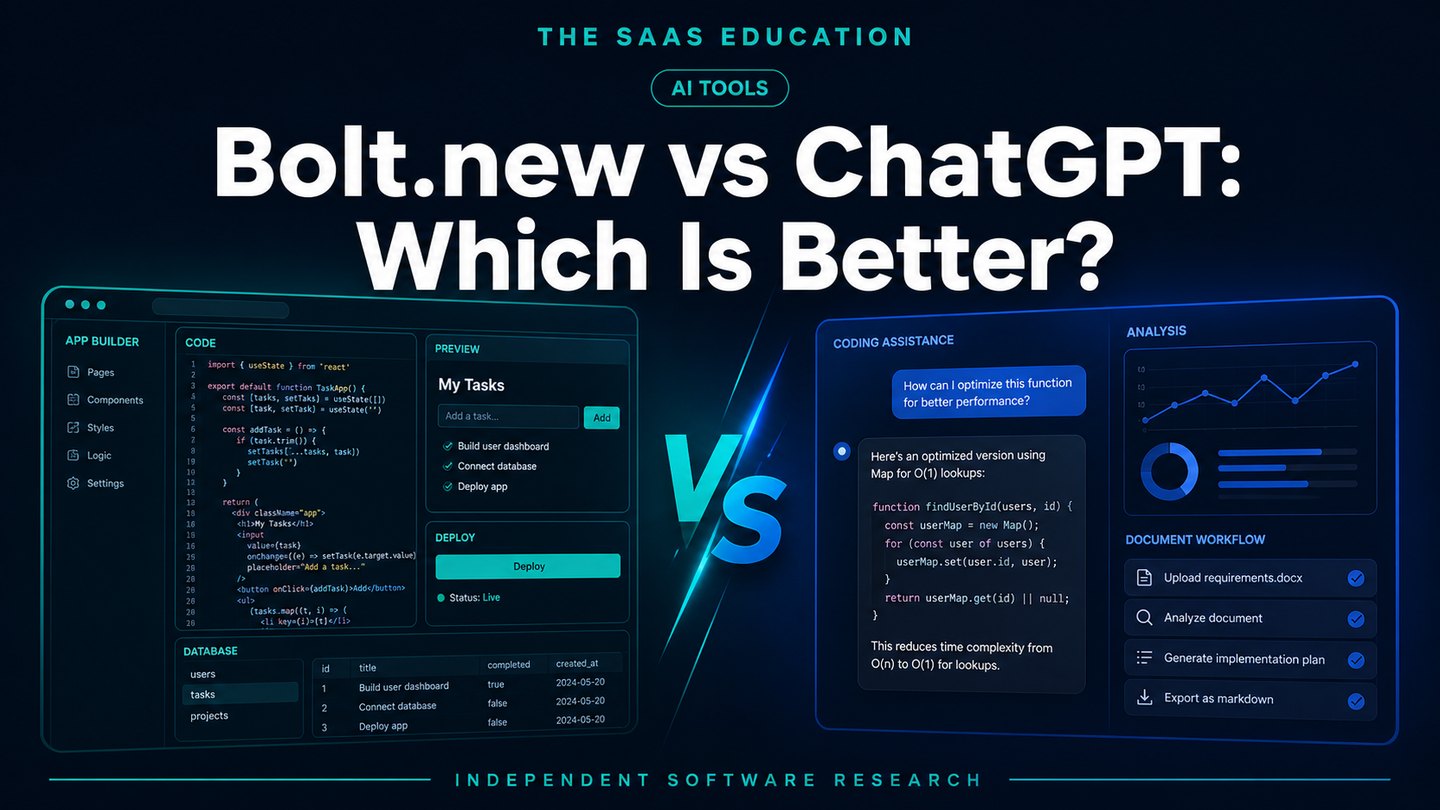
Bolt.new is better for turning a prompt into a working web application inside an integrated browser workspace. ChatGPT is better as a general-purpose assistant for planning, writing, research, analysis, coding guidance, and review. Choose Bolt when deployment and an interactive app preview are central to the job. Choose ChatGPT when the work extends beyond one application project or when you want a broader reasoning and collaboration workspace.
This is not a like-for-like contest. Bolt is an AI application builder; ChatGPT is a general AI workspace that also supports coding. We compared official pricing, product, help, and release documentation checked on August 7, 2026. We did not independently benchmark generated code quality or deployment reliability.
Bolt.new vs ChatGPT at a glance
| Decision | Bolt.new | ChatGPT |
|---|---|---|
| Primary job | Build and deploy web apps from a browser workspace | General assistance across writing, analysis, research, coding, and team knowledge |
| App preview | Integrated development preview | Can create and revise code, but is not the same managed app-hosting workflow |
| Hosting and domains | Bolt plans document hosting and custom domains | Not positioned as an equivalent website hosting service |
| Collaboration | Teams plan adds team management and collaboration | Business workspace supports shared administration and company context |
| Usage model | Token allowances vary by plan | Seat plans and model/feature limits vary by plan |
| Best fit | Rapid web prototypes and contained app projects | Broader business work and technical reasoning |
Methodology
We evaluated the products by job fit, not by asking which model is “smarter.” The criteria were:
- speed from brief to working prototype;
- control over code, dependencies, data, and deployment;
- breadth beyond software development;
- collaboration and administration;
- pricing and usage constraints;
- security and production-review requirements.
Where Bolt.new is stronger
Bolt combines prompt-driven development with a browser-based project environment. Its official pricing page documents hosting, token allowances, private projects on paid plans, custom domains, and team administration in relevant tiers. That reduces the handoff between generating code, seeing the application run, and publishing a prototype.
Bolt is the better fit when the reader’s job is concrete: create a landing page, internal tool, small web application, or prototype and iterate visually. It is not an excuse to skip engineering review. Authentication, secrets, database permissions, dependency risk, logging, accessibility, and rollback still need human ownership.
Sources: Bolt pricing , Bolt documentation , and Bolt release notes .
Where ChatGPT is stronger
ChatGPT covers a broader operating surface. OpenAI documents plans for individual and business use, coding and analysis capabilities, Canvas for working on text and code, connected tools in eligible business plans, and administrative controls. It is better when the same workspace must support research, requirements, data analysis, documentation, code explanation, review, and communication.
ChatGPT can help design an architecture, critique code, explain an error, draft tests, or produce a component. It does not remove the need for a development environment, deployment system, monitoring, and secure secret management.
Sources: ChatGPT pricing , ChatGPT Business overview , and Canvas documentation.
Pricing and cost drivers
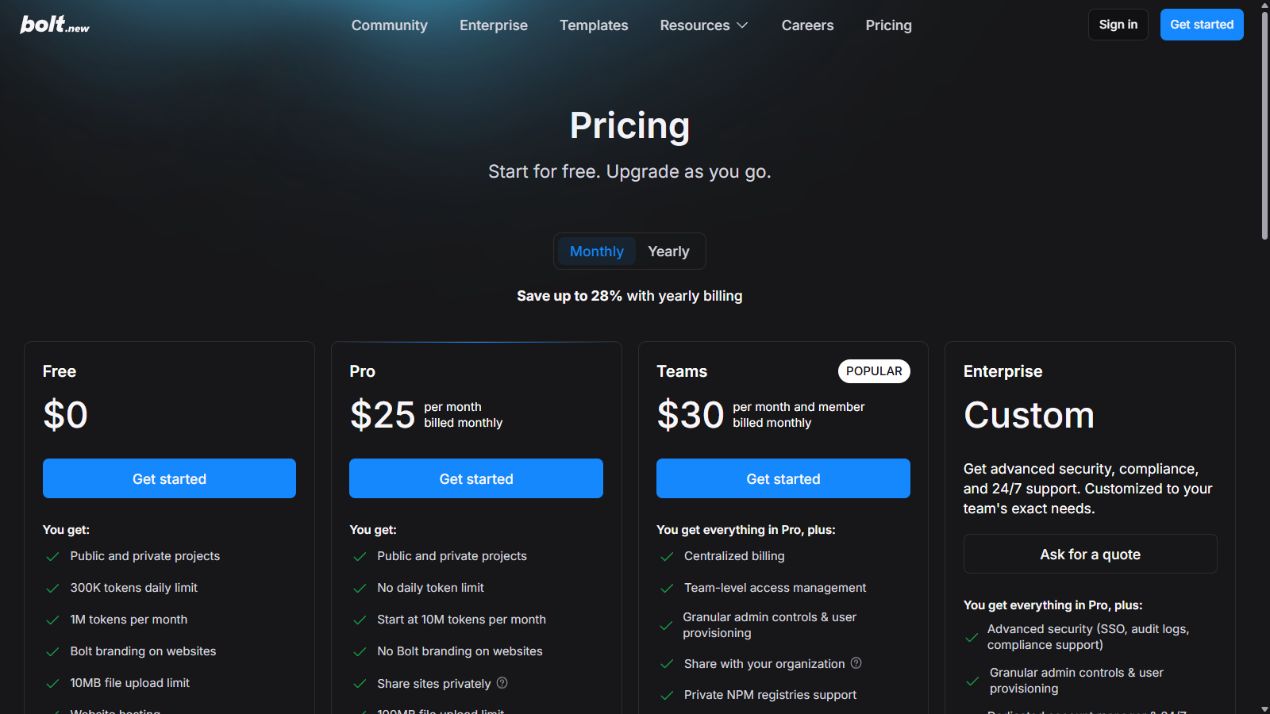
Bolt’s public pricing page listed Free, Pro, Teams, and Enterprise plans when checked. Pro and Teams add larger token allowances and business-oriented controls. The practical cost driver is not only the monthly plan: token consumption, hosting usage, domains, databases, and the engineering time needed to harden generated work can matter more.
ChatGPT’s public plan structure includes individual and business editions. Its cost driver is generally seats and plan limits, while API usage is separate. Verify current checkout terms for both products because promotions, taxes, currencies, model access, and usage allowances change.
Which should you choose?
Choose Bolt.new when:
- the target is a web application or website prototype;
- integrated preview and hosting reduce meaningful setup work;
- the team can review generated code and deployment settings;
- the project is contained enough to understand its data and security risk.
Choose ChatGPT when:
- the work includes research, planning, documentation, analysis, and coding;
- developers want explanation and review across an existing toolchain;
- the company needs one general workspace for several roles;
- deployment remains in established engineering systems.
Choose neither as the sole production control when the application handles regulated data, payments, critical operations, or high-risk authentication without professional engineering and security review.
A fair pilot
Give both tools the same small project: a three-page internal directory with form validation, search, role restrictions, and an export function. Record time to first working version, defects, accessibility, security assumptions, dependency choices, editability, deployment steps, and total usage. The winner is the tool that leaves the team with the most understandable and maintainable result, not the fastest first screen.
Use our AI tool selection guide and AI tools evaluation guide to structure that test.
Verdict
Bolt.new wins for integrated prompt-to-app prototyping. ChatGPT wins for breadth, reasoning, and work that spans coding and non-coding tasks. A mature team may use both, but it should define which system owns source code, secrets, deployment, and approval before the prototype becomes a production service.
Frequently asked questions
Is Bolt.new better than ChatGPT for building an app?
Bolt.new is the more direct choice when the goal is to generate, run, host, and iterate on a web application in one browser workspace. ChatGPT is broader and better suited to planning, explaining, reviewing, and assisting across many kinds of work.
Can ChatGPT replace Bolt.new?
Not completely. ChatGPT can help write and reason about code, but Bolt is designed around an integrated app-building and deployment workflow.
Should a non-developer use Bolt.new?
A non-developer can prototype with Bolt, but production use still requires review of security, authentication, data handling, dependencies, errors, and deployment settings.