Character.AI Features: Complete Guide
Understand Character.AI chat, character creation, voice, memory, discovery, creator tools, privacy, and the practical limits to test in 2026.
Direct answer
Character.AI is an AI entertainment and creation platform built around discovering, creating, and interacting with characters. Its main feature groups are character chat, character creation and definitions, profiles and discovery, voice experiences, memory tools, creator resources, sharing, and plan-dependent enhancements.
The platform should not be evaluated as a conventional productivity assistant. Its central promise is expressive, continuing interaction with a designed persona. That makes character quality, conversation continuity, discovery, safety, and creator control more important than spreadsheet analysis, coding, or source-grounded research.
This guide uses official sources checked on September 3, 2026 and a live review of ranking-page coverage. We did not run a controlled feature test. Response quality, memory, latency, moderation, and consistency must therefore be tested directly rather than inferred from documentation.
Character.AI homepage captured September 3, 2026. Feature availability can differ by account, age, platform, region, experiment, and plan.
Character.AI feature map
For the underlying product references, use Character.AI’s official help center , Calls and Voice documentation , and product announcements . Check the current subscription page for paid entitlements. These sources describe offered capabilities, not independently measured performance.
| Feature area | What it supports | What to verify |
|---|---|---|
| Character discovery | Browsing and finding public characters and experiences | Identity, source rights, quality, safety, and whether a creator is official |
| Character chat | Text interaction with a selected persona | Continuity, accuracy, boundaries, moderation, and recovery from drift |
| Character creation | Name, avatar, greeting, tags, description, definition, visibility, and related settings | How reliably the character follows its intended voice and rules |
| Voice experiences | Character voice across supported calls, stories, streams, or other experiences | Consent, impersonation risk, privacy, environment, and availability |
| Memory | Message history and documented memory tools such as Story Memories and Facts | Capacity, plan rights, user control, errors, and sensitive information |
| Creator and discovery tools | Guidance, publishing, presentation, audience, and discovery support | Eligibility, content policy, metrics, ownership, and discoverability |
| Paid enhancements | c.ai+ or other current plan-dependent capabilities | Exact entitlement, limits, renewal, cancellation, and actual value |
1. Character discovery
Character.AI allows users to explore characters created by the platform’s community and other available experiences. Discovery is important because most users do not begin by building a character from scratch. They choose from names, genres, scenarios, tags, and presentation cards.
Discovery should not be mistaken for verification. A familiar name, realistic avatar, or confident description does not prove that a character is official, authorized, accurate, or safe. Public characters may be inspired by fictional works, historical figures, public people, original personas, or concepts. Users should inspect the profile and creator information and avoid assuming endorsement.
For creators, tags, names, avatars, greetings, and descriptions are not decorative metadata. Official creator guidance explains that these fields shape how a character appears and can be found. A discoverable profile makes a clear promise about the interaction without using misleading identity or rights-sensitive material.
2. Character chat
Text chat is the central interaction. A user selects a character and enters an open-ended conversation or scenario. The character responds according to the model, its definition, conversation context, platform behavior, and safety systems.
Good character chat is judged differently from a factual assistant. Voice, personality, pacing, initiative, emotional tone, and continuity may matter more than concise correctness. That does not remove the risk of false information. A character can sound certain while inventing facts, misremembering earlier events, or contradicting its own premise.
Use chat for entertainment, creative exploration, roleplay, dialogue practice, and low-risk brainstorming. Do not treat it as professional medical, legal, financial, safety, or crisis guidance. Important claims should be verified with authoritative sources and qualified people.
Test a character over a longer session. Ask whether it preserves names, relationships, setting, goals, boundaries, and unresolved events. Note how it handles corrections and whether it begins controlling the user’s role without permission. One entertaining exchange is not proof of sustained quality.
3. Character creation
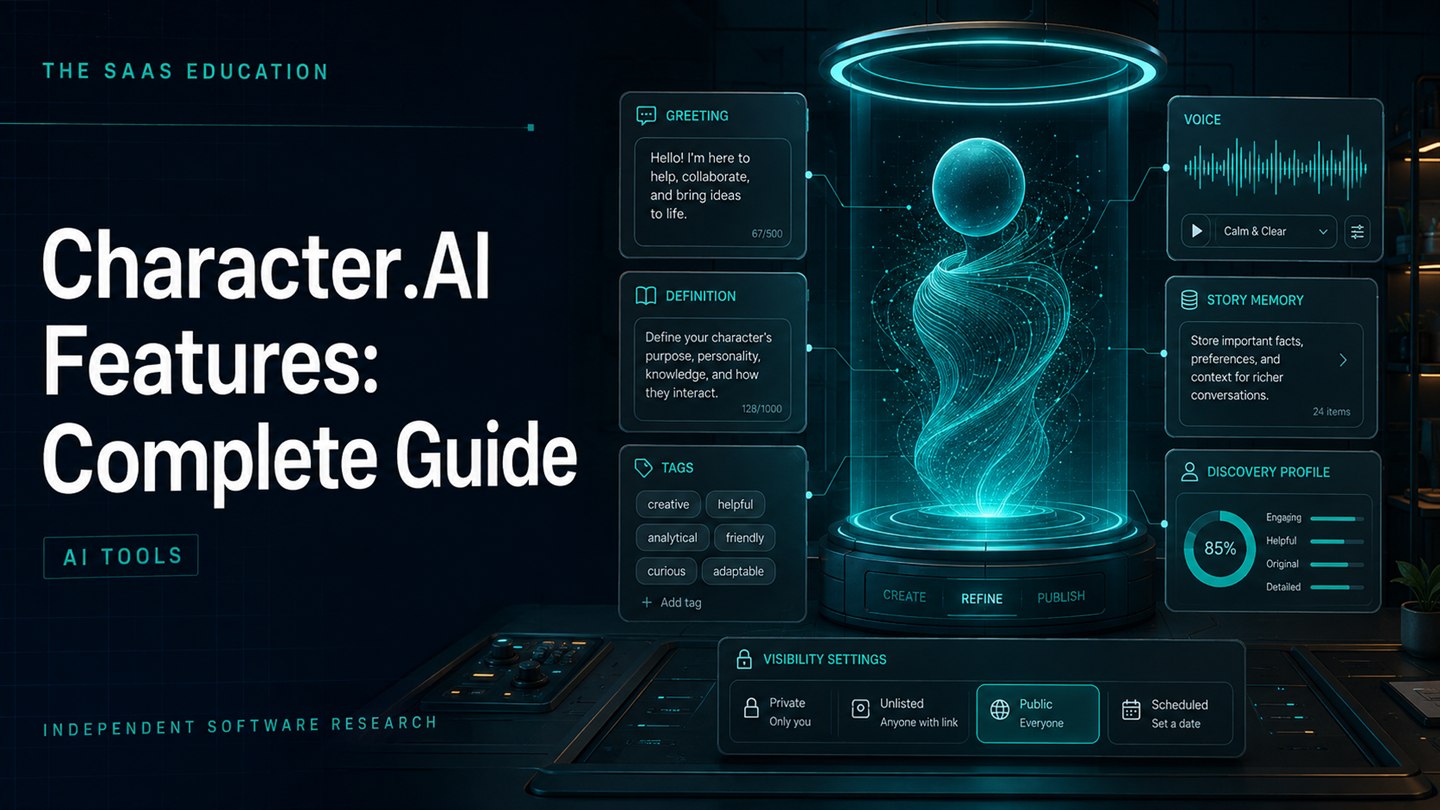
Official creator documentation describes a creation flow with fields such as name, avatar, greeting, tags, description, definition, visibility, and voice. These fields work together to establish identity, presentation, behavior, and discovery.
Name and avatar
The name and avatar are the first identity signals. Use an original or authorized identity and avoid implying that a public figure, brand, or rights holder created or endorsed the character. An attractive avatar cannot compensate for a confusing premise.
Greeting
The greeting opens the interaction. It can establish setting, voice, tension, relationship, and a clear invitation for the user to respond. A generic greeting forces the model and user to invent context immediately. A strong greeting demonstrates the experience without writing the user’s actions for them.
Tags and description
Tags support categorization and discovery. The description communicates the premise. Keep both specific and consistent. If tags promise mystery while the description presents casual tutoring, users and the system receive conflicting signals.
Definition
The definition is the deeper behavioral specification. Official guidance describes approaches including structured character information, example dialogue, or a combination. Focus on stable identity, motivation, knowledge boundaries, speech patterns, relationships, and scenario rules.
More text is not automatically better. Contradictory details, excessive trivia, and vague adjectives can weaken behavior. Test the definition with adversarial prompts: ask about unknown facts, change the setting, challenge a boundary, and see whether the character recovers after correction.
Visibility and publication
Visibility determines who can access the character under current product controls. Before publishing, review names, images, source material, personal data, and content-policy requirements. A private setting reduces discovery but should not be treated as a substitute for appropriate data handling.
4. Voice features
Character.AI’s current creator guide references audio that gives characters a voice in calls, stories, and streams. Voice can make an interaction feel immediate and improve accessibility or performance for some users.
Synthetic voice also raises additional questions. A voice may resemble a real person, expose conversation content to people nearby, or encourage users to perceive the system as more human and authoritative than it is. Do not create or share deceptive impersonations, and follow current consent, rights, and platform requirements.
Test pronunciation, names, accents, emotional range, interruptions, latency, and environmental behavior. Use headphones where appropriate and avoid disclosing sensitive information aloud in public or shared spaces.
5. Memory tools
Conversation continuity is a major user concern. Character.AI’s official memory update documents elements such as message history, Story Memories, Facts, and a view of memory usage. It also identifies plan-dependent capability, including Facts as a c.ai+ feature when that update was published.
Memory should be treated as assistance, not perfect recall. A system can omit, distort, or overemphasize details. Users should not store secrets merely to improve continuity. For a long creative project, keep an external story bible containing canonical people, places, chronology, rules, and unresolved plot points.
Test memory by introducing a small set of explicit facts, continuing the conversation, changing topics, and checking later recall. Correct errors clearly. Observe whether the correction persists and whether older context is displaced as the session grows.
6. Creator guidance and audience tools
Character.AI publishes a Creator Guide covering creation, refinement, presentation, discovery, voice, and related workflows. Official 2026 updates also describe creator-focused capabilities intended to help characters improve and reach an audience.
Creators should define success before chasing visibility. Measures can include returning users, conversation depth, follows, qualitative feedback, completion of a scenario, or successful discovery through appropriate tags. Engagement alone is not proof that an experience is healthy or high quality.
Maintain version notes for meaningful changes to a definition, greeting, avatar, or premise. Test privately before exposing an update to a large audience. Provide a way for users to report identity, safety, or quality concerns.
7. Stories, streams, and evolving experiences
Character.AI has expanded beyond a single text-chat format. Official guides and updates reference stories, streams, scenes, and other changing experiences. Some experiences and youth access can differ materially from the open-ended chat a reviewer describes.
Because the product evolves quickly, use the current account interface and official help center as the source of truth. Check age, platform, regional, and experimental availability. Do not promise a feature to a classroom, community, or campaign until it is confirmed for the intended users.
8. c.ai+ and plan-dependent features
Character.AI offers free access and a paid c.ai+ path, with current pricing and entitlements described on official pages. Paid value can include experience or feature differences, but old articles can become inaccurate as benefits change.
Evaluate the paid plan after observing actual use. Record waiting, speed, memory needs, usage frequency, and which paid-only capability would change the experience. Subscribe because a named limitation is worth solving, not because “premium” is assumed to improve every response.
Review billing period, renewal, cancellation, refunds, regional taxes, age requirements, and account ownership. For a family or organization, confirm whether an individual subscription is appropriate rather than informally sharing credentials.
9. Safety, reporting, and age-related controls
Character interaction can involve mature themes, emotional attachment, user-generated identities, and unpredictable model output. Character.AI publishes safety and policy information and has changed youth experiences over time. Current controls and age rules must be checked directly.
Users should know how to report a character or response, block unwanted interaction where supported, and leave a distressing conversation. Parents and guardians should review the actual product experience, not only a feature list. Establish time limits and discuss that a fluent character is generated software, not a conscious confidant or qualified professional.
Creators should test boundary cases and avoid designs that encourage dangerous dependence, deception, harassment, or disclosure of sensitive information. Moderation can reduce risk but cannot guarantee that every output is suitable.
10. Privacy and data handling
Review Character.AI’s current privacy policy and terms before entering personal or confidential information. Consider account data, conversation content, uploaded media, voice, character definitions, public profiles, retention, deletion, and service providers.
Do not paste credentials, financial details, medical records, private workplace information, unreleased intellectual property, or another person’s personal data into a character chat. For creative work, remove unnecessary real-world identifiers and keep authoritative project files outside the platform.
If an organization is considering a use case, complete privacy, security, legal, records, accessibility, and procurement review. A consumer entertainment account is not automatically an approved workplace system.
How to evaluate Character.AI features
Use a small test plan rather than browsing randomly:
- Define the intended experience and age group.
- Select several public characters and inspect identity and creator information.
- Test short and long conversations for voice, continuity, boundaries, and recovery.
- Create a private character using a focused greeting, description, and definition.
- Test memory with known facts and corrections.
- Test voice only in an appropriate environment with consent and privacy in mind.
- Review safety, reporting, privacy, deletion, and plan controls.
- Compare free access with the specific paid limitation you would solve.
Record results rather than relying on novelty. A feature is useful when it improves a repeatable experience without introducing unacceptable safety, privacy, rights, or cost problems.
Final assessment
Character.AI’s strongest feature is not one button. It is the combination of community discovery, persona design, open-ended interaction, voice, and evolving memory that supports character-centered entertainment. The creator fields provide meaningful influence over identity and presentation, while newer guidance makes the creation process easier to understand.
Its limits are equally important. Characters can be inconsistent or wrong, memory is not perfect, feature access changes, public identities require care, and emotionally engaging output can be mistaken for trustworthy human understanding. Use it as an entertainment and creative platform with clear boundaries.
Frequently asked questions
What are the main Character.AI features?
The main groups are character discovery, chat, character creation, voice, memory, creator tools, evolving story or stream experiences, and paid enhancements. Availability can vary.
Can anyone create a character?
Eligible users can use the documented creation flow, but account, age, publication, and content requirements apply. Review current rules before sharing a character publicly.
Does Character.AI remember conversations?
It documents history and memory tools, but recall is limited and can be wrong. Keep important creative canon externally and avoid entering secrets.
Does Character.AI support voice?
Official guides describe voice across supported experiences. Test availability and consider consent, privacy, impersonation, and environmental safety.
Is it suitable for factual research?
No, not as an authoritative source. Characters may be fictional or inaccurate. Verify consequential claims through reliable primary sources.
Are all features free?
No. Some capabilities or experience differences are plan dependent. Check current official pricing and the account interface for exact entitlements.
How should parents evaluate it?
Review current age rules, youth experiences, safety controls, privacy, reporting, content, and time boundaries, then discuss the product actively with the child.
Frequently asked questions
What are the main Character.AI features?
Character.AI centers on discovering and chatting with AI characters, creating characters with identity and behavior fields, voice-enabled experiences, memory controls, creator and discovery tools, and paid enhancements. Exact availability can vary by age, platform, region, experiment, and plan.
Can anyone create a Character.AI character?
Eligible users can create characters through the documented creation flow using a name, avatar, greeting, tags, description, definition, voice, and visibility settings. Review current account, age, content, and publication requirements before sharing a character.
Does Character.AI remember conversations?
Character.AI documents memory features including message history and newer tools such as Story Memories and Facts, with some capabilities tied to c.ai+. Memory remains limited, so users should verify important continuity and avoid relying on it as an authoritative record.
Does Character.AI support voice?
Official guides describe voice-related experiences for characters, calls, stories, and streams. Availability and behavior can vary, and users should consider consent, privacy, impersonation, and environmental safety before using synthetic voices.
Is Character.AI suitable for factual research?
It is primarily an AI entertainment and character platform, not an authoritative research database. Character responses can be fictional, inconsistent, or wrong. Verify consequential facts with reliable primary sources.
Are all Character.AI features free?
No. Character.AI offers free access, while c.ai+ and other current offerings can include plan-dependent enhancements. Check the official pricing page for current limits and entitlements rather than relying on older reviews.
How should parents evaluate Character.AI features?
Review current age requirements, youth experiences, parental tools, content and safety documentation, privacy terms, reporting controls, time boundaries, and the child's use case. Product controls do not replace active supervision and conversation.