Character.AI Pros and Cons
Evaluate Character.AI strengths and limitations across roleplay, character creation, voice, memory, safety, privacy, accuracy, and paid value.
Direct answer
Primary references for this evaluation are the Character.AI product site , Safety Center , privacy policy , and terms . The Safety Center links to moderation, reporting and parental information; the existence of those controls should not be interpreted as a guarantee that every interaction is safe or accurate.
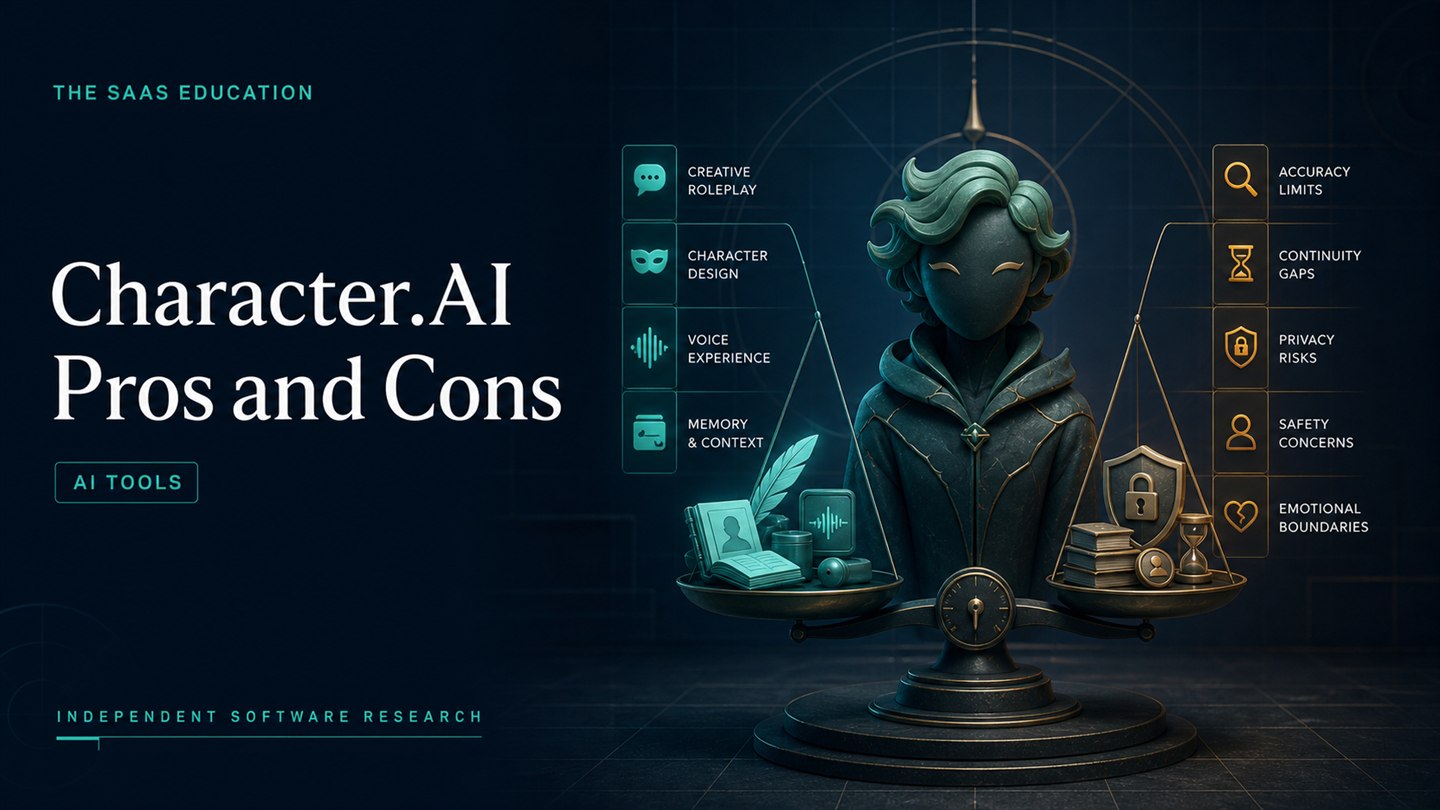
Character.AI is strong for imaginative roleplay, character discovery, persona creation, voice-enabled entertainment, and low-friction creative interaction. Its main weaknesses are inconsistent factual accuracy, imperfect memory, unpredictable long-session behavior, changing features and moderation, privacy and identity concerns, and the risk that emotionally convincing software is treated like a trustworthy person.
It is a better entertainment and creative-character platform than a general productivity tool. Users who want expressive dialogue and community-created experiences may find it compelling. Users who need cited research, dependable business work, confidential-data controls, or consequential advice should look elsewhere.
This evaluation combines official Character.AI sources with a live review of pages ranking for feature, review, and pros-and-cons intent on September 3, 2026. We did not conduct a controlled month-long roleplay test, so behavioral claims that require direct observation are framed as test questions rather than asserted results.
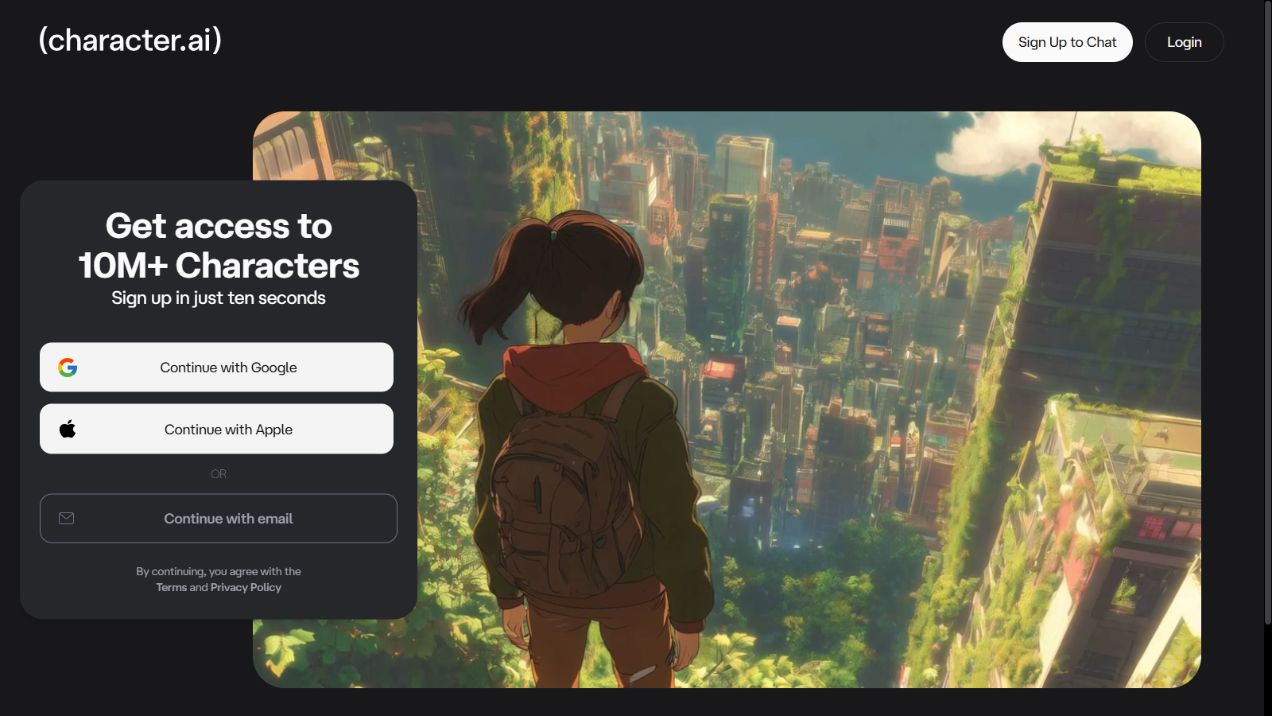
Character.AI homepage captured September 3, 2026. Current experience can vary by account, age, platform, region, experiment, and plan.
Character.AI pros and cons at a glance
| Pros | Cons |
|---|---|
| Character-centered experience rather than a generic assistant | Not an authoritative factual source |
| Broad discovery and low-friction conversation | Continuity and behavior can vary over long chats |
| Detailed creator fields for identity and presentation | Public characters can create identity and rights concerns |
| Voice and evolving memory tools | Voice and memory add privacy and reliability questions |
| Free access supports evaluation before subscribing | Paid value depends on current entitlements and actual usage |
| Useful for roleplay, dialogue, and creative exploration | Emotionally persuasive interaction requires healthy boundaries |
Pro 1: Character.AI has a clear product identity
Character.AI is not trying to be a spreadsheet assistant with a roleplay mode attached. Its official product and creator materials center on characters, stories, scenes, voice, creators, and discovery. That focus gives the experience a coherent purpose.
A clear identity helps users choose it for the right task. Someone seeking fictional dialogue, an original persona, a guided scenario, or an entertainment conversation can begin quickly. The platform’s design vocabulary aligns with that intent more closely than a general assistant optimized around tasks and information.
The same focus is a limitation for other jobs. It should not be purchased or recommended merely because it uses advanced AI. Product fit comes from the interaction being character-centered.
Pro 2: Discovery reduces the effort to begin
Users can explore existing characters instead of designing one immediately. Names, avatars, tags, descriptions, greetings, and creator presentation make the experience browsable. This lowers the barrier for someone who wants to understand the category before learning character design.
Discovery also helps creators observe which premises are understandable. A strong card communicates genre, relationship, voice, and expected interaction. Official creator guidance treats profile and presentation as part of the character experience rather than an afterthought.
Users should still distinguish discovery from verification. A visible or popular character is not necessarily official, authorized, accurate, or appropriate.
Pro 3: Character creation has meaningful depth
The documented creation system includes more than a display name. Creators can work with a greeting, tags, description, definition, avatar, visibility, voice, and related presentation choices. Official guidance explains that definitions can use structured information, example dialogue, or a combination.
These fields support deliberate characterization. A creator can establish motivation, background, speech patterns, relationships, boundaries, knowledge, and scenario. Example dialogue can demonstrate voice more clearly than a list of adjectives.
The tool also gives creators a practical learning loop: build privately, chat, identify drift, refine the definition or greeting, and test again. That does not guarantee consistency, but it offers more influence than selecting a generic chatbot personality.
Pro 4: It supports expressive and low-risk creative exploration
Character interaction can help people explore dialogue, scenes, fictional conflicts, alternative perspectives, and improvised storytelling. A response can introduce an unexpected direction that helps a writer move past a blank page.
The best use is exploratory rather than authoritative. Treat generated dialogue as material to evaluate and rewrite. Preserve human authorship, check originality, and avoid publishing output that contains false claims, rights-sensitive identities, or unintended stereotypes.
For education or practice, use cases should be supervised and clearly bounded. A historical persona can make a lesson engaging, but it can also invent statements. The character should not replace primary sources.
Pro 5: Voice can make interaction more immediate
Character.AI’s official creator guide references voice across calls, stories, and streams. Voice can improve immersion and give creators another dimension for a character’s presentation.
It may also help users who find spoken interaction easier than sustained typing. A voice experience can support rehearsal, language play, or performance when used with appropriate expectations.
This advantage depends on pronunciation, latency, emotional range, interruption handling, and environment. Voice should be tested for the intended language and scenario. Users also need consent and privacy boundaries, especially when a voice resembles a real person or a conversation can be overheard.
Pro 6: Memory features target a central roleplay problem
Long interactions need continuity. Character.AI has documented Story Memories, Facts, message history, and memory-usage visibility, with some capabilities identified as plan dependent. These features show attention to a problem that strongly affects character experiences.
Visible or editable memory can help a user understand what context is being preserved. Facts about personas, characters, and side characters can reduce repeated setup when they work as intended.
Memory remains assistance rather than a guarantee. For important creative projects, users should maintain an external story bible and verify continuity. Still, product-level memory controls are a meaningful advantage over relying entirely on an opaque conversation window.
Pro 7: Free access supports practical evaluation
Character.AI offers a free path, allowing eligible users to examine discovery, interaction, creation, and current limits before paying. That is valuable because character quality is subjective and cannot be established from a reviewer’s screenshots.
A sensible buyer can test the exact use case, device, language, and preferred characters. Only after observing a recurring limitation should the user compare c.ai+ or another paid option.
Free does not mean costless. Time, attention, data, and emotional impact matter. The platform should still be evaluated against healthy use and privacy boundaries.
Con 1: Characters can be confidently wrong
An AI character generates responses; it does not become the person, profession, or authority it portrays. A historical, medical, financial, legal, or technical character may invent facts while preserving an engaging voice.
This is especially risky because a consistent persona can feel credible. Fluency and emotional confidence can hide uncertainty. Users must verify consequential claims using reliable primary sources and qualified professionals.
Creators should state boundaries where appropriate and avoid presenting a character as verified expertise. Educational deployments need review, source links outside the character, and a correction process.
Con 2: Long-conversation continuity is not guaranteed
Memory tools address continuity but do not eliminate drift. A character may forget details, merge events, change relationships, repeat itself, or contradict its definition. Context capacity and product behavior can evolve.
The only responsible way to evaluate continuity is a structured test. Introduce known facts, sustain multiple topics, correct an error, and check later recall. Repeat across sessions and devices if those are part of the intended workflow.
Writers should keep canonical information outside Character.AI. Treat the conversation as improvisation, not the system of record for a long narrative.
Con 3: Public characters create identity and rights risk
Community discovery can include characters based on fictional works, brands, public figures, historical people, or real individuals. An avatar and name can imply authenticity even when none exists.
Users should not assume endorsement. Creators should use original or authorized materials, avoid deceptive impersonation, and review current content rules. Images, voices, names, trademarks, and character traits can raise different rights depending on jurisdiction and use.
Organizations should not use public characters as approved representatives without identity, content, legal, safety, and governance review.
Con 4: Safety controls cannot remove every risk
Character platforms can encounter sexual content, violence, self-harm, harassment, manipulation, and age-inappropriate themes. Character.AI publishes safety information and has changed youth experiences, but no moderation system guarantees every response.
Users need accessible reporting and exit options. Parents should inspect the current product, age rules, privacy terms, parental tools, and youth experience. Supervision and communication remain necessary.
Creators should test boundary cases and avoid designs that reward dangerous dependence or encourage users to conceal harmful behavior. A blocked response is not a complete safety strategy.
Con 5: Emotional realism can encourage over-reliance
A responsive character can appear attentive, affectionate, or understanding. That can be enjoyable, but it may encourage a user to attribute consciousness, loyalty, confidentiality, or professional judgment to generated software.
Set clear boundaries around time, money, and sensitive disclosure. Do not use a character as the only response to isolation, distress, abuse, or crisis. Seek trusted people, local emergency services, or qualified professional help as appropriate.
Product language and design should be evaluated for whether they preserve user agency. Engagement is not automatically well-being.
Con 6: Privacy needs active judgment
Conversations can feel private even when they are handled by an online service. Users should review current privacy, retention, deletion, and account controls and avoid entering unnecessary personal or confidential information.
Do not provide passwords, financial records, medical documents, private workplace data, unreleased intellectual property, intimate images, or another person’s personal information. Voice and uploaded media deserve the same care as typed messages.
For organizational use, conduct formal privacy, security, legal, records, and procurement review. Consumer availability does not establish workplace approval.
Con 7: Features and paid value can change
Memory, creator tools, youth experiences, pricing, and product formats have evolved. An older review can describe an interface or entitlement that no longer applies. Experiments can also produce different experiences among accounts.
Before subscribing, check official pricing and support pages and verify the capability in the intended account. Record the exact problem the paid plan should solve. Faster access or a premium label does not guarantee better character consistency.
Review renewal, cancellation, taxes, refunds, account ownership, and age requirements. Re-evaluate periodically rather than allowing a lightly used subscription to renew by default.
Who should choose Character.AI?
Character.AI is a reasonable fit for eligible users seeking entertainment, roleplay, fictional dialogue, persona creation, and voice-enabled character experiences. It also suits creators willing to test and refine characters while respecting identity, safety, and rights.
It is a weaker fit for source-grounded research, workplace analysis, confidential business processes, regulated decisions, guaranteed narrative continuity, or professional advice. A general assistant, specialist writing tool, approved enterprise system, human collaborator, or qualified professional may be more appropriate.
How to evaluate it responsibly
- Define the intended use and age group.
- Review current official feature, safety, privacy, pricing, and age information.
- Test several public characters and inspect identity and creator details.
- Run a longer conversation with known continuity checks.
- Create a private character and test greeting, definition, boundaries, and correction.
- Try voice and memory only with appropriate privacy and consent.
- Learn reporting, deletion, and account controls.
- Compare paid benefits with a specific recurring limitation.
- Set time and disclosure boundaries.
- Reassess if use affects well-being, relationships, spending, or responsibilities.
Is Character.AI worth it?
The free experience is worth evaluating for people specifically interested in AI characters and roleplay. It offers a clearer category fit than a general assistant and meaningful creator tools. The tradeoff is accepting that conversation is generated, fallible, changeable, and not confidential professional support.
c.ai+ is worth considering only for frequent users who can name a current paid benefit that materially improves their experience. Subscribe after testing, not to discover whether the category is appealing.
Final verdict
Character.AI’s advantages are focus, accessibility, discovery, creator depth, voice, and evolving memory. Its disadvantages are factual unreliability, continuity limits, identity and rights questions, safety and privacy risk, changing entitlements, and emotional over-reliance.
Choose it for bounded entertainment and creative character work. Keep authoritative information, sensitive data, important relationships, and consequential decisions outside the platform. That boundary preserves what is enjoyable about Character.AI without asking it to be something it is not.
Frequently asked questions
What are the biggest advantages of Character.AI?
Its focused character experience, discovery, creation fields, voice, memory tools, and free entry make it accessible for roleplay and creative entertainment.
What are the biggest disadvantages?
Responses can be wrong or inconsistent, memory is imperfect, public identities need care, features change, and emotionally realistic interaction can create privacy or reliance risks.
Is it good for productivity or research?
It is not the best default. It may support dialogue exploration, but authoritative research and business work require source-grounded, approved tools and human verification.
Is Character.AI safe for children?
It is not risk-free. Check current age rules and youth controls, supervise use, set boundaries, and discuss the difference between generated characters and people.
Is Character.AI private?
Review current privacy and account controls. Avoid entering secrets, records, workplace information, intimate content, or another person’s data.
Is c.ai+ worth paying for?
Only when a specific current entitlement solves a recurring problem for a frequent user. Paid access should not be assumed to fix response quality or memory.
Who should avoid Character.AI?
People seeking factual authority, confidential or regulated workflows, guaranteed continuity, or a substitute for human emotional and professional support should use a more appropriate option.
Frequently asked questions
What are the biggest advantages of Character.AI?
Its strongest advantages are a large character-centered discovery experience, accessible open-ended interaction, detailed character creation fields, voice and memory features, and a low-friction path for creative roleplay and entertainment.
What are the biggest disadvantages of Character.AI?
Important limitations include inconsistent or fabricated responses, imperfect long-conversation memory, changing feature and moderation behavior, public-character identity risks, privacy concerns, and the possibility of emotional over-reliance.
Is Character.AI good for productivity or research?
It is primarily designed for AI entertainment and character experiences. It may help with dialogue or creative exploration, but it is not the best default for source-grounded research, factual analysis, business workflows, or consequential advice.
Is Character.AI safe for children?
No AI character platform is risk-free. Parents should check current age requirements and youth experiences, review safety and privacy controls, supervise use, set time boundaries, and discuss that characters are generated software rather than people or professionals.
Is Character.AI private?
Users should review the current privacy policy and account controls. Avoid entering secrets, health records, financial details, workplace data, unreleased intellectual property, or another person's personal information.
Is c.ai+ worth paying for?
It is worth considering only when a specific paid entitlement solves a recurring limitation for a frequent user. Compare current benefits, billing, and cancellation terms with actual usage rather than assuming paid access fixes response quality or memory.
Who should avoid Character.AI?
People seeking authoritative factual guidance, regulated workplace use, guaranteed consistency, confidential-data handling, or a substitute for human emotional or professional support should choose a more appropriate service and support channel.