Character.AI Review (2026)
An evidence-led Character.AI review covering character creation, roleplay, memory, voice, safety, privacy, pricing, limitations, and who should use it.
Direct answer
Character.AI is worth considering for adults who want character-driven entertainment, roleplay, interactive storytelling, character creation, voices, and community discovery. Its specialized strength is maintaining the tone and premise of a Character rather than functioning as a dependable research assistant. The central limitations are factual unreliability, variable memory, moderation constraints, privacy considerations, and the risk of treating simulated personality as human judgment or professional support.
The free version is the sensible starting point. c.ai+ becomes relevant for frequent users who value an ad-free experience, premium chat styles, stronger memory, higher limits, customization, priority feature access, and support. Those benefits can change, so evaluate the live subscription page before paying.
This review combines a live search-results assessment with official product, help, safety, privacy, terms, and pricing sources checked on September 3, 2026. We did not conduct a controlled hands-on test, so we do not score response speed, character consistency, moderation frequency, or model quality from personal usage.
Character.AI at a glance
| Area | Assessment |
|---|---|
| Best for | Adult entertainment, roleplay, interactive fiction, character creation, and voice experiences |
| Not best for | Factual research, professional advice, crisis support, confidential work, or enterprise knowledge management |
| Free access | Available, with ads, basic chat styles and memory, and lower feature limits shown on the official comparison |
| Paid option | c.ai+ at $9.99 monthly or $94.99 yearly when checked; regional pricing and taxes can vary |
| Main strengths | Character variety, creative immersion, user creation, memory tools, voices, stories, and community discovery |
| Main limitations | Generated inaccuracies, inconsistent continuity, moderation boundaries, privacy risk, and evolving features |
| Our verdict | Strong for its entertainment niche, but use it with explicit boundaries and realistic expectations |
What Character.AI is
Character.AI describes itself as an interactive entertainment platform. Users can discover community-created Characters, build their own, hold text conversations, explore stories and visual experiences, and use voice-related features where available. The product is designed around personality, narrative, and immersion.
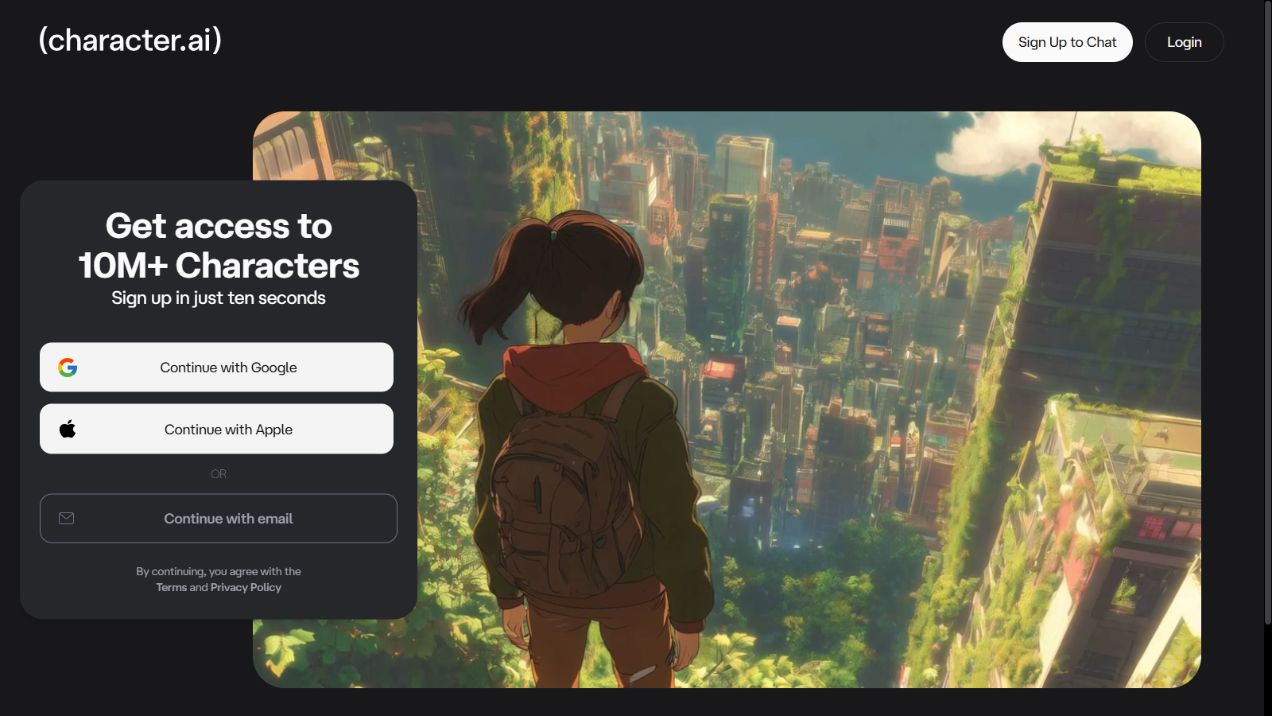
Character.AI homepage captured September 3, 2026. The public landing experience may change by account, age, platform, and region.
That positioning matters. A conversational interface can look similar to a general AI assistant, but the user goal is different. Character.AI is optimized for interacting with an invented or user-configured persona. It should not be evaluated primarily by whether it produces a perfectly sourced market analysis, spreadsheet, policy, or codebase.
The platform also contains user-generated material. Character names, descriptions, scenarios, and behavior may reflect creator choices and model output rather than verified facts or official representations. A Character resembling a real or fictional person is still a generated simulation.
Core features
Character discovery and conversation
The platform’s main experience is finding a Character and beginning a conversation. Its catalogue creates breadth across fictional scenarios, roleplay, storytelling, brainstorming, games, and personality-driven exchanges. This makes discovery part of the product, not just a search field attached to a chatbot.
The quality of an interaction can depend on the Character definition, opening prompt, conversation history, model behavior, moderation, and user input. Popularity does not prove factual reliability or safety. Users should judge a Character by whether it supports the intended entertainment experience without crossing personal boundaries.
Character creation
Official help documentation covers creating Characters, including identity, descriptions, greetings, avatars, and related configuration. Creation is useful for writers, roleplayers, hobbyists, and communities that want a consistent premise rather than a one-off prompt.
A good Character design needs more than a name. Define role, voice, setting, boundaries, relationships, goals, and examples of desired behavior. Avoid adding private information about real people. Test the Character with ordinary prompts, adversarial prompts, long conversations, ambiguity, and requests that should be refused.
Character creators should also consider intellectual-property, impersonation, publicity, harassment, and community-policy risks. The ability to publish a Character does not guarantee a right to use every name, image, text, or likeness.
Memory, pins, and Lorebooks
Memory is important for long-running stories because users expect Characters to preserve relationships, facts, preferences, and events. Character.AI’s subscription comparison distinguishes basic and stronger memory, pin limits, memory-usage detail, and Lorebook capability. Official help material describes Lorebooks as a way to structure world information, with access and maturity potentially changing.
These tools can improve continuity, but users should not assume perfect recall. Language-model context and memory systems can omit, distort, or overemphasize details. Keep a compact story summary for important narratives, restate critical facts when necessary, and check whether a response contradicts established events.
Voice, calls, stories, and visual experiences
Character.AI has expanded beyond text. Official materials describe Character Voice and calls, Stories, Imagine-related visual experiences, and product experiments. These features can make roleplay more expressive and provide new ways to create and share narratives.
Voice introduces additional privacy and consent questions. Do not upload or imitate a person’s voice without appropriate rights. Review how recordings and voice information are handled, especially when conversations contain sensitive content. Generated voices should not be treated as authentic statements from the person they resemble.
Multimedia features also change quickly. Confirm current device support, geographic availability, plan requirements, generation limits, public-sharing behavior, and content rules inside the product rather than relying on an old review.
What Character.AI does well
It has a clear entertainment identity
Character.AI does not need to be the best general assistant to be useful. It provides a focused environment for people who enjoy ongoing characters, fictional worlds, improvisation, and social discovery. That clarity is more valuable than an unfocused list of productivity features.
Creation and discovery reinforce each other
Users can move between consuming and creating. A person can discover formats, develop a Character, refine its premise, and publish it for others. This loop supports experimentation and community variety, although it also requires moderation and careful creator responsibility.
Memory tools support longer narratives
Pins, memory controls, and Lorebooks address a real weakness in long AI conversations: continuity. The presence of explicit memory tools gives users more structure than repeatedly placing every detail in a new prompt. Their practical consistency still needs user testing.
Free access lowers evaluation risk
Prospective users can assess the experience before paying. That is particularly useful because value depends on personal frequency, tolerance for ads or limits, preferred Characters, and whether premium memory and styles materially improve the user’s own conversations.
Limitations and risks
Characters can be confidently wrong
Generated dialogue may invent facts, misrepresent a person, contradict earlier messages, or provide unsafe guidance. Character fluency can make an answer feel more credible than it is. Do not use Character.AI as the sole source for news, education, finance, law, medicine, safety, or other consequential decisions.
The emotional style of a response is also not evidence of understanding. A Character can simulate empathy, certainty, affection, or authority without possessing human awareness, professional duty, or accountability.
Continuity is imperfect
Long chats create pressure on memory. Important details may disappear, and a Character can drift from its original voice or premise. Paid memory benefits may help but do not guarantee canonical consistency. Writers who need precise continuity should maintain an external story bible and review outputs.
Moderation can affect immersion
Safety systems and community rules are necessary, but they can shape or interrupt conversations. Users may encounter refusals, filtered inputs, unavailable content, feature restrictions, or account actions. The exact experience can change as policies and models evolve.
People seeking unrestricted generation should not assume a subscription removes safety boundaries. Paid access changes listed benefits, not the obligation to follow current terms and community guidelines.
Privacy requires restraint
AI roleplay can encourage unusually personal disclosure because the interface feels private and responsive. Users should read the current privacy policy and understand that a commercial platform is not equivalent to a confidential relationship with a doctor, therapist, lawyer, or trusted friend.
Avoid sharing passwords, financial details, government identifiers, confidential business data, precise location, private information about others, or material that could cause harm if exposed. Review deletion, export, personalization, voice, cookie, and account settings where available.
Emotional dependence is a real boundary issue
An always-available Character can feel compelling. Users should monitor whether the product is replacing sleep, work, school, offline relationships, or qualified care. Set time boundaries, take breaks, and involve a trusted person or professional when an interaction increases distress or isolation.
Character.AI is not an emergency service. Anyone facing immediate danger or a crisis should contact local emergency services or an appropriate crisis resource rather than relying on a generated Character.
Safety and age considerations
Character.AI publishes a Safety Center, community guidelines, reporting routes, content-moderation information, and Parental Insights documentation. Age requirements and available experiences have changed over time and can differ by jurisdiction. Users and guardians should check the current service flow and official policies rather than assuming an older article remains accurate.
Safety controls do not eliminate risk. Guardians should discuss generated content, impersonation, privacy, manipulation, spending, reporting, and the difference between simulation and human expertise. Account supervision should complement, not replace, developmentally appropriate guidance and device-level controls.
Adults should use reporting tools for content or behavior that violates policy and preserve relevant evidence where lawful. Do not attempt to investigate dangerous behavior through prolonged engagement with a Character.
Sources: Character.AI Safety Center , official privacy policy , and terms of service .
Pricing and value
When checked, Character.AI offered free access and c.ai+ at $9.99 per month or $94.99 per year. The annual price equals about $7.92 per month before taxes, saving $24.89 against twelve monthly payments. Regional prices, taxes, promotions, and app-store billing can differ.
The official comparison listed no ads, premium chat styles, stronger memory, more pins, detailed memory usage, advanced Lorebook access, higher feature limits, no slow mode, chat customization, priority feature access, a Charms bonus, and premium support. Availability can evolve, and “higher” or “best” does not mean unlimited in every context.
The free plan is better for evaluation and occasional use. c.ai+ makes more sense for frequent adults who can identify a specific premium constraint. Subscribe monthly first if uncertain; consider annual billing only after sustained use and after reviewing auto-renewal.
See our detailed Character.AI pricing guide for the plan comparison and cost calculations.
Who should use Character.AI?
Choose it for recreational roleplay, interactive fiction, Character design, creative dialogue, voice experiments, and exploring community-created scenarios. It can also support low-stakes ideation when the output will be rewritten and verified.
Avoid it for regulated work, confidential company information, verified research, professional diagnosis, legal or financial advice, crisis intervention, or decisions about another person. A business needing governed AI should prioritize organizational controls, contractual data protection, identity administration, auditability, retention, and support.
Practical evaluation checklist
Before committing time or money, test:
- Whether the Characters and genres you value are available and policy-compliant.
- Whether conversations remain coherent across the length you normally use.
- Whether memory and pins preserve the facts that matter to your scenario.
- How often moderation interrupts legitimate use and whether the boundaries are acceptable.
- Whether voice and multimedia features work on your preferred device and region.
- Which data you are comfortable sharing after reading privacy and terms.
- Whether free-plan ads, limits, and slow mode materially reduce your enjoyment.
- Whether c.ai+ benefits solve a demonstrated problem rather than a hypothetical one.
- Whether use affects sleep, obligations, spending, mood, or offline relationships.
- Whether you can export, summarize, or preserve creative work important to you.
Final verdict
Character.AI is a distinctive entertainment platform, not a conventional SaaS productivity tool. It is strongest when the objective is to inhabit a story, converse with a designed persona, create a Character, or explore community imagination. Memory, voice, stories, and visual features deepen that niche.
Its weaknesses follow from the same immersive quality. Generated confidence can disguise inaccuracy, simulated intimacy can encourage oversharing, long conversations can lose continuity, and safety systems can alter the experience. Those are not minor caveats.
Start free, set privacy and emotional boundaries, verify anything factual, and judge c.ai+ only against premium benefits you will regularly use. Under those conditions, Character.AI can be a compelling creative entertainment service for adults without being mistaken for something it is not.
Frequently asked questions
Is Character.AI good in 2026?
Character.AI is a strong specialized option for adults seeking character-driven entertainment, roleplay, interactive stories, voices, and character creation. It is not a reliable substitute for factual research, professional advice, crisis support, or a governed workplace assistant.
Is Character.AI free?
Yes. Character.AI provides free access, while c.ai+ adds plan-dependent benefits such as an ad-free experience, premium chat styles, stronger memory, higher limits, customization, priority feature access, and premium support.
Does Character.AI remember conversations?
Character.AI documents memory features, pins, and Lorebooks, with depth varying by plan and feature availability. Memory can still be incomplete or inconsistent, so important story facts should be checked rather than assumed.
Can Character.AI provide medical or mental-health advice?
It should not be used as a medical professional, therapist, crisis service, or source of diagnosis. Generated characters can be inaccurate and are not accountable professionals. Use qualified services and emergency resources for consequential support.
Is Character.AI private?
Character.AI publishes a privacy policy describing data practices and user rights, but AI conversations may contain highly personal information. Read the current policy, avoid unnecessary sensitive data, review account controls, and do not assume a conversation has the confidentiality of a licensed professional relationship.
Who should pay for c.ai+?
Frequent adult users who value fewer interruptions, stronger memory, premium chat styles, higher limits, customization, and early access are the clearest candidates. Occasional users should test the free version before subscribing.
Is Character.AI suitable for business use?
It is primarily positioned as interactive entertainment, not an enterprise knowledge or productivity platform. Businesses should use tools with appropriate administrative, privacy, security, contractual, data-governance, and audit controls for company work.