ChatGPT Pricing: Plans, Costs, and Value
A practical guide to ChatGPT Free, Go, Plus, Pro, Business, and Enterprise pricing, plan fit, hidden costs, limits, credits, and API billing.

Direct answer
ChatGPT pricing spans a Free plan, paid individual tiers, and organizational plans designed for managed team use. The cheapest sensible plan is not automatically the one with the lowest monthly price. It is the plan that supports the required tasks, models, limits, privacy posture, and administration without creating more interruption or risk than the work justifies.
Free is the best starting point for testing low-risk tasks. Go and Plus target progressively broader or heavier individual use. Pro is intended for demanding individual research and coding workloads with substantially more usage. Business adds a managed workspace and organizational capabilities. Enterprise is a negotiated option for organizations that need deeper security, administration, support, deployment, and contractual requirements.
This guide does not reproduce one universal checkout total because OpenAI can localize prices, taxes, currencies, offers, and plan availability. It explains the decision structure. Confirm the exact amount and entitlement on the official pricing page immediately before purchase.
ChatGPT plans at a glance
| Plan | Best starting fit | Main reason to move up | Main caution |
|---|---|---|---|
| Free | Occasional and first-time users | Test core workflows before paying | Lower allowances can interrupt repeated work |
| Go | Individuals needing more routine capacity | More messages, uploads, images, voice, and memory than Free | Availability and included features may vary |
| Plus | Professionals using advanced work features | Expanded models, research, projects, tasks, and tools | Still an individual account, not team governance |
| Pro | Heavy individual research and coding users | Much higher access to advanced reasoning and tools | Premium cost only pays back with sustained use |
| Business | Teams needing a managed workspace | Administration, company use, billing, and business data terms | Seat and advanced-use economics require governance |
| Enterprise | Larger or regulated organizations | Contracted controls, deployment, support, and scale | Requires procurement and a full operational evaluation |
The labels above describe buyer fit, not a guarantee of any one feature. OpenAI changes models and entitlements, and some advanced organizational usage can involve credits in addition to seats.
Official ChatGPT pricing page
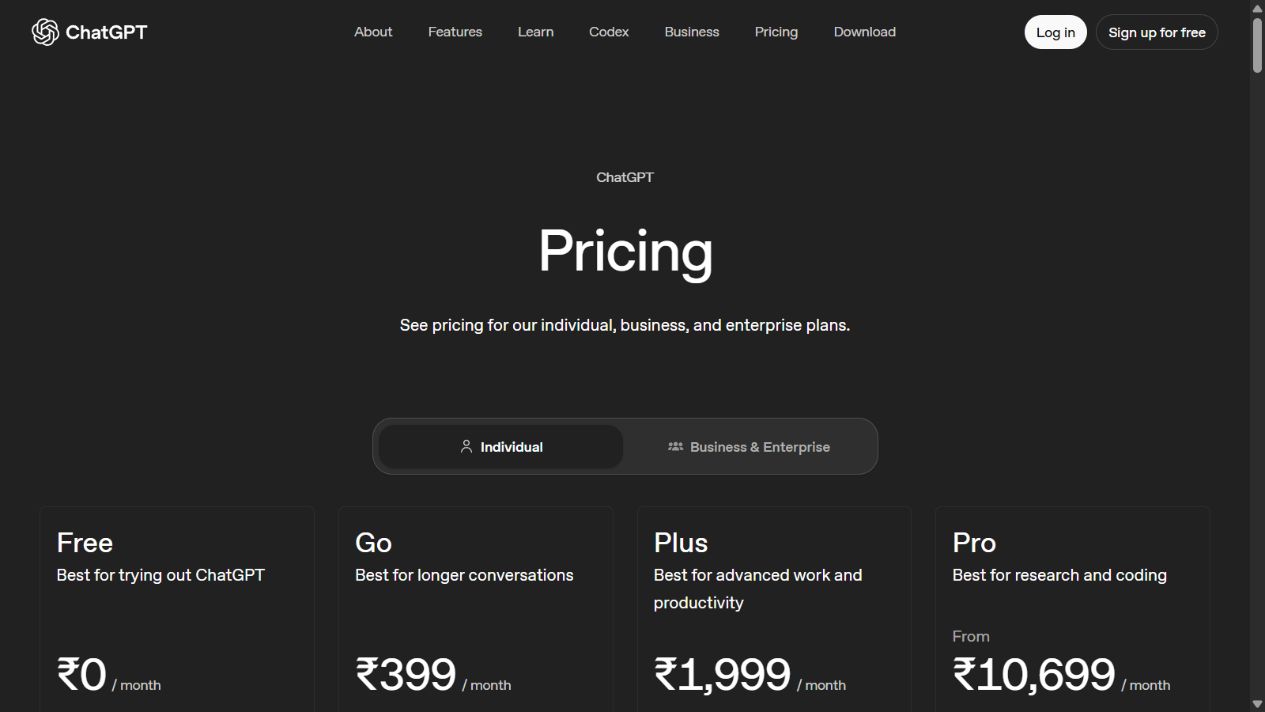
Official ChatGPT pricing page captured September 5, 2026. Prices and plan details can be localized or updated; verify the current page before purchasing.
ChatGPT Free
Free is the correct first step when the buyer has not yet proved a repeatable use case. OpenAI currently presents it as a way to try ChatGPT, with core text access and limited use of uploads, image creation, voice, deep research, memory, and coding-related capabilities.
The plan is useful for evaluating prompt quality, output review, file handling, and whether ChatGPT fits an existing process. A team can create a small test set of representative tasks and measure accepted outputs before anyone requests a paid subscription.
Its limitation is operational consistency. A feature may be available but at a lower allowance or speed. That is manageable for occasional exploration but can become expensive in time when a recurring workflow stops midway. Upgrade only after the interruption has a measurable cost.
ChatGPT Go
Go sits between Free and Plus for individual users who want longer or more frequent sessions without immediately choosing the broader professional tier. OpenAI’s current page describes more messages with tools, uploads, image creation, voice use, and memory than Free.
This plan can fit routine personal productivity where advanced research or maximum reasoning access is not the central requirement. It may also provide a practical paid test before committing to a higher tier.
Check regional availability, advertising terms where applicable, model access, and actual limits. A lower paid price is attractive only if the plan contains the capabilities the workflow uses. Buyers should not infer that every Plus feature is included simply because Go is paid.
ChatGPT Plus
Plus is the general professional starting point for an individual who uses ChatGPT across writing, research, files, images, planning, analysis, and coding. OpenAI currently positions it for advanced work and productivity, with expanded access compared with Go and features such as projects, scheduled tasks, custom GPTs, deeper research, and broader coding support, subject to current limits.
The value case is strongest when the user already has several repeatable tasks and Free or Go limits create delays. Examples include researching a brief with cited sources, iterating a document in Canvas, analyzing a file, maintaining project context, or reviewing code.
Plus does not provide an organizational control plane. A company should not treat a collection of individually reimbursed subscriptions as equivalent to a managed business workspace. Account ownership, data rules, shared context, offboarding, and spending remain governance questions.
ChatGPT Pro
Pro targets high-intensity individual work, particularly advanced research, reasoning, and coding. The official page currently describes materially greater usage than Plus and maximum or expanded access across several demanding capabilities.
The plan makes economic sense when one person repeatedly reaches lower-tier constraints and the additional access affects valuable output. A researcher running deep investigations, a developer using coding workflows throughout the day, or a specialist processing many complex files may have a stronger case than an occasional writer.
Do not justify Pro through feature curiosity alone. Track how often lower limits are reached, how much productive time is lost, and whether higher access improves accepted results. “Unlimited” language is generally subject to reasonable-use and abuse guardrails, so it should not be interpreted as unbounded automated capacity.
ChatGPT Business
Business is the relevant comparison when multiple people need an approved ChatGPT workspace rather than isolated consumer accounts. The decision is less about receiving a smarter chat box and more about administration, centralized billing, workspace controls, shared work, and organizational data treatment.
OpenAI states that data from its business offerings is not used to train models by default. Current plan documentation also distinguishes organizational security and administration capabilities from individual plans. Exact controls and eligibility should be verified against the current Business page and agreement.
Estimate the full seat population, not only initial enthusiasts. Include administrators, people who review shared work, contractors, joiners and leavers, and teams likely to request access after launch. Define who can create shared assets, connect apps, purchase additional usage, and approve sensitive use cases.
ChatGPT Enterprise
Enterprise is not simply the next self-service tier. It is a procurement and deployment decision for organizations that need negotiated commercial terms, larger-scale administration, advanced security or identity requirements, support, data residency choices, compliance capabilities, or contractual commitments.
Build a requirements matrix before contacting sales. It should cover identity management, provisioning and deprovisioning, role controls, audit or compliance needs, retention, data location, legal terms, incident handling, support, adoption reporting, integrations, and expected usage.
The enterprise price cannot be assessed from seats alone. Implementation, security review, change management, internal support, and workflow redesign can exceed the visible software cost. Those costs may still be justified, but they belong in the business case.
ChatGPT subscription versus API pricing
A ChatGPT subscription pays for access to the ChatGPT product under the chosen plan. OpenAI API usage is billed separately. Plus, Pro, or Business should not be purchased with the assumption that it includes API credits for an application, automation, or backend integration.
The distinction changes governance and budgeting. ChatGPT usage is generally organized around accounts or workspace seats and plan limits. API usage is metered according to the applicable model and service pricing. An organization using both should maintain separate owners, budgets, keys, monitoring, and acceptable-use controls.
Use ChatGPT for human-operated workflows in its interface. Evaluate the API when software must call models programmatically, process structured traffic, or integrate model behavior into a product. Do not automate a consumer interface as a substitute for an API architecture.
Flexible credits and advanced usage
OpenAI documents credit-based expansion for certain advanced organizational capabilities. The practical implication is that a seat price may not be the complete upper bound for heavy use. Included access, credit eligibility, rate cards, administrator permissions, and replenishment behavior should be checked for the exact workspace.
Treat credits as a controlled variable cost. Decide which roles may consume them, which workflows justify them, how usage is monitored, and what happens at a threshold. An apparently small unit price can become material when an unbounded workflow is repeated across many users.
Hidden costs to include
Subscription comparisons often omit the largest operational costs:
- time spent preparing clean instructions and source material;
- human verification of claims, calculations, code, and citations;
- correcting outputs that are plausible but unsuitable;
- onboarding, policy, administration, and access reviews;
- connected tools and storage required to complete workflows;
- taxes, currency conversion, seats, credits, and API charges;
- migration or rework when features and models change.
Measure cost per accepted result. If a paid tier saves twenty minutes of generation but creates forty minutes of verification, it has not improved that workflow. Conversely, a higher plan can be economical when it removes recurring limits and produces a reliably reviewable first draft.
How to choose the right plan
Start with tasks, not plan names. List five recurring jobs, their frequency, data sensitivity, required tools, acceptable error rate, and accountable reviewer. Test them on the lowest eligible plan.
For an individual, upgrade when a specific limit repeatedly interrupts valuable work or an included capability materially improves an accepted outcome. For a team, evaluate Business when account management, shared context, billing, offboarding, and data commitments matter. Consider Enterprise when formal security, identity, residency, support, compliance, or contractual requirements exceed the self-service offering.
Review after thirty days. Record active users, completed workflows, accepted outputs, correction time, incidents, and unused seats. Downgrade or cancel where value is not demonstrated. A subscription should not survive solely because it is inexpensive relative to payroll.
Three practical buying scenarios
An occasional individual user should begin with Free and identify the first genuine constraint. If the work consists of a few questions, short drafts, and occasional file checks, paying may not improve the outcome. If sessions repeatedly stop at a limit or a required tool is unavailable, compare Go and Plus against the value of that lost time.
A professional using ChatGPT every working day should compare Plus and Pro with a usage diary. Record advanced research runs, coding tasks, uploads, image work, interruptions, and accepted deliverables for two weeks. Pro is easier to justify when higher access supports billable or high-value work throughout the day. Plus is usually the more disciplined starting point when demand is broad but not consistently intensive.
A ten-person company should compare ten unmanaged individual subscriptions with a Business workspace as two different operating models, not only two totals. Include centralized billing, onboarding, offboarding, data policy, shared assets, administrative effort, and the cost of inconsistent account practices. Even when individual subscriptions appear cheaper, missing governance can create avoidable operational risk. Conversely, a managed workspace is poor value when only one or two people have validated use cases.
For a larger organization, run security, legal, procurement, and technical reviews before treating an Enterprise quote as comparable. Ask the vendor to map every required control to the proposed agreement and distinguish included capacity from separately metered usage.
Purchase checklist
Before buying, verify:
- the current price, currency, taxes, and billing term;
- the exact models and tools included in the selected region;
- message, file, image, research, voice, coding, and project limits;
- whether advanced usage requires separate credits;
- whether API work has a separate budget and owner;
- workspace data treatment, retention, sharing, and app connections;
- administrative, identity, offboarding, and reporting requirements;
- the review process for important outputs;
- the expected cost per accepted workflow outcome.
Save the dated order details and plan terms. Product pages evolve, so the organization should be able to identify what it actually purchased.
Final verdict
Use ChatGPT Free to prove the workflow, choose a paid individual plan when higher capability or capacity removes a measured bottleneck, and choose Business or Enterprise when organizational control is part of the requirement. The best-value tier is the lowest one that reliably supports accepted work and the necessary governance.
Do not compare only the monthly headline. Include limits, seats, credits, API separation, review labor, administration, and risk. Recheck official pricing at checkout and review usage after adoption because both the product and the buyer’s needs can change.
Sources checked
Frequently asked questions
Is ChatGPT free?
Yes. OpenAI offers a Free plan with access to core ChatGPT capabilities subject to current limits. It is useful for initial evaluation, but availability and usage allowances should be checked on the official pricing page.
Which ChatGPT plan is best for an individual?
Free is appropriate for occasional evaluation, while Go, Plus, or Pro may fit progressively heavier work. The right choice depends on required models, tools, limits, and the value of avoided waiting or interrupted workflows.
Is ChatGPT Business priced per user?
OpenAI describes paid organizational subscriptions as seat-based offerings. Confirm the current per-user price, minimum commitment, billing term, taxes, and any credit-based advanced usage in the official checkout.
Does ChatGPT Plus include API credits?
No. ChatGPT subscriptions and OpenAI API usage are separate products with separate billing. A paid ChatGPT plan does not create an included API allowance.
What costs are not shown in the ChatGPT subscription price?
Potential additional costs include taxes, currency conversion, extra seats, flexible credits, API usage, connected software, administration, training, review time, and correcting unsuitable outputs.
Can a company use an individual ChatGPT plan for business work?
A person may use an eligible individual plan, but organizations should evaluate whether they need a managed workspace, centralized billing, administrative controls, contractual data commitments, and shared governance available in business offerings.
Can ChatGPT pricing change?
Yes. Prices, plan names, limits, included models, features, and regional offers can change. Treat this guide as decision support and verify the official pricing page and checkout before buying.