ChatGPT Pros and Cons
Evaluate the main advantages and disadvantages of ChatGPT for research, writing, files, data, creative work, coding, and team adoption.
Direct answer
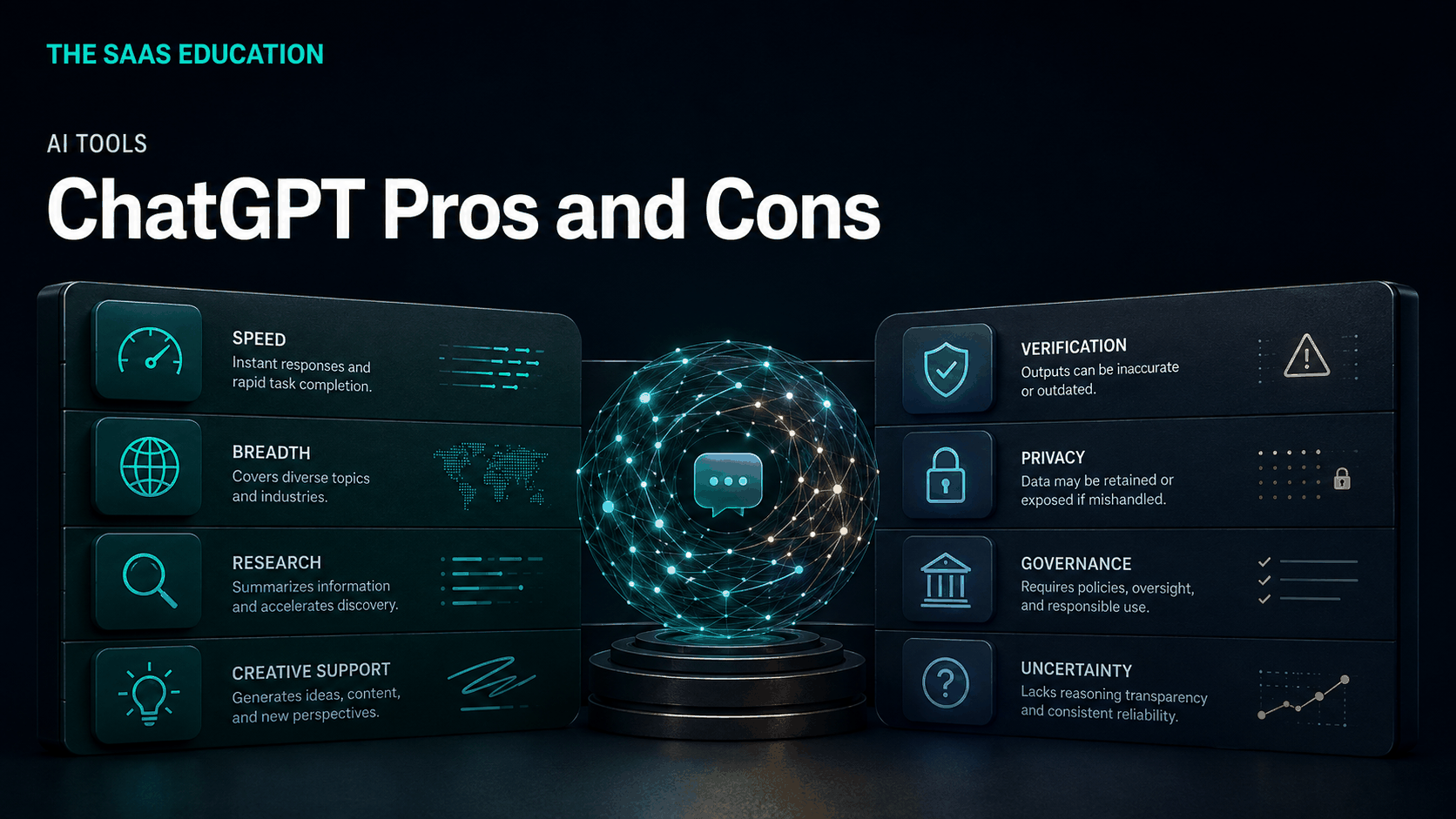
ChatGPT’s main advantage is that it combines many forms of assistance in one approachable workspace. It can help a person move from a question to research, a draft, file analysis, a calculation, an image, code, or a continuing project without changing tools for every step. That breadth can shorten routine work and make advanced capabilities accessible to people who do not use specialist software every day.
Its central disadvantage is that fluent output is not the same as verified output. ChatGPT can misunderstand context, omit important qualifications, use weak evidence, produce incorrect calculations or code, and vary between attempts. The product also introduces privacy, governance, cost, adoption, and workflow-design questions that a team must solve outside the chat window.
The balanced conclusion is not that ChatGPT is universally good or bad. It is a capable general assistant when the task is bounded, inputs are appropriate, and a responsible person checks the result. It is a weak substitute for authoritative systems, specialist judgment, or accountable review.
ChatGPT pros and cons at a glance
| Area | Advantage | Limitation to manage |
|---|---|---|
| Breadth | Writing, research, files, data, images, voice, and coding in one environment | Broad menus can encourage unfocused adoption |
| Speed | Produces useful first passes quickly | Fast output can spread errors just as quickly |
| Accessibility | Natural-language interface lowers the starting barrier | Good prompting does not remove the need for expertise |
| Research | Search and Deep Research can gather cited information | Citations and synthesis still require inspection |
| Files and data | Can summarize documents and analyze supported files | Extraction, formulas, context, and calculations can fail |
| Creativity | Supports ideation, drafting, and image workflows | Outputs may be generic, inconsistent, or unsuitable for a brand |
| Continuity | Projects and memory can preserve useful context | Stored context may be incomplete, outdated, or inappropriate |
| Team use | Business offerings add administration and workspace controls | Governance must be designed and maintained by the organization |
| Cost | One broad assistant may reduce tool switching | Limits, seats, specialist tools, and review time affect total cost |
How we evaluated the tradeoffs
This is a commercial evaluation, not a feature inventory or a controlled product benchmark. We reviewed OpenAI’s official product, Help Center, pricing, privacy, and business documentation, then assessed how the documented capabilities affect real work.
We used five questions:
- Does the capability shorten a repeatable task rather than create novelty?
- Can a user inspect the sources, inputs, assumptions, or outputs?
- What happens when the output is wrong?
- Does the organization retain a clear owner and authoritative record?
- Are plan limits, privacy settings, and connected systems appropriate for the data?
That method matters because the same feature can be an advantage in a low-risk drafting task and a disadvantage in an uncontrolled financial, legal, medical, employment, or security decision.
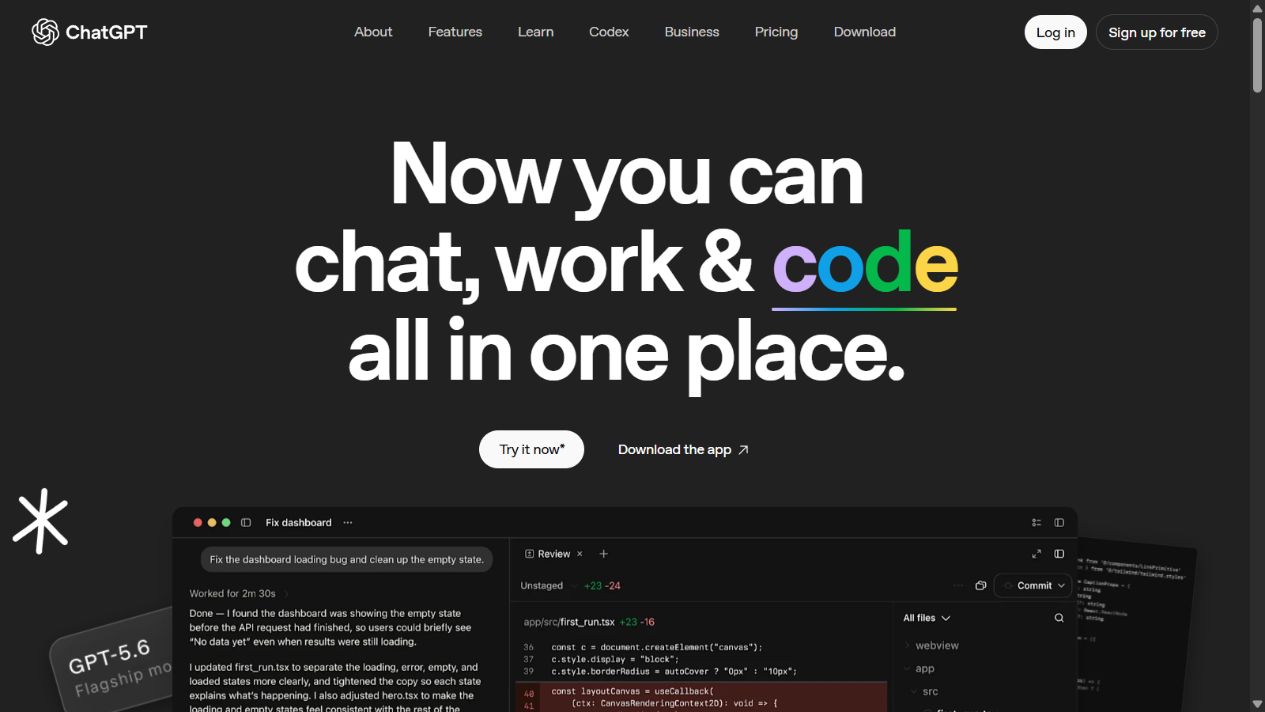
ChatGPT’s official homepage presents a broad assistant workspace. Available models, tools, limits, and controls depend on the current plan and account.
Advantages of ChatGPT
1. One workspace supports many kinds of work
OpenAI documents capabilities spanning conversation, writing, search, Deep Research, file uploads, data analysis, image creation, voice, Canvas, Projects, memory, tasks, GPT experiences, apps, and coding. The meaningful advantage is not merely the length of that list. It is the ability to carry context from one stage of work into the next.
A buyer can explore a subject, upload supporting material, analyze a table, draft a recommendation, and revise the language within one thread or project. For small teams, that can reduce the friction of moving information among separate tools. For larger organizations, it can provide a common assistance layer across roles, although specialist systems remain necessary.
2. It accelerates first drafts and repetitive knowledge work
ChatGPT can produce outlines, summaries, transformations, explanations, email drafts, meeting follow-ups, checklists, code scaffolds, and alternative wording quickly. The best use is usually a first pass whose quality can be judged by a person who understands the task.
That distinction protects the value. Drafting an internal agenda from approved notes is different from independently deciding a compliance position. In the first case, speed is the desired outcome and review is inexpensive. In the second, the cost of a plausible mistake may exceed the time saved.
3. Natural language makes sophisticated tools easier to approach
Users can describe the outcome, constraints, audience, and format in ordinary language. This lowers the starting barrier for data exploration, coding help, research, and creative work. A nontechnical manager may be able to ask for a chart or inspect a document without learning a specialist interface first.
Accessibility does not make expertise irrelevant. A knowledgeable user is still better positioned to define the right problem, notice missing context, and challenge an answer. ChatGPT can make a capability easier to begin using; it does not guarantee that the user has framed the work correctly.
4. Search and Deep Research improve evidence discovery
ChatGPT Search is designed for current web information with source links, while Deep Research is intended for longer multi-source investigation and cited reports. These modes can reduce the effort required to discover terminology, identify candidate sources, compare claims, and organize an initial evidence set.
This is especially useful when a user treats the result as a research workspace rather than a final authority. Opening the cited pages, checking publication dates, confirming that a source actually supports the sentence, and prioritizing primary evidence remain essential. Used that way, the assistant can improve research throughput without hiding the evidence trail.
5. File and data tools can compress analysis cycles
Official documentation describes file uploads and data analysis capabilities for supported documents and structured data. A user can ask questions about a PDF, compare documents, inspect a CSV, calculate metrics, or generate visualizations. Code execution for analysis can make the steps more inspectable than an unsupported numerical answer written directly in prose.
The benefit is strongest when inputs are clean and the user validates the extraction, units, formulas, filters, and outputs. It is less dependable when a scanned document has poor text recognition, a spreadsheet contains hidden business logic, or the necessary context exists outside the uploaded file.
6. It supports iterative creative and technical work
Conversation is useful for iteration. A user can ask ChatGPT to change tone, challenge an assumption, explain code, generate alternatives, or revise an image. Canvas can provide an editable space for writing or code, and project organization can keep related material together.
This iterative loop often matters more than a single generated answer. It lets the user refine constraints and compare options. The result still needs brand review, technical testing, accessibility checks, or editorial judgment according to the medium.
7. Projects and memory can reduce repeated setup
Projects can organize related chats, files, and instructions, while memory features can personalize future conversations subject to settings and availability. These capabilities may reduce repeated explanations and help maintain continuity across a continuing body of work.
Continuity is valuable for recurring workflows, but it should not become the only place where essential knowledge lives. Approved requirements, decisions, customer records, policies, and final deliverables belong in systems designed to preserve and govern them.
8. Business plans provide a path to managed adoption
OpenAI offers business-oriented plans and documentation covering administration, privacy, security, and workspace use. Centralized accounts and controls are preferable to a team informally mixing personal tools, unmanaged subscriptions, and sensitive information.
The advantage is a foundation rather than a complete governance program. The organization still needs to decide who may use the service, which data classes are allowed, how apps and sharing are approved, when human review is required, and where final work is stored.
Disadvantages of ChatGPT
1. It can be confidently wrong
The most important limitation is reliability. A response may contain invented details, incorrect facts, missing exceptions, broken citations, flawed reasoning, or code that appears convincing but fails. Fluent language can make uncertainty difficult to notice.
Verification should match impact. A casual brainstorm may need only a quick sense check. A public claim needs source review. A calculation needs reconciliation. Code needs tests and security review. Advice affecting rights, money, health, employment, or safety requires qualified oversight and authoritative evidence.
2. Output quality depends heavily on context and review
ChatGPT cannot automatically know the user’s complete objective, internal definitions, organizational constraints, customer history, or risk tolerance. A vague request can produce a generic response, while an incomplete brief can lead to a polished answer for the wrong problem.
Providing examples, constraints, source material, acceptance criteria, and an explicit output format improves usefulness. Yet even a detailed prompt does not create missing evidence or transfer accountability to the model. Prompting is workflow design, not a substitute for judgment.
3. Privacy and data handling require deliberate controls
Users may paste customer records, confidential drafts, credentials, contracts, source code, or personal data into an assistant without considering policy. Appropriate use depends on the selected offering, account settings, data controls, retention obligations, connected apps, and current OpenAI terms.
Organizations should classify data before rollout, prohibit secrets and unsupported sensitive information, review current privacy documentation, configure approved workspaces, and establish an incident path. A consumer account and an administered business environment should not be treated as interchangeable.
4. It can create overreliance and skill erosion
Convenient output can encourage users to stop examining sources, doing calculations, reading documents, or developing their own reasoning. This risk is greatest when the user cannot independently assess the response.
A healthier workflow asks the assistant to expose assumptions, alternatives, and evidence; requires the human to make the decision; and periodically checks performance against work completed without assistance. Training should teach verification and task judgment, not only prompt techniques.
5. Features, models, and limits can change
Plan entitlements, model names, usage limits, interfaces, regional access, and feature behavior can change. A workflow built around an undocumented detail or a temporary allowance may break or become more expensive.
Teams should test critical workflows, record dependencies, retain an alternative process, and review release notes and pricing before renewal. This is particularly important when ChatGPT is connected to other applications or embedded in a recurring operational process.
6. Broad capability can hide gaps versus specialist tools
ChatGPT can assist with many domains, but breadth does not mean depth in every workflow. A dedicated accounting platform maintains ledgers and controls; a CRM governs customer records; a design platform manages brand assets and production; an analytics system supports governed metrics. A conversational assistant does not automatically replace those responsibilities.
Buyers should identify the system of record, the assistant’s role, and the handoff between them. ChatGPT may help prepare, explain, transform, or analyze information while the specialist platform continues to execute and preserve the authoritative process.
7. Total cost includes review and governance
The subscription price is only one cost. Teams may need higher-tier seats, training, policy design, administration, connected apps, specialist tools, output review, rework, and monitoring. Higher usage does not guarantee proportional value.
A practical pilot measures completed outcomes: time saved after review, error and rework rates, adoption by role, escalation frequency, and avoided software or contractor costs. If the pilot measures only messages sent, it cannot establish return on investment.
8. Automation can magnify mistakes
Scheduled tasks, apps, integrations, copied workflows, and generated code can increase leverage, but they can also distribute an error faster. The risk grows when the assistant can access external information or when nobody reviews the final action.
Use least-privilege access, approval points, logging, limited pilot groups, and rollback procedures. High-impact actions should remain deterministic and auditable, with clear human ownership.
Who should choose ChatGPT?
ChatGPT is a strong candidate for individuals and teams with varied knowledge-work needs who want one flexible assistant. It fits organizations that can identify repeatable tasks, supply appropriate context, review results, and maintain authoritative records elsewhere.
Typical good-fit workloads include drafting from approved material, summarizing non-sensitive documents, exploring data with reconciliation, researching with citation review, generating alternatives, explaining code, and organizing ongoing project context.
Who should avoid relying on it?
Do not rely on ChatGPT alone when the workflow requires guaranteed correctness, regulated approval, deterministic calculation, formal legal or medical judgment, irreversible action, or a complete audit trail. It may still assist with preparation, but the final process needs specialist systems and accountable experts.
It is also a poor fit for a team that has no data policy, no reviewer, no owner for AI use, or no way to measure whether the output is actually helping.
A practical adoption checklist
- Define two or three bounded tasks before buying seats.
- Specify permitted and prohibited data.
- Use managed organizational accounts where appropriate.
- Confirm current plan features, limits, privacy terms, and regional availability.
- Require primary-source checks for consequential claims.
- Test calculations, code, files, and integrations independently.
- Keep final records in the authoritative business system.
- Assign a human owner for each output and automated action.
- Measure time saved after review, not generation speed alone.
- Reassess the workflow when models, features, or pricing change.
Final verdict
ChatGPT is valuable because it makes a wide range of useful assistance available through one conversational interface. It can accelerate research discovery, first drafts, analysis, creative iteration, and technical work, especially when users already understand the desired outcome.
Its limits are equally important: output can be wrong, context can be incomplete, privacy requires policy, specialist systems remain necessary, and scale can amplify weak controls. The right buying decision is therefore conditional. Choose ChatGPT when breadth and iteration support a governed workflow; do not treat it as an autonomous authority.
Sources checked
Frequently asked questions
What is the biggest advantage of ChatGPT?
Its biggest advantage is breadth: one conversational workspace can support writing, research, files, data analysis, images, voice, coding, and ongoing projects. The practical value depends on whether those capabilities fit a repeatable workflow.
What is the biggest disadvantage of ChatGPT?
ChatGPT can produce confident but inaccurate or incomplete output. Important facts, citations, calculations, code, and recommendations still require source checking, testing, or accountable human review.
Is ChatGPT safe for confidential business information?
Safety depends on the plan, settings, organizational controls, connected apps, retention requirements, and the data being entered. Businesses should review OpenAI's current privacy and enterprise documentation and establish an approved-data policy before use.
Can ChatGPT replace employees or specialist software?
It can accelerate parts of many jobs, but it does not automatically replace domain expertise, ownership, approval, auditability, or specialist systems of record. It is usually strongest as an assistant inside a governed workflow.
Is ChatGPT good for research?
ChatGPT Search and Deep Research can help discover and synthesize sources. Users should still open citations, check dates and scope, distinguish primary from secondary evidence, and verify high-impact conclusions.
Is the paid version of ChatGPT worth it?
A paid plan may be worthwhile when higher limits, additional models, advanced tools, or business controls save enough time or reduce tool fragmentation. Buyers should compare current plan entitlements and total seat cost against a defined workload.
Who should not rely on ChatGPT?
Anyone needing guaranteed correctness, deterministic output, regulated approval, authoritative records, or fully automated high-impact decisions should not rely on ChatGPT alone. Those uses need specialist controls and human accountability.