ChatGPT Review (2026)
An official-source ChatGPT review covering projects, search, research, files, data analysis, Canvas, privacy, team use, limitations, and value.

Direct answer
ChatGPT is one of the strongest general-purpose AI workspaces for people who need writing, web research, file analysis, data work, images, voice, planning, coding support, and continuing project context in one product. Its main advantage is breadth: a conversation can develop into a cited research brief, an edited document, a data analysis, or a project that retains files and instructions.
Its main limitation is the same breadth. ChatGPT can sound authoritative across tasks where it has not established that an answer is correct. Models, tools, usage limits, data behavior, and administrative controls also depend on the current plan and settings. It works best as an assistant inside a defined review process, not as an unaccountable source of truth.
This review uses current official OpenAI sources checked September 5, 2026. We did not run a controlled benchmark or measure accuracy, speed, coding quality, image quality, or hours saved.
ChatGPT at a glance
| Area | Assessment | What to verify |
|---|---|---|
| General knowledge work | Strong fit | Define which outputs require evidence or approval |
| Web research | Useful starting point | Open citations and confirm they support each claim |
| Documents and files | Broad documented capability | Test real formats, tables, versions, and limits |
| Data analysis | Potentially valuable | Reconcile calculations with known results |
| Writing and editing | Flexible | Apply editorial review, sources, and brand standards |
| Coding assistance | Broad support | Run tests, security review, and version control |
| Images and voice | Integrated tools | Check quality, consent, accessibility, and rights |
| Team deployment | Clear business path | Verify plan, administration, identity, retention, and spend controls |
| Consequential decisions | Assistant only | Keep a qualified human accountable |
What ChatGPT is
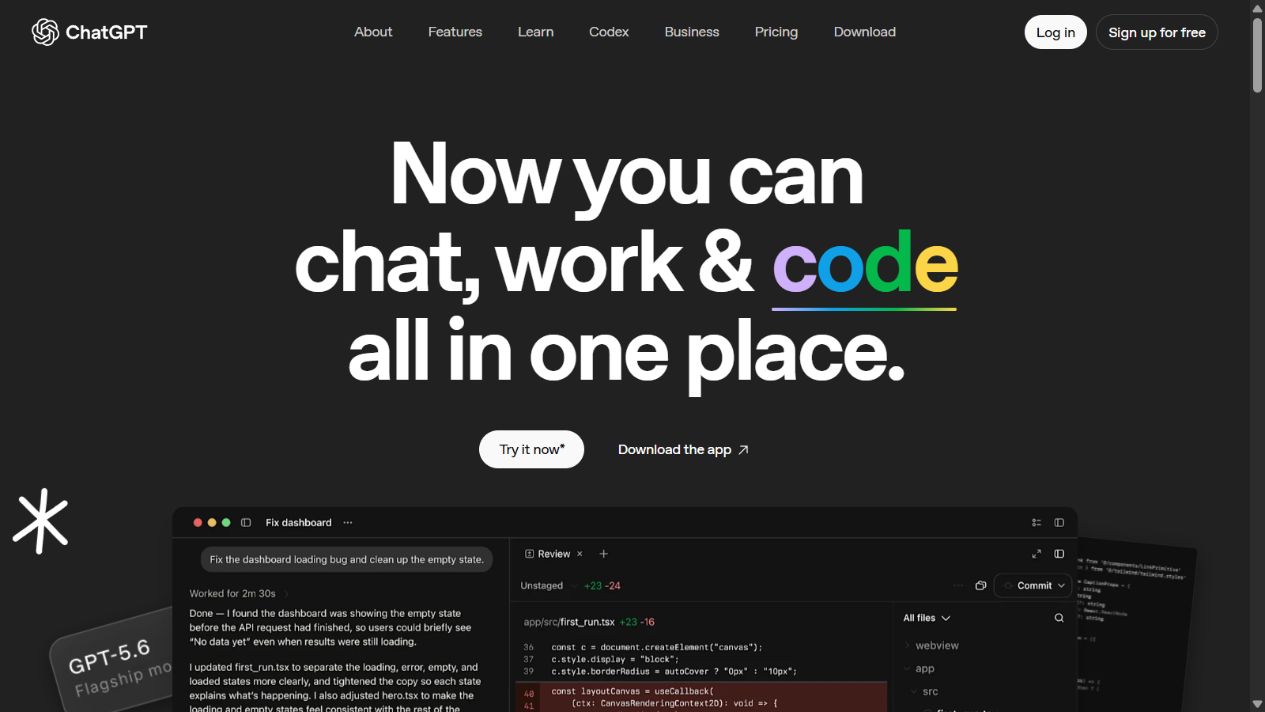
Official ChatGPT overview homepage, captured September 5, 2026. It shows current vendor positioning, not an independent performance test.
ChatGPT is a conversational AI product from OpenAI. Its official capabilities documentation describes question answering, explanation, drafting, rewriting, summarization, translation, creative work, and reasoning. Plan-dependent tools extend the product into current web search, deep research, file and image input, data analysis, image generation, voice, Canvas, memory, projects, scheduled tasks, and GPT-related experiences.
It is better understood as a changing work environment than one fixed chatbot model. The underlying model, tools, context, limits, and interface may differ by plan and task. A statement such as “ChatGPT can do X” should therefore be followed by two questions: in which product surface, and under which account?
Core strengths
One workspace for different task types
ChatGPT can support a sequence rather than one isolated response. A user can clarify a problem, search for current information, upload source files, analyze structured data, draft a document, revise it in Canvas, and preserve the material in a project. That reduces context switching when the workflow is appropriate for AI assistance.
The benefit depends on boundaries. Accepted facts should still point to their sources. Final documents belong in the normal document system. Code belongs in version control. Approved decisions belong in the relevant project, CRM, ticket, or policy record.
Projects for continuing context
OpenAI describes Projects as containers for chats, files, and project-specific instructions. Shared projects can provide collaborators with a common context hub. Current file limits and sharing behavior vary by plan, and organizational workspace controls continue to apply.
Projects are useful for recurring reports, research, content production, learning, or a software initiative where the same background material matters across sessions. They are less useful when the source files are stale, permissions are unclear, or the chat history becomes an undocumented substitute for decisions.
Search and deep research
ChatGPT Search can retrieve current web information and provide links. Deep research is designed for longer, multi-source investigation. These tools address a major weakness of a closed model response: current questions need current evidence.
Citations are a starting point, not proof. Open the source, confirm the publication date, distinguish primary from secondary evidence, and check that the cited page supports the exact sentence. A source can be credible but irrelevant to the claim.
Files and data analysis
Official documentation describes uploads for documents, images, and structured files. Data analysis can execute code in a controlled environment to clean, calculate, summarize, and visualize data.
This can accelerate exploratory work, but validation is essential. Ask the system to show definitions, filters, joins, exclusions, units, and calculation steps. Compare a known total. Inspect outliers and missing values. Do not accept a polished chart when the source rows or metric definition are wrong.
Canvas for writing and coding
Canvas is an editable workspace for drafting, revising, and debugging alongside ChatGPT. It can make focused changes easier to inspect than a sequence of complete rewrites in chat.
For writing, keep the brief, audience, evidence requirements, style rules, and prohibited claims explicit. For code, review the diff, run the project tests, scan dependencies, and verify behavior. Generated code should pass the same change controls as human-written code.
Multimodal interaction
ChatGPT can work with text, images, files, and voice in supported experiences, and can generate or edit images. This is useful when a problem is easier to show than describe, such as a screenshot, chart, layout, or photographed object.
Multimodal input creates additional risk. Images and recordings may reveal personal data, locations, confidential screens, voices, or hidden metadata. Visual interpretation can also be confidently wrong. Verify details and provide accessible alternatives such as text descriptions, captions, and transcripts.
Limitations
Plausible answers can be wrong
ChatGPT generates responses from patterns and available context. It does not automatically establish truth. It can invent a citation, misread a page, omit a constraint, use the wrong formula, or produce insecure code. Fluency makes these errors harder to notice.
Use an acceptance standard tied to the task. A brainstorming suggestion may need only judgment. A customer statement needs approved facts. A financial calculation needs reconciliation. A production code change needs tests and review.
Feature availability changes
OpenAI changes models, names, tools, limits, and plan entitlements. Current documentation shows different access across Free, Go, Plus, Pro, Business, Enterprise, and Edu, and advanced organizational usage may involve credits. Rollouts can vary by product and region.
An annual review cannot replace the purchase page or in-product account information. Verify the exact plan at the time of adoption and again before designing a process around a specific model or limit.
Context is not governance
Memory and project context can make responses more relevant, but they do not establish authorization, correctness, or document control. A remembered preference is not an approved company policy. An uploaded draft is not necessarily the current contract.
Keep authoritative sources clearly named and versioned. Limit project access. Remove outdated files. Require reviewers to identify the evidence used for material outputs.
Cost is broader than the subscription
The visible subscription price is only one component. Teams should consider user count, advanced usage or credits, review time, integrations, administration, training, and error correction. API use is billed separately from ChatGPT subscriptions.
Measure cost per accepted outcome. Count how much human effort is needed to brief, verify, revise, and transfer the result. Faster generation does not create value if review effort or error risk increases.
Privacy and security
OpenAI’s consumer Data Controls allow users to choose whether conversations help improve models, export data, delete an account, and use Temporary Chats. OpenAI says Temporary Chats do not appear in history or create memories, are not used for training, and are deleted from its systems after 30 days, subject to stated safety monitoring.
OpenAI separately states that business-offering data is not used to train models by default, with plan-dependent enterprise controls. Consumer and organizational terms should not be treated as equivalent.
Before business use, decide:
- which account type is approved;
- what data users may submit;
- whether apps or external sources may be connected;
- who can share projects or links;
- how retention and deletion work;
- who reviews outputs and incidents;
- where accepted work is stored.
Do not enter passwords, API keys, private customer records, health data, legal material, or production secrets into an unapproved workflow.
Who should choose ChatGPT
ChatGPT is a strong candidate for:
- individuals who want one assistant across research, writing, planning, files, and analysis;
- teams with recurring knowledge work that benefits from shared project context;
- analysts who can independently validate calculations and sources;
- developers who will review, test, and version generated changes;
- organizations prepared to define data, access, review, and spend controls.
It is less appropriate as an autonomous authority for regulated advice, final financial reporting, production changes, employee decisions, security response, or customer commitments.
A practical evaluation plan
Run a short pilot with five representative tasks:
- Research a current question and verify every citation.
- Summarize a real approved document and check omissions.
- Analyze a structured file and reconcile known totals.
- Draft and revise one deliverable in Canvas.
- Explain or modify noncritical code and run the full test process.
Record accepted output, factual errors, correction time, review time, privacy concerns, export steps, and usage. Include difficult cases, not only polished demonstrations. Compare the result with the existing workflow and with a credible alternative.
How ChatGPT fits into a working process
ChatGPT works best as a defined stage in a workflow rather than an unmonitored destination. A useful pattern is brief, generate, verify, approve, and store. The brief supplies the objective, audience, constraints, approved evidence, and required output format. Generation produces a draft or analysis. Verification checks claims, calculations, citations, and omissions against authoritative material. An accountable person approves the result, and the accepted version moves into the system where the organization normally manages work.
This distinction matters because a conversation history is convenient but is not automatically a records system. Final policies belong in the approved knowledge base, production code belongs in version control, customer commitments belong in the CRM, and financial decisions belong with their supporting records. ChatGPT can accelerate work between those systems without replacing their ownership rules.
Teams should also separate reusable instructions from task-specific evidence. Stable tone, format, and review requirements can live in a project. Current prices, contracts, campaign results, or customer facts should be supplied from an approved and dated source for each material task. This reduces the chance that old context silently influences a new answer.
For recurring work, create a short quality checklist that another person can apply without reading the entire conversation. It might require source links, an assumptions list, reconciled totals, a test result, or confirmation that restricted data was excluded. Track the percentage of outputs accepted after review, not simply the number generated. A workflow is valuable when it improves the speed or quality of accepted work while keeping correction effort and risk within a known limit.
ChatGPT pricing and value
OpenAI publishes free and paid individual plans plus Business, Enterprise, and education-oriented options. Plan contents and prices can be localized and may change. Organizational advanced usage can also involve flexible credits. API billing remains separate.
The Free plan is suitable for learning the interface and testing low-risk tasks within its current limits. Paid individual plans may make sense when higher limits or advanced models and tools reduce a real bottleneck. A business workspace becomes relevant when shared work, administration, organizational data commitments, and controls matter.
Use our dedicated ChatGPT pricing guide for plan-selection logic once it is published. Verify the current official pricing page immediately before purchase.
Final verdict
ChatGPT is a compelling general-purpose AI workspace, especially when work moves among research, files, writing, data, images, and code. Projects and Canvas make it more than a one-off chatbot, while search and deep research can connect answers to current sources.
It is not a substitute for evidence, expertise, security review, or accountability. The best implementation treats ChatGPT as a flexible assistant, keeps authoritative data and accepted outputs in controlled systems, and measures value after verification effort. Start with a bounded pilot, choose the plan from observed needs, and reassess whenever models, limits, or controls change.
Sources checked
Frequently asked questions
Is ChatGPT worth using in 2026?
ChatGPT is worth evaluating when one workspace for writing, research, files, analysis, images, voice, projects, and coding support can improve recurring work. Value depends on task quality, review effort, limits, and data controls.
Is ChatGPT accurate?
ChatGPT can produce useful answers but can also be inaccurate, incomplete, or unsupported. Important claims, calculations, code, and decisions require source verification and accountable review.
Can ChatGPT search the web?
Yes. OpenAI documents web search with links and citations across current plans, subject to usage limits and availability. Users should still open and verify important sources.
Can ChatGPT analyze files and spreadsheets?
OpenAI documents uploads for documents and images plus code-backed data analysis for structured files. Supported formats, file limits, tools, and project capacity depend on the current plan and settings.
Is ChatGPT safe for confidential business data?
Do not submit confidential data until the organization has approved the account type, contract, workspace settings, retention, access controls, and use case. Consumer controls and business commitments differ.
Does a ChatGPT subscription include API usage?
No. ChatGPT subscriptions and OpenAI API billing are separate products and charges. Teams should budget and govern them independently.
What is the main limitation of ChatGPT?
Its breadth can create misplaced confidence. A polished answer may still be wrong, and current models, features, limits, and controls vary by plan and change over time.