Claude Pricing: Plans, Costs, and Value
Understand Claude Free, Pro, Max, Team, Enterprise, and API pricing, plan limits, hidden costs, and how to choose the right option.
Direct answer
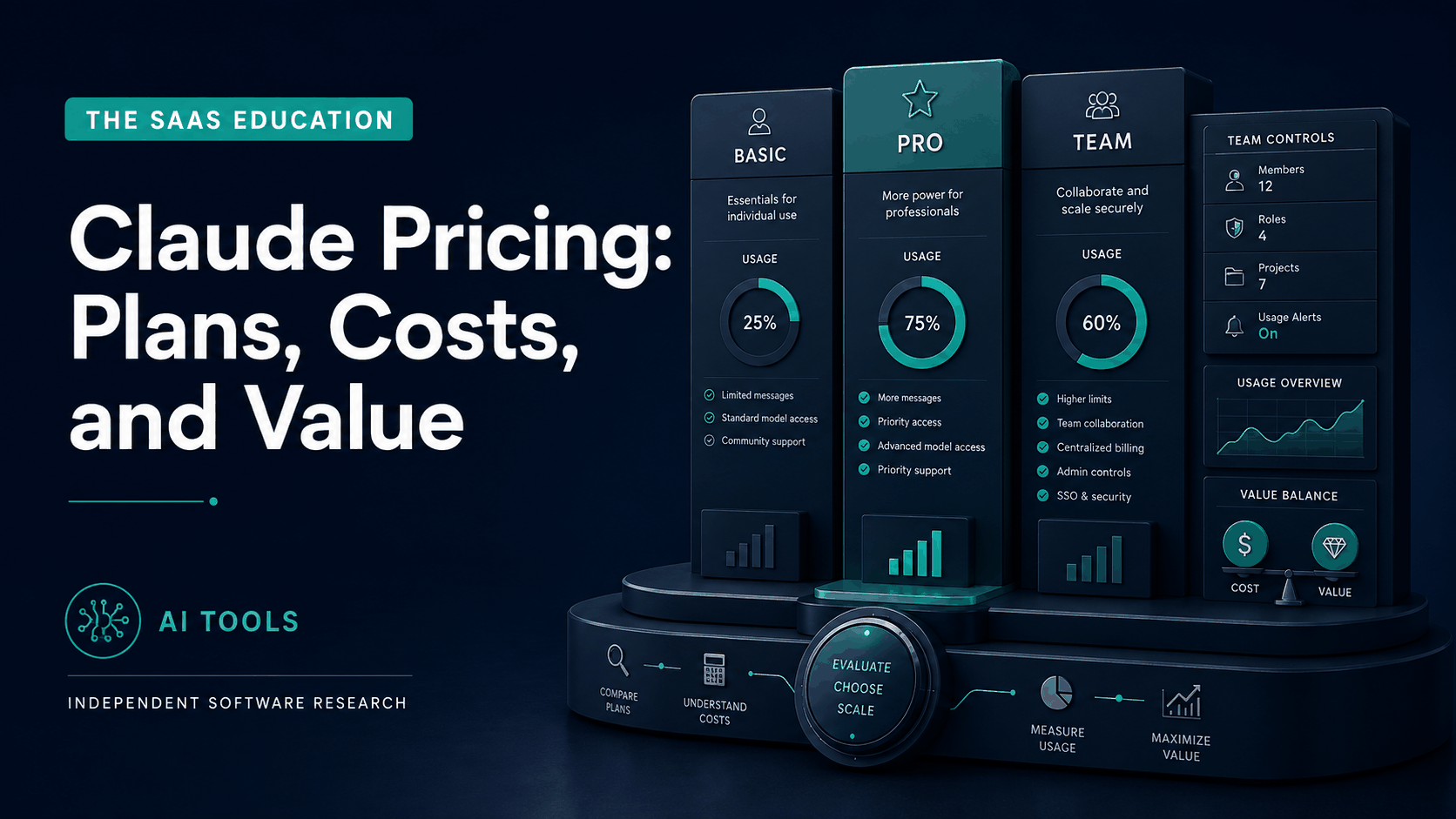
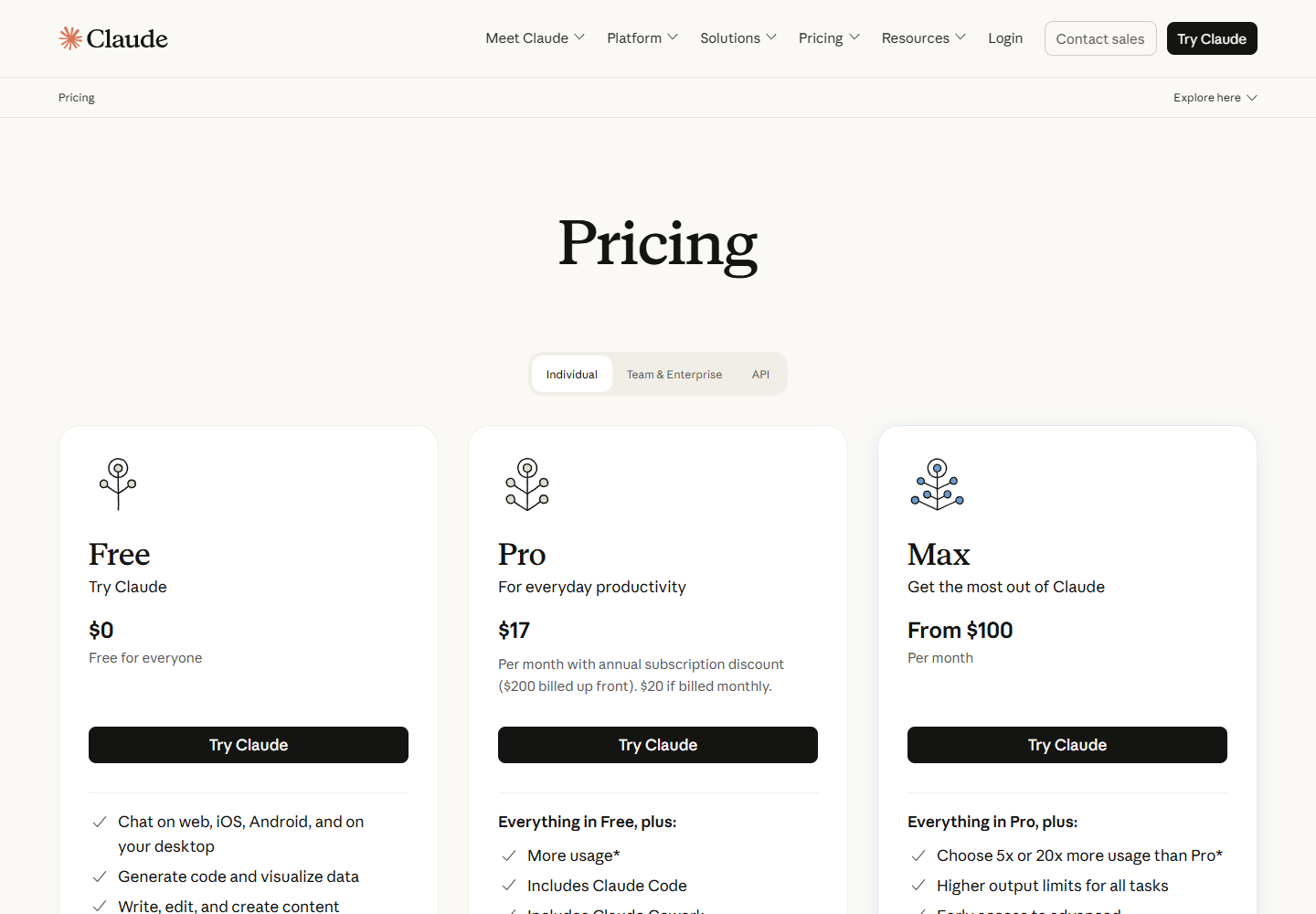
Claude has a Free plan, a Pro plan listed at $20 per month in the US or $200 with annual billing, and Max plans starting at $100 per month for users who need substantially more capacity. Anthropic also offers Team and Enterprise options for organizations, while Claude API usage is billed separately.
For occasional questions, the Free plan is the sensible starting point. Pro is the default paid shortlist for an individual using Claude regularly. Max is for people whose work repeatedly hits Pro capacity and can justify a much higher monthly cost. Team and Enterprise should be selected for collaboration, administration, security, and contractual needs rather than simply as ways to obtain more messages.
The published subscription price is only one part of cost. Usage limits, review effort, API consumption, connectors, implementation, unused seats, and workflow design can matter more than the headline rate.
Claude pricing at a glance
The following reflects official information checked September 7, 2026. Prices exclude applicable taxes and may vary by region.
| Plan | Published starting point | Best fit | Main buying question |
|---|---|---|---|
| Free | $0 | Occasional users and evaluation | Are limits and available features sufficient for the task? |
| Pro | $20 monthly or $200 annually in the US | Regular individual use | Does added capacity and feature access save more than it costs? |
| Max 5x | $100 monthly | Frequent professional use | Are Pro limits creating measurable workflow interruption? |
| Max 20x | $200 monthly | Very heavy individual use | Is the highest individual capacity consistently utilized? |
| Team | Check current official pricing | Collaborative organizational use | Are shared work and administrative capabilities required? |
| Enterprise | Custom | Larger or controlled deployments | Do security, governance, support, and contract requirements justify it? |
| API | Usage based | Products, automation, and developer workflows | What is the cost per successful production task? |
How we evaluated Claude pricing
We reviewed current search results to identify buyer questions around Free, Pro, Max, Team, Enterprise, usage limits, Claude Code, and API billing. Material pricing claims were checked against the official Claude pricing page and Claude Help Center.
We did not estimate an artificial “messages per dollar” score. Claude usage can depend on model, context length, files, tools, conversation length, demand, and product changes. A single universal message count would be misleading.
Instead, we evaluate:
- Published subscription or usage cost.
- Intended user and workflow.
- Included capability and plan boundaries.
- Capacity and interruption risk.
- Collaboration and administrative needs.
- API separation and production economics.
- Verification, training, and governance cost.
- Three-year total cost and renewal flexibility.
Claude Free
Claude Free provides access to the core assistant without a subscription, subject to current limits and availability. Official pricing material lists common capabilities such as chat across supported surfaces, content creation, code and data work, web search, memory, files, and connectors, although availability can change.
Who should choose Free?
Use Free when evaluating whether Claude fits a real task, supporting occasional questions, or training users on responsible workflows. It can also serve users whose needs are light and who do not require organizational administration.
Main limitation
Capacity and access are limited. A successful demonstration does not prove that the plan can sustain a daily professional workflow. Test representative files, long conversations, peak periods, and required features.
Do not use a personal free account for organizational data merely to avoid procurement. Account terms, retention, sharing, and governance should match the information being processed.
Claude Pro
Claude Pro is listed at $20 per month in the US, or $200 per year, equivalent to roughly $17 per month before applicable taxes. Anthropic describes it as the plan for regular individual productivity.
Official materials currently identify benefits such as more usage, Claude Code, projects, research, access to additional models, and other advanced capabilities. The exact feature set and limits can change.
When Pro is worth it
Pro is a sensible choice when a user has several repeatable weekly workflows and Free limits interrupt useful work. Examples include drafting from approved material, analyzing documents, coding with test feedback, preparing research briefs, or maintaining contextual projects.
Measure value using:
- Accepted outputs per month.
- Minutes saved after review and correction.
- Reduction in cycle time or rework.
- Avoided spend on another tool.
- Quality or consistency improvement.
- Usage interruptions and failed tasks.
If Claude saves two hours but creates two hours of verification and correction, the subscription is not generating meaningful value.
Important boundary: API usage
Anthropic states that Claude Pro does not include general API usage through the Claude Console. A developer who pays for Pro still needs separate API access and billing for applications or automated workloads.
Claude Max
Claude Max is offered in higher-capacity individual tiers. Official pricing currently shows Max starting at $100 per month, with options described relative to Pro capacity.
Who should choose Max?
Max is designed for frequent users who rely on Claude across many tasks and regularly encounter the practical limits of Pro. It can suit an engineer using Claude Code extensively, an analyst processing substantial material, or a creator working through long iterative sessions.
Do not buy Max in anticipation of use. First measure how often Pro blocks productive work, how much time is lost, whether the higher tier resolves that constraint, and whether another workflow design would be cheaper.
Max is not unlimited
Higher capacity does not mean unrestricted service. Anthropic may apply session, weekly, monthly, model, feature, or fair-use constraints. Context-heavy prompts can consume capacity differently from short chats. Verify current terms and monitor actual use.
Claude Team
Claude Team is intended for organizations that need collaboration and administrative capability beyond separate personal subscriptions. The current official pricing page should control seat requirements, billing, included usage, feature access, and regional availability.
When Team makes sense
Choose Team when the organization needs a managed workspace, shared projects or collaboration, centralized purchasing, administrative visibility, and a clearer boundary between personal and company use.
Evaluate:
- Minimum seats and user types.
- Included capacity and overage behavior.
- Workspace ownership and transfer.
- Identity and access administration.
- Sharing and external collaboration.
- Data, retention, and export treatment.
- Connectors and integrations.
- Support and billing administration.
A Team plan does not replace internal governance. The company still needs approved use cases, data rules, review standards, offboarding, and incident handling.
Claude Enterprise
Claude Enterprise uses custom commercial terms and is intended for larger or more controlled deployments. Buyers should evaluate it around security, identity, administration, auditability, data controls, support, legal terms, capacity, and procurement requirements.
Questions for an enterprise proposal
- Which models and features are included?
- How is usage measured, pooled, limited, or expanded?
- What identity, provisioning, and role controls are available?
- What logs, audit events, retention, and exports are provided?
- How do connectors inherit source permissions?
- What data terms and regional options apply?
- Which support, service-level, and incident commitments are contractual?
- What implementation and training services are included?
- How do renewals, price changes, and termination work?
- Can the organization retrieve its data in a usable form?
Request written answers. A sales demonstration is not a contract.
Claude API pricing
The Claude API is a separate developer product with usage-based pricing. Cost depends on the selected model and the types and quantities of tokens or features consumed. Anthropic may offer prompt caching, batch processing, regional inference, or other rates under current terms.
Do not compare API models using input price alone. Production cost includes:
- Input and output tokens.
- System prompts and repeated context.
- Retrieval and data preparation.
- Tool calls and external services.
- Caching and batch design.
- Retries, failures, and fallbacks.
- Evaluation, observability, and security.
- Human review and exception handling.
- Engineering and ongoing maintenance.
Calculate cost per successful business task. A more expensive model can be cheaper if it requires fewer retries or less correction. A lower-cost model can win when the task is constrained and quality is sufficient.
Hidden and indirect costs
Verification
Generated facts, citations, calculations, code, and recommendations need task-appropriate review. Measure that time. It is part of the unit economics.
Context preparation
Cleaning files, removing sensitive data, writing instructions, organizing projects, and maintaining source material can be substantial work. Good context improves results but is not free.
Integration and connectors
Connected systems create implementation, permission, monitoring, and incident responsibilities. A connector that saves copying may also widen access to sensitive data.
Training and adoption
Licenses do not create capability. Users need examples, boundaries, verification habits, and support. Some roles may not find enough repeatable value to justify a seat.
Administration and governance
Someone must manage procurement, access, offboarding, usage, policy, data rules, incidents, renewals, and product changes. Include that time in organizational cost.
Parallel tools
Claude may not replace specialist research, design, coding, analytics, legal, or operational systems. Count the subscriptions that remain after adoption rather than assuming consolidation.
Which Claude plan should you choose?
Choose Free when usage is occasional or the user is conducting a controlled evaluation.
Choose Pro when an individual uses Claude regularly, benefits from paid capabilities, and can demonstrate monthly value above the subscription and review cost.
Choose Max only when measured Pro interruptions materially affect productive work and the higher capacity resolves that constraint.
Choose Team when a group needs a managed collaborative workspace and organizational controls beyond personal subscriptions.
Choose Enterprise when security, identity, audit, support, legal, regional, and contractual requirements require a negotiated deployment.
Use the API when building applications or automated workflows. Treat it as a production system with separate budgeting, evaluation, security, and observability.
A 30-day value test
Before annual commitment, define three to five tasks and record a baseline.
For each task, track:
- Attempts and successful completions.
- First-pass acceptance.
- Unsupported or incorrect output.
- Generation, review, and correction time.
- Usage-limit interruptions.
- Downstream quality or business outcome.
- Data or governance exceptions.
At the end of 30 days, calculate net time saved and cost per accepted output. Remove novelty use. If the workflow depends on one enthusiastic user but cannot be repeated by the role, do not generalize the result.
Three-year organizational model
Create low, expected, and high scenarios covering:
- Seat growth and inactive licenses.
- Pro, Max, Team, and Enterprise mix.
- API model and usage growth.
- Implementation and integrations.
- Security, legal, and procurement review.
- Training and change management.
- Administration and support.
- Verification and correction.
- Renewal increases and switching cost.
Review quarterly. Reclaim unused seats, move users to appropriate tiers, improve prompts and source preparation, and retire workflows that do not produce accepted value.
Verdict
Claude Free is a credible evaluation path, Pro is the most reasonable paid starting point for regular individuals, and Max should be justified by measured capacity pressure. Team and Enterprise solve organizational problems that personal subscriptions do not. API usage belongs in a separate production budget.
Do not choose a plan by enthusiasm or advertised capacity. Choose the lowest tier that reliably completes the approved workflow, then include review, governance, and operating cost in the decision.
Frequently asked questions
How much does Claude cost?
Claude Free costs $0. In the US, Pro is currently listed at $20 monthly or $200 annually, while Max starts at $100 monthly. Team, Enterprise, API, regional, and tax treatment differ.
Is Claude Pro worth $20 per month?
It can be when regular use produces accepted work and measurable time or quality gains after verification. A 30-day task-based pilot provides better evidence than feature comparison.
What is the difference between Claude Pro and Max?
Max primarily offers much higher usage capacity and related premium benefits for frequent users. It remains subject to limits and does not guarantee better output for every task.
Does Claude Pro include API credits?
No. Claude subscriptions and Claude API billing are separate. Developers need a Claude Console account and a separate production budget.
How much does Claude Team cost?
Check the current official Team and Enterprise pricing tab. Seat minimums, billing, entitlements, limits, and regional terms may change.
Is Claude free enough for work?
It can be sufficient for light, approved work or evaluation. Regular professional use may require more capacity, features, collaboration, administration, or API access.
What hidden costs should businesses include?
Include verification, correction, unused seats, higher-capacity tiers, API usage, context preparation, connectors, integration, training, administration, security, support, and renewal changes.
Sources
Frequently asked questions
How much does Claude cost?
Claude has a Free plan. In the US, Pro is listed at $20 monthly or $200 annually, and Max starts at $100 monthly. Team, Enterprise, and API costs follow different structures. Verify current regional pricing and taxes.
Is Claude Pro worth $20 per month?
It can be worth it for regular users who gain measurable value from more usage and paid features such as Claude Code and projects. Test the workflow and include verification time before deciding.
What is the difference between Claude Pro and Max?
Max adds substantially higher usage capacity and priority-oriented benefits for frequent users. It does not remove the need to verify outputs or guarantee unlimited use.
Does Claude Pro include API credits?
No. Anthropic states that Claude Pro does not include general API usage through the Claude Console. API billing requires separate setup.
How much does Claude Team cost?
Team pricing and packaging should be checked on the current official Team and Enterprise tab because seats, billing, features, and regional terms can change.
Is Claude free enough for work?
The Free plan can support occasional evaluation and light work. Regular professional use may require paid capacity, features, organizational controls, or a separate API arrangement.
What hidden costs should businesses include?
Include unused seats, higher-capacity plans, API usage, connectors, implementation, verification, correction, training, administration, security review, integrations, and renewal changes.