Consensus Features: Complete Guide
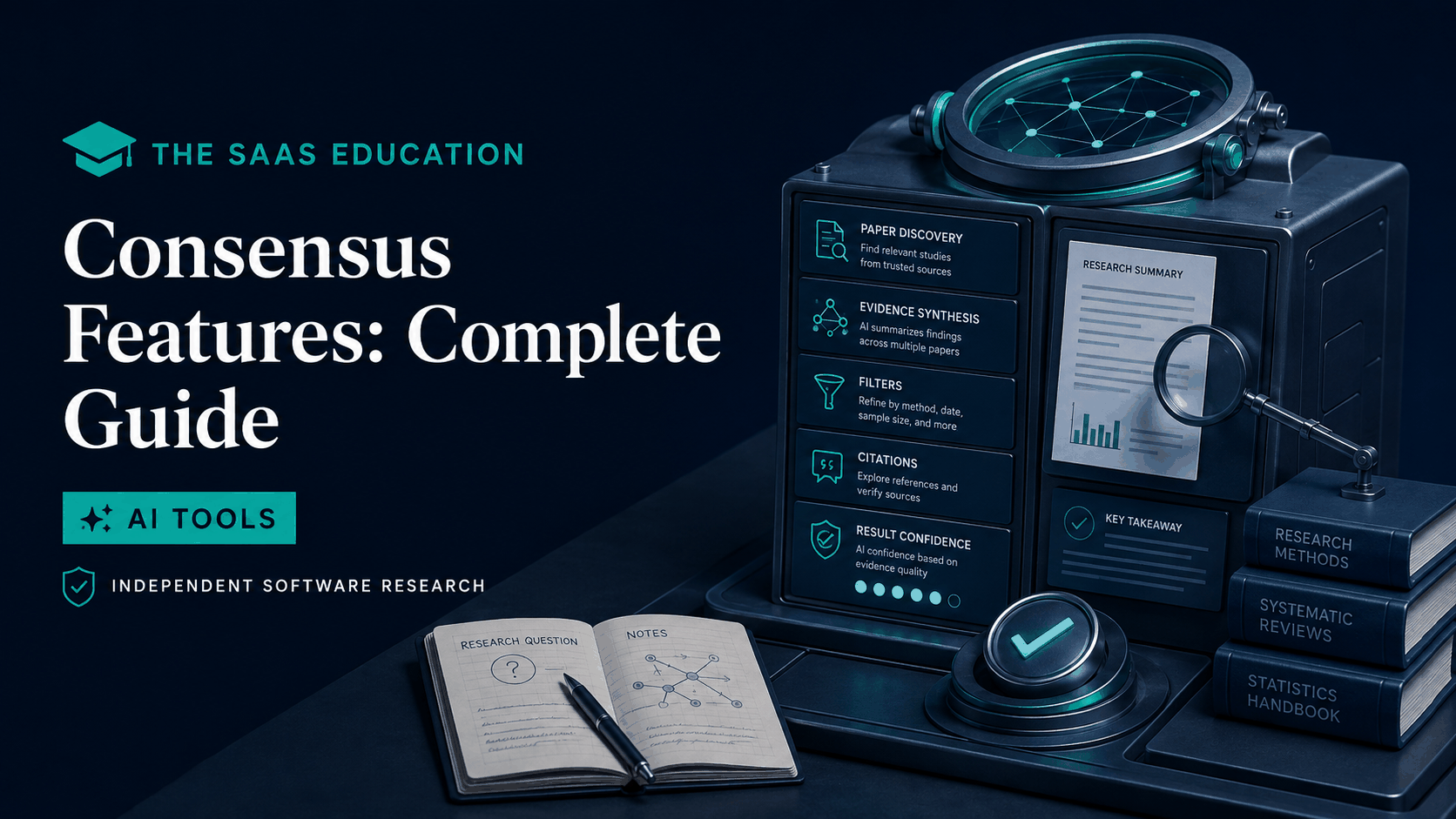
A practical guide to Consensus features, including academic search, synthesis, Pro Analysis, Ask Paper, filters, lists, Deep Search, and research agents.
Direct answer
Consensus combines natural-language academic search with AI-assisted synthesis and paper-level research tools. Its core features include search over a large corpus of peer-reviewed papers, answers linked to studies, synthesis views, Pro Analysis, Ask Paper, academic filters, saved lists, Deep Search, and research-agent workflows.
These features are most useful as a connected process. Search identifies candidate evidence. Filters narrow it. Synthesis helps map patterns. Ask Paper supports extraction from individual studies. Lists preserve the reading set. Deep Search and agents follow additional evidence paths. Human appraisal determines what the research actually supports.
This guide explains what each feature is for, where it adds value, and what must still be verified. Plan availability and usage limits can change, so check the current product and pricing pages before relying on a particular capability.
Consensus feature overview
| Feature | Primary use | Best practice | Limitation to remember |
|---|---|---|---|
| Natural-language search | Turn a question into academic discovery | Use several formulations and domain terms | One query is not comprehensive |
| Paper-linked answers | Connect a claim with candidate studies | Open and read the cited source | A link does not prove correct interpretation |
| Synthesis | Map patterns across results | Preserve disagreement and study differences | Concise summaries can flatten nuance |
| Pro Analysis | Inspect study attributes and evidence in more depth | Verify extracted fields | Extraction may omit or misclassify details |
| Ask Paper | Question one paper | Check the exact passage, table, or method | It does not replace close reading |
| Filters | Narrow by relevant academic attributes | Document applied filters | Incorrect filters can exclude useful evidence |
| Lists | Save and organize papers | Record inclusion reason and claim supported | A saved list is not an appraisal |
| Deep Search | Run a more intensive investigation | Review sources, scope, and stopping rule | Longer output is not guaranteed completeness |
| Research Agent | Follow multi-step evidence paths | Inspect each action and source | An agent can drift from the question |
1. Natural-language academic search
Consensus lets users begin with a plain-language research question instead of requiring a complete database query. Official documentation says its database contains more than 220 million peer-reviewed papers. The product uses AI to help interpret the question and surface relevant research.
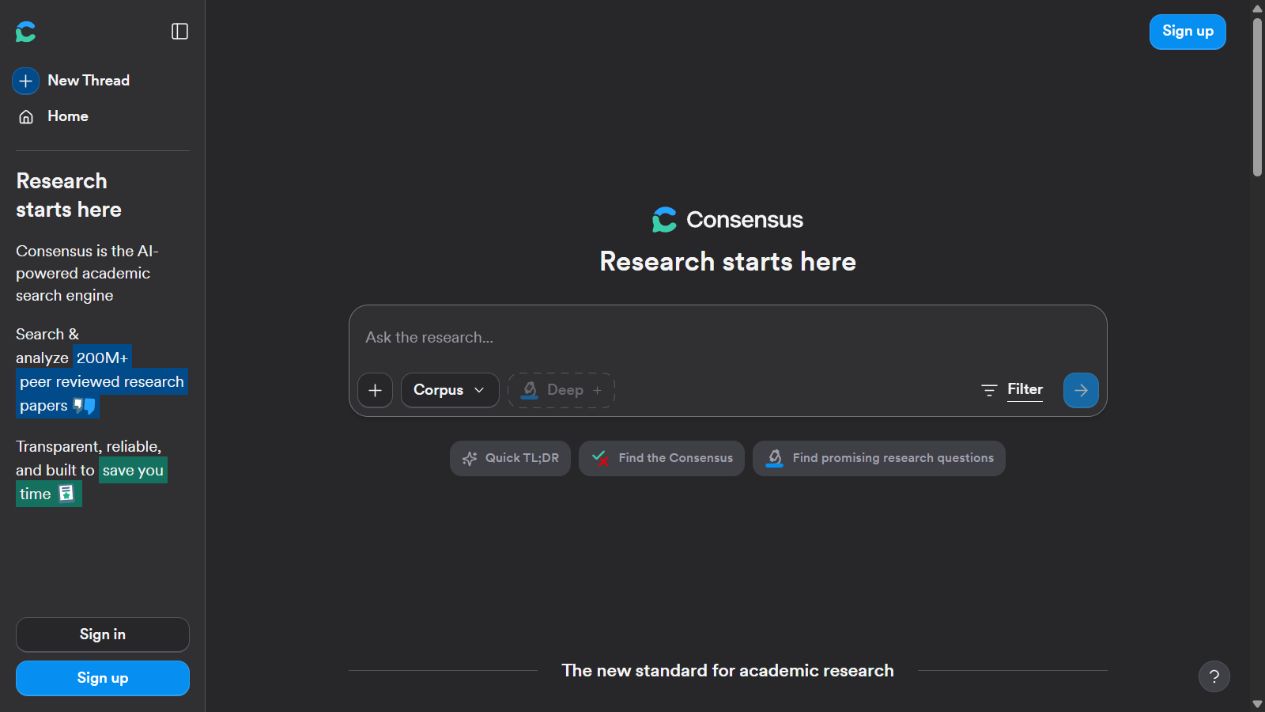
This lowers the entry barrier for students, writers, analysts, and practitioners. A user can ask whether an intervention is associated with an outcome, what evidence exists for a behavior, or how two approaches compare. Search results can reveal the vocabulary and paper set needed for deeper work.
Natural language should not become a single-query habit. Important topics use synonyms, acronyms, older terminology, spelling variants, and discipline-specific concepts. Rephrase the question, search key concepts separately, and inspect references. For systematic work, translate the concepts into documented database strategies.
2. Paper-linked answers
Consensus is differentiated from a general chatbot by its emphasis on research papers. Answers and summaries are intended to remain connected to identifiable studies. This improves traceability because a reader can move from generated language to the underlying source.
Traceability is only the first step. Open the paper. Confirm that the cited result concerns the same population, intervention, comparison, outcome, context, and time. Check whether the answer came from the abstract or full text. Review the authors’ limitations and uncertainty.
Do not cite the Consensus summary in place of the original study. Cite the paper directly when it supports the claim, and represent it accurately.
3. Synthesis
Synthesis features help users understand what a group of papers appears to say. This is valuable when search returns many studies and the user needs an initial map of agreement, disagreement, and evidence direction.
A responsible synthesis keeps unlike evidence separate. Randomized trials, observational studies, surveys, case reports, reviews, and laboratory work answer different questions. Populations, measures, durations, and contexts may also differ. A generated majority signal does not automatically establish the best conclusion.
Use synthesis to decide which papers to inspect first and which dimensions need an evidence table. Record study design, sample, exposure or intervention, comparator, outcome, estimate, uncertainty, and limitations. Then write the conclusion from the verified table.
4. Pro Analysis
Consensus documents Pro Analysis as a deeper way to examine a research question and the papers behind it. Depending on the current interface, it can help organize attributes and findings that would otherwise require opening each result independently.
The practical value is extraction consistency. Asking the same questions across studies reduces ad hoc reading. It can reveal that apparently similar papers use different outcomes or designs. That supports a more careful comparison.
AI extraction remains fallible. Validate values against the paper, especially sample size, direction of effect, statistical result, follow-up, and subgroup. If a paper cannot be accessed, label the evidence as abstract-only rather than inferring missing details.
5. Ask Paper
Ask Paper lets a user question one selected paper. Useful questions include: What population was studied? What was the primary outcome? How was the comparison defined? What limitations did the authors report? Was the finding statistically and practically important?
This can accelerate triage and help a reader navigate unfamiliar terminology. It is also useful when extracting the same fields across many studies.
Do not depend on a short answer for tables, figures, appendices, supplementary methods, or complex statistical interpretation. Locate the exact section and verify it. Ask Paper is a navigation assistant, not an authority separate from the document.
6. Academic filters
Filters help narrow a broad result set. Depending on available metadata, users may focus by publication date, field, study type, population, or other research characteristics. This is useful when a business question needs recent evidence or a clinical question requires a particular design.
Apply filters deliberately and record them. An incorrect date boundary or study-type label can remove the most relevant paper. Metadata is not always complete or consistent. Compare the filtered and unfiltered result sets before treating exclusion as final.
For reproducible work, preserve the query, date, filters, result count, and screening rule. Screenshots alone are not a durable search record.
7. Lists and saved research
Lists let users keep papers associated with a question or project. This prevents repeated discovery and supports a shared reading workflow. A list can become the basis for an evidence brief, article, lesson, product decision, or research proposal.
Add structure outside the title. Record why the paper was saved, which claim it informs, its study design, quality concerns, and review status. Mark duplicates, updates, corrections, and retractions. A list of links without decisions does not create institutional knowledge.
Test export and account continuity. Important evidence should also live in a reference manager or organizational system so it does not depend on one user’s subscription.
8. Deep Search
Deep Search is intended for questions that require more work than a basic result page. It can investigate a topic and create a more developed source-backed output. This may help a user move from an initial question to a structured research brief.
Review what “deep” means for the actual task. Inspect the sources, query scope, time range, exclusions, and whether contrary evidence appears. A long report can still be incomplete. Compare key findings with an independent subject database.
Use Deep Search for scoping and synthesis, then perform manual appraisal for consequential conclusions. Preserve the underlying papers and verification notes, not only the generated report.
9. Research Agent
Consensus’s official Research Agent page describes multi-step work using capabilities such as citation crawling, DOI lookup, author search, and similar-paper discovery. These tools mirror how experienced researchers expand from one useful paper into a network of related evidence.
Citation crawling can find earlier foundations and later responses. DOI lookup helps resolve an exact publication. Author search can reveal a program of work. Similar-paper discovery can surface studies that use different keywords.
Agents need boundaries. Define the question, required evidence types, exclusions, date range, and stopping rule. Inspect each source path. Citation networks can amplify a prominent but weak claim, and one research group can dominate a narrow field.
10. Use Consensus in a trustworthy research workflow
Start with a question that can be evaluated. Search several formulations. Use filters only after inspecting the broad landscape. Save candidate papers and record why they matter. Use synthesis to identify patterns and disagreements. Ask each paper the same extraction questions, then verify the answers directly.
Escalate to Deep Search or the Research Agent when basic discovery is insufficient. Compare the resulting paper set with a domain database. Document what was searched and when. Have a qualified reviewer approve high-stakes conclusions.
The output should be an evidence record: question, search method, included papers, appraisal, findings, uncertainty, and decision. Generated prose is secondary.
11. Export, reproducibility, and team review
Before building an important project in Consensus, test how searches, lists, citations, notes, and generated outputs can be preserved outside the account. A reviewer should be able to reconstruct the evidence trail without relying on one user’s memory or a screen capture.
Store the research question, exact query formulations, search date, applied filters, candidate count, inclusion decisions, and final paper identifiers. Use a reference manager or controlled project repository for the durable record. When an output changes after a product or model update, the team can then compare versions instead of losing the reasoning history.
For shared work, assign separate roles for search, extraction, and approval when stakes justify it. A second reviewer should verify the most important sources and any disagreement. Consensus can accelerate each step, but reproducibility comes from the recorded method and evidence.
Plan and usage considerations
Consensus provides free and paid access with plan-dependent usage and features. Advanced analysis, Deep Search, or other capabilities may have distinct allowances. Check the current pricing page for exact packaging, billing, and eligibility.
Start free with representative questions. Upgrade only when a proven feature or limit blocks recurring valuable work. For teams, verify administration, shared work, security, support, data terms, export, and offboarding.
Measure cost per verified brief or screened paper set, including correction time. More AI usage is not automatically more research value.
Limitations across all features
Consensus can miss relevant studies, surface weak studies, misread a paper, simplify disagreement, or produce an answer that does not apply to the user’s context. Peer review does not eliminate bias, error, publication problems, or retraction.
Full-text access may depend on publisher or institutional rights. Do not upload licensed or confidential material without permission. Avoid entering identifiable patient, student, customer, or unpublished research data into an unapproved service.
Systematic reviews require comprehensive methods beyond one product. Clinical, legal, financial, safety, and policy decisions require qualified review and current authoritative guidance.
Final verdict
Consensus’s features form a coherent academic research workflow: natural-language search, paper-linked answers, synthesis, analysis, paper questions, filters, lists, deeper search, and multi-step agents. The product is strongest when each feature moves the user closer to inspectable evidence.
Use the tools to reduce discovery and organization time. Do not outsource appraisal or authorship. The complete workflow ends with a human reading the sources and owning the conclusion.
Sources checked
Frequently asked questions
What are the main Consensus features?
Consensus provides natural-language academic search, paper-linked answers, synthesis, Pro Analysis, Ask Paper, filters, saved lists, Deep Search, and research-agent workflows, with access varying by plan.
What is Consensus Pro Analysis?
Pro Analysis helps users inspect and organize information across relevant papers. Treat its output as a structured research aid and verify every material conclusion in the underlying studies.
What does Ask Paper do?
Ask Paper lets users pose focused questions about an individual paper. It can speed orientation, but tables, appendices, methods, and limitations still require direct reading.
What is Consensus Deep Search?
Deep Search is a more intensive research workflow intended to investigate a question beyond a basic query. Current availability and usage depend on the selected plan.
Does Consensus have a research agent?
Yes. Official material describes multi-step tools such as citation crawling, DOI lookup, author search, and similar-paper discovery for deeper research tasks.
Can Consensus replace a literature database?
No single tool guarantees comprehensive coverage. Use subject databases, documented queries, reference management, screening, and expert appraisal for systematic or high-stakes work.
Can Consensus summarize research accurately?
It can produce useful summaries, but retrieval, extraction, and synthesis can be incomplete or wrong. Open the cited paper and verify population, method, result, uncertainty, and applicability.