Consensus Pricing: Plans, Costs, and Value
Understand Consensus pricing, free and paid plan fit, usage limits, team purchasing, hidden costs, value calculations, and how to choose a plan.
Direct answer
Start with Consensus’s free access and upgrade only when plan limits or advanced research workflows interrupt valuable, repeatable work. Paid access can make sense for students, researchers, clinicians, analysts, writers, and teams that regularly search and synthesize academic literature. It is poor value when use is occasional, source verification is skipped, or the same work is already covered by institutional databases and other tools.
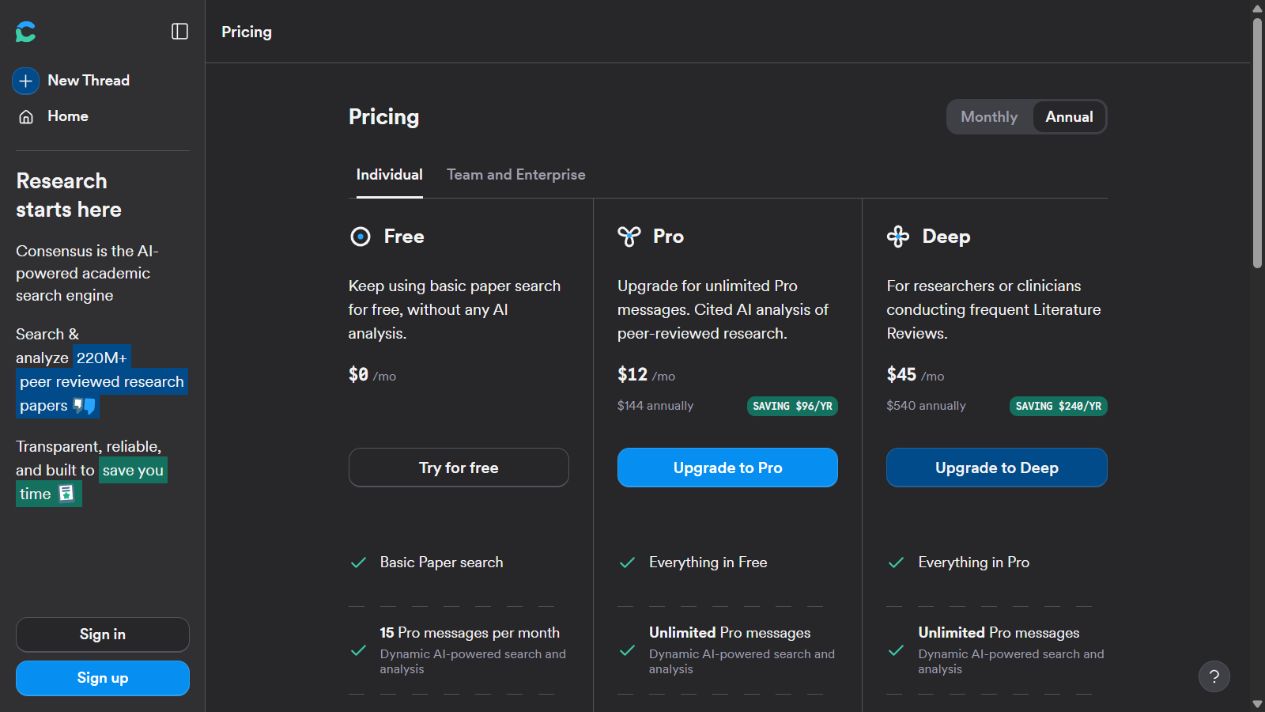
Consensus publishes current free and paid options on its official pricing page. Because prices, billing periods, taxes, promotions, regional availability, eligibility, usage allowances, and feature packaging can change, this guide does not freeze one checkout figure into a recommendation. The reliable decision is to compare the live offer with a measured workload.
The key question is not “How many AI searches do I get?” It is “How much does the plan cost per verified research outcome?” A useful outcome might be a screened reading list, an evidence table, a reviewed briefing, or a defensible answer whose cited papers have been opened and assessed.
Consensus pricing at a glance
| Buying path | Best for | What to verify | Main risk |
|---|---|---|---|
| Free access | Occasional users and evaluation | Search allowance, advanced-feature limits, exports, and current account requirements | Mistaking a light test for proof of fit |
| Paid individual | Frequent students, analysts, writers, clinicians, or researchers | Monthly versus annual billing, feature access, usage, cancellation, taxes, and eligibility | Paying for capacity that is not used |
| Team or organization | Shared research workflows and managed purchasing | Seats, administration, security, data terms, support, usage allocation, renewal, and procurement | Buying seats without a governed workflow |
| Institutional arrangement | Education or research environments | Eligibility, identity, access duration, user management, permitted use, and support | Assuming every user or feature is included |
What you are paying for
Consensus is not simply charging for access to a chatbot. Its product is organized around academic search and a large corpus of peer-reviewed research papers. Official documentation describes natural-language search, paper-linked answers, synthesis, Pro Analysis, Ask Paper, filters, lists, Deep Search, and research-agent capabilities.
Paid value can come from three places. First, higher usage may let a frequent researcher complete more work without interruption. Second, advanced tools can reduce manual screening, extraction, and organization. Third, an organizational arrangement may add purchasing, administration, support, or governance appropriate to shared use.
None of those benefits removes source review. A paid synthesis can still omit a relevant study. A research agent can follow an unhelpful path. An extracted answer can lose an important qualifier. Subscription cost must therefore be evaluated together with the human time required to check the result.
The free plan: who should start here?
The free path is the correct starting point for most new users. It allows a buyer to test whether the interface finds relevant papers for the actual field, whether the summaries are useful, and whether the workflow improves on existing search habits. A demonstration question chosen by a vendor is not enough.
Prepare ten representative questions. Include a broad question, a narrow technical question, a recent topic, an older established topic, a contested claim, and a question with known key papers. Record which studies are found, which are missed, whether the extracted claims are accurate, and how long verification takes.
Free access may be sufficient for occasional coursework, preliminary fact-checking, article research, or irregular evidence questions. Upgrade only when a documented limit blocks work that has already proved useful. Scarcity alone is not evidence that the paid tier will improve quality.
Users should also test export and continuity. Determine whether lists, saved papers, notes, searches, or generated reports remain accessible after a plan change. Do not create an important research archive without understanding how it can be retained independently.
Paid individual access: when it makes sense
An individual paid plan is most defensible when one person conducts frequent academic research and repeatedly benefits from deeper or higher-capacity features. Examples include a graduate student mapping a field, an analyst preparing evidence briefs, a clinician monitoring literature, or a writer who verifies scientific claims.
The plan should remove a real bottleneck. That might be insufficient advanced searches, limited analyses, interrupted paper questions, or a workflow that takes substantially longer in conventional tools. Measure the before and after state using completed work.
Annual billing may lower the effective monthly cost, but it increases commitment and unused-subscription risk. Begin monthly when uncertainty is high, unless refund and cancellation terms make the annual choice suitably low risk. Reassess after a full work cycle rather than after one enthusiastic session.
Students should verify current eligibility and institutional access. A personal paid plan can be unnecessary if a university already provides databases, library support, reference management, or access arrangements that solve the same problem. Conversely, Consensus can complement those services when its synthesis workflow saves time.
Team and organizational purchasing
Teams need more than multiplied individual subscriptions. Before buying, identify the shared use case. A product research group may build evidence briefs. A healthcare organization may support literature surveillance. An editorial team may verify claims. A consultancy may answer recurring client questions. Each requires different controls.
Ask the vendor to document user administration, authentication, roles, data handling, support, service terms, usage allocation, reporting, procurement, invoicing, renewals, and offboarding. Confirm whether team members can share lists or projects, and what happens when a user leaves.
Define ownership of research artifacts. Important search strategies, selected studies, notes, and evidence tables should belong to the organization, not remain trapped in one employee account. Establish a durable reference-management or document system where final evidence records live.
Seat utilization matters. A team plan is wasteful when only one analyst uses advanced features. A smaller specialist group can produce reviewed research for the wider organization. Expand only after requests, turnaround, and value show that distributed access is better.
Monthly versus annual billing
Monthly billing is usually appropriate for evaluation, short projects, uncertain workloads, or users whose research demand varies. It costs more per month when an annual discount exists, but reduces commitment and makes cancellation easier to time.
Annual billing is appropriate when the product has been used through a representative cycle, the required features are stable, and the renewal owner is known. Calculate the break-even point after taxes and discounts. Do not treat a displayed percentage saving as value if several months will be unused.
Record the renewal date, notice period, cancellation process, owner, payment method, and required review. Organizations should avoid unmanaged auto-renewal. Review usage and alternatives before the renewal window, not after the charge.
Usage limits and fair comparisons
AI research products often distinguish ordinary search from computationally heavier analysis or agent workflows. A page may describe access without promising unlimited use. Verify the current unit, allowance, reset period, queuing, throttling, and what happens after the allowance is exhausted.
Compare plans using the tasks that consume scarce capacity. If one research brief uses several deep analyses and many paper questions, a headline search allowance may not predict practical capacity. Track the median and worst-case usage for a real deliverable.
Do not compare Consensus query counts directly with ChatGPT messages, Google Scholar searches, or another vendor’s credits. The units perform different work. Compare the total cost and time required to reach the same accepted evidence standard.
Hidden and indirect costs
The subscription is only one part of ownership. Include:
- taxes, currency conversion, and payment fees;
- unused annual commitment or inactive seats;
- training and workflow documentation;
- time spent correcting retrieval or synthesis errors;
- access to full-text papers not included through the discovery tool;
- reference management and document storage;
- institutional security, privacy, and procurement review;
- duplication with databases, library services, or other AI subscriptions;
- migration and export effort if the tool is replaced.
Paywalled papers can be a major indirect cost. Discovering a citation does not necessarily grant lawful full-text access. Use institutional subscriptions, open-access sources, interlibrary services, or direct publisher options as permitted. Do not upload licensed material to an unapproved service.
How to calculate return on investment
Choose one recurring research output and establish a baseline. Record time spent defining the question, building searches, screening results, retrieving papers, extracting evidence, checking claims, writing the brief, and obtaining approval.
Repeat the task with Consensus. Include correction and verification time. Compare evidence quality, missed studies, traceability, turnaround, and reviewer confidence. A fast draft that creates extra review work is not a saving.
Use this practical model:
Net monthly value = verified hours saved × appropriate labor value + avoided tool cost - subscription - implementation - additional review cost.
Do not inflate the labor value by assuming every saved minute becomes billable revenue. Use a conservative number. Require repeated results across several tasks before purchasing for a full team.
Pricing by user type
Students
Start free and use university databases and librarians. Upgrade during periods of sustained research only if higher limits materially improve a compliant workflow. Follow academic integrity rules and cite original papers.
Researchers
Evaluate coverage in the relevant discipline and compare results with established databases. Paid capacity may help discovery and triage, but reproducible reviews still require documented search methods, screening, and appraisal outside a single AI interface.
Clinicians and health teams
Consensus can support preliminary evidence discovery and education. It should not replace clinical guidelines, specialist databases, institutional policy, or professional judgment. Privacy and governance review are mandatory before sensitive use.
Writers and analysts
Paid access can be valuable when frequent claims need primary research support. Build an evidence ledger linking each publishable claim to the paper and verification note. Never cite a generated summary as if it were the study.
Organizations
Buy for a defined group and approved process. Require administration, ownership, source traceability, export, security review, and measured seat use. A pilot is more informative than a broad rollout.
Alternatives and total stack cost
Google Scholar, PubMed, Semantic Scholar, subject databases, library discovery services, and publisher platforms cover different parts of research. Elicit and Scite offer other AI-assisted approaches. ChatGPT provides a broader general-purpose workspace. Reference managers such as Zotero address durable citation organization.
The cheapest option may be a combination of free discovery plus institutional access and a disciplined manual process. The best-value option may be a paid specialist that saves skilled research time. Avoid paying for several AI products that produce similar summaries without improving coverage or verification.
Map each tool to a role: discovery, full-text retrieval, screening, appraisal, citation management, synthesis, writing, and approval. Remove products that do not own a distinct recurring job.
Cancellation and renewal checklist
Before subscribing, verify:
- billing currency, taxes, and renewal price;
- monthly or annual commitment;
- promotional period and post-promotion amount;
- cancellation deadline and effective date;
- refund policy and exceptional terms;
- feature or usage changes after cancellation;
- data, list, citation, and report export;
- account deletion and retention behavior;
- institutional or team offboarding;
- procurement and renewal owner.
Capture the terms shown at checkout and store the invoice. Pricing pages can change after purchase, while the accepted agreement controls the subscription.
Which Consensus plan should you choose?
Choose free access when you are evaluating the product, research only occasionally, or have not yet proven that advanced features improve accepted work.
Choose an individual paid plan when one user repeatedly reaches meaningful limits and the added capacity or workflow saves verified research time. Prefer a lower-commitment billing period until usage is stable.
Choose a team or organizational path when several people share an approved research process and need managed purchasing, support, administration, or collaboration. Negotiate against documented requirements and pilot with representative users.
Choose no paid plan when conventional databases, institutional resources, or an existing tool meet the need; when source review is not available; or when the intended data cannot be handled safely.
Final verdict
Consensus pricing should be judged as the cost of an evidence workflow, not the cost of generated answers. Free access is the sensible entry point. Paid individual access can be worthwhile for frequent, source-conscious researchers. Organizational purchasing can make sense when it adds governance and repeatable shared value.
The decision becomes simple after measurement: verify the live offer, test representative questions, count total research and review time, and pay only when the product repeatedly improves a trustworthy deliverable.
Sources checked
Frequently asked questions
How much does Consensus cost?
Consensus offers free and paid options with current prices, billing terms, and usage shown on its official pricing page. Verify checkout because rates, taxes, discounts, and limits can change.
Is Consensus free to use?
Yes, Consensus provides a free access path with plan-dependent limits. It is suitable for testing representative research questions before paying for higher usage or advanced workflows.
Is Consensus Premium worth it?
Paid access is worth considering when advanced research features or higher recurring usage save more verified work than the subscription and review cost. Measure accepted research outputs, not query volume.
Does Consensus offer student pricing?
Eligibility and promotional arrangements may change. Check the current official pricing and institutional information using the relevant account and region rather than relying on an old discount claim.
Does Consensus have a team plan?
Consensus provides organizational purchasing paths. Confirm seats, shared administration, usage, security, support, procurement, data terms, and renewal conditions in the current proposal.
Can I cancel a Consensus subscription?
Review the current account and billing terms for cancellation timing, renewal, refunds, and continued access. Save or export important research records before changing a plan.
What is the cheapest alternative to Consensus?
Google Scholar, PubMed, and other subject databases may be free, while AI research products offer different paid workflows. Compare coverage, synthesis, organization, and total human review cost.