Consensus Pros and Cons
Evaluate Consensus pros and cons across academic search, evidence synthesis, paper analysis, research agents, pricing, reliability, and workflow fit.
Direct answer
Consensus’s main advantage is that it makes academic evidence easier to search and synthesize while keeping results connected to research papers. Its main disadvantage is that an approachable answer can feel more complete and reliable than the underlying retrieval and appraisal justify.
The product is a strong fit for students, analysts, writers, clinicians, educators, and research-oriented professionals who need faster discovery and are willing to read the sources. It is a weak fit for anyone who wants an automatic conclusion, cannot verify papers, or needs one tool to prove a search was comprehensive.
Consensus should be judged as research infrastructure, not an answer machine. Used well, it reduces friction between a question and an evidence set. Used carelessly, it can turn incomplete evidence into confident prose.
Consensus pros and cons at a glance
| Pros | Cons |
|---|---|
| Natural-language access to academic research | Natural-language ease can encourage shallow questions |
| Answers linked to identifiable papers | A linked paper can still be weak or misinterpreted |
| Large documented corpus of peer-reviewed papers | Corpus and ranking do not guarantee complete coverage |
| Synthesis and Pro Analysis reduce manual orientation | Summaries can flatten heterogeneity and uncertainty |
| Ask Paper speeds focused extraction | It can miss tables, appendices, or nuanced methods |
| Filters, lists, and deeper workflows support organization | Metadata and saved lists still require human decisions |
| Research agents can follow citations and related evidence | Multi-step agents can drift or amplify a weak starting path |
| Free access supports evaluation | Valuable advanced usage may require a paid plan |
What Consensus does
Consensus is an AI-powered academic search product. Official documentation says it searches more than 220 million peer-reviewed papers and offers search, paper-linked answers, synthesis, Pro Analysis, Ask Paper, filters, lists, Deep Search, and research-agent capabilities.
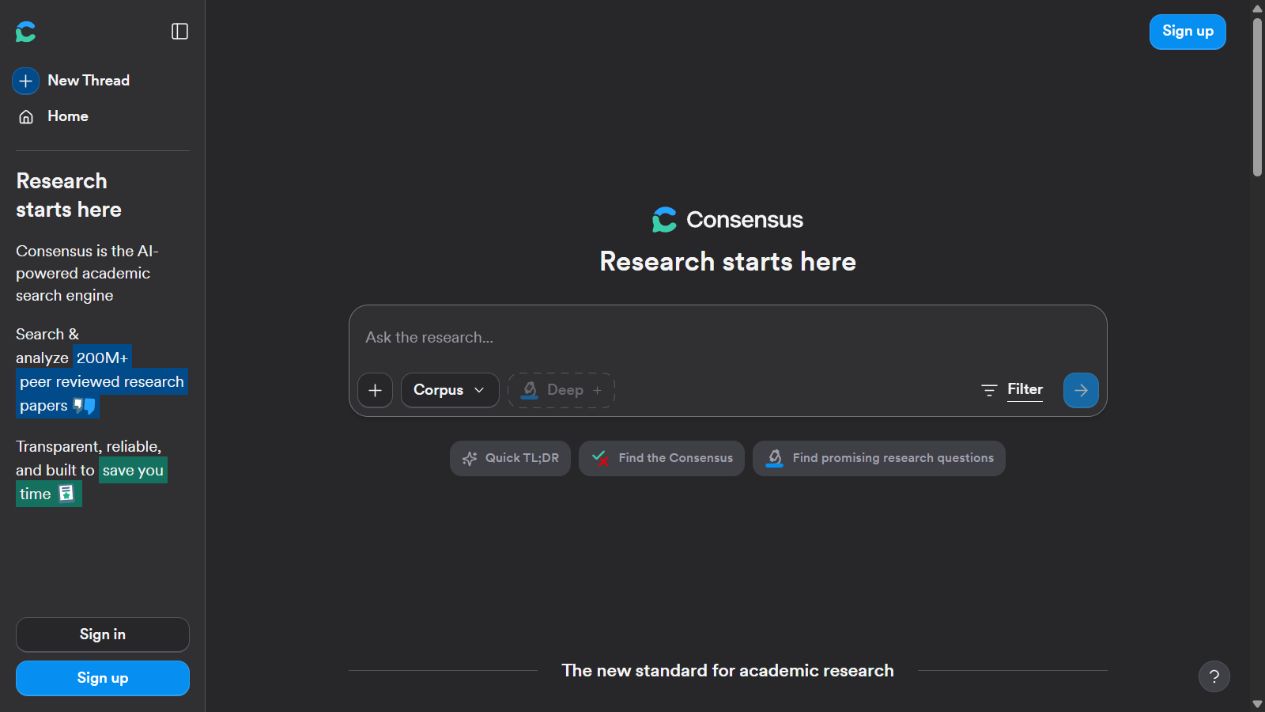
The interface is designed to help users move from a question to relevant research without learning every convention of a specialist database first. Its deeper tools can help organize papers, extract information, follow citation relationships, locate identifiers, search authors, and discover similar work.
The product does not make the literature internally consistent or automatically applicable. Every feature sits between the user and a complex publication system, so the method around the tool determines the value.
Pro 1: approachable academic search
Natural-language search reduces the effort required to start. A user can ask a practical question and receive research-oriented results instead of constructing a precise Boolean query immediately. This helps people learn the terminology of a field and find candidate papers.
The feature is valuable for exploratory work. A product manager can investigate behavioral evidence, a writer can trace a scientific claim, and a student can identify major concepts. The interface makes the first step less intimidating than many academic databases.
Accessibility should lead to better questions. After the first search, users should separate concepts, add synonyms, test narrower populations, and search contrary positions. The tool is an entry point, not a reason to stop learning search methods.
Pro 2: source-linked output
Consensus keeps the result tied to identifiable papers. This is a meaningful improvement over unsupported chatbot prose because the user can inspect where a claim may have come from. Source links also make review, citation, and correction more practical.
Source linking changes the right user behavior: open the paper, find the relevant passage, compare the question with the study, and record the limitation. It supports a defensible evidence ledger.
The advantage is traceability, not guaranteed truth. Users still need to verify that the source supports the wording and that the paper is appropriate evidence.
Pro 3: synthesis across papers
Synthesis can make a large result set easier to understand. Instead of reading abstracts in arbitrary order, a user can see an initial representation of findings and identify where evidence appears to align or disagree.
This can reduce orientation time and reveal dimensions for a structured table. It is particularly helpful for preliminary briefs and topic mapping, where the goal is to understand the field before close appraisal.
Good users treat synthesis as a hypothesis about the literature. They validate the study set, preserve different designs and populations, and rewrite the conclusion from checked evidence.
Pro 4: paper-level questioning
Ask Paper helps users locate information within one study. Repeated questions about population, intervention, outcome, methods, results, and limitations can accelerate consistent extraction across a reading set.
This is useful for long or unfamiliar papers. It can direct attention to the relevant section and reduce the time spent scanning for terminology. It may also help users identify what a paper does not answer.
The strongest workflow pairs the answer with the exact source passage. That protects against accidental paraphrase errors and makes reviewer checks faster.
Pro 5: filters and organization
Filters can narrow a broad question by relevant academic attributes, while lists preserve useful papers for a project. These features make the product more than a one-off question interface.
Saved research supports continuity. A team can return to an evidence set, mark what has been reviewed, and avoid rediscovering the same papers. Filters help focus attention when the research question has a defined date, field, population, or study requirement.
The organizational value increases when teams record inclusion reasons, claim relationships, quality concerns, and review status outside the paper title.
Pro 6: deeper and agent-led research
Consensus documents Deep Search and a Research Agent that can use tools such as citation crawling, DOI lookup, author search, and similar-paper discovery. These are legitimate research moves that go beyond matching one query.
Following citations can uncover foundations and later challenges. DOI lookup resolves exact records. Author search reveals connected work. Similar-paper discovery can find studies that use different keywords. An agent can coordinate these steps faster than manual tab switching.
This is valuable when the process remains inspectable. Users should be able to see what was found and decide whether the path is still relevant.
Pro 7: a free path to evaluation
Consensus offers free access, allowing users to test real questions before committing. That is important because fit varies by field, question, and evidence requirement. A product that works well for a common clinical question may be less useful in a narrow technical discipline.
Use the free plan for a known-item test. Search for papers you expect to find, evidence that disagrees, and recent work. Check summaries against the originals. Upgrade only if a paid feature or allowance solves a demonstrated bottleneck.
Con 1: incomplete retrieval remains possible
No single academic search product guarantees complete coverage. Relevant studies may use different language, appear in databases or publication types outside the indexed corpus, be too recent, rank poorly, or lack accessible metadata. A natural-language result can hide what was not found.
This limitation matters most for systematic, clinical, legal, regulatory, or policy work. Those tasks require documented searches across appropriate databases, controlled vocabulary, citation methods, screening, and reporting.
Use Consensus as one discovery layer. Compare with subject databases, library resources, standards, guidelines, and reference lists. Record the query and date.
Con 2: peer review is not a quality guarantee
Consensus emphasizes peer-reviewed literature, which narrows the source environment. Peer review does not make every paper valid. Studies can contain weak design, bias, small samples, selective reporting, conflicts, errors, or conclusions that exceed the data.
Publication status can also change through corrections, expressions of concern, or retraction. A tool may surface a paper without fully communicating its current status or place in later evidence.
Appraise methods and source status. Prefer reviews, guidelines, or primary studies appropriate to the question. Involve domain expertise when the consequences are material.
Con 3: synthesis can erase important differences
A concise answer can combine studies that should not be pooled conceptually. Different populations, interventions, outcomes, durations, designs, and contexts may produce apparently conflicting results for understandable reasons.
The danger is a smooth conclusion that hides heterogeneity. A majority of surfaced papers is not automatically the strongest evidence. Ranking and publication patterns affect what appears.
Build an evidence table and separate unlike studies. State uncertainty and applicability. Do not translate “some evidence suggests” into a universal recommendation.
Con 4: extraction can be wrong
Ask Paper and analysis features can misread or omit information. An abstract may not include the primary analysis. A table may contain adjusted estimates that differ from the narrative. Supplementary material may change interpretation. Negation, subgroup labels, and confidence intervals are easy to mishandle.
Verify every value and consequential statement. Distinguish abstract-only review from full-text review. Never quote generated wording as if it appeared in the paper.
Con 5: ease can create overconfidence
The product’s greatest UX strength is also a risk. A clear interface and direct answer can make research feel finished. New users may not ask how results were selected, what evidence is missing, or whether the studies apply.
Organizations need research literacy alongside software access. Teach users to formulate answerable questions, inspect designs, trace claims, look for disagreement, and communicate uncertainty. High-stakes output needs an independent reviewer.
Con 6: plan limits and total cost
Free and paid access have different capabilities and usage. Frequent advanced analyses or deeper workflows may require a subscription. Current prices, billing periods, allowances, and eligibility can change.
The subscription is not the full cost. Include time verifying sources, acquiring full text, correcting output, maintaining references, training users, and operating adjacent databases or tools. A product that creates more unchecked summaries can increase workload.
Measure cost per verified research deliverable, not per query. Annual billing is sensible only after representative use proves ongoing value.
Con 7: privacy, licensing, and institutional constraints
Researchers may handle unpublished ideas, confidential projects, licensed documents, student records, patient information, or customer data. Not all of that material should enter an external AI service.
Review current terms, privacy, security, retention, training, and organizational controls. Use approved accounts. Remove unnecessary identifiers. Confirm whether full-text licenses permit upload or processing. Preserve important work in an institutional system.
Who should use Consensus?
Consensus is a good fit for people who regularly need academic evidence, value approachable discovery, and can appraise the sources. It can help students learn a field, writers verify claims, analysts create evidence briefs, clinicians explore literature, and product teams investigate research-backed questions.
It is especially useful for scoping: discovering vocabulary, candidate papers, themes, and disagreements before a deeper review.
Who should avoid relying on it?
Avoid relying on Consensus alone when the task requires comprehensive retrieval, formal reproducibility, clinical or legal authority, regulatory evidence, or a decision whose harm cannot be corrected easily. Use domain databases and qualified professionals.
It is also a poor fit when users will not open papers, when required literature is outside the covered environment, or when sensitive material cannot be processed under the proposed terms.
Alternatives
Google Scholar offers broad discovery and citation navigation. PubMed and other subject databases provide domain-specific indexing. Elicit offers AI-assisted research workflows. Scite emphasizes citation context. Semantic Scholar provides discovery and paper relationships. ChatGPT is broader for general research, files, writing, and analysis.
These tools are not mutually exclusive. A robust workflow may use Consensus for question-led discovery, a subject database for coverage, a reference manager for durable organization, and an expert for appraisal.
How to evaluate Consensus
Select ten known questions in the target field. Include easy, narrow, recent, contested, and interdisciplinary topics. Define expected papers and minimum evidence criteria. Run alternative query wording.
Measure known-paper retrieval, relevance, source clarity, extraction accuracy, representation of disagreement, review time, exports, and cost. Inspect whether another qualified user can reproduce the evidence set. Record severe errors separately from average usefulness.
Only purchase after the test proves a recurring workflow. Reassess coverage, plans, permissions, usage, exports, and alternatives before renewal.
Final verdict
Consensus offers a thoughtful bridge between plain-language questions and academic evidence. Its paper-linked answers, synthesis, analysis, organization, deeper search, and research agents can save meaningful discovery time.
Its limitations are not minor disclaimers. Search can be incomplete, papers can be weak, extraction can be wrong, and synthesis can hide uncertainty. Consensus is worth using when it strengthens an evidence process. It should never be allowed to become the evidence process by itself.
Sources checked
Frequently asked questions
What is the biggest advantage of Consensus?
Its biggest advantage is connecting approachable AI-assisted answers and synthesis to identifiable academic papers, making evidence easier to discover and inspect than in a general chatbot alone.
What is the biggest limitation of Consensus?
It cannot guarantee complete retrieval or correct appraisal. Users must verify that relevant studies were found and read the papers to judge methods, quality, uncertainty, and applicability.
Is Consensus accurate?
Consensus can produce useful source-linked results, but accuracy depends on the query, corpus, retrieval, extraction, synthesis, and quality of the papers. Consequential claims need direct verification.
Is Consensus good for literature reviews?
It is useful for scoping, discovery, and preliminary evidence organization. A formal literature review still needs a protocol, multiple appropriate databases, screening, appraisal, synthesis, and transparent reporting.
Is Consensus worth paying for?
It can be worth paying for when higher usage or advanced research tools repeatedly save verified work. Start free, measure complete research tasks, and include review time in the calculation.
Who should avoid relying on Consensus alone?
Anyone conducting systematic, clinical, legal, regulatory, safety, or other high-stakes work should not rely on it alone. Use authoritative databases, standards, and qualified expert review.
What are the best Consensus alternatives?
Alternatives include Google Scholar, PubMed and subject databases, Elicit, Scite, Semantic Scholar, and ChatGPT. The best choice depends on coverage, synthesis, citation context, and workflow.