Consensus Review (2026)
An evidence-led Consensus review covering academic search, AI synthesis, Deep Search, Ask Paper, research agents, limitations, pricing, and best-fit users.
Direct answer
Consensus is a strong AI research tool for people who want to search, inspect, and synthesize peer-reviewed literature without beginning every question in a conventional database interface. Its academic focus, paper-linked answers, filters, Ask Paper workflow, synthesis features, and research agents make it more useful for evidence discovery than a general chatbot alone.
It is not a substitute for reading papers, judging study quality, checking whether a result applies to the target population, or conducting a reproducible systematic review. Retrieval can miss relevant evidence. Extracted findings can lose context. A concise synthesis can make disagreement look simpler than it is. The product is most valuable when it shortens the route to evidence while the user remains responsible for appraisal.
Our verdict is positive for exploratory and practical research. Students, analysts, clinicians, writers, and product teams can use Consensus to map a question, identify papers, compare findings, and create a reading list. Researchers doing publication-grade or high-stakes work should use it as one layer in a broader method.
Consensus at a glance
| Area | Assessment |
|---|---|
| Core use | AI-assisted search and synthesis of academic research |
| Best for | Rapid evidence discovery, question mapping, paper exploration, and cited research briefs |
| Corpus | Consensus documents access to more than 220 million peer-reviewed papers |
| Notable tools | Search, synthesis, Pro Analysis, Ask Paper, filters, lists, Deep Search, and research agents |
| Main strength | Keeps the research workflow connected to identifiable papers |
| Main limitation | AI output and retrieval are not complete evidence appraisal |
| Best users | Students, researchers, clinicians, analysts, educators, and evidence-oriented professionals |
| Buying rule | Pay when deeper or more frequent research saves verified work, not merely reading time |
What is Consensus?
Consensus is an AI-powered academic search and research product. Its official documentation says it searches a database of more than 220 million peer-reviewed papers and uses language models to help users discover and understand relevant evidence. Rather than answer from a broad conversational model alone, the product centers the interface on research papers and their extracted content.
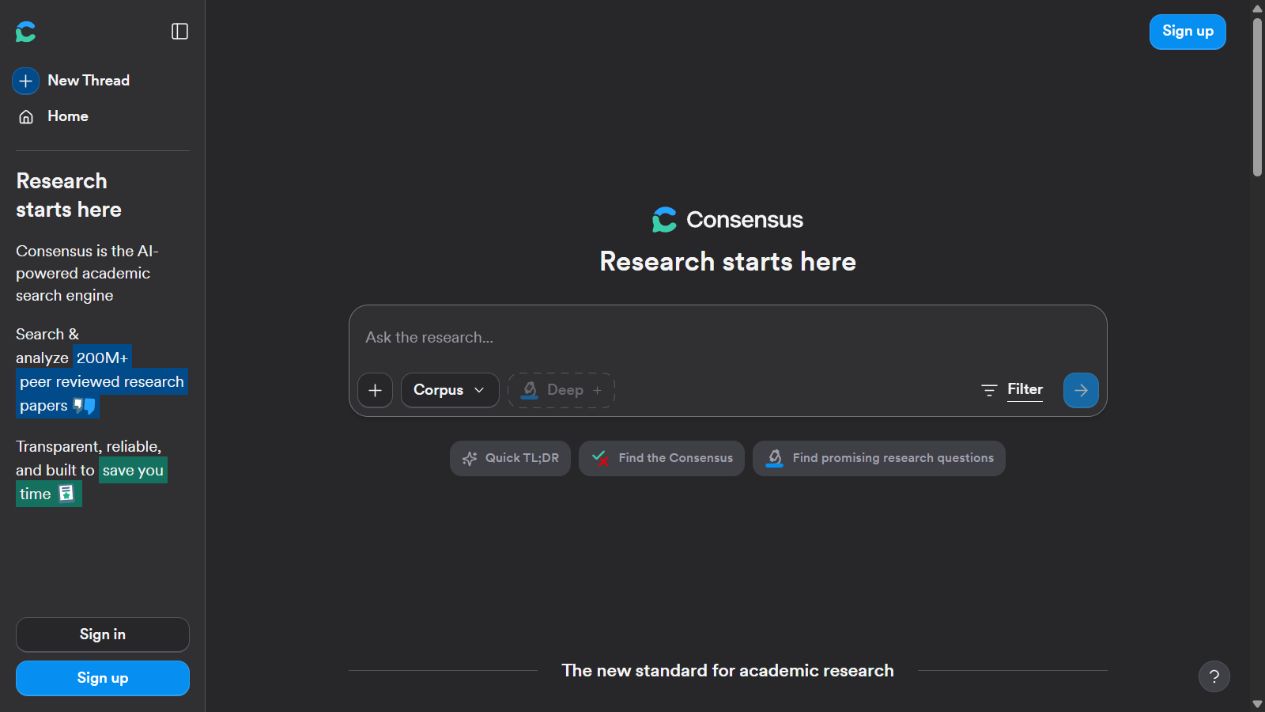
A user can pose a natural-language question, inspect surfaced studies, review synthesized information, apply academic filters, ask questions of a paper, save material, and use deeper research workflows. Consensus also documents research-agent capabilities such as citation crawling, DOI lookup, author search, and finding similar papers.
That design addresses a real problem. Conventional academic databases are powerful but can be difficult for new users. General search engines mix scholarship with commentary. General chatbots can answer without making the evidence chain clear. Consensus creates a more approachable entry point while retaining links to papers.
How Consensus works
At a high level, the user states a research question and Consensus retrieves papers that appear relevant. AI systems help interpret the query, rank or organize results, extract information, and present summaries or synthesis. The exact experience varies by query, feature, plan, and current product state.
This workflow contains several independent stages, each of which can fail. The question may be underspecified. Relevant papers may not be in the corpus or may not rank highly. A paper’s abstract may omit an important limitation. Extraction may confuse population or outcome. Synthesis may combine studies that should remain separate. The user therefore needs to inspect the evidence chain rather than treating the final prose as an answer key.
Good use begins with a structured question. Define population, intervention or exposure, comparison, outcome, context, and time where relevant. Run alternative terms. Inspect inclusion and exclusion. Open the strongest papers. Check publication dates, methods, sample sizes, effect estimates, conflicts, corrections, and applicability.
Search and evidence discovery
Consensus’s most compelling feature is natural-language discovery within an academic context. A practitioner can begin with “Does remote work improve software-team productivity?” rather than building a complex Boolean query. The returned view can help identify vocabulary, influential papers, and areas of disagreement.
This is particularly useful at the beginning of a project. It helps a user move from a broad business question to researchable concepts. A writer can locate primary studies behind a popular claim. A clinician can identify candidate evidence for further review. A student can see how a topic is discussed in the literature.
Coverage should not be assumed complete. Different disciplines rely on different databases, controlled vocabularies, conference proceedings, preprints, books, legal sources, technical standards, or non-English collections. A systematic search needs a documented strategy across appropriate resources. Consensus can inform that strategy, but should not silently define it.
AI synthesis and Pro Analysis
Consensus documents synthesis and Pro Analysis features intended to make multiple papers easier to interpret. This can save time when a question has many results. A structured view of findings, methods, or attributes is more useful than opening tabs without a plan.
The danger is false coherence. Studies may investigate different populations, interventions, measurements, follow-up periods, or designs. A positive result in a small observational study does not carry the same weight as a preregistered randomized trial. A synthesis needs to preserve heterogeneity and uncertainty.
Use generated synthesis as an index, not the final analysis. Trace every consequential statement to the source. Record which version was reviewed. Distinguish a paper’s result from the tool’s interpretation. Where studies conflict, explain why instead of choosing the most convenient conclusion.
Ask Paper
Ask Paper supports focused questions about an individual paper. This can help locate definitions, methods, outcomes, limitations, and relevant passages in a long document. It is useful for triage and orientation, especially when a user needs to decide whether a paper deserves deeper reading.
The feature does not eliminate close reading. Tables, appendices, figures, supplementary files, statistical details, and nuanced limitations may not survive a short answer. A model can also attribute an answer too broadly. Open the paper and confirm the passage before quoting, citing, or relying on it.
A productive workflow is to ask the same structured questions of each shortlisted study: What was the population? What was measured? What was the comparison? What was the effect? How certain was it? What limitations did the authors report? Then verify each answer manually and place it in an evidence table.
Filters, lists, and organization
Academic filters can help narrow results by date, study characteristics, field, or other available attributes. Lists allow users to preserve a research trail rather than repeat discovery. These features matter because research quality depends partly on process, not just individual answers.
Organization should include decisions as well as saved links. Record why a paper was included, what claim it supports, what limitations apply, and when it was checked. Duplicate papers, updated versions, corrections, and retractions require attention. Export or retention behavior should be tested before building a long-lived workflow around the platform.
Deep Search and research agents
Consensus describes deeper research and agent capabilities designed to run multi-step discovery. The research-agent page lists operations including citation crawling, DOI lookup, author search, and similar-paper retrieval. These are sensible academic tasks because good research often follows relationships rather than one keyword result list.
Agentic work is helpful when its steps remain inspectable. A chain that finds a seminal paper, follows later citations, identifies an author’s related work, and searches similar papers can reveal a field more effectively than one query. It can also drift, repeat weak assumptions, or overweight a citation network.
Users should review the plan, sources, exclusions, and stopping rule. A longer generated report is not necessarily a more complete review. For high-stakes work, preserve query terms, dates, databases, filters, and screening decisions independently.
Accuracy and reliability
Consensus has a structural advantage over a general chatbot because answers are designed around research papers. That improves traceability, but it does not guarantee truth. Peer review is a quality-control process, not a certificate that every result is correct. Published literature contains weak methods, small samples, selective reporting, disagreement, errors, and retractions.
Reliability depends on four layers: whether the right evidence was retrieved; whether the paper itself is credible; whether the relevant finding was extracted correctly; and whether the synthesis applies to the user’s question. Review all four.
For health, legal, financial, safety, or policy decisions, involve qualified professionals. Do not convert an exploratory search result into a recommendation without considering guidelines, jurisdiction, patient or user context, and current authoritative evidence.
Ease of use
The product’s natural-language entry point lowers the barrier to academic search. Clear links between answers and papers can make the interface more teachable than a blank database query screen. Specialized tools reduce prompt engineering because the workflow already assumes research intent.
Ease can create overconfidence. A polished summary may feel complete even when important evidence is absent. Teams should teach users to open sources, identify study design, question generalization, and document uncertainty. The interface should accelerate those habits, not replace them.
Pricing and value
Consensus offers free and paid purchasing paths, including options aimed at individuals and organizations. Usage, advanced features, billing, and eligibility vary by plan. Because product pricing can change, verify the official pricing page at purchase rather than relying on an old quoted amount.
Value depends on verified research time saved. Count time to formulate searches, screen papers, extract findings, correct mistakes, and prepare a usable output. A student running occasional queries may be well served by free access. A consultant, analyst, clinician, or research team with frequent evidence tasks may justify paid capacity if it reduces repeated discovery work.
Do not pay merely for longer summaries. Pay for a workflow that improves source discovery, traceability, consistency, and accepted deliverables.
Privacy and research governance
Researchers may work with unpublished questions, confidential projects, patient or customer information, manuscript drafts, and licensed documents. Review current privacy, security, retention, sharing, and institutional requirements before uploading or entering sensitive material.
Remove unnecessary identifiers. Use approved organizational accounts where available. Define what may be searched, uploaded, shared, or exported. Maintain a separate source record for consequential work so a change in the tool does not erase the audit trail.
Consensus alternatives
Google Scholar provides broad scholarly discovery and citation navigation. It is familiar and free, but offers a different synthesis experience.
PubMed is essential for biomedical research because of its domain focus, indexing, and established search practices. Other disciplines have their own specialist databases.
Elicit focuses on AI-assisted research workflows and evidence extraction. Compare corpus, questions, outputs, and review controls.
Scite emphasizes citation context and how publications support, mention, or contrast claims. It can complement discovery and appraisal.
ChatGPT is broader and useful for explanation, files, writing, and general research. Consensus remains more explicitly centered on academic literature.
The best stack may combine products. Use Consensus for approachable discovery, a subject database for coverage, a reference manager for durable organization, and domain expertise for appraisal.
Who should choose Consensus?
Choose Consensus when you frequently need to answer questions from peer-reviewed research, want a faster route to relevant papers, and will verify the evidence. It is a good fit for research-led writing, product discovery, education, preliminary clinical evidence mapping, and analyst work.
Avoid relying on it alone for systematic reviews, regulatory submissions, clinical decisions, legal conclusions, or any task requiring demonstrably comprehensive retrieval. It can assist those workflows only within a documented method and qualified review.
Before committing, run a known-item test. Select several papers that domain experts consider central, plus recent studies, a retracted or corrected item, and evidence that reaches conflicting conclusions. Search using natural language and alternative terminology. Record what appears, how it is summarized, whether source links are clear, and how much manual work is required to establish the accurate position. This test reveals more than a generic demonstration because it measures the product against evidence whose context is already understood.
Repeat the exercise in the team’s weakest area. A tool that performs well for common health questions may behave differently in engineering, social science, education, or a narrow emerging field. Fit is discipline- and question-dependent.
Final verdict
Consensus is one of the more coherent applications of generative AI to research because the product is organized around identifiable academic papers rather than detached answers. Search, synthesis, Ask Paper, filters, lists, Deep Search, and research agents can meaningfully reduce the friction of evidence discovery.
Its limits are equally important. Retrieval is not completeness, synthesis is not appraisal, and peer-reviewed does not mean universally correct. Use Consensus to find and understand evidence faster, then read the papers and own the conclusion.
Sources checked
Frequently asked questions
Is Consensus AI reliable?
Consensus can accelerate discovery and synthesis, but reliability depends on retrieval, paper quality, extraction, and interpretation. Users must open, read, and appraise the underlying studies.
Is Consensus better than Google Scholar?
Consensus offers AI-assisted answers and specialized synthesis, while Google Scholar provides broad scholarly discovery and citation navigation. Serious research may benefit from both plus subject databases.
Can Consensus write a literature review?
It can help find, organize, and summarize studies, but a defensible literature review requires a documented protocol, comprehensive database strategy, screening, appraisal, synthesis, and author judgment.
Does Consensus only use peer-reviewed papers?
Consensus describes its search corpus as more than 220 million peer-reviewed research papers. Users should still inspect each record, publication type, corrections, and source status.
Is Consensus free?
Consensus offers a free access path and paid options with plan-dependent usage and features. Verify the current pricing page because limits, eligibility, and billing can change.
Who should use Consensus?
It is most useful for students, researchers, clinicians, analysts, and evidence-oriented professionals who need faster academic discovery and can critically assess research papers.
Can Consensus replace PubMed or a librarian?
No. It can complement specialist databases and expert search support, but high-stakes or systematic work needs domain-appropriate databases, transparent methods, and qualified review.