Copy.ai Pricing: Plans, Costs, and Value
Compare Copy.ai Chat, Growth, Expansion, Scale, and Enterprise pricing, including annual billing, seats, workflow credits, and value.
Copy.ai pricing separates a smaller Chat offer from workflow-oriented plans with larger annual commitments. As checked on 30 October 2026, its official page displays Chat at $29 billed monthly or $288 billed yearly. Growth, Expansion, and Scale display annual bills of $12,000, $24,000, and $36,000 respectively. Enterprise requires a sales discussion. Verify checkout, taxes, currency, and contract terms before purchasing.
Research scope and limitations
- Research type
- Official-source documentation review and editorial analysis
- Hands-on tested
- No
- Last verified
- October 30, 2026
- Limitations
- No paid-account or accuracy benchmark; unverified entitlements excluded. Editorial analysis is not first-hand testing.

Table of contents
Direct answer
Copy.ai pricing separates a smaller Chat offer from workflow-oriented plans with larger annual commitments. As checked on 30 October 2026, its official page displays Chat at $29 billed monthly or $288 billed yearly. Growth, Expansion, and Scale display annual bills of $12,000, $24,000, and $36,000 respectively. Enterprise requires a sales discussion. Verify checkout, taxes, currency, and contract terms before purchasing.
The useful buying question is not simply the price per seat. Chat and workflow capacity describe different work. Determine the required process, active users, credit consumption, review effort, and acceptable annual commitment before selecting a plan. A low monthly equivalent can conceal a much larger upfront decision.
This article is an official-source pricing analysis, not a paid-account test or a quotation from Copy.ai. We reviewed the public pricing page on 30 October 2026. Commercial terms may change. Worked examples below are hypothetical arithmetic intended to explain a decision, not measured customer savings or guarantees.
Current plans and pricing table
Copy.ai’s official pricing page is the source for this snapshot. Amounts are displayed in dollars as shown by that page; they are not converted into rupees or presented as a locally applicable tax-inclusive quotation.
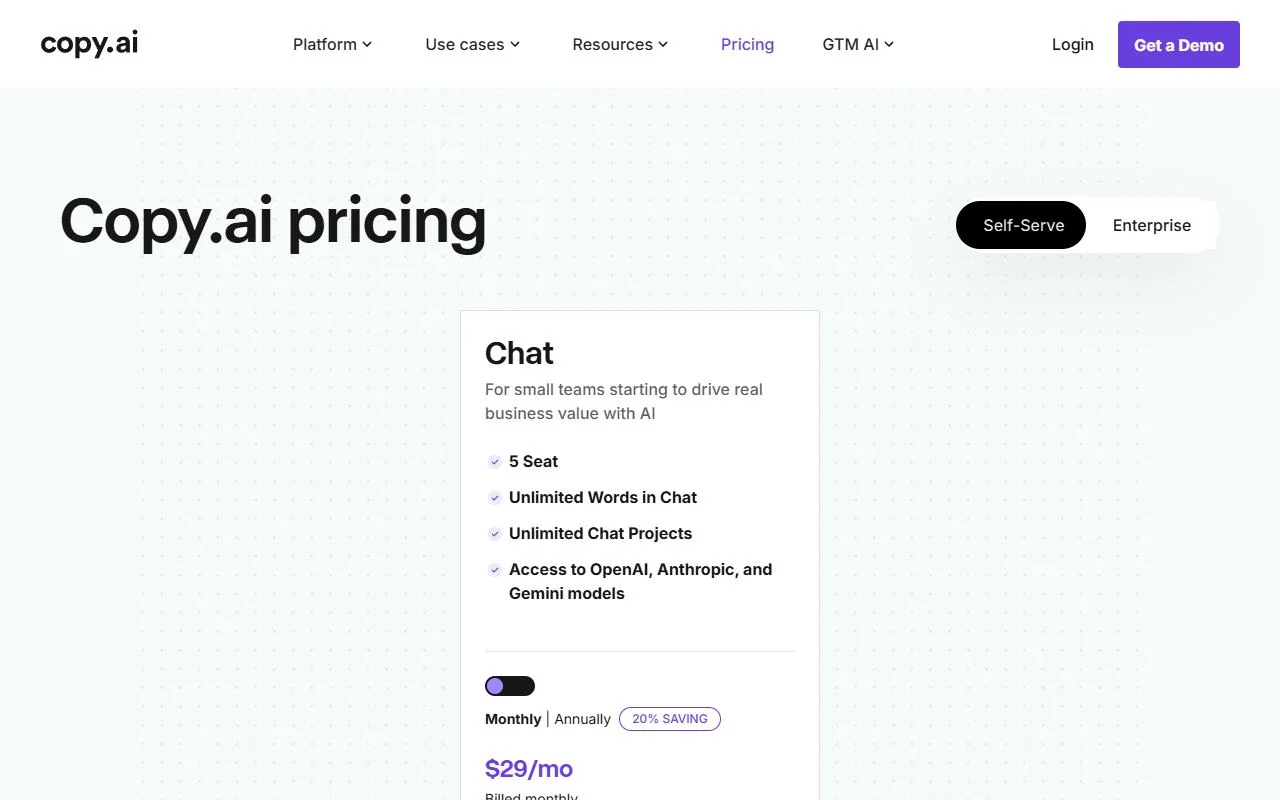
Official copy-ai-pricing public page, captured 30 October 2026. Source . This public-page capture illustrates the entry point, not paid-account testing or plan entitlement.
| Offer | Displayed billing | Listed seats | Listed monthly workflow credits |
|---|---|---|---|
| Chat, monthly | $29 per month | 5 | Not listed in the Chat card |
| Chat, annual | $288 per year, equivalent to $24 per month | 5 | Not listed in the Chat card |
| Growth | $12,000 per year, equivalent to $1,000 per month | 75 | 20,000 |
| Expansion | $24,000 per year, equivalent to $2,000 per month | 150 | 45,000 |
| Scale | $36,000 per year, equivalent to $3,000 per month | 200 | 75,000 |
| Enterprise | Custom sales discussion | Confirm in the proposal | Confirm in the proposal |
The public page describes unlimited words in Chat. That wording should not be interpreted as unlimited workflow runs or unlimited workflow credits. Likewise, a seat allowance does not prove that every seat will be useful to your organization. Model actual users and actual work separately.
The page’s displayed offer is not a complete contract. Obtain confirmation of the required features, support, billing conditions, and treatment of unusual usage. Unknown terms should remain unresolved purchasing questions instead of being filled with assumptions from older reviews or search snippets.
Who this pricing guide is for
This guide is for a buyer comparing occasional AI assistance with a maintained go-to-market workflow. It is also useful for a finance or operations reviewer who needs to distinguish a headline monthly number from the amount the organization may actually commit to pay.
Who should avoid choosing a tier immediately? A team without a defined workload should measure the task first. If nobody can estimate how many usable outputs are needed, which people need access, or what approval remains necessary, the plan comparison is premature.
For qualitative product fit, use our Copy.ai versus ChatGPT comparison and AI tools evaluation guide . The purpose here is narrower: understand costs, units, and commitment rather than reproduce a feature review.
Chat pricing: compare commitment before discounts
Chat’s displayed annual bill is $288. Paying the displayed monthly rate for twelve months would total $348. The arithmetic difference is $60 over that period. This comparison assumes the listed rates remain unchanged and ignores taxes or other charges; it does not establish cancellation or refund rights.
An annual discount matters only if the team expects to use the product for the full period and is comfortable with the commitment. A short evaluation may justify a higher monthly rate because it limits the decision while the use case remains uncertain. A discount does not make unused software economical.
Consider a hypothetical team that expects a three-month experiment. At the displayed monthly price, three months would total $87 before other charges. The $288 annual bill is a different commitment. Do not compare those options by looking only at $24 versus $29; compare the period you actually intend to fund.
Also determine who will use the included seats. Five available seats do not mean five employees have useful work for the tool. If only one person uses the product, the cost should be assessed against that person’s accepted work. Avoid presenting a theoretical fully occupied seat cost as the organization’s realized economics.
Workflow plans: separate people from processing capacity
Growth, Expansion, and Scale list both seats and monthly workflow credits. These are two separate dimensions. A company may have many occasional users and a modest workload, or a small operations team running a substantial process. Neither pattern can be understood through seat count alone.
The displayed annual bills also matter. A monthly equivalent is useful for budgeting comparisons, but the public cards state annual billing. Do not describe a $1,000 monthly equivalent as a verified month-to-month Growth subscription. Obtain written terms if flexibility is material to the decision.
Create a workload register before requesting a proposal. For each process, list its owner, expected frequency, typical input size, intended output, review standard, and known exceptions. Then ask the vendor to explain how that representative work maps to credit consumption under the proposed configuration.
Do not assume one credit equals one finished lead, document, email, or workflow. This article does not establish a universal conversion. The relevant unit is the accepted result your business needs, and the proposed workflow must demonstrate how resource use relates to that result.
How to estimate workflow credit needs
Start with a small representative pilot. Record the resources used for ordinary runs, failed runs, retries, and work requiring correction. Keep all four categories visible. A planning model based only on successful ideal runs can underestimate the capacity needed for actual operations.
Use a simple ledger with task, date, run outcome, credit usage where observable, reviewer effort, and final acceptance. Where usage cannot be measured directly, ask the vendor for a traceable explanation. A sales estimate should be recorded as an estimate until the pilot supports it.
For a hypothetical example, suppose a process needs 100 accepted outputs. If the team generates 125 candidates and accepts 100, the resource requirement follows all 125 attempts, not just the final accepted set. Actual credit use depends on the process and terms; the example illustrates why acceptance and generation are different measures.
Add a realistic allowance for variability without disguising it as a verified entitlement. State which assumptions drive the forecast and how sensitive the decision is to them. If a small change in retry rate makes the plan unsuitable, that uncertainty deserves attention before an annual commitment.
Features and commercial terms to confirm
Plan selection should follow required capabilities, not only capacity. Identify which controls, connections, support arrangements, and operating conditions are essential. Ask the vendor to tie each requirement to the specific offer in the written proposal.
| Question | Why it affects cost | Evidence to obtain |
|---|---|---|
| What counts toward workflow usage? | Attempts and reprocessing may affect consumption | A worked example for your proposed process |
| What happens at the allowance boundary? | Interruption or additional charges may affect operations | Written limit and overage terms |
| How are unused resources treated? | Timing can affect the effective economics | Current rollover and expiry terms |
| Which people need access? | Included capacity may differ from useful adoption | A role-based access plan |
| What is the billing commitment? | Monthly equivalents can mask annual exposure | Order form, renewal, and cancellation conditions |
These questions are not claims that a particular unfavorable term exists. They identify gaps that a public card does not resolve. Record answers and their dates so future reviewers can distinguish current commitments from assumptions made during early research.
Total cost of ownership
The subscription is one cost. Add setup, approved-source preparation, instruction design, review, quality assurance, maintenance, and any other systems required to deliver accepted work. A tool can reduce drafting effort while increasing review effort; both effects belong in the calculation.
Keep staff time estimates explicit. If the organization assigns a hypothetical internal cost to an hour of review, label that as an assumption. Do not use a generic labor rate as proof of savings for every company. The business case should use the actual roles and opportunity costs relevant to the buyer.
Include transition work as well. Existing templates may need revision, employees may need training, and the process may run alongside the previous method during validation. Those costs need not make a purchase unattractive, but omitting them makes the comparison less reliable.
For a broader evaluation of retained subscriptions and renewals, see our SaaS spend control guide and SaaS renewal checklist . A product should be evaluated as part of a maintained operating stack.
Calculate cost per accepted result
A practical comparison uses total cost divided by accepted outputs. Include rejected and repaired work in the numerator because it consumes resources even when it does not become usable output. Keep the definition of acceptance the same across the existing and proposed processes.
For a hypothetical month, imagine $1,200 of combined subscription allocation, preparation, review, and maintenance supporting 300 accepted results. The illustrative cost is $4 per accepted result. If only 150 meet the standard, the same cost becomes $8. This is arithmetic, not a Copy.ai performance claim.
The purpose is to expose the effect of quality. A larger number of generated drafts can make a dashboard look productive without improving the amount of usable work. Measure what reaches an approved destination, how much correction it requires, and whether it supports the intended business decision.
Also compare the alternative. That could be the existing manual process, a narrower assistant, or a different automation approach. Use the same inputs, quality standard, and review responsibilities. A fair comparison may reveal that only one part of the job needs automation.
Pros, limitations, and buying guidance
The pricing structure gives buyers separate paths to investigate chat and higher-volume workflow work. That is useful when the organization can distinguish those needs. The limitation is that published units alone do not reveal the cost of the actual process; seat counts and credits must be translated into usable outcomes.
A buyer should also resist upgrading because a larger tier has more impressive capacity. Extra capacity has value only when there is a maintained, approved workload to use it. An operations bottleneck caused by unclear data or slow review may not improve with a larger allowance.
Before signing, document the proposed tier, annual commitment, expected workload, acceptance standard, process owner, and unresolved commercial questions. Require a decision-maker to acknowledge the assumptions that materially affect the business case. That creates a useful record for renewal rather than a forgotten purchasing spreadsheet.
If the pilot does not establish credit needs or accepted-output quality, revise the pilot. Do not insert a confident forecast simply to complete procurement. Our workflow automation buying guide explains why implementation responsibility belongs in the evaluation.
Evidence and methodology
Prices, listed seats, and workflow-credit allowances above come from the official page checked on 30 October 2026. Checkout and contractual terms remain authoritative for a purchase. This guide does not verify taxes, refunds, rollover, overage rates, regional offers, or a particular account’s entitlement.
All workload and cost examples are hypothetical. No paid workspace was used, and no performance or savings benchmark is claimed. See our review methodology for the boundaries of documentation-based analysis.
Frequently asked questions
How much does Copy.ai Chat cost?
The checked official page lists $29 billed monthly or $288 billed annually. The annual bill is equivalent to $24 per month; verify current checkout terms and any applicable charges before purchasing.
Can I pay monthly for Growth at the displayed monthly equivalent?
The public card checked for this guide states $12,000 billed yearly. Do not infer month-to-month availability from the $1,000 monthly equivalent. Ask for written confirmation if a different arrangement is required.
Are unlimited chat words the same as unlimited workflows?
No. The public page lists chat wording separately from workflow-credit allowances. Establish the terms of your intended process rather than treating the two units as interchangeable.
How many credits does one completed task use?
This guide does not establish a universal conversion. Measure representative runs, including failures and retries, and ask the vendor to explain usage for the proposed workflow.
Which tier offers the best value?
The best value is the smallest suitable commitment that supports required capabilities and accepted work at a defensible total cost. Verify usage, review effort, and commercial terms before choosing a larger allowance.
Decision guidance
Evaluate Copy.ai pricing through actual commitments and accepted results. Separate chat from workflows, verify billing frequency, model useful seats and realistic usage, and include review and maintenance. If those inputs remain uncertain, the next step is a narrower pilot rather than a larger annual purchase.
Browse the AI Tools category for related independent software research.
Frequently asked questions
How much does Copy.ai Chat cost?
The checked official page lists $29 billed monthly or $288 billed annually. The annual bill is equivalent to $24 per month; verify current checkout terms and any applicable charges before purchasing.
Can I pay monthly for Growth at the displayed monthly equivalent?
The public card checked for this guide states $12,000 billed yearly. Do not infer month-to-month availability from the $1,000 monthly equivalent. Ask for written confirmation if a different arrangement is required.
Are unlimited chat words the same as unlimited workflows?
No. The public page lists chat wording separately from workflow-credit allowances. Establish the terms of your intended process rather than treating the two units as interchangeable.
How many credits does one completed task use?
This guide does not establish a universal conversion. Measure representative runs, including failures and retries, and ask the vendor to explain usage for the proposed workflow.
Which tier offers the best value?
The best value is the smallest suitable commitment that supports required capabilities and accepted work at a defensible total cost. Verify usage, review effort, and commercial terms before choosing a larger allowance.