Cursor Pricing: Plans, Costs, and Value
Compare current Cursor pricing with legacy plans. Understand monthly and annual rates, separate model charges, and a practical budget for accepted work.
Cursor pricing for new customers currently lists Free, Plus at $8 per month, Premium at $30, Super at $100 and Ultra at $200, before applicable taxes. Existing Pro-family subscriptions are a separate legacy case. For a useful budget, distinguish the recurring subscription from included usage, separately billed model consumption and the team’s own review effort.
Research scope and limitations
- Research type
- Official-source documentation review and editorial analysis
- Hands-on tested
- No
- Last verified
- November 3, 2026
- Limitations
- No hands-on benchmark or human signoff claimed. Hypothetical examples are editorial analysis. Unverified entitlements excluded.

Table of contents
Cursor pricing for new customers currently lists Free, Plus at $8 per month, Premium at $30, Super at $100 and Ultra at $200, before applicable taxes. Existing Pro-family subscriptions are a separate legacy case. For a useful budget, distinguish the recurring subscription from included usage, separately billed model consumption and the team’s own review effort.
These are official-source figures checked November 3, 2026, not a checkout quote or a prediction of your bill. The current official offer has changed substantially from older indexed pages. Do not combine a current subscription price with a historical request allowance, and do not assume an existing account has automatically moved to the new structure.
This article provides a dated plan comparison and an original budgeting method. We have not run a paid consumption benchmark. Examples below are hypothetical planning exercises. Confirm the offer attached to your account, billing currency, taxes and controls before purchasing or changing a subscription.
Cursor pricing: current individual plans
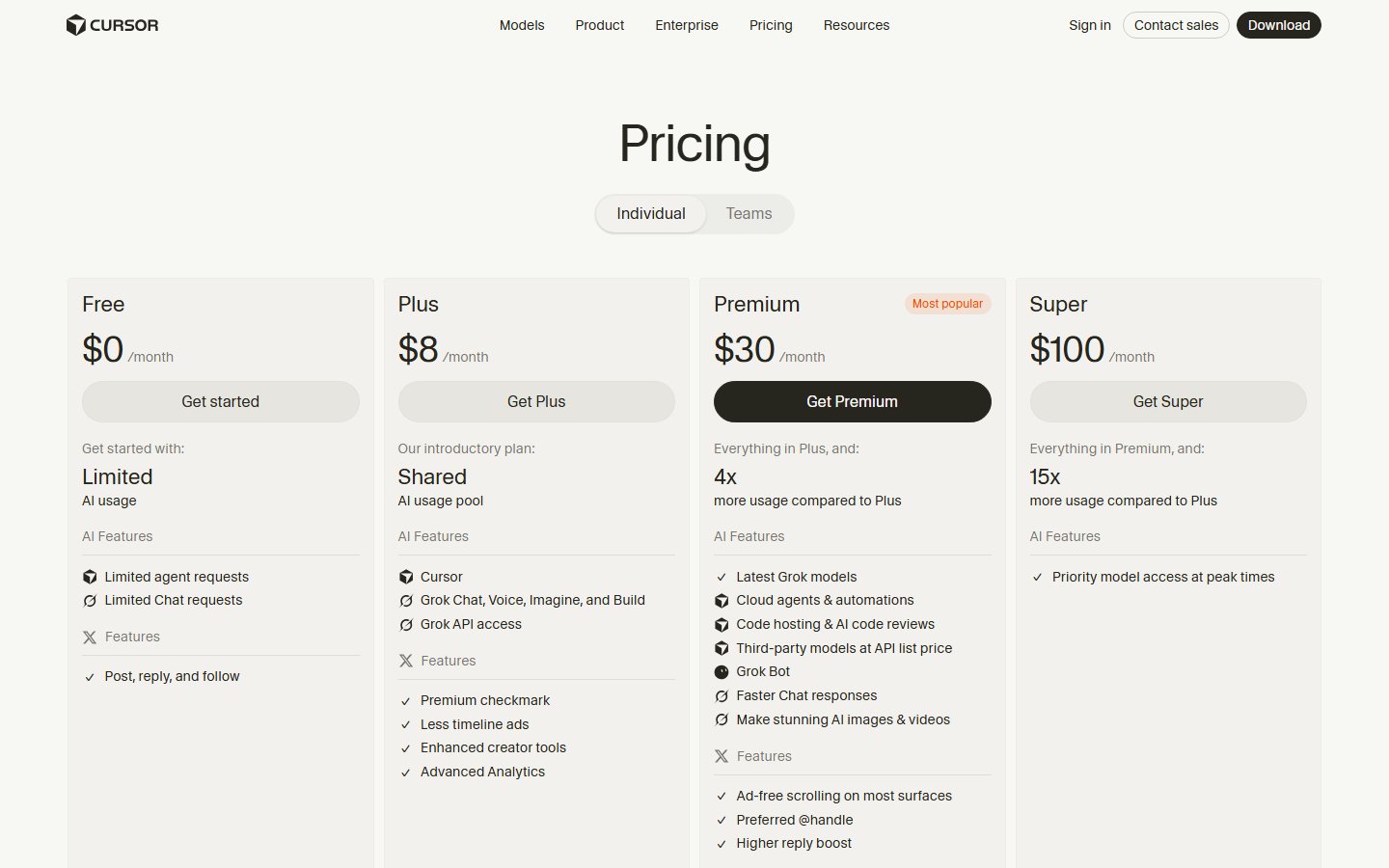
Official-source screenshot: https://cursor.com/pricing , captured November 3, 2026. Cursor official pricing page, dated public offer; checkout may differ.
| Plan | Published monthly base, USD | Published annual price, USD | Initial buying question |
|---|---|---|---|
| Free | $0 | No paid annual commitment shown | Can limited access support the initial evaluation? |
| Plus | $8 | $80 per year | Does the entry model access fit the task? |
| Premium | $30 | $300 per year | Do the additional capabilities justify the base commitment? |
| Super | $100 | $1,000 per year | Is a higher included usage level needed? |
| Ultra | $200 | $2,000 per year | Can measured workload justify the highest listed individual tier? |
The official pricing page and model-pricing documentation are the primary references. Annual amounts are annual commitments as displayed, not the monthly prices multiplied by twelve. Taxes and separately billed consumption can change the final cost.
Separate current offers from legacy subscriptions
The official documentation identifies Pro, Pro+, older Ultra and other named subscriptions as legacy arrangements. Their usage structure continues separately from the current offer. A familiar plan name in an old article is therefore insufficient to establish which rules govern a new purchase or an existing renewal.
Start by recording the exact plan and billing terms visible in your account. Save the renewal date, currency and the relevant usage view in your own purchasing records. This is especially important when a business has several accounts created at different times. Do not assume they share identical terms merely because everyone uses the same application.
For a new purchase, use current checkout and current documentation together. For an existing subscription, compare the account’s terms with the proposed change before accepting a migration. Questions about unused allowances, renewal treatment or account-specific offers should be resolved directly rather than answered from historical search snippets.
The practical limitation of this article is that it cannot inspect your private account. It reports a public offer and a decision method. If the account or checkout differs, treat that discrepancy as an unresolved purchasing question, not permission to select whichever allowance seems most favorable.
Subscription access and model consumption are different costs
Current documentation describes a weekly pool for Cursor’s own models, shared across subscription activity. Third-party models are outside that included pool and are separately billed where the plan makes them available. This is the central budgeting distinction in the present offer.
A higher base subscription can therefore increase one kind of capacity without covering every kind of consumption. Do not infer that paying for a larger tier makes all model usage free. Conversely, do not assume that every task incurs a separate provider charge. Identify the selected model route and the applicable pool first.
The documentation gives relative included usage levels rather than a universal number of completed software tasks. A task may involve several requests, context sizes and rounds of repair. Request counts or broad multipliers should not be converted into a guaranteed number of accepted pull requests.
For a pilot, record the actual usage display alongside the work completed. Preserve the date and plan so the result remains interpretable if the offer changes. Your observation should say what that configured account consumed during that exercise, without claiming that another model or task will cost the same amount.
Understand the annual commitment before comparing savings
The published annual amounts differ from twelve monthly payments. For example, twelve hypothetical monthly Plus payments at the cited rate total $96, compared with the listed $80 annual amount. The arithmetic difference is $16 before taxes or other costs. That is a subscription comparison, not a total-cost forecast.
The value of annual billing depends on whether the organization will keep using the product under suitable terms. A lower annualized rate can be a poor decision for a team that has not established product fit. Complete the operating pilot before treating an annual commitment as an automatic saving.
Read the applicable renewal and cancellation terms at purchase. Record who owns the renewal decision and when the organization must review it. Do not rely on this article for account-specific refund or cancellation treatment. Those conditions need current contractual evidence.
For internal budgeting, show the cash commitment and the accounting assumption separately. A business may spread an annual subscription across monthly management reports while paying the invoice upfront. That reporting choice does not change the vendor’s billing schedule or create monthly cancellation rights.
Build a budget with four lines
Use four lines: recurring subscription, separately billed consumption, operational overhead and contingency assumptions. The first comes from the chosen offer. The second comes from actual usage and current rates. The third is your own effort estimate for setup, review and administration. The last captures unresolved variability rather than hiding it.
Consider a hypothetical individual evaluating Premium at the cited $30 monthly base. If that person budgets another $15 for separately billed usage, the planned vendor spend is $45 before tax. The $15 is an invented budget assumption for this example, not an included allowance, measured typical charge or vendor recommendation.
Now add the person’s own time. If review takes longer than expected, that does not appear as a Cursor invoice line, but it affects the business case. Estimate that effort using an internal rate if appropriate and clearly label it as an assumption. Keep it separate from vendor charges so the calculation remains auditable.
Review the budget after the pilot. Replace assumptions with observations where the evidence supports doing so, and retain uncertainty where it does not. A small exercise can establish a plausible range for further evaluation without supporting a universal cost-per-task claim.
Teams need a seat and usage map
The current official documentation lists team seat tiers separately and identifies Enterprise as a custom arrangement. A business purchase should map the actual roles and required administration before multiplying an individual price by headcount. Seat access, shared usage and variable charges need their own confirmation.
List the intended users and the job each needs to perform. A developer evaluating occasional changes, a daily agent user and an administrator may have different requirements. Confirm what the current team offer supports and whether the proposed mix is available. This guide does not promise arbitrary mixed-seat configurations.
Then establish the purchasing owner and the usage reviewer. Someone should recognize unusual consumption, understand which project generated it and decide whether the workload should continue. A budget limit without a responsible operator can still produce confusion when work stops or a balance needs replenishing.
For a multi-person pilot, record usage by the attribution available in the actual account. Avoid splitting a shared total equally unless that is explicitly your internal allocation method. Averages can conceal a small number of heavy workloads and lead to the wrong tier decision for everyone else.
Compare plans using accepted work
A useful plan test asks whether the selected tier supports a representative workload at an acceptable total effort. Choose a small defect, a modest feature change and a maintenance task. Define acceptance before beginning, then inspect the actual patch and validation rather than counting generated lines.
Record preparation, interaction, review and repair separately. If a task is abandoned, keep its consumption in the evaluation. Excluding failed attempts makes the product appear cheaper than the operation you actually experienced. The objective is an honest decision about your workload, not a favorable demonstration.
Compare the result with the current approach. A subscription may be worthwhile if it helps produce understandable accepted changes with manageable review. It may be unsuitable if usage is low, essential model access is missing or review effort dominates. These are editorial decision conditions, not measured findings about every customer.
The Cursor review explains the product-fit pilot in more detail. Use the AI tools evaluation guide for a broader requirements framework, and the Cursor versus ChatGPT comparison when the main question is workflow choice.
Pros and cons of the current pricing structure
The potential strength is a visible range of entry prices and usage tiers, allowing an evaluator to begin with a smaller commitment. The current-versus-legacy documentation also makes it possible to identify why an older account may not match a new public offer. These are useful starting points for a purchasing review.
The principal tradeoff is that one subscription number does not describe every cost. Separate model charges, shared activity and the organization’s own operating effort must still be considered. A larger included pool is useful only if it corresponds to the work the team actually intends to run.
Another limitation is change over time. This guide’s figures are dated deliberately because current public terms and account-specific arrangements can diverge. Preserve the purchase evidence and review the account at renewal. Do not build a long-term budget around an unverified historical request count.
For buyers comparing assistant categories, the Tabnine comparison provides another workflow lens. It is not a substitute for current quotes. Compare alternatives using equivalent tasks, actual offers and the same acceptance standard, rather than treating different products’ headline prices as identical units.
Make the purchase decision from a dated worksheet
The practical answer to Cursor pricing is a dated worksheet with the exact account offer, recurring base, variable-usage assumption, tax treatment and review owner. Keep current and legacy arrangements separate. Link every numerical entitlement to the evidence that applies to the account you plan to buy or renew.
Begin with a bounded pilot, inspect actual consumption and accepted work, and revisit the estimate before a larger commitment. Upgrade when a demonstrated requirement or measured workload justifies it. A higher tier is not evidence of better value until it solves a specific constraint in your own operation.
Explore the AI Tools category for related evaluation guides and current software research.
Frequently asked questions
What is the cheapest current paid Cursor plan?
The public offer checked November 3, 2026 lists Plus at eight US dollars monthly before applicable taxes, with separate annual billing shown in the table. Confirm current checkout and model access before buying. An entry subscription is not automatically the right plan for every workflow, and it should not be combined with legacy request allowances from older articles. Account-specific terms remain a separate check.
Does a higher subscription include every model charge?
No. The current documentation distinguishes included Cursor-model usage from separately billed third-party consumption where available. Match the task to the actual model route and review the usage display. Do not treat a larger included pool as free unlimited access to every provider. This article does not predict the number of completed tasks or the final bill your specific prompts and review process will produce.
Does the new pricing automatically apply to my old Pro account?
This guide does not establish an automatic migration. Current official documentation treats older Pro-family arrangements separately. Review your private account, renewal terms and applicable usage rules before changing plans. If public documentation and account treatment differ, resolve the discrepancy before purchase. Preserve the exact offer evidence so a later renewal decision does not rely on a stale search snippet or another customer account.
Is annual billing always better value?
The listed annual subscription amounts are lower than twelve payments at the cited monthly rates, but value depends on continued fit and the applicable commitment terms. Complete a pilot first. Show the upfront cash commitment separately from any monthly internal allocation, and verify current renewal or cancellation treatment. A lower annualized subscription figure does not include taxes, variable usage or the cost of maintaining an effective review process.
What should a Cursor budget include besides the subscription?
Include separately billed consumption, the organization effort needed for setup and review, and clearly labeled assumptions for variability. Keep vendor charges separate from internal labor estimates. After a representative pilot, replace assumptions with observations where possible and retain unresolved questions. The purchasing owner should know who reviews usage, when the plan renews and which demonstrated constraint would justify moving to a higher tier.