DeepL vs ChatGPT: Which Is Better?
Compare DeepL and ChatGPT for translation, multilingual documents, writing, research, integrations, governance, and the right business workflow.
Direct answer
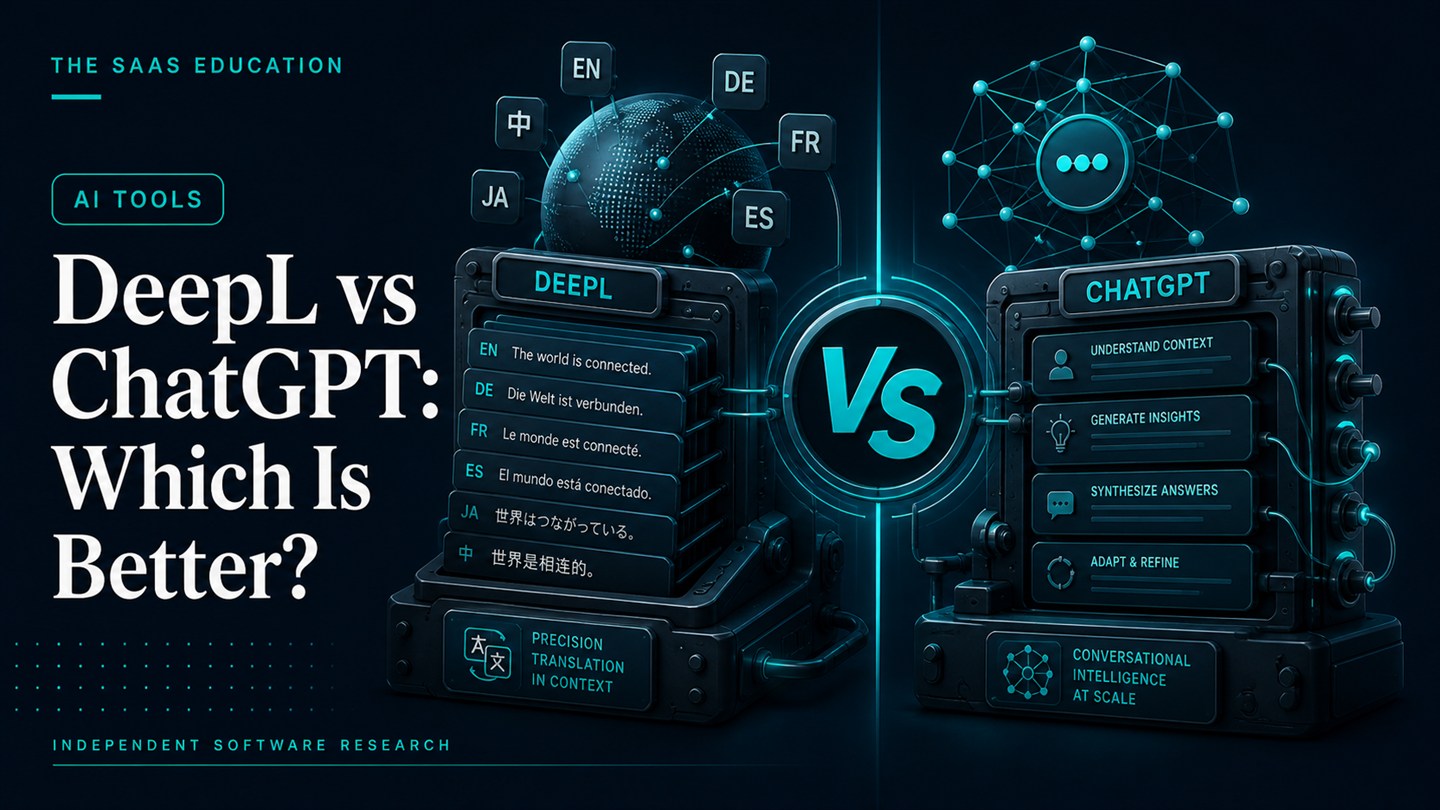
DeepL is better when accurate, repeatable translation is the main job. ChatGPT is better when translation is one part of a broader task involving research, explanation, analysis, drafting, or ongoing conversation.
DeepL is a language-focused platform. Its official product material centers on translating text, files, images, and speech; managing terminology; improving writing; and integrating language workflows through applications and APIs. ChatGPT is a general AI workspace that can translate, but it also handles files, analysis, research, writing, planning, images, and coding.
Choose DeepL when the output must be a controlled multilingual version of an existing source. Choose ChatGPT when the reader needs to understand, transform, or create material around that source. For high-stakes legal, medical, financial, safety, or public-facing language, neither product removes the need for qualified human review.
This comparison uses official DeepL and OpenAI sources checked on August 24, 2026. We did not run a controlled translation benchmark or test paid enterprise workspaces. Product facts are verified from official material; recommendations are editorial inferences based on documented workflow fit.
DeepL vs ChatGPT at a glance
| Decision area | DeepL | ChatGPT |
|---|---|---|
| Primary role | Language AI for translation, writing, voice, and API workflows | General-purpose AI workspace for research, creation, analysis, and conversation |
| Best for | Repeatable translation, documents, terminology, and multilingual operations | Mixed knowledge work where translation is one step in a larger task |
| Source-to-output model | Converts or improves supplied text, files, images, and speech | Interprets prompts and context to answer, transform, analyze, or generate |
| Document workflow | Dedicated document translation with format support and layout preservation claims | File upload, analysis, summarization, and transformation vary by plan and tool |
| Terminology control | Glossaries and organization-oriented customization are documented | Instructions and project context can guide language, but this is not the same as a managed translation glossary |
| Developer use | Dedicated translation API and official client libraries | General model and tool APIs are separate from ChatGPT subscriptions |
| Main limitation | Narrower outside language-centric work | Less specialized for governed translation operations |
The central difference: language operation versus general reasoning
The products overlap because both can work with language. That overlap can hide a more important distinction.
DeepL starts with a language operation: translate this passage, preserve this document, apply this terminology, improve this sentence, or connect translation to an application. Its interface, features, and documentation are organized around that job.
ChatGPT starts with an outcome expressed through conversation: explain this document, compare two versions, summarize a foreign-language report, draft a response, identify contradictions, or turn source material into a plan. Translation can be part of the process, but it is not the only process.
This distinction changes the buying decision. A localization manager needs consistency, file handling, language support, review controls, and integration into content operations. A strategy team may need to translate a source and then question it, compare it with other evidence, and produce a new brief. The first case points toward DeepL; the second often points toward ChatGPT.
Choose DeepL for focused translation workflows
DeepL’s official features page describes text, document, image, and writing capabilities. It also documents glossaries, formality controls, alternatives, dictionary functions, writing styles, tones, and editing support. The exact availability of a feature depends on the product, language, plan, platform, and market.
That focus makes DeepL a strong shortlist candidate for:
- translating recurring business communications;
- converting supported files while retaining their structure;
- enforcing preferred terminology through glossaries;
- supporting multilingual teams with desktop, browser, and productivity integrations;
- translating application content through an API;
- improving existing writing in supported languages;
- managing higher-volume language work under organization controls.
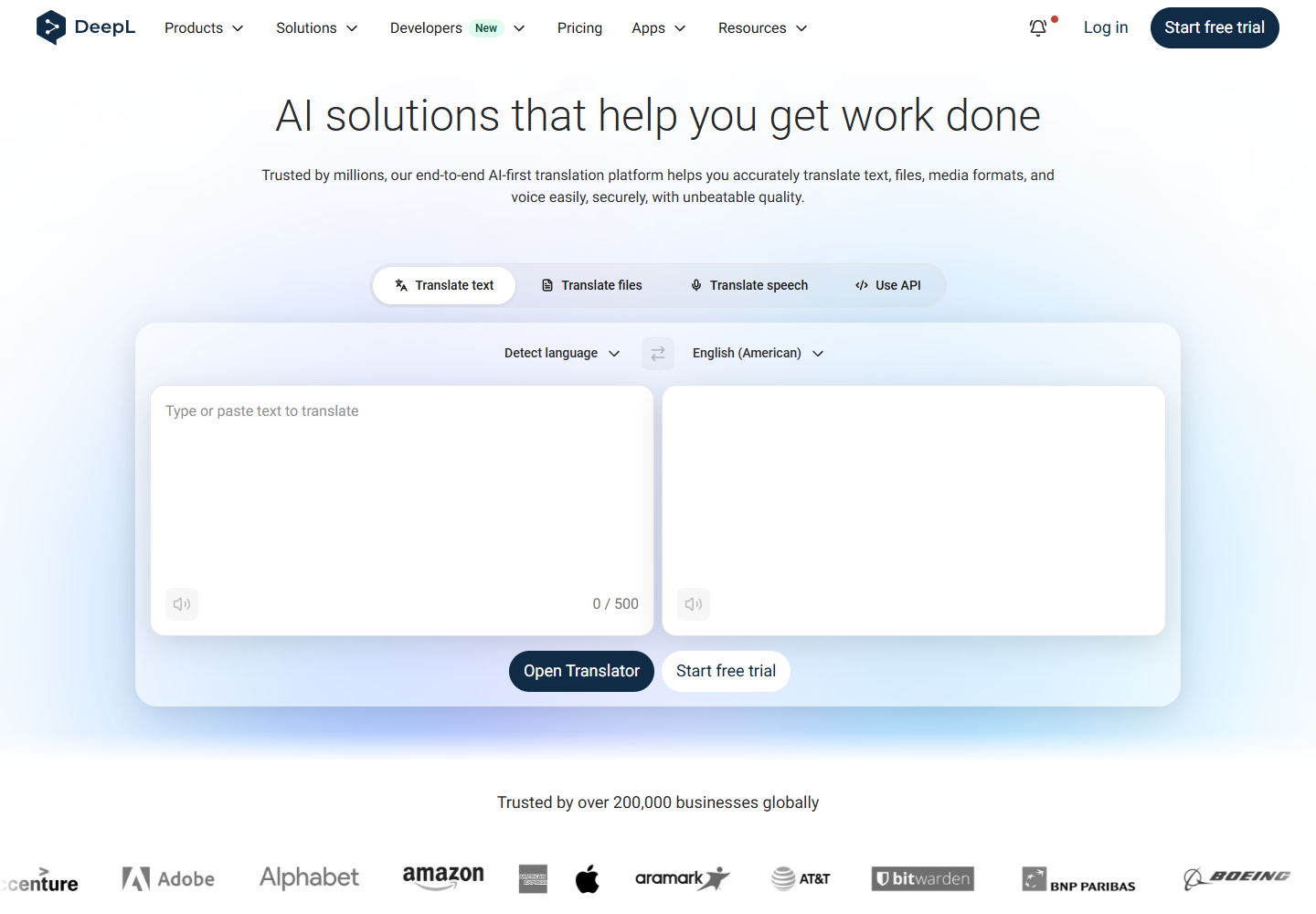
DeepL’s official homepage. Source: DeepL . Captured August 24, 2026, to document its language-focused product positioning and translation entry points.
DeepL’s strengths
Translation is the product’s center of gravity. A user does not need to design a complex prompt to access the main workflow. The product asks for source material, target language, and relevant controls.
Document translation is explicit. DeepL documents translation for common file types and says it preserves formatting and layout. Buyers should test their actual files, because complex tables, fonts, scans, embedded media, and design elements can still require review.
Glossaries support terminology consistency. A controlled term list matters when a company repeatedly translates product names, legal phrases, technical vocabulary, or approved brand language.
Writing assistance is available. DeepL Write supports correction and stylistic improvement rather than limiting the platform to literal translation.
The API has a defined translation purpose. DeepL’s developer documentation provides HTTP endpoints and official client libraries for supported programming languages. This is useful when translation must happen inside a product or operational system.
DeepL’s limitations
It is narrower than a general AI workspace. DeepL can improve and translate language, but it is not positioned as a broad research, reasoning, coding, or multimodal project environment.
Feature availability varies. Language pairs, file limits, glossary capabilities, writing features, voice, and integrations can differ by plan and region. A buyer must verify the exact required workflow rather than infer it from the platform overview.
Good machine translation still needs review. Meaning can change through ambiguity, domain jargon, cultural context, dates, units, names, and sentence structure. High-impact material needs a fluent reviewer with subject knowledge.
Translation operations can require several systems. Larger teams may still need a translation management system, content connectors, quality assurance, human vendors, and approval workflows around DeepL.
Choose ChatGPT for translation inside broader knowledge work
ChatGPT is useful when the request cannot be reduced to “convert this language into that language.” A user can ask it to explain an idiom, summarize a translated report, compare two versions, rewrite for a different audience, extract action items, or continue a discussion using the translated context.
Official OpenAI material describes ChatGPT as a broader environment for conversation, files, data analysis, projects, search, images, and other work, with capabilities and limits varying by plan. Translation benefits from that context, but the output must still be checked.
ChatGPT is a strong shortlist candidate for:
- understanding the meaning and context of a foreign-language passage;
- translating and then summarizing a source;
- adapting tone, reading level, format, or audience;
- comparing multiple documents or versions;
- drafting a response using translated information;
- researching unfamiliar concepts around the text;
- supporting occasional multilingual work across several business roles.
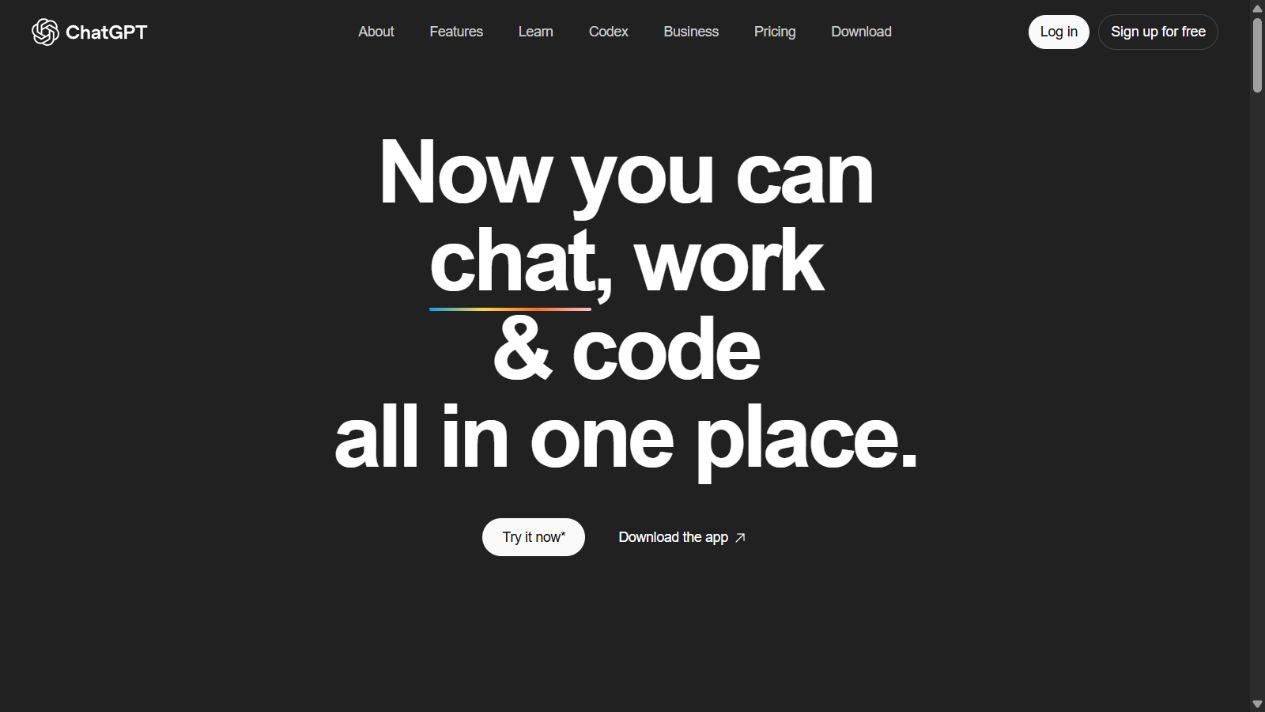
OpenAI’s official ChatGPT homepage. Source: ChatGPT . Captured August 15, 2026, to document its general-purpose conversational workspace.
ChatGPT’s strengths
The conversation can continue beyond translation. Users can ask why a phrase was translated a certain way, request alternatives, apply a style, or transform the result into a different artifact.
It supports mixed tasks. Translation can be combined with research, analysis, writing, data work, and planning rather than handled as a separate stage.
Context can include more than one passage. A user can provide instructions, reference files, examples, and audience requirements, subject to plan limits and data-governance rules.
It can make language accessible to non-specialists. Explanations, definitions, and audience-specific rewrites help users understand a source instead of merely receiving a converted version.
ChatGPT’s limitations
General flexibility is not translation governance. A conversational instruction does not automatically provide the controlled terminology, file pipeline, or repeatable quality process a localization team may require.
Output can drift from the source. When asked to improve, summarize, or adapt, ChatGPT may omit, reinterpret, or add material. Users must separate faithful translation from editorial transformation.
Consistency requires deliberate controls. Repeated translations can vary unless users provide stable instructions, examples, terminology, and review steps.
Plan and tool details change. File limits, models, workspace controls, apps, and other features should be checked against current OpenAI documentation before procurement.
Which is better for translation quality?
There is no responsible universal answer without a test design.
Translation quality depends on the source and target languages, subject domain, sentence structure, terminology, document type, acceptable style, and evaluation method. A result that reads smoothly can still change a legal obligation, technical instruction, dosage, product specification, or cultural meaning.
Run a blind pilot with representative material:
- Select at least three document types from the real workflow.
- Include common language, domain terminology, ambiguous sentences, names, dates, numbers, and formatting.
- Define what counts as an error before comparing outputs.
- Have qualified bilingual reviewers score accuracy, terminology, omissions, fluency, and required editing time.
- Record whether the product preserves the intended structure and metadata.
- Repeat the test for every important language pair.
DeepL has the clearer specialized workflow. ChatGPT may produce useful translations, especially with context, but broader generation capabilities are not proof of better translation accuracy.
Which is better for documents?
DeepL is the more direct fit when a company needs to translate an existing document and retain its format. Its official document-translation material lists common business file types and describes layout-preserving workflows.
ChatGPT is often more useful when a document must be understood or transformed: summarize a report, identify decisions, extract entities, compare clauses, explain a section, or rewrite the content for a new audience.
The distinction can be expressed as two questions:
- Must the translated document remain the same artifact in another language? Start with DeepL.
- Must the document become a new analysis, answer, or deliverable? Consider ChatGPT.
Do not upload confidential files until the organization has reviewed the selected plan’s data handling, retention, training policy, access controls, and contract terms.
Which is better for writing?
DeepL Write is a focused editing assistant. Official product material describes grammar correction, word alternatives, clarity improvements, styles, tones, and support across specified languages. It is appropriate when a writer already has text and wants to improve it.
ChatGPT covers a wider writing process. It can help develop an outline, ask questions, create a draft, revise a structure, summarize sources, change formats, or produce variants. That flexibility comes with a greater need to verify facts and remove unsupported additions.
Choose DeepL Write for controlled language improvement. Choose ChatGPT for ideation and content transformation. For important editorial work, retain a human owner who can validate meaning, evidence, and voice.
Which is better for developers and automation?
DeepL provides an API designed for translation and related language operations. Its documentation describes authentication, text and document workflows, separate Free and Pro endpoints, and official client libraries for several languages. This creates a relatively clear implementation boundary.
ChatGPT subscriptions and OpenAI API usage are different products and billing arrangements. Developers considering OpenAI should evaluate the current API documentation and models independently rather than assuming a ChatGPT seat includes application integration.
Use DeepL’s API when the application requirement is explicit translation. Consider an OpenAI model when the application needs broader interpretation, generation, extraction, or tool use. Some systems may combine them, but every additional model increases cost, monitoring, privacy, and failure-handling requirements.
Which is better for teams and enterprise buyers?
Localization and content teams
DeepL has the more natural fit because translation, glossaries, files, and language consistency are the primary requirements. Evaluate supported languages, terminology management, review workflow, connectors, document limits, and export quality.
General business teams
ChatGPT may provide broader value across research, writing, analysis, planning, and support. Translation may be sufficient for occasional internal use, but teams should define when professional review is mandatory.
Regulated or security-sensitive organizations
Compare the exact commercial plans, not consumer experiences. Review identity management, SSO, retention, model-training terms, encryption, audit controls, data location, subprocessors, contractual protections, and support. DeepL publishes security claims for business products, while OpenAI documents business and enterprise controls. Those claims still need procurement and security review.
Pricing and total cost
This article does not quote exact prices because plan names, currencies, taxes, promotions, usage limits, and regional availability are volatile.
DeepL separates several product paths, including translator subscriptions, writing products, API use, and enterprise arrangements. Cost can depend on users, file volumes, characters, product modules, and required controls.
ChatGPT offers plan-dependent access for individuals and organizations, while API usage is billed separately. Cost can depend on seats, workspace tier, included capabilities, flexible usage, and separate API consumption.
Compare total cost using the real workflow:
- number and type of users;
- monthly text, file, or API volume;
- languages and file formats;
- terminology and administration needs;
- human review time;
- integration and implementation work;
- security and procurement requirements;
- cost of translation errors or rework.
The cheaper subscription can be the more expensive system if users spend more time correcting output or moving material between tools.
Privacy and governance questions to ask
Before approving either product, document:
- which plan and legal entity will process the data;
- whether submitted content is stored or used for model improvement;
- how long content and logs are retained;
- who can access the workspace;
- whether SSO and user provisioning are required;
- which document types or data classifications are prohibited;
- how approved terminology and prompts are maintained;
- when human linguistic or subject-matter review is mandatory;
- how incidents and incorrect translations are reported;
- how API keys and integrations are secured.
Do not rely on a general privacy statement when a commercial plan has its own terms and controls.
A practical selection framework
Score each product from 1 to 5 against the following weighted criteria:
| Criterion | Suggested weight | What to test |
|---|---|---|
| Translation accuracy | 25% | Representative language pairs and domain text |
| Workflow fit | 20% | Time from source to approved output |
| Terminology consistency | 15% | Glossary and repeated phrase handling |
| Document handling | 10% | Layout, tables, files, scans, and export |
| Broader task support | 10% | Analysis, explanation, drafting, and transformation |
| Governance | 10% | Access, retention, policy, administration, and review |
| Cost | 10% | Seats, usage, implementation, and editing time |
Do not average away a non-negotiable requirement. If a product fails a required language, file, security, or accuracy condition, remove it regardless of its total score.
Neither may be right if…
Neither product should be treated as the complete answer when:
- certified or sworn translation is required;
- legal rights or safety depend on exact wording;
- a specialist human translator must understand local regulation or culture;
- the organization needs a full translation management system;
- the content contains data that cannot be sent to an external service;
- supported languages or file formats do not cover the workflow;
- quality cannot be validated by a qualified reviewer.
In those cases, use professional language services, an approved internal process, or specialist tooling, potentially with machine assistance under human control.
Final verdict: DeepL or ChatGPT?
Choose DeepL when translation is the job. Choose ChatGPT when translation supports a larger job.
DeepL has the stronger product fit for repeatable language workflows, document translation, terminology, and translation APIs. ChatGPT has the stronger fit for research, explanation, analysis, creation, and conversational work around multilingual material.
A team may use both: DeepL for controlled language conversion and ChatGPT for broader knowledge work. That combination is defensible only when responsibilities, data rules, review steps, and costs are explicit. Run a pilot with real material before committing to organization-wide licenses.
Frequently asked questions
Is DeepL better than ChatGPT for translation?
DeepL is generally the stronger workflow fit when translation is the primary task, especially for documents, terminology consistency, and repeatable language operations. ChatGPT is more flexible when translation is combined with explanation, analysis, or new content. Test both with your own language pairs before deciding.
Can ChatGPT replace DeepL?
ChatGPT may replace a separate tool for occasional, low-risk translation, but it does not directly replace every DeepL workflow. Dedicated document translation, managed terminology, and translation API operations can make DeepL more appropriate for structured business use.
Can DeepL write and rewrite text?
Yes. DeepL Write supports correction, word alternatives, clarity improvements, styles, and tones in supported languages. It is a focused writing assistant rather than a general research and generation workspace.
Which tool is better for business documents?
DeepL is the more focused choice for translating documents while preserving structure. ChatGPT may be better for analyzing, summarizing, or restructuring a document. Sensitive documents require plan-specific privacy and governance review in either system.
Should a company use both DeepL and ChatGPT?
Possibly. Use DeepL for governed translation and multilingual document work, and ChatGPT for broader research, drafting, analysis, and explanation. Avoid duplicate licenses unless a measured pilot shows distinct value.
Official sources reviewed
Frequently asked questions
Is DeepL better than ChatGPT for translation?
DeepL is generally the stronger workflow fit when translation is the primary task, especially for documents, terminology consistency, supported file formats, and organization-wide language operations. ChatGPT is more flexible when translation is one step inside research, writing, analysis, or a broader conversation. Translation quality should be tested with your own language pairs and subject matter.
Can ChatGPT replace DeepL?
ChatGPT may replace a separate translation tool for occasional, low-risk passages when users also need explanation or rewriting. It is not a direct replacement for every DeepL workflow, particularly document translation, managed glossaries, language-specific controls, and translation API operations.
Can DeepL write and rewrite text?
Yes. DeepL Write is the company's writing assistant and officially supports grammar correction, word-choice suggestions, clarity improvements, styles, and tones in supported languages. Its scope is narrower than ChatGPT's general research and generation capabilities.
Which tool is better for business documents?
DeepL is the more focused choice when the main requirement is translating documents while preserving layout and applying consistent terminology. ChatGPT may be better when the document needs analysis, summarization, restructuring, or new content in addition to language conversion. Sensitive documents require a plan-level privacy and governance review in either product.
Should a company use both DeepL and ChatGPT?
Possibly. DeepL can own governed translation and multilingual document workflows while ChatGPT supports broader research, drafting, analysis, and knowledge work. Buying both makes sense only when the responsibilities are distinct and a pilot shows enough value to justify overlapping seats.