Elicit vs ChatGPT: Which Is Better?
Compare Elicit and ChatGPT for literature reviews, paper search, evidence extraction, deep research, citations, collaboration, and pricing.
Direct answer
Elicit is better for structured scholarly literature work. ChatGPT is better for broad research, analysis, writing, and problem-solving across web sources, files, and general knowledge work.
Choose Elicit when the core task is finding research papers, screening studies against criteria, extracting comparable fields, building evidence tables, or supporting a systematic or rapid literature review. Choose ChatGPT when the task crosses scholarly and non-scholarly sources, requires an extended planning conversation, involves varied files or data, or must end as a broader work product rather than a literature-review table.
The products can work together. Elicit can organize the evidence layer; ChatGPT can help frame the question, develop a research plan, explain methods, interrogate supplied documents, or turn verified findings into audience-appropriate prose. Neither should be allowed to convert an unverified summary into a factual claim without checking the cited original source.
This comparison uses official Elicit and OpenAI material checked on August 28, 2026. We did not benchmark paper recall, screening accuracy, extraction accuracy, hallucination rate, citation validity, or report quality. Capability statements are verified; recommendations are editorial inferences from documented workflow fit.
Elicit vs ChatGPT at a glance
| Decision area | Elicit | ChatGPT |
|---|---|---|
| Primary role | AI assistant for scientific research and evidence synthesis | General AI assistant for research, analysis, writing, coding, and creation |
| Best for | Paper search, literature review, screening, extraction, and evidence tables | Broad web and file research, planning, explanation, synthesis, and varied work products |
| Source focus | Scholarly papers and clinical trials, plus uploaded material and supported imports | Public web, uploaded files, and enabled connected sources depending on feature and plan |
| Review structure | Dedicated search, report, screening, extraction, and systematic-review workflows | Flexible conversation and Deep research reports rather than a dedicated systematic-review database workflow |
| Auditability | Paper-level tables, criteria, supporting quotes, citations, and literature exports | Source links and citations in supported research modes; verification process remains user-owned |
| Collaboration | Plan-dependent real-time collaboration, admin, usage, and review features | Projects, sharing, workspace features, apps, and administration vary by plan |
| Main limitation | Specialized around research literature | Breadth can encourage an insufficiently systematic literature search |
The central difference: evidence workflow versus general research workspace
Elicit is designed around the structure of scholarly evidence. Its official pages describe searching a large paper corpus, creating research reports, screening against inclusion criteria, extracting data into columns, tracing statements to source passages, importing and exporting references, and supporting systematic literature reviews. The interface treats papers, criteria, extraction fields, and decisions as first-class objects.
ChatGPT is designed around a broader conversation and task. OpenAI’s Deep research documentation says it can research the public web, selected sites, uploaded files, and enabled apps, produce a plan that a user can review, and return a documented report with citations or links. Projects can retain chats, files, and instructions as a continuing workspace.
Those designs lead to different strengths:
- Elicit asks, “Which studies belong, what did each study report, and how can the evidence be compared?”
- ChatGPT asks, “What outcome do you need, which available sources can inform it, and how should the findings be explained or used?”
Both can summarize. The distinction is whether the research process needs a dedicated literature-review structure.
Choose Elicit for scholarly literature discovery
Elicit’s official search page describes semantic paper search and research workflows built on scholarly material. Its pricing page currently advertises search across more than 138 million papers, with plan-dependent clinical-trial search and usage. The exact corpus, indexing cadence, full-text access, and database coverage must be confirmed for a research field rather than assumed from a headline number.
Semantic search is useful when terminology varies or the researcher is still refining a question. It is not automatically a reproducible systematic search. A formal review may require named bibliographic databases, controlled vocabularies, exact search strings, dates, deduplication, and discipline-specific guidance. Elicit can supplement or structure that process, but the review protocol determines what counts as sufficient.
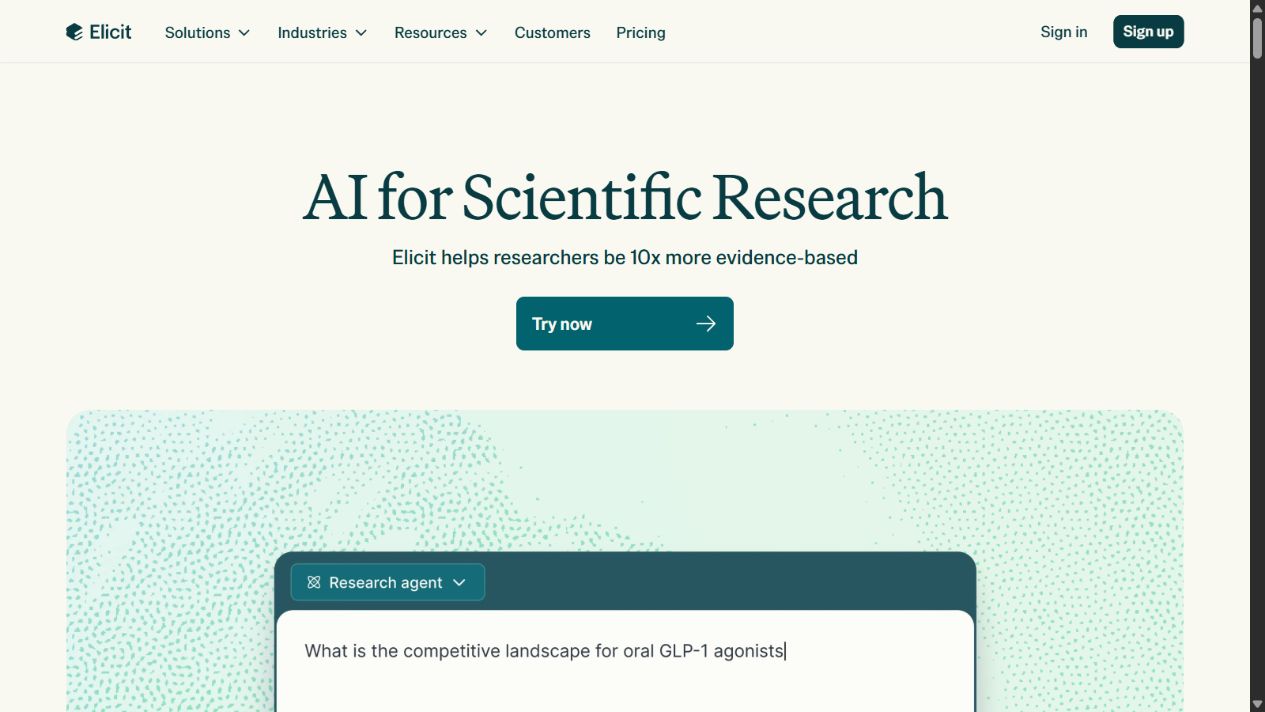
Elicit official homepage, captured August 28, 2026.
Choose Elicit when: the starting point is a research question and the expected evidence consists mainly of scholarly papers or clinical trials.
Check before relying on it: field coverage, language coverage, publication types, date coverage, full-text availability, duplicate handling, search export, query reproducibility, and whether required databases must be searched separately.
Choose Elicit for screening and data extraction
A literature review becomes difficult after search. Researchers must apply inclusion and exclusion criteria, document reasons, inspect full text, and extract comparable data. Elicit’s systematic-review pages describe workflows for protocol refinement, gathering sources, screening, extracting qualitative and quantitative fields, and synthesizing evidence. The product also describes supporting quotes and explanations around AI-generated decisions and data.
This structure can reduce clerical effort, but automation must not become unreviewed authority. Screening errors can change the study set. Extraction errors can change the conclusion. Researchers should inspect the original paper, resolve unclear fields, document human overrides, and preserve a reproducible decision record.
Elicit’s plan limits matter. The official pricing page differentiates the number of papers that can be screened, extraction columns, report source counts, usage multipliers, collaboration, API access, and enterprise controls. A casual individual review and a multi-reviewer institutional project have different requirements.
Choose Elicit when: the team needs a paper-by-paper table, explicit screening decisions, structured extraction, literature exports, and an auditable path from a claim to a source passage.
Check before buying: paper and column limits, reviewer roles, dual screening, export formats, figure and table extraction, audit records, API access, collaboration, data policy, and how unreadable or missing full text is represented.
Choose ChatGPT for broad Deep research
ChatGPT Deep research is not limited to academic literature. OpenAI documents that a user can select public websites, upload files, and use enabled connected apps. ChatGPT creates a proposed plan, lets the user refine the scope while work runs, and returns a structured report with citations or links.
That breadth fits market research, policy scans, company research, technical landscape analysis, procurement, and questions that combine official documentation, public web material, internal files, and data. It also creates a source-quality challenge. A broad search can mix primary research, vendor claims, journalism, blogs, and duplicated summaries unless the user restricts the source set and verifies material claims.
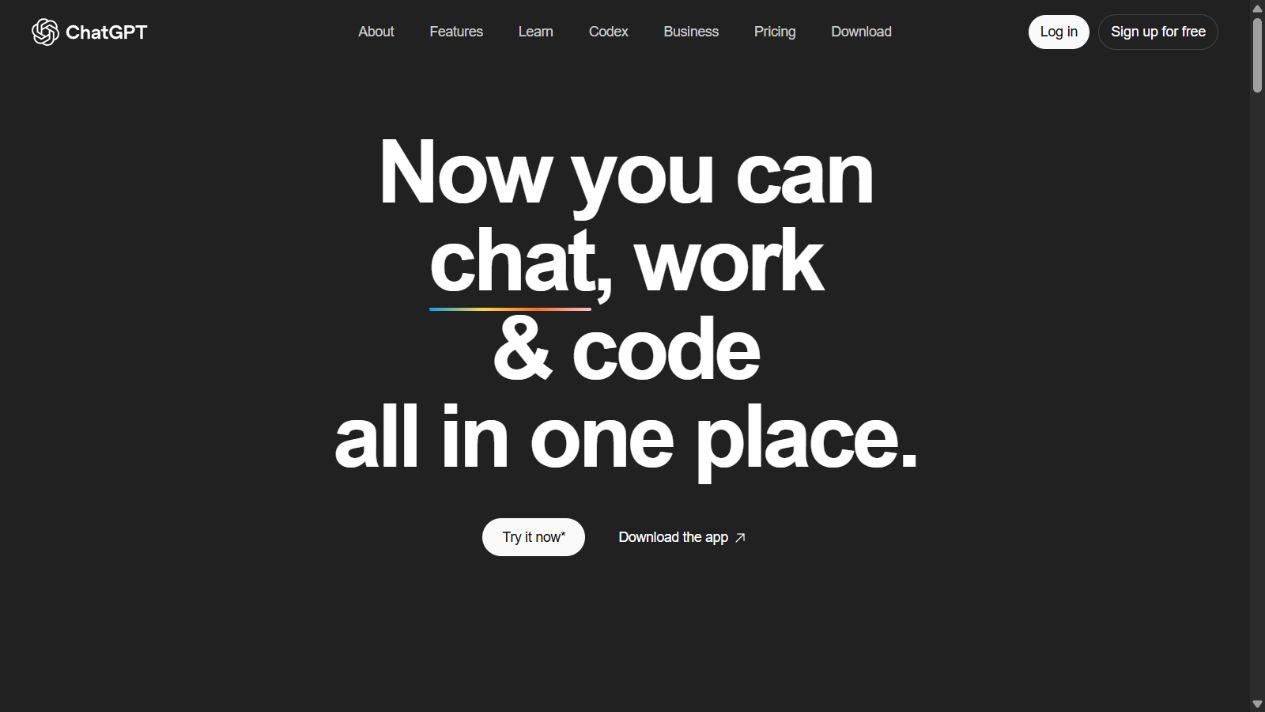
ChatGPT official homepage, captured August 15, 2026.
Choose ChatGPT when: the job is broader than academic literature, the source set includes varied files or sites, or the research must flow directly into analysis, writing, coding, or another general work product.
Check before relying on it: enabled sources, plan limits, workspace controls, citation completeness, access date, source authority, file limits, connected-app permissions, and whether a claim is supported by the cited passage rather than merely accompanied by a link.
Which is better for a literature review?
Elicit has the more appropriate default structure. It treats the review as a pipeline of search, screening, extraction, and synthesis. It can keep study-level information in a table and export references or data in formats useful to other research tools.
ChatGPT can help with important surrounding work:
- translating a broad topic into answerable research questions;
- explaining review methodologies and reporting standards;
- drafting a protocol template from user-supplied requirements;
- developing extraction-field definitions;
- analyzing an exported table provided by the researcher;
- drafting plain-language explanations after findings are verified.
ChatGPT should not be used as the sole evidence that a literature search is comprehensive. A persuasive narrative can hide missing databases, weak criteria, publication bias, study heterogeneity, and unverified citations.
For a formal systematic review, neither product replaces domain experts, an approved protocol, appropriate bibliographic databases, duplicate review where required, risk-of-bias assessment, statistical expertise, and transparent reporting.
Which is better for systematic reviews?
Elicit’s dedicated systematic-review workflow makes it the more direct candidate. Official material describes screening, extraction, supporting quotes, methods information, PRISMA-oriented outputs, and plan-dependent scale. Those features align with review operations.
The claim should remain qualified. “Supports systematic reviews” does not mean “automatically produces a publishable systematic review.” The research team remains responsible for:
- Defining the protocol before seeing convenient results.
- Selecting required databases and grey-literature sources.
- Registering the review where appropriate.
- Designing reproducible search strategies.
- Resolving duplicates and inaccessible sources.
- Applying criteria consistently with human oversight.
- Assessing risk of bias and evidence certainty.
- Explaining deviations, exclusions, and limitations.
ChatGPT can support documentation and explanation, but its flexible conversation is not a substitute for this controlled record.
Citations and verification
Both products expose sources in supported workflows, but a citation is not proof that the associated sentence is correct.
Elicit emphasizes source passages and paper-level evidence. The official Reports page says claims can link to exact supporting quotes. This is useful because the reviewer can inspect the passage. The passage may still be limited by study design, context, sample, outcome definition, or a mismatch between the paper and the claim.
ChatGPT Deep research provides citations or links in its documented reports. A reviewer should open each important source, confirm the statement, record the access date, and prefer original studies or authoritative primary sources over derivative summaries.
Use a claim ledger for either tool:
| Claim | Source | Exact support | Study or source limitations | Reviewer decision |
|---|---|---|---|---|
| Proposed statement | Original paper or primary source | Page, table, figure, or passage | Design, population, date, conflict, or scope | Keep, qualify, rewrite, or remove |
This separates evidence management from fluent drafting.
Data extraction and analysis
Elicit is purpose-built for extracting repeated fields across papers. A researcher can define columns such as population, intervention, comparator, outcome, design, duration, and effect. Structured columns make inconsistencies and missing values visible.
ChatGPT can analyze tables and files in supported workflows, but the user must create or supply the research structure. It can be more flexible for calculations, transformations, code, and explaining an exported dataset. Flexibility raises the risk of changing definitions between rows or inferring values that the source did not report.
For either tool:
- define each extraction field before scaling;
- distinguish “not reported” from “not applicable” and zero;
- retain the supporting passage, page, table, or figure;
- check a representative sample and every critical field;
- document transformations and calculations;
- never silently infer missing outcomes.
Pricing and plan fit
Elicit’s pricing page lists Basic, Plus, Pro, Scale, and Enterprise paths. When checked, the page showed a free Basic plan, annual and monthly paid options, and plan differences for reports, systematic reviews, extraction columns, source counts, exports, collaboration, API access, and enterprise controls. These facts are volatile and must be rechecked before purchase.
ChatGPT uses plan-dependent access to models, Deep research, files, projects, apps, and workspace controls. OpenAI’s pricing and help pages should be checked for the intended user type and market. API use is separate from a ChatGPT subscription.
Compare total research cost:
- number of researchers and reviewers;
- review count and corpus size;
- screening and extraction volume;
- exports and integrations;
- connected data sources;
- human verification time;
- collaboration and administration;
- institutional security and retention requirements;
- cost of a missed or incorrectly included study.
For a literature-review team, a more expensive structured workflow may save reviewer time. For occasional mixed research, a broad ChatGPT plan may support more jobs. A pilot should measure completed, verified work rather than generated pages.
Collaboration, governance, and sensitive research
Elicit’s Scale and Enterprise descriptions include plan-dependent collaboration, administration, usage tracking, and enterprise controls. ChatGPT Business, Enterprise, and Edu provide workspace controls and data policies that differ from consumer accounts. The exact contract and administrator configuration matter more than a general security-page claim.
Before uploading unpublished papers, interview transcripts, personal data, licensed databases, or confidential research:
- confirm authorization and contractual rights;
- document account and workspace type;
- review retention, training, residency, sharing, and deletion settings;
- restrict connected apps and external search where needed;
- remove unnecessary identifiers;
- define who can export or share results;
- follow institutional ethics, legal, and information-security requirements.
Do not use either consumer account as an assumed repository for restricted research.
A fair pilot
Use the same bounded research question and a preselected benchmark set.
For Elicit, test search relevance, known-study retrieval, criteria handling, screening explanations, extraction fields, source-passage traceability, exports, and reviewer overrides. Record papers missed, irrelevant papers included, fields extracted incorrectly, and time saved after human checking.
For ChatGPT, restrict sources deliberately, review the proposed research plan, test web and uploaded-file coverage, inspect every material citation, evaluate synthesis, and record unsupported claims or missing perspectives. Test whether outputs remain useful after all unverifiable statements are removed.
Do not ask which output sounds more authoritative. Measure:
- retrieval of known relevant sources;
- false inclusion and exclusion;
- extraction correction rate;
- citation support rate;
- reviewer minutes per verified finding;
- completeness of the audit trail;
- export and handoff quality.
Common research mistakes
Treating semantic search as comprehensive search
Semantic relevance is helpful, but formal reviews may require multiple databases, controlled terms, exact strings, dates, and grey-literature strategies.
Treating a linked citation as verified support
Open the original source and inspect the passage, methods, population, outcome, and limitations.
Mixing screening and conclusion writing
Define criteria before reviewing convenient evidence. Preserve excluded-paper reasons and human overrides.
Allowing the tool to fill missing data
Record “not reported.” Do not convert absence into an inferred value.
Using fluent prose as a quality metric
A readable report can still have incomplete search coverage or weak evidence. Evaluate the research record first.
Final recommendation
Choose Elicit when the project is centered on scholarly papers and needs repeatable search, screening, extraction, evidence tables, source passages, and literature exports. It is the more focused research instrument for literature reviews and evidence synthesis.
Choose ChatGPT when research spans the web, internal files, connected sources, analysis, writing, and other work. Deep research is valuable for broad multi-source questions, but the user must control source quality and verification.
Use both when the division is clear: Elicit manages the scholarly evidence workflow; ChatGPT supports question refinement, methodology explanation, analysis of verified exports, and audience-specific drafting. Keep the protocol, original sources, evidence ledger, and human review outside any single generated narrative.
Official sources
- Elicit homepage
- Elicit pricing
- Elicit paper search
- Elicit Reports
- Elicit systematic literature reviews
- Elicit export documentation
- OpenAI Deep research help
- OpenAI ChatGPT pricing
- OpenAI ChatGPT Projects help
- ChatGPT homepage
Frequently asked questions
Is Elicit better than ChatGPT for literature reviews?
Elicit is the more specialized choice for searching scholarly literature, screening papers, extracting structured data, and producing an auditable evidence-synthesis workflow. ChatGPT is broader and can support research planning and synthesis across the web, files, and connected sources.
Can ChatGPT replace Elicit?
ChatGPT can replace some exploratory research, question development, summarization, and report drafting. It does not automatically replace Elicit’s dedicated paper corpus, screening tables, extraction columns, systematic-review workflow, and literature-oriented exports.
Can Elicit replace ChatGPT?
No. Elicit is focused on scientific research and evidence synthesis. ChatGPT supports a much wider set of research, writing, data, coding, image, and general conversational tasks.
Which tool is better for a systematic review?
Elicit has the more directly relevant workflow, but neither tool removes the need for a registered protocol, appropriate databases, human screening, risk-of-bias assessment, reproducible records, domain expertise, and reporting standards.
Should researchers use Elicit and ChatGPT together?
They can be complementary. Elicit can structure literature discovery, screening, and extraction, while ChatGPT can help refine questions, explain methods, analyze supplied material, and draft non-factual working text. Claims and citations still require verification against original sources.
Frequently asked questions
Is Elicit better than ChatGPT for literature reviews?
Elicit is the more specialized choice for searching scholarly literature, screening papers, extracting structured data, and producing an auditable evidence-synthesis workflow. ChatGPT is broader and can support research planning and synthesis across the web, files, and connected sources.
Can ChatGPT replace Elicit?
ChatGPT can replace some exploratory research, question development, summarization, and report drafting. It does not automatically replace Elicit's dedicated paper corpus, screening tables, extraction columns, systematic-review workflow, and literature-oriented exports.
Can Elicit replace ChatGPT?
No. Elicit is focused on scientific research and evidence synthesis. ChatGPT supports a much wider set of research, writing, data, coding, image, and general conversational tasks.
Which tool is better for a systematic review?
Elicit has the more directly relevant workflow, but neither tool removes the need for a registered protocol, appropriate databases, human screening, risk-of-bias assessment, reproducible records, domain expertise, and reporting standards.
Should researchers use Elicit and ChatGPT together?
They can be complementary. Elicit can structure literature discovery, screening, and extraction, while ChatGPT can help refine questions, explain methods, analyze supplied material, and draft non-factual working text. Claims and citations still require verification against original sources.