Fliki vs ChatGPT: Which Is Better?
Compare Fliki and ChatGPT for video production, scripting, voiceovers, editing, team workflows, pricing, control, and practical business use.
Direct answer
Fliki is better when the job is turning an approved idea, script, article, presentation, or product brief into a narrated and captioned video through one production workflow. ChatGPT is better when the job is research, reasoning, writing, analysis, revision, and general-purpose team knowledge work.
Choose Fliki for repeatable script-to-video production, AI voiceover, scene assembly, avatars, captions, translation, dubbing, and video export. Choose ChatGPT when the team needs to investigate a topic, develop the angle, structure the script, analyze source material, revise messaging, or support many non-video tasks in the same workspace.
For many teams, the practical answer is not one product replacing the other. ChatGPT can support the research and script stage; Fliki can support production. That combined workflow is defensible only when a human verifies the facts, rights, visuals, pronunciation, captions, and final output.
This comparison uses official sources checked on August 29, 2026. We did not run a controlled production test, measure rendering quality, or compare outputs under identical prompts. Product facts are verified; workflow conclusions are editorial inferences.
Fliki vs ChatGPT at a glance
| Decision area | Fliki | ChatGPT |
|---|---|---|
| Primary role | AI-assisted video and audio production | General-purpose reasoning, content, analysis, and work platform |
| Best starting input | Idea, prompt, script, article, presentation, image, audio, or video | Prompt, conversation, files, connected sources, data, or project context |
| Finished video workflow | Central product purpose | Capabilities depend on plan and feature access; not the same integrated editing workflow |
| Voice and narration | Large published voice and language library, voiceover, cloning, dubbing | Voice supports interaction and content work; not a direct substitute for Fliki’s production library |
| Scene assembly | Script segmentation, visuals, captions, music, and timeline | Can draft scene plans and assets but does not mirror the full Fliki composer |
| Research and reasoning | Secondary to production | Core strength |
| Business workspace | Team and brand features vary by Fliki plan | Shared workspace, billing, administration, apps, projects, and knowledge features vary by ChatGPT plan |
| Main cost driver | Plan, credits or minutes, export quality, premium assets/features, and seats | Plan, seats, usage limits, credits, and advanced feature use |
| Main risk | Publishing polished-looking video with weak evidence or mismatched visuals | Treating fluent output as verified fact or assuming broad capability replaces production controls |
The real choice: production system or thinking workspace
The products overlap around generative content, but they start at different points in the workflow. Fliki’s official feature pages describe an integrated path from prompt or script to scenes, visual material, voiceover, captions, music, editing, and export. ChatGPT’s official business material describes a broader workspace for models, projects, apps, company knowledge, analysis, research, content, and delegated work.
That difference affects the purchase decision. A marketing team producing ten localized explainers per month has a video-production bottleneck. A strategy team developing campaign arguments, reviewing evidence, writing briefs, and analyzing feedback has a knowledge-work bottleneck. Buying the wrong category creates extra handoffs instead of removing them.
Before choosing, write the required output precisely:
- duration, aspect ratio, resolution, and publishing channels;
- source material and person responsible for factual approval;
- narration language, pronunciation, voice rights, and localization;
- visual source, licensing, brand, and accessibility requirements;
- revision, approval, version, and file-retention process;
- expected monthly volume and deadline;
- definition of acceptable quality;
- measurement and correction process after publication.
Fliki: stronger for end-to-end script-to-video production
Fliki’s official feature directory lists text-to-video, idea-to-video, AI voiceover, avatars, text to speech, voice cloning, blog-to-video, presentation-to-video, image-to-video, translation, dubbing, subtitles, screen recording, image generation, and editing tools. The company publishes support for a large voice library and many languages, but buyers should verify the exact voice, language, model, and plan needed.
The important advantage is orchestration. A script can be divided into scenes, paired with stock or generated visual material, narrated, captioned, scored, edited, and exported without assembling a separate chain of tools. That does not guarantee good storytelling, but it shortens the route from approved script to reviewable video.
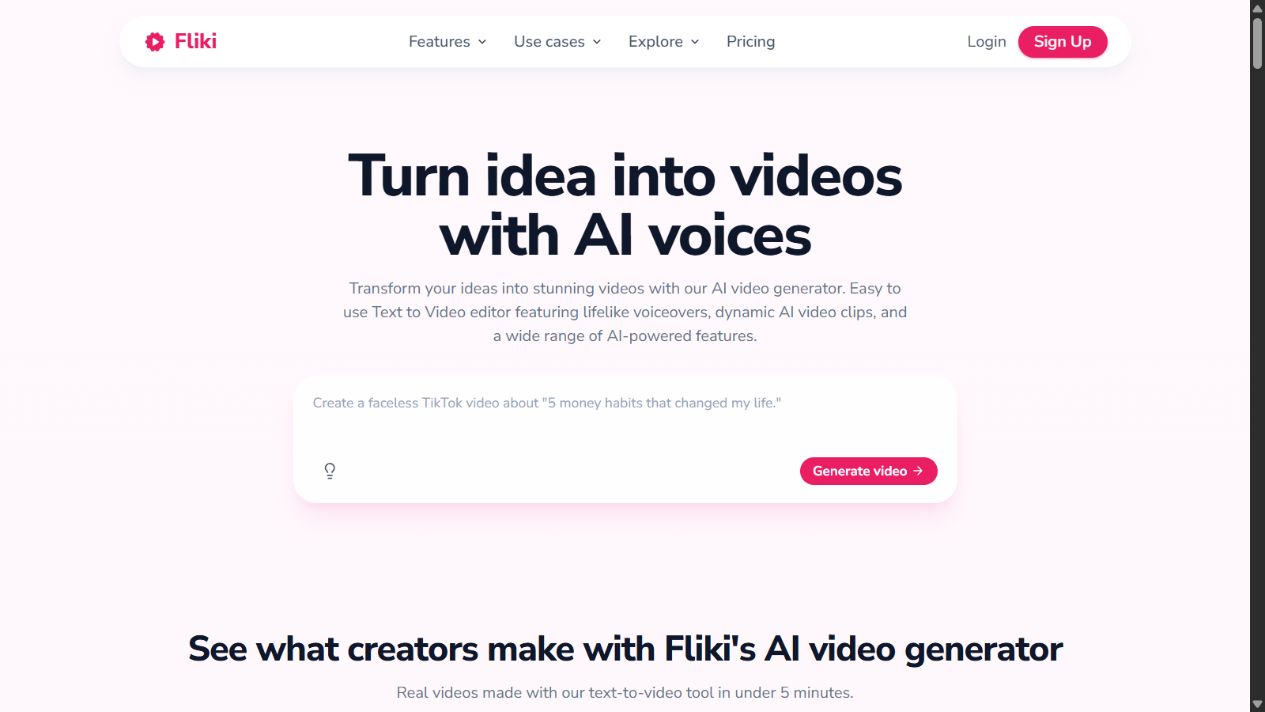
Fliki official homepage, captured August 29, 2026. Source: Fliki .
Where Fliki is the better fit
- Narrated explainers: a team has an approved script and needs scenes, voiceover, captions, and export.
- Content repurposing: an article, deck, or long-form source must become a video draft.
- Localization: the business needs translated narration, captions, or dubbing and can review the target language.
- Training production: subject-matter content must become a repeatable narrated format.
- Social video: one source needs variants for different aspect ratios or channels.
- Voice-led production: the project depends on a consistent narration workflow rather than live recording.
Fliki limitations to evaluate
Automated scene matching can select a visually plausible but inaccurate or generic clip. A natural-sounding voice can mispronounce names or give unsupported content more authority than it deserves. Translation can preserve words while losing technical meaning. Voice cloning and avatars introduce consent, identity, disclosure, and misuse risks. Stock and generated media require rights review.
Fliki is therefore not an unattended publishing system. A reviewer must compare every scene with the source, inspect captions, verify pronunciation, check licensing and disclosures, and confirm that the final video does not imply evidence that was never collected.
Official sources: Fliki features , script to video , AI video generator , and Fliki pricing .
ChatGPT: stronger for research, scripting, and broader work
ChatGPT is a general work environment rather than a dedicated script-to-video editor. Official business documentation describes shared workspaces, administration, billing, projects, apps, company knowledge, research, analysis, custom GPTs, agent capabilities, and access to different models or features depending on seat and plan.
For video work, ChatGPT is most valuable before and around production. It can help a team turn source material into a brief, compare audience angles, draft and revise scripts, build interview questions, identify unsupported claims, create a shot list, generate review checklists, analyze feedback, and create channel-specific copy. Those uses still require source verification and editorial approval.
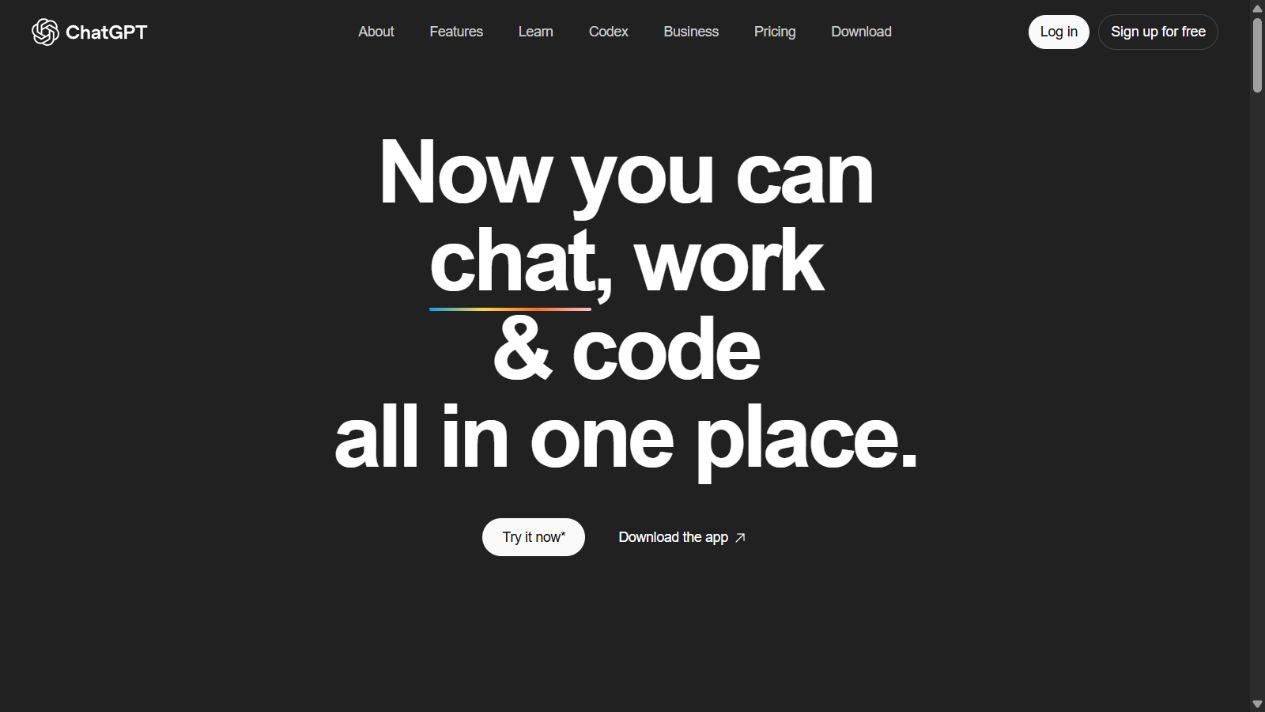
ChatGPT official homepage, captured August 15, 2026. Source: ChatGPT .
Where ChatGPT is the better fit
- Evidence synthesis: organize approved source material and identify gaps.
- Script development: draft hooks, structure, narration, examples, and calls to action.
- Revision: adapt length, tone, audience, format, or reading level while preserving approved facts.
- Analysis: examine campaign results, comments, transcripts, or qualitative feedback.
- Cross-format work: create related briefs, articles, emails, social posts, and sales enablement.
- Team knowledge: use projects, apps, or company context under appropriate plan and governance controls.
ChatGPT limitations to evaluate
Fluent output can contain errors, outdated facts, weak causal claims, or invented detail. Model access and limits vary. Connected sources can be incomplete or misconfigured. Generated images or video do not automatically provide the integrated scene, voice, caption, timeline, and export workflow that makes Fliki specialized.
ChatGPT should not be instructed to “research and create a publishable video” without an approved evidence set and checkpoints. The team should preserve sources, separate verified facts from inference, and prevent private or regulated data from entering an unauthorized environment.
Official sources: ChatGPT , ChatGPT pricing , What is ChatGPT Business? , and ChatGPT Business FAQ .
Which is better by task?
Turning an approved script into video: Fliki
Fliki is designed to carry the script into scenes, visual material, narration, captions, music, and export. ChatGPT can improve the script and plan the sequence, but a separate production workflow remains necessary.
Researching and writing the script: ChatGPT
ChatGPT is the broader environment for interrogating source packs, outlining, comparing arguments, drafting, and revising. Fliki includes script-generation features, but research quality depends on the evidence and review process, not the presence of a script button.
Localization: Fliki, with human review
Fliki publishes translation, dubbing, voice, caption, and language capabilities directly related to localized video. A qualified reviewer must still check technical terminology, local context, pronunciation, timing, and disclosure.
General business use: ChatGPT
ChatGPT supports many tasks outside video, including analysis, writing, research, coding, files, projects, and connected work. If video is occasional, a company may gain more utility from ChatGPT and use a separate production method only when needed.
Consistent video throughput: Fliki
Templates, brand assets, voice choices, and a repeatable composer can reduce production friction. Consistency is valuable only if the template remains appropriate and a human checks every output.
Pricing and total-cost comparison
The products cannot be compared by one monthly price because they meter different work.
For Fliki, model:
- monthly video volume and duration;
- required export resolution;
- premium voice, avatar, model, stock, or cloning needs;
- users and collaboration;
- localization and rerendering;
- failed generations and revision cycles;
- storage, downloads, and downstream editing.
For ChatGPT, model:
- individual or business plan;
- number and type of seats;
- included usage and advanced-feature limits;
- workspace credits or flexible usage where applicable;
- connected systems and administration;
- separate video-production tools;
- reviewer time and source management.
The least expensive plan can be the wrong economic choice if it creates manual rework. Run two real projects, record every paid unit and human minute, then forecast a normal month. Recheck official prices and limits on the purchase date.
A safe combined workflow
1. Approve the evidence
Collect primary sources, product facts, quotations, dates, permissions, and required disclosures. Mark every statement as verified, inference, or unresolved. Do not start video production while critical claims remain unknown.
2. Draft in ChatGPT
Provide the approved source pack, audience, goal, format, length, tone, must-cover points, prohibited claims, and CTA. Ask for a claim ledger with the script. A human editor should resolve every unsupported sentence.
3. Lock the script
Obtain subject-matter, legal, brand, and compliance review as required. Confirm pronunciation, names, figures, dates, and on-screen text. Version the approved script.
4. Produce in Fliki
Import or paste the script. Select the correct aspect ratio, language, voice, visual style, and brand assets. Treat automatically chosen visuals as suggestions, not evidence.
5. Review scene by scene
Check whether each visual accurately represents the narration. Verify captions, timing, cuts, music, contrast, text size, keyboard-independent access to equivalent information, and any required audio description.
6. Publish with provenance
Retain the approved script, source ledger, licenses, consent records, model and plan notes, capture date, final file, and approver. Disclose synthetic voice, avatar, or generated material when policy, law, platform rules, or audience trust requires it.
Neither is right when…
Neither product is sufficient when the work requires verified filming of a real process, regulated evidence, testimony whose identity must be authenticated, or a high-end production with complex direction and original cinematography. A screen-recording tool, professional editor, localization specialist, accessibility expert, legal reviewer, or production team may be the correct route.
Do not use synthetic media to create a customer quote, employee likeness, product demonstration, news event, or test result that did not occur. Do not clone a voice without explicit authorization. Do not upload confidential footage, private customer records, or licensed assets unless the service and organizational policy permit it.
Evaluation checklist
- The team has defined whether the bottleneck is thinking, scripting, or production.
- The same approved brief and evidence set will be used in the pilot.
- Every material claim has a source and verification date.
- Voice, likeness, stock, music, and generated-media rights are documented.
- Required languages, voices, captions, and export formats are tested.
- Human correction time is included in total cost.
- Private data and connected sources follow organizational policy.
- Brand and accessibility review occurs before publication.
- The workflow preserves scripts, sources, versions, and approvals.
- The team can explain when the output is synthetic.
Pilot scorecard for a real business decision
Run the comparison with one representative project, not a polished demo supplied by either vendor. A useful test might be a three-minute product explainer built from a verified brief, a 900-word source document, an approved brand kit, and a fixed delivery deadline. Record the input, prompt, settings, plan, reviewer, corrections, and output so another person can reproduce the assessment.
Score each area from one to five and preserve the notes behind the score:
| Criterion | What to measure | Why it matters |
|---|---|---|
| Factual fidelity | Unsupported claims, altered figures, missing qualifications, and source traceability | A polished video is harmful when it misstates the source |
| Script quality | Structure, clarity, pacing, audience fit, and revision count | The script determines whether production effort has value |
| Visual relevance | Accurate scene-to-narration match and number of replacements | Generic or misleading visuals reduce trust |
| Voice quality | Pronunciation, pacing, tone, language fit, and correction effort | Natural sound does not guarantee accurate delivery |
| Caption quality | Word accuracy, timing, speaker context, punctuation, and readability | Captions are both an accessibility and comprehension requirement |
| Brand control | Fonts, colors, logo, layout, voice, approvals, and reusable templates | Fast production should not create inconsistent publishing |
| Editorial control | Versioning, reviewer access, comments, approvals, and rollback | Teams need a reliable path from draft to accountable release |
| Output quality | Resolution, compression, aspect ratios, audio levels, and export reliability | The file must work on the intended channel |
| Security and rights | Data handling, permissions, licenses, consent, and retention | Production convenience cannot override legal or privacy duties |
| Total effort | Setup, generation, correction, rendering, export, and administration time | Subscription price alone does not represent the cost |
Do not average away a critical failure. A strong speed score cannot compensate for an invented product claim, unauthorized voice, inaccessible output, or misleading scene. Define non-negotiable gates before the pilot: zero unresolved factual claims, documented rights for every asset, approved pronunciation, acceptable captions, and a final human sign-off.
Questions to ask Fliki
- Which plan and credit type covers the intended duration, resolution, voices, models, and monthly volume?
- What rights and restrictions apply to stock, generated media, cloned voices, avatars, music, and commercial exports?
- How are source files, deleted projects, team permissions, and generated assets handled?
- Which language and voice features are generally available versus limited to specific plans or models?
- Can the team export captions, audio, project data, or editable assets for correction and migration?
Questions to ask OpenAI
- Which ChatGPT plan and seat type supports the required models, projects, apps, files, workspace controls, and usage?
- What data controls, retention options, training defaults, and regional requirements apply to the workspace?
- Which advanced capabilities draw from included limits or purchased credits?
- How will connected sources be permissioned, reviewed, and removed?
- What separate production system is required to turn the approved script into the final video?
The questions expose an important asymmetry. Fliki buyers must investigate media-production rights and output limits. ChatGPT buyers must investigate knowledge-work governance and the cost of the production tools that remain outside ChatGPT.
Final verdict
Choose Fliki when success means producing a finished narrated video from approved source material through one specialized workflow. Choose ChatGPT when success means researching, reasoning, drafting, revising, analyzing, and supporting many kinds of knowledge work.
Use both when the handoff is explicit: ChatGPT helps create and verify the script; Fliki turns the approved script into a reviewable video. The combination is useful, but neither tool should receive authority to publish without human evidence, rights, brand, and accessibility checks.
Sources and verification notes
Official Fliki and OpenAI sources were checked on August 29, 2026. Product plans, credits, model access, voices, languages, export quality, workspace features, and usage limits are volatile. Screenshots show public official homepages and do not imply hands-on testing. The SaaS Education did not receive compensation from either company for this comparison.
Frequently asked questions
Is Fliki better than ChatGPT for making videos?
Fliki is the more complete option when the required output is a narrated, captioned video assembled from a script, prompt, article, presentation, or other source. ChatGPT is stronger for research, reasoning, drafting, revision, and broader knowledge work, but it is not the same end-to-end video-production workflow.
Can ChatGPT replace Fliki?
ChatGPT can help develop concepts, scripts, shot lists, and review criteria, and plan-dependent features may create images or video. It does not automatically replace Fliki's scene assembly, stock or generated visuals, voice library, captions, timeline, localization, and export workflow.
Can Fliki use a ChatGPT script?
Yes. Fliki publishes a workflow for turning a ChatGPT-generated script into video. Treat the script as a draft: verify factual claims, permissions, pronunciation, visual fit, and brand requirements before generating or publishing the final video.
Which tool is better for training videos?
Fliki is the clearer production choice for narrated training videos, especially when voice, captions, localization, and repeatable video output matter. ChatGPT is useful for structuring the lesson and drafting content. Neither removes the need for subject-matter and accessibility review.
Which tool is cheaper, Fliki or ChatGPT?
There is no stable universal answer because the products use different plans and usage models. Compare the required Fliki export minutes, voices, resolution, and seats with the relevant ChatGPT plan, limits, credits, and any separate production tools needed to finish the video.
Should a business use both Fliki and ChatGPT?
Using both can be sensible when ChatGPT supports research and scripting while Fliki handles video assembly, narration, captions, and export. Define which system owns factual approval, source files, brand assets, and the final publishing decision.
How should a team test Fliki and ChatGPT?
Use the same approved brief and source pack. Measure research accuracy, script quality, revision effort, scene fit, voice quality, caption accuracy, accessibility, brand consistency, rendering time, export quality, total cost, and the amount of human correction required.