Grammarly vs ChatGPT: Which Is Better?
Compare Grammarly and ChatGPT for editing, drafting, rewriting, research, files, team workflows, business controls, integrations, and writing governance.
Direct answer
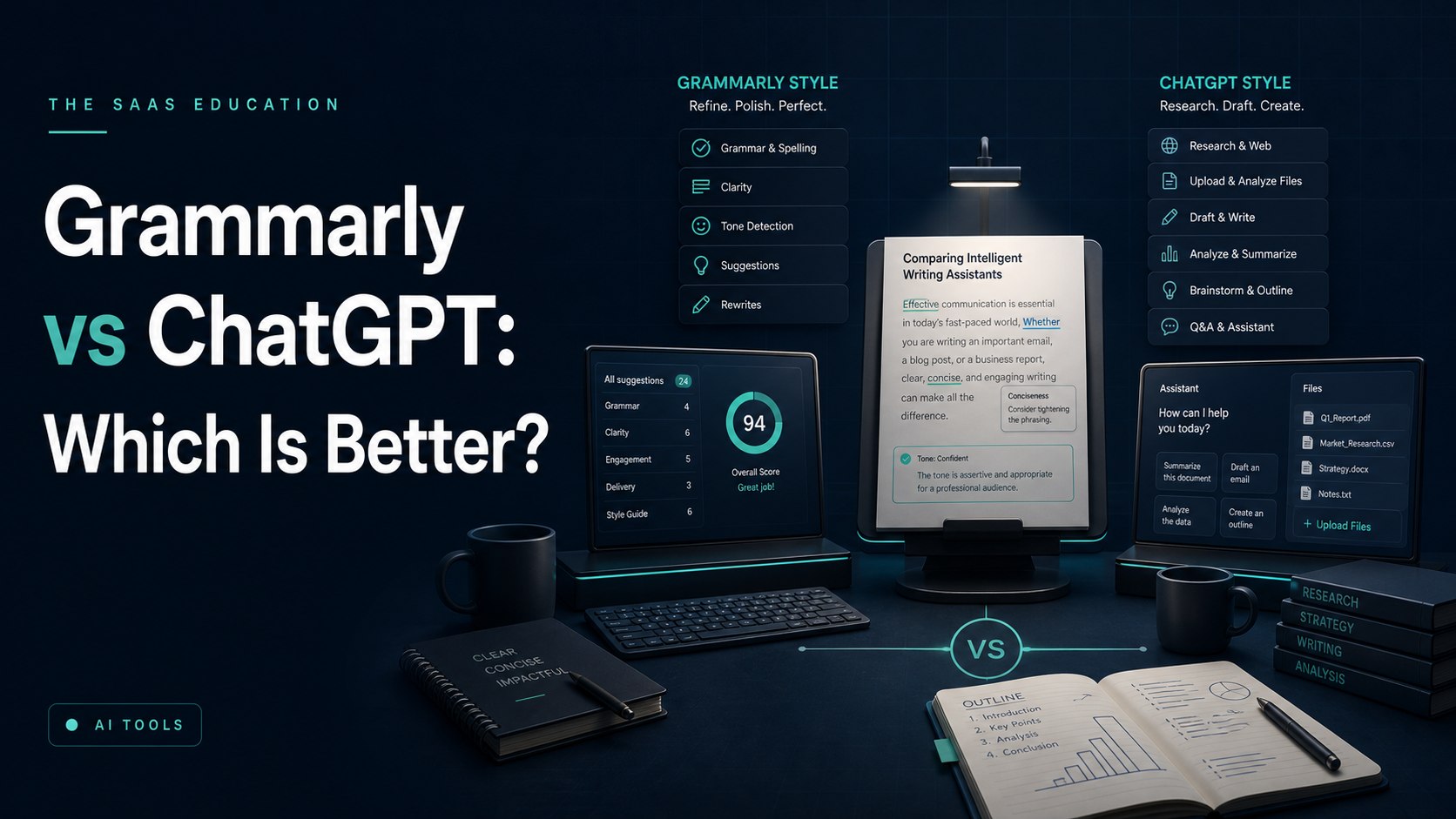
Grammarly is better when the central job is improving writing where people already compose it: email, documents, browsers, and supported applications. ChatGPT is better when writing is one part of a broader AI workspace that also includes research, files, data analysis, ideation, coding, images, connected applications, projects, and reusable assistants.
Grammarly’s advantage is workflow proximity. Its official product material presents an AI writing partner that helps users generate, rewrite, adjust tone, review, and improve communication across supported work surfaces. ChatGPT’s advantage is breadth. OpenAI presents ChatGPT as a general assistant with writing plus plan-dependent search, deep research, file analysis, projects, tasks, GPTs, apps, voice, images, and coding capabilities.
For an individual, choose based on whether the recurring problem is revision inside existing applications or broader thinking and production in a separate AI workspace. For a company, compare the exact business plans, not consumer impressions. Identity, administration, data handling, retention, connector permissions, policy controls, procurement, and review requirements matter as much as sentence quality.
This comparison uses official Grammarly and OpenAI sources checked on August 30, 2026. We did not run a controlled writing benchmark or submit confidential company documents. Product facts are sourced; workflow recommendations are editorial inferences.
Because both vendors change AI features and packaging frequently, treat the comparison table as dated evidence rather than a permanent inventory. Before purchase, verify the selected account type, supported applications, usage limits, administrator controls, connectors, data terms, and regional availability. Record the plan and settings used during a pilot so later reviewers can reproduce the decision.
For a broader selection method, use our AI Tools evaluation guide , prompt-engineering explainer , and SaaS security checklist .
Grammarly vs ChatGPT at a glance
| Decision area | Grammarly | ChatGPT |
|---|---|---|
| Best overall fit | Embedded writing improvement across supported applications | Broad AI workspace where writing is one of many tasks |
| Core interaction | Suggestions, rewrites, generation, tone, and review near the writing surface | Conversational workspace for drafting, research, files, analysis, and tools |
| Editing | Strong focus on revising existing communication | Flexible editing through prompts and iterative conversation |
| Long-form drafting | Supported, with product features oriented around writing workflow | Strong general drafting and restructuring workflow, subject to plan and model |
| Research | Not the primary product identity | Search and deep-research experiences on supported plans |
| Business deployment | Grammarly business and enterprise offerings with plan-specific controls | ChatGPT Business and Enterprise with workspace and plan-specific controls |
| Main risk | Assuming every writing surface and advanced control is covered by the selected plan | Using fluent generation without source, policy, or editorial controls |
The products solve different primary problems
Grammarly is designed around communication quality. The product follows writing into supported contexts and offers assistance close to the sentence, paragraph, document, or message. That can reduce the friction of moving text to a separate tool and can make consistent revision more accessible to employees who would not open a dedicated AI chat.
ChatGPT is designed as a general-purpose assistant. Writing can begin from a blank prompt, source files, research, a structured brief, or an ongoing project. The same workspace may support outlining, analysis, coding, image work, data tasks, or a custom GPT. That versatility is useful when the writing task depends on more than wording.
The overlap is real: both can generate, rewrite, summarize, adjust style, and support ideation. The difference is the surrounding operating model. A buyer should evaluate where the work begins, what context is required, where the result must go, and how a reviewer verifies it.
1. Everyday editing and revision
Grammarly’s official homepage and product pages emphasize clear, credible writing, generative assistance, rewrites, tone, and support across work contexts. The product’s embedded orientation makes it especially relevant for email, short documents, messages, and routine professional communication. A user can receive help during composition rather than building a separate prompt and pasting the result back.
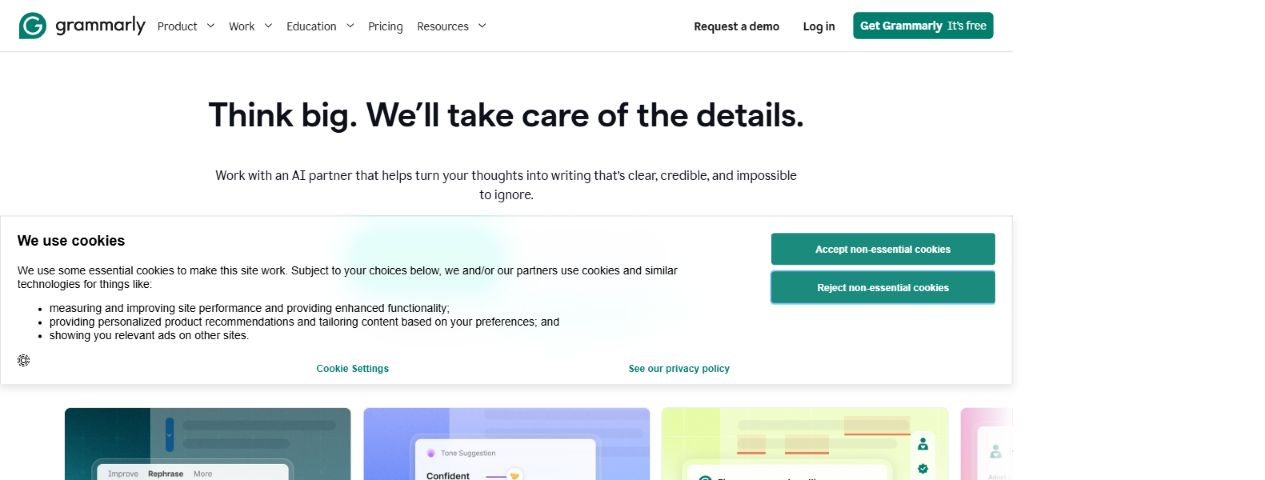
Grammarly’s official homepage, captured August 30, 2026. Source: Grammarly .
ChatGPT can review pasted or uploaded text, explain changes, generate alternatives, apply a style guide, and iterate through feedback. Its conversational model can be more flexible for complex revision: a user can ask why a passage fails, preserve evidence, restructure an argument, or compare several versions. The cost is workflow separation and the need to provide sufficient context safely.
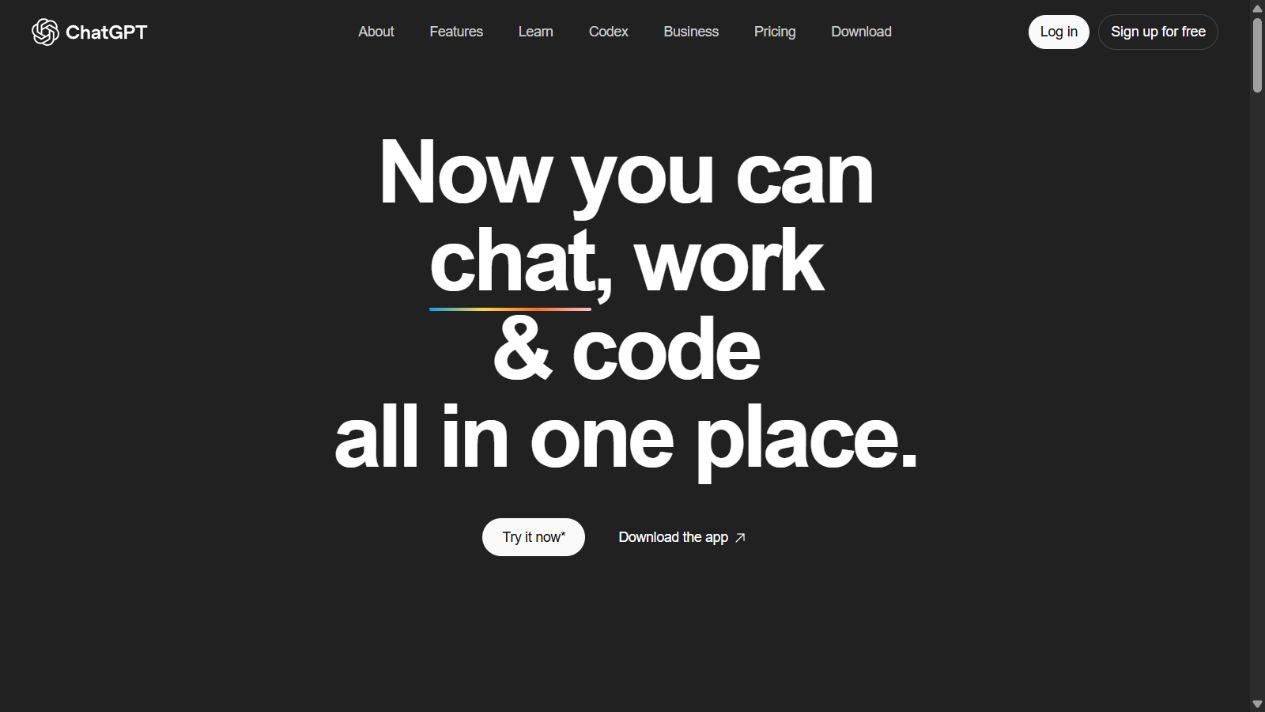
ChatGPT’s official homepage, captured August 15, 2026. Source: ChatGPT .
Decision: choose Grammarly for continuous, low-friction revision near the writing surface. Choose ChatGPT when revision needs a deeper conversation, supplied evidence, or substantial restructuring.
2. Drafting from a blank page
Both products can help start a draft. Grammarly presents generative AI and writing assistance in its product workflow. ChatGPT accepts detailed prompts, files, project context, and iterative instructions in supported plans. The quality of either output depends on the brief, source material, constraints, and review.
ChatGPT has the broader blank-page workspace. It can develop an outline, interview the user for missing context, compare structures, and produce several forms of the same underlying analysis. Grammarly’s advantage is that the draft and subsequent editing can remain closer to the destination application.
The most important control is source discipline. Neither product should invent customer evidence, legal facts, statistics, product capabilities, quotations, or citations. A reliable drafting workflow separates verified notes from inference, requires links for unstable claims, and records what a human checked.
Decision: ChatGPT is usually more flexible for exploratory drafting and complex transformations. Grammarly is usually more convenient when the writer needs to compose and refine inside the existing workflow.
3. Grammar, clarity, tone, and style
Grammarly’s brand and product design are directly centered on language improvement. Its official materials describe suggestions and assistance for correctness, clarity, engagement, delivery, tone, and brand-related writing workflows, with availability depending on product and plan. This structured focus can be useful for organizations that want employees to receive consistent assistance without becoming prompt experts.
ChatGPT can apply a style guide when one is supplied, explain tone, and rewrite at different levels of formality. It can also over-apply an instruction, flatten a distinctive voice, or make a sentence more fluent while changing its meaning. The writer must compare the revision against the source and intended audience.
Test with representative text: an executive email, support response, policy note, product explanation, and sensitive correction. Score meaning preservation, tone, false corrections, readability, and the amount of reviewer work. Do not score only whether the result sounds polished.
Decision: Grammarly has the clearer specialist position for ongoing language and tone assistance. ChatGPT is stronger when style changes must be discussed and combined with broader content work.
4. Research and source-grounded writing
Research is the clearest difference. ChatGPT offers plan-dependent search, deep research, file handling, connected apps, and other tools that can help collect and synthesize information. These features still require source checking: a cited page must support the claim, dates matter, and a summary can overstate evidence.
Grammarly is not primarily a research platform. Its value begins after or during composition, where source material may already exist. A writer who needs extensive current research will likely use other tools before Grammarly, even if Grammarly helps refine the final language.
A company should separate research capture from final prose. Keep a source ledger with URL, publisher, date, claim, and evidence class. Ask the assistant to use only supplied or cited material. Mark editorial inference explicitly. This practice matters more than which product produces the first draft.
Decision: ChatGPT is the stronger choice for research-connected writing. Grammarly is the specialist layer for improving the communication produced from an established evidence base.
5. Documents, files, and project context
ChatGPT’s official plan pages describe file uploads, data analysis, projects, apps, and other context mechanisms with plan-dependent limits. These capabilities can support a long-running editorial project, proposal, report, or policy where multiple files and reusable instructions matter.
Grammarly offers document and application workflows, but buyers should verify exactly how the selected product handles shared context, knowledge, brand controls, and supported applications. A feature described for an enterprise offering may not exist in an individual account.
The governance question is what the assistant is allowed to read. A connected drive or document system may expose more material than the task requires. Use least privilege, approved folders, defined retention, and human review. Convenience is not evidence that the broadest connector scope is appropriate.
Decision: ChatGPT generally provides the broader project and file workspace. Grammarly is better when assistance should follow ordinary writing without turning every task into a project.
6. Team consistency and brand voice
Organizations often buy writing software to reduce inconsistent tone, terminology, and quality across marketing, sales, support, recruiting, and leadership communication. Grammarly’s business materials describe team-oriented writing and brand capabilities under eligible offerings. This aligns naturally with an organization-wide communication program.
ChatGPT can encode instructions in projects, workspace guidance, or custom GPTs where supported. That can create powerful role-specific assistants, but each configuration needs ownership, testing, versioning, and access control. A custom assistant is not a substitute for an approved style guide or editorial policy.
Test whether the product preserves required terminology, prohibited claims, reading level, tone boundaries, and escalation rules. Include adversarial examples and ambiguous text. Measure consistency across users and applications rather than one administrator’s demonstration.
Decision: Grammarly has the clearer embedded brand-consistency use case. ChatGPT offers broader custom workflows when the organization can govern them.
7. Nonwriting work
ChatGPT is the decisive winner for breadth. Official OpenAI materials describe analysis, coding, images, voice, files, search, research, tasks, GPTs, and connected applications across supported plans. A user can move from a spreadsheet to a report, from code to documentation, or from research to a presentation outline in the same general workspace.
Grammarly remains focused on writing and communication. That narrower scope can be positive: procurement can define a clear use case, employees receive assistance where needed, and administrators avoid positioning one product as a universal answer.
If a company already licenses ChatGPT broadly, it should test whether Grammarly adds measurable value beyond overlapping rewrite and drafting. If it already licenses Grammarly, it should identify nonwriting workflows before adding ChatGPT.
Decision: choose ChatGPT for cross-functional AI work. Choose Grammarly when a narrower communication layer is the objective.
8. Integrations and workflow placement
Grammarly provides applications and extensions designed to bring writing support into supported products and surfaces. Compatibility can vary by operating system, browser, application, feature, and account. Buyers should test the actual employee environment, including managed devices and security controls.
ChatGPT provides web and application experiences plus plan-dependent apps or connectors. A connected application can make context easier to retrieve, but it also expands the permission and data-governance surface. Verify what the integration reads, when it is invoked, and how administrators can restrict it.
Map the full workflow: source, assistant, destination, reviewer, and archive. Count copy-paste steps, lost formatting, missing citations, and context recreation. The better integration is the one that reduces friction without broadening access unnecessarily.
Decision: Grammarly is usually closer to everyday writing surfaces. ChatGPT is more extensible as a broad AI workspace, with a larger governance burden.
9. Business controls, privacy, and security
Grammarly publishes business, enterprise, privacy, security, and trust material. OpenAI publishes ChatGPT Business and Enterprise information, business-data privacy commitments, security documentation, and a trust portal. Review the exact current plan and contract because consumer settings and business commitments are not interchangeable.
At minimum, evaluate identity, provisioning, roles, policy controls, logging, retention, training terms, model or feature controls, integrations, data residency where required, subprocessors, deletion, and incident support. Confirm whether protections apply across extensions, desktop applications, mobile, APIs, connectors, and new AI features.
Classify writing data before rollout. Public marketing copy, internal planning, customer messages, legal drafts, HR material, source code, and regulated data should not automatically follow the same policy. Keep restricted data out of unapproved services and provide an escalation path when users are uncertain.
Decision: neither product is automatically safer. The safer choice is the approved plan, configuration, scope, and review process that matches the organization’s data.
10. Pricing and total cost
Both vendors offer multiple plans, and exact prices and packaging can change. Compare the current official Grammarly pricing and business pages with the current ChatGPT pricing, Business, or Enterprise offer relevant to the buyer. Do not compare an individual Grammarly account with ChatGPT Enterprise or a free ChatGPT account with Grammarly Business as though controls are equivalent.
Include licenses, minimum seats, premium usage or limits, implementation, identity setup, integrations, training, administration, support, and renewal. Also include duplicated spend. If both products are licensed, identify the distinct workflow and role that justifies each seat.
Measure review-adjusted value. A tool that generates more text but increases source checking, policy violations, or editorial correction may reduce productivity. Conversely, a specialized writing layer may save small amounts of time across many employees and still justify its cost.
Decision: model cost by role and workflow, not by headline monthly price.
A practical evaluation framework
Step 1: define five writing jobs
Select representative work: an executive email, customer response, product article, research summary, and policy explanation. Use safe or synthetic content and provide the same sources, style guide, and constraints.
Step 2: define quality criteria
Score meaning preservation, correctness, source fidelity, tone, structure, readability, terminology, false claims, and reviewer time. Include a task where the right response is to ask for missing evidence rather than generate confidently.
Step 3: test workflow fit
Run the tasks in the applications employees actually use. Measure setup, copy-paste, lost formatting, context entry, suggestions ignored, and the time from first draft to approved output.
Step 4: test administration
Provision and remove a user, apply a policy, inspect available controls, restrict a connector, review retention and deletion, and document support. Confirm which controls apply to every surface in the pilot.
Step 5: calculate total cost
Model current and growth scenarios by role. Count overlapping subscriptions and administration. Record which roles need Grammarly, ChatGPT, both, or neither.
Common mistakes
Using fluency as proof
A polished sentence can still be inaccurate, misleading, or unsupported. Verify meaning and evidence.
Rewriting without preserving intent
Tone and clarity changes can weaken a legal distinction, product limitation, apology, or commitment. Compare revisions against the original purpose.
Giving a connector excessive access
Connect only approved sources and apply least privilege. A convenient integration should not expose an entire drive when one folder is sufficient.
Buying both for everyone
Overlap in drafting and rewriting can create duplicate cost. Purchase by measured role and workflow.
Treating a style configuration as governance
Brand voice does not enforce factual, legal, privacy, or accessibility requirements. Maintain accountable review.
Final recommendation
Choose Grammarly when the organization wants writing assistance embedded across supported communication surfaces and values continuous editing, tone, and brand consistency. Choose ChatGPT when writing must connect to broader research, files, analysis, coding, images, or reusable assistants. Consider both only when a pilot demonstrates distinct value for defined roles.
The better product is not the one that produces the most fluent sample. It is the one that improves approved communication inside a workflow the organization can govern. Test representative writing, preserve source evidence, review the exact business controls, calculate duplicated cost, and keep humans accountable for every published or sent message.
Sources
Frequently asked questions
Is Grammarly better than ChatGPT for writing?
Grammarly is the stronger first choice when the main job is improving writing inside everyday applications with suggestions, rewrites, tone, and organization features. ChatGPT is stronger when writing is part of a broader workflow involving research, files, analysis, ideation, coding, or custom assistants. Test both with the same source-bound brief.
Can ChatGPT replace Grammarly?
ChatGPT can edit, rewrite, and explain text, but it does not reproduce every in-context Grammarly workflow. Replacement depends on where employees write, how suggestions are delivered, which controls are required, and whether a separate chat workflow is acceptable.
Can Grammarly replace ChatGPT?
Grammarly can support substantial drafting and revision work, but ChatGPT is a broader general-purpose AI workspace. Teams needing research, files, data analysis, coding, images, reusable GPTs, or wider connected workflows may still need ChatGPT or another general assistant.
Which is better for students?
The better choice depends on institutional policy and learning goals. Grammarly can assist revision in the writing surface, while ChatGPT can explain concepts and discuss drafts. Neither should replace original work, source checking, citation, or instructor rules.
Which is better for business teams?
Grammarly fits organizations that want writing assistance embedded across employee communication. ChatGPT fits organizations that need a broader AI workspace. Compare the exact business plans for identity, administration, data terms, retention, controls, connectors, and adoption.
Is Grammarly or ChatGPT safer for confidential writing?
Safety depends on the exact plan, configuration, data class, contract, retention, integrations, and administrator controls. Do not infer business protection from a consumer account. Review current official business terms and keep restricted data out of unapproved tools.
Should a company buy both Grammarly and ChatGPT?
Only when measured workflows are distinct. Grammarly may cover embedded writing assistance while ChatGPT covers research and broader knowledge work, but overlapping drafting and rewriting can duplicate cost. Pilot by role and remove subscriptions that lack a documented use case.