Grok vs ChatGPT: Which Is Better?
Compare Grok and ChatGPT for current research, writing, files, images, voice, business workspaces, privacy, and enterprise administration.
Direct answer
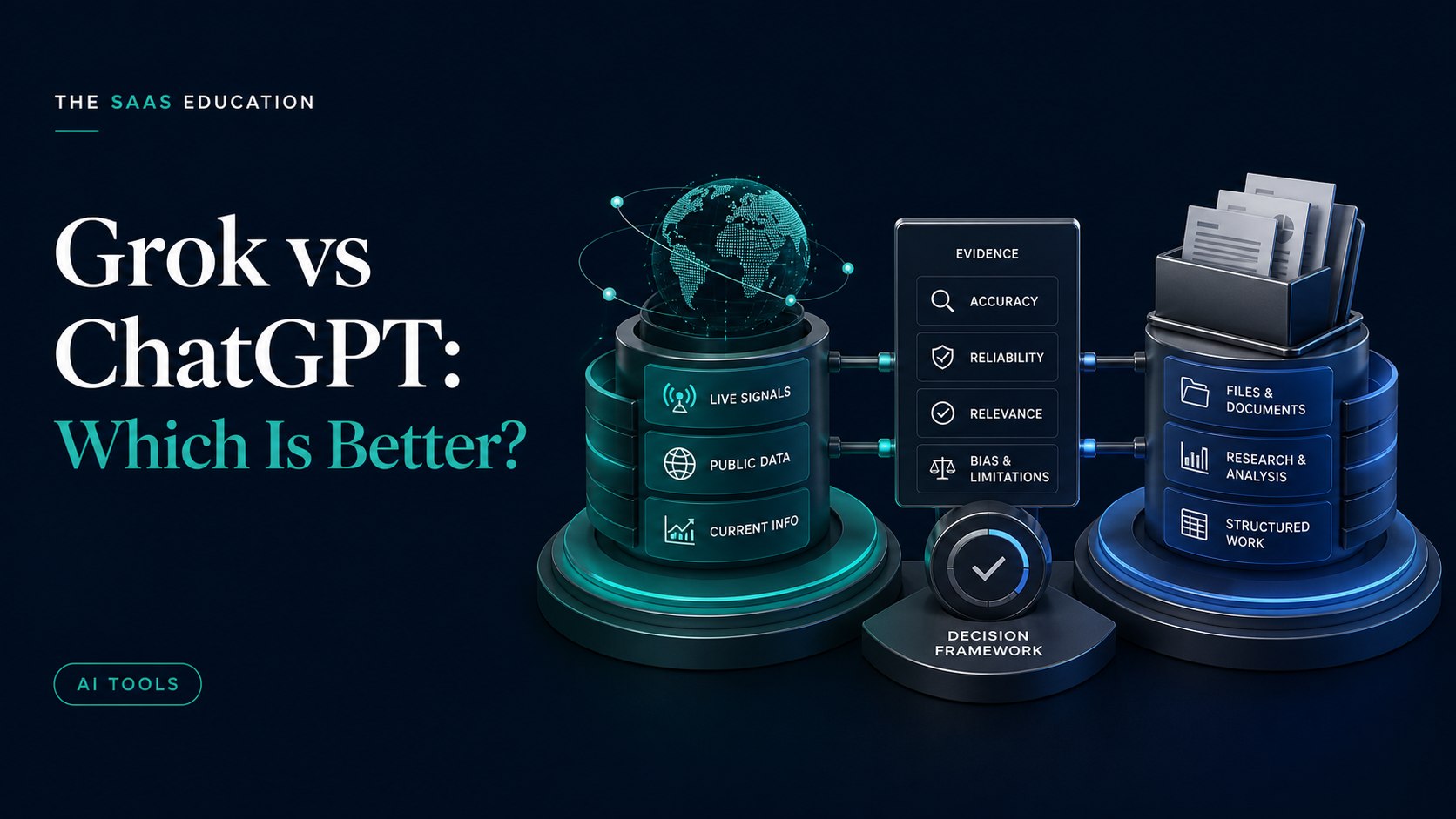
Grok is better when the central requirement is an xAI assistant oriented toward current information, public conversation, search, reasoning, and creation, particularly for people already close to X. ChatGPT is better when the buyer needs a broader general-purpose work platform spanning research, files, data analysis, projects, apps, custom assistants, images, voice, coding, and mature business administration.
That does not make either product universally more accurate. xAI and OpenAI change models and capabilities frequently, and an answer can look confident while containing an outdated fact, weak source, or unsupported inference. A serious comparison therefore measures each product on the same real tasks, sources, and review rules instead of choosing from a memorable demonstration.
For individual exploration, interface preference and current plan limits may decide the result. For a company, the larger issue is operational fit: identity, provisioning, roles, data use, retention, connectors, auditability, support, regional requirements, and the cost of corrected work. This guide separates those questions so a buyer can choose an approved workflow rather than a fashionable brand.
Grok vs ChatGPT at a glance
| Decision area | Grok | ChatGPT |
|---|---|---|
| Best starting point | Current-information and X-adjacent exploration | Broad general-purpose knowledge work |
| Research | Search and current-information orientation | Search, deep research, files, projects, and apps, plan dependent |
| Creation | Text, Imagine, and voice are documented on current product pages | Text, images, voice, canvas, files, and other tools, plan dependent |
| Business workspace | Grok Business and Enterprise | ChatGPT Business and Enterprise |
| Administration | Team and enterprise controls vary by offering | Centralized workspace controls vary by plan |
| Data decision | Distinguish Grok on X, consumer Grok, Business, Enterprise, and API | Distinguish consumer ChatGPT, Business, Enterprise, Edu, Healthcare, and API |
| Buying risk | Assuming X settings represent every xAI service | Assuming consumer behavior represents business products |
| Evaluation method | Same prompts, dated sources, correction log | Same prompts, dated sources, correction log |
The table describes product orientation, not a quality score. Buyers should verify current packaging because a named feature can move between plans, acquire separate usage limits, or operate differently in a managed workspace.
Retest the shortlist whenever a material model, policy, connector, or pricing change occurs.
How we evaluated the products
This comparison reviewed official xAI, X, and OpenAI product, business, pricing, privacy, security, help, and legal material available on August 30, 2026. It did not run a controlled prompt benchmark and does not claim first-hand testing.
We used seven practical criteria:
- Task coverage: research, writing, reasoning, files, analysis, creation, voice, and coding.
- Evidence handling: whether a team can inspect sources, dates, assumptions, and corrections.
- Workflow fit: where work starts, where context lives, and where the result must go.
- Business administration: identity, provisioning, roles, analytics, billing, and support.
- Data governance: training terms, retention, encryption, residency, connectors, and contractual controls.
- Adoption cost: licences plus review time, correction work, duplicated subscriptions, and enablement.
- Exit readiness: revocation, exports, connector removal, retained records, and workflow portability.
The recommendation is an editorial inference from documented scope. It is not a claim that one underlying model wins every prompt.
1. Grok: best for xAI and current-information-oriented workflows
xAI presents Grok as an assistant for chat, search, reasoning, and creation, available on the web and mobile platforms and also associated with X. Its current business page lists model access, Imagine, voice, workspace capabilities, consolidated billing, team management, and business or enterprise security controls. That combination makes Grok relevant beyond casual social-media use.
The practical appeal is proximity to what is happening now. A communications, market-intelligence, founder, media, or research team may value an assistant designed around current public information and conversation. But proximity is not verification. Fast-moving public posts can be incomplete, manipulated, promotional, satirical, or simply wrong. Every consequential answer still needs the original source, publication time, author context, and independent confirmation.
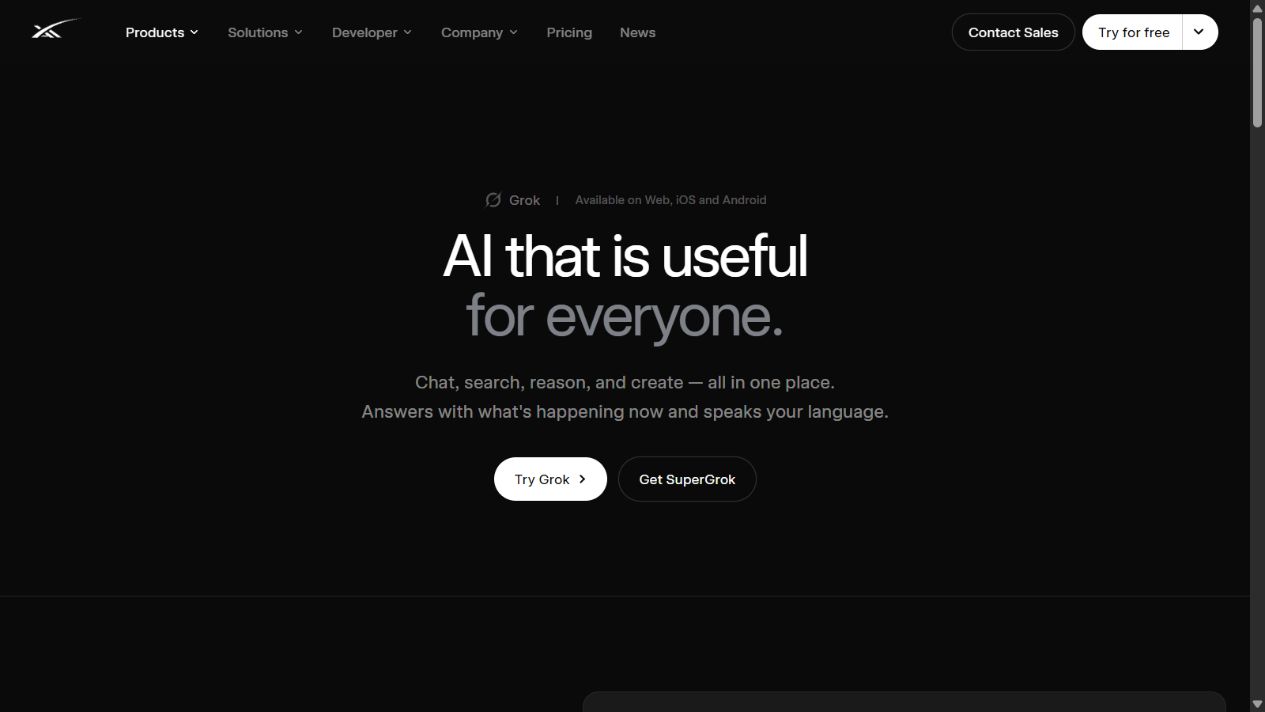
Grok homepage captured from xAI on August 30, 2026. Product wording, models, and availability can change.
Where Grok fits
- Monitoring a current topic and generating questions for deeper research.
- Summarizing public conversation before checking primary evidence.
- Exploring competing interpretations of a developing event.
- Drafting text or creative concepts from a current-information brief.
- Teams that want a managed xAI workspace and can verify its controls.
What buyers must verify
Do not treat “Grok” as one uniform data environment. Grok on X, Grok’s consumer service, Grok Business, Grok Enterprise, and the xAI API can have different settings, terms, retention behavior, administrative controls, and contractual commitments. X’s help documentation describes user controls related to training and personalization for Grok interactions on X. xAI’s business page separately describes no-training and enterprise control commitments for organizational offerings.
For a company, inspect the exact order form and admin tenant. Test SSO, SCIM, domain claims, role-based access, retention, audit and security controls, encryption options, connectors, user analytics, support, and offboarding. A feature listed for Enterprise should not be assumed to exist in a consumer or Business account.
Grok limitations
Current-information access can increase noise as well as speed. A source-rich answer may still omit decisive evidence or overrepresent highly active accounts. Public conversation is not a representative dataset. In addition, xAI’s product packaging and model names can change quickly. Procurement teams need a dated capability register rather than a static checklist copied from a review.
2. ChatGPT: best broad general-purpose work platform
OpenAI presents ChatGPT as a broad assistant across writing, search, deep research, files, data analysis, projects, tasks, apps, voice, images, canvas, custom GPTs, and coding-related work, with availability dependent on plan and current product configuration. That breadth makes ChatGPT the more straightforward default when several departments want one governed starting point.
The benefit is not merely a longer feature list. A researcher may combine web work and uploaded documents; an analyst may inspect a file; a team may organize recurring context in projects; and an organization may connect approved internal sources. Fewer handoffs can reduce friction, although they can also concentrate risk if permissions, data quality, and review rules are weak.
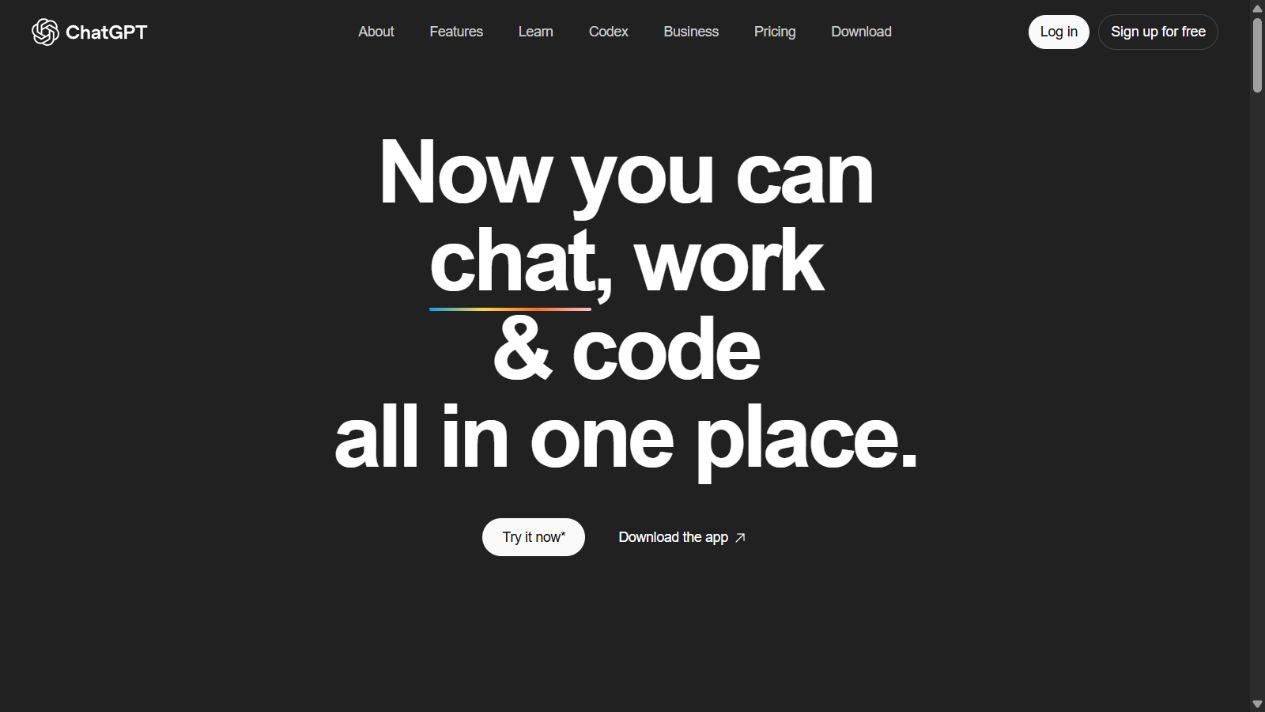
ChatGPT homepage captured from OpenAI on August 15, 2026. The interface and available tools can change.
Where ChatGPT fits
- Multi-step research involving web sources and supplied files.
- Drafting, rewriting, analysis, ideation, and structured outputs.
- Teams that need projects, connected applications, or reusable assistants.
- Cross-functional rollouts requiring a managed workspace.
- Organizations that want published Business or Enterprise privacy and administration commitments.
What buyers must verify
OpenAI distinguishes consumer and organizational services. Its business-data material states that Business and Enterprise inputs and outputs are not used to train models by default and documents encryption, retention, residency, access, and other plan-dependent controls. A consumer subscription should not be used as evidence that an enterprise requirement is satisfied.
Map the exact Business or Enterprise plan to SAML SSO, SCIM, role controls, domain verification, analytics, retention, data residency, connectors, support, legal terms, and billing. Test whether connected sources preserve underlying permissions. Confirm what happens when a file is deleted, an employee changes roles, a connector is disabled, or a workspace is terminated.
ChatGPT limitations
Breadth can make governance harder. Teams may begin with editing and gradually add files, connectors, custom assistants, agents, or coding workflows without a fresh risk review. Different tools can also carry separate limits or usage economics. A company needs feature-level approvals and cost monitoring, not a one-time approval for the ChatGPT brand.
Research and source quality
For research, the winner is the product that produces the highest percentage of reviewable, source-supported answers for the organization’s actual questions. “Has web access” is not a sufficient requirement.
Build a test set containing stable facts, fast-changing facts, ambiguous questions, disputed claims, niche domain questions, and prompts with intentionally misleading premises. Record whether each answer:
- identifies the relevant date and jurisdiction;
- links the original or most authoritative source;
- distinguishes fact from inference;
- acknowledges missing evidence;
- quotes or summarizes the source accurately;
- corrects itself when shown contradictory evidence; and
- avoids inventing a citation, statistic, product feature, or policy.
Grok’s current-information orientation may be useful for discovery. ChatGPT’s documented research, file, and connected-workspace scope may be useful for assembling evidence across sources. Neither advantage removes the need for a human evidence check. For legal, medical, financial, security, employment, or public claims, use qualified review and the original record.
Writing, analysis, images, and voice
Both products cover more than question answering. xAI lists creation, Imagine, and voice in current Grok materials. OpenAI lists writing, image, voice, canvas, data analysis, files, and other tools across ChatGPT plans. The meaningful comparison is the completed workflow.
For writing, test a fixed brief with required facts, banned claims, house style, target reader, and source pack. Measure factual corrections, structural edits, tone fixes, citation repairs, and time to approval. For analysis, use a known dataset with pre-calculated answers and check formulas, exclusions, units, and reproducibility. For images, assess prompt adherence, text rendering, brand safety, editing, provenance requirements, and commercial policy. For voice, assess transcription quality, interruption handling, accessibility, recording consent, retention, and whether a transcript becomes a governed record.
Do not add all outputs into one subjective score. A product can be strong at ideation and weak at source discipline. Keep task-level measures so the purchasing decision remains explainable.
Business security, privacy, and administration
Both vendors publish organizational offerings, but buyers must compare the exact plan rather than brand-level promises.
xAI’s business material lists Business and Enterprise capabilities including team or seat management, billing, no training, role controls, domain verification, analytics, retention, connectors, SSO, SCIM, advanced access controls, encryption options, a dedicated data plane, and support. Some items are enterprise-specific.
OpenAI’s Business and Enterprise material documents managed workspaces, administration, identity, data-use commitments, encryption, retention, connectors, analytics, residency, support, and other plan-dependent controls. Enterprise commercial terms are sales-led.
Create a control matrix with evidence for:
- Contracting entity, service, plan, and region.
- Training and product-improvement defaults.
- Retention, deletion, legal hold, and export.
- Encryption in transit, at rest, and customer-managed options.
- SSO, SCIM, MFA, domains, roles, and privileged administration.
- Connector permissions and service accounts.
- Audit events, analytics, alerts, and incident response.
- Subprocessors, residency, processing location, and transfers.
- Support, service levels, security notices, and legal commitments.
- Offboarding, revocation, deletion verification, and exit assistance.
Then test the controls. Create users with different permissions, connect a limited source, change a role, remove a file, suspend an account, and inspect what remains searchable. Documentation is necessary; tenant behavior is the acceptance test.
Pricing and total cost
Do not compare only the visible monthly seat price. Grok publishes Business pricing and directs Enterprise buyers to sales. ChatGPT publishes consumer and Business options while Enterprise uses custom commercial arrangements. Packaging, included usage, models, credits, add-ons, regions, support, and taxes can change.
Calculate annual cost as:
licences + usage charges + integrations + security review + implementation + training + output review + correction work + duplicate tools + migration + exit
A cheaper seat can cost more if employees spend additional time verifying weak sources or transferring work between systems. A broad platform can also waste money when most users need only one narrow workflow. Run cost per approved outcome, not cost per generated message.
Which product should you choose?
Choose Grok when current public information, X-adjacent discovery, and xAI’s chat, search, reasoning, voice, or creation environment are central to the approved workflow. It is especially worth testing for teams that monitor developing topics and already understand how to validate noisy public sources.
Choose ChatGPT when the organization needs a broad assistant across research, files, analysis, projects, apps, custom workflows, images, voice, and coding, supported by a mature Business or Enterprise workspace. It is the stronger default for a cross-functional rollout, subject to plan and tenant verification.
Choose both only when the use cases are genuinely different. For example, a small research group might use Grok for current public-signal discovery while a wider workforce uses ChatGPT for governed knowledge work. Document separate owners, data classes, success metrics, and renewal gates.
Choose neither yet when the organization lacks clean permissions, approved data rules, a review process, or measurable tasks. Governance debt does not disappear when a vendor offers an enterprise plan.
A practical four-week pilot
Week 1: define the decision
Select 20–30 representative tasks, approved source packs, expected outputs, reviewers, prohibited data, and pass thresholds. Configure the exact plans being considered. Record model and feature settings.
Week 2: controlled comparison
Give both products the same prompts and inputs. Measure completion, factual corrections, citation repairs, source quality, editing time, latency, accessibility, and failure modes. Preserve evidence for consequential outputs.
Week 3: workflow and administration
Test real handoffs, files, connectors, permissions, user provisioning, role changes, analytics, retention, incident handling, and revocation. Do not connect sensitive repositories before access controls are clean.
Week 4: economics and approval
Calculate cost per approved outcome by role. Review unresolved risks and duplicated software. Approve only the workflows that clear quality, security, accessibility, and cost gates. Set a review date because model and plan changes can invalidate the result.
Common comparison mistakes
Comparing different plans
A free Grok surface and ChatGPT Enterprise are not peers. Record the exact service, plan, model, region, and settings for every result.
Treating current information as verified information
Recency improves discovery, not truth. Trace claims to the original record and preserve the date.
Using one impressive prompt
A polished answer reveals little about repeatability. Use a diverse fixed task set and score corrected outcomes.
Ignoring the data boundary
Consumer settings, X settings, business workspaces, enterprise contracts, and APIs are distinct. Evaluate the surface employees will actually use.
Counting features instead of completed work
More tools do not guarantee a better workflow. Measure review effort, handoffs, adoption, and approved output.
Forgetting exit cost
Test exports, revocation, connector removal, record retention, and workflow portability before expanding seats.
Final recommendation
Grok is the better specialist choice for current-information and X-adjacent exploration. ChatGPT is the better general-purpose choice for broad individual and organizational knowledge work.
The final decision should come from a dated, plan-matched pilot. Compare the same tasks, verify sources, test tenant controls, calculate corrected outcomes, and approve workflows rather than brands. That process will remain useful even as xAI and OpenAI change models, interfaces, limits, and pricing.
Sources
Frequently asked questions
Is Grok better than ChatGPT?
Grok is the stronger fit when a buyer prioritizes xAI's assistant, current-information workflows, and X-related context. ChatGPT is the stronger general-purpose work platform when files, projects, deep research, data analysis, apps, custom assistants, coding, and established business administration matter. The result depends on the exact plan and task set.
Is Grok or ChatGPT better for research?
Both publish research and search capabilities, but buyers should test source quality, citation traceability, date accuracy, and correction effort with the same questions. Grok may appeal to teams that value current public conversation, while ChatGPT documents a broader set of research, file, and connected-workspace workflows.
Can Grok create images?
xAI's current product and business pages list Imagine among Grok capabilities. Availability, limits, eligible plans, and usage rules should be checked in the current account before purchase. Image quality was not benchmarked for this comparison.
Which is better for business teams?
ChatGPT is the safer default for a broad business rollout because OpenAI documents dedicated Business and Enterprise workspaces, administration, identity, privacy, connectors, and support. Grok Business and Enterprise also publish team, billing, security, retention, SSO, SCIM, and enterprise controls; evaluate their exact availability and contract against your requirements.
Does Grok use conversations for training?
The answer depends on the product surface and plan. X publishes controls for whether Grok interactions on X can be used for training or personalization, while xAI's business page states no training for business offerings. Review the exact consumer, X, Business, Enterprise, or API terms and settings rather than generalizing across them.
Does ChatGPT use business data for training?
OpenAI states that data from ChatGPT Business and Enterprise is not used for model training by default. Consumer settings and services can differ. Confirm the selected plan, contract, retention configuration, connectors, and regional requirements before entering confidential information.
Should a company pay for both Grok and ChatGPT?
Only if role-based tests prove distinct value. Buying both for overlapping chat, research, writing, image, and analysis tasks can duplicate cost and governance. Define separate approved workflows, measure corrected outcomes, and remove the product that does not clear the agreed threshold.