Hugging Face vs ChatGPT: Which Is Better?
Compare Hugging Face and ChatGPT for model discovery, datasets, AI apps, deployment, research, files, team use, governance, and total cost.
Direct answer
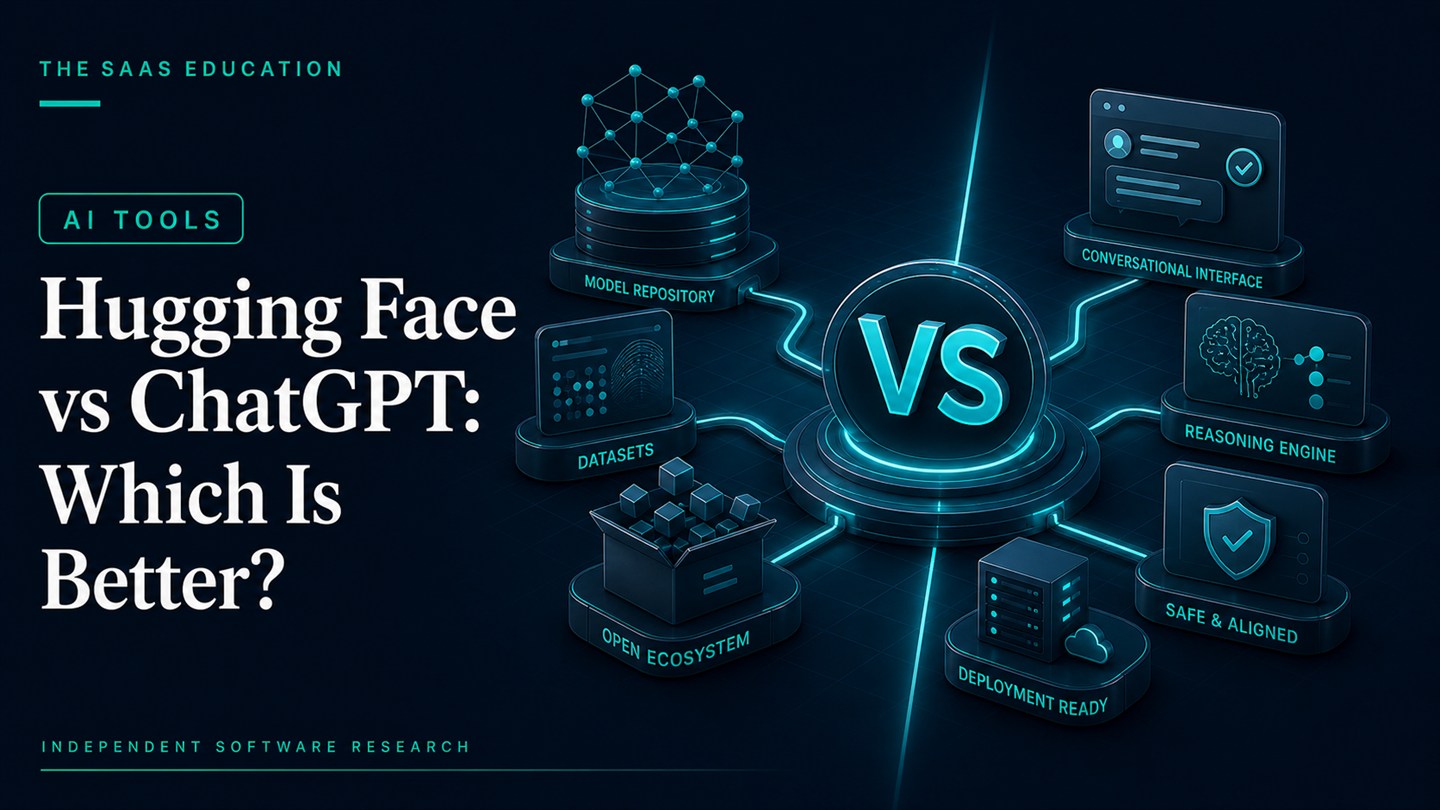
Hugging Face is better when the job is to discover, evaluate, share, fine-tune, or deploy models, datasets, and AI applications with meaningful control over the technical stack. ChatGPT is better when people need a managed general-purpose assistant for research, writing, files, analysis, images, voice, coding, projects, and connected work without assembling model infrastructure.
The products overlap because both can expose conversational AI and support developers. Their centers of gravity are different. Hugging Face is an open machine-learning platform and ecosystem. Its Hub organizes models, datasets, Spaces, repositories, cards, discussions, APIs, libraries, inference providers, and deployment options. ChatGPT is a finished assistant workspace. OpenAI selects and operates the core experience, then packages models and tools into plans for individual and organizational use.
The practical question is therefore not “Which chatbot gives the better answer?” It is “Are we selecting and operating AI components, or are we adopting a managed AI workspace?” A product team can use Hugging Face to build a specialized application and still give employees ChatGPT for general work. A small company may need only ChatGPT. A research team may need Hugging Face even if it never deploys an internal chat assistant.
This comparison uses official sources checked on August 30, 2026. It does not claim hands-on testing or rank undisclosed models. Quality varies by model, provider, prompt, retrieval, tools, data, hardware, region, and evaluation method.
Hugging Face vs ChatGPT at a glance
| Decision area | Hugging Face | ChatGPT |
|---|---|---|
| Best starting point | Model, dataset, and AI application discovery or development | Managed general-purpose AI assistance |
| Primary audience | ML engineers, researchers, developers, data teams, and AI platform teams | Individuals, knowledge workers, developers, teams, and enterprises |
| Model choice | Broad catalog of open and third-party models | OpenAI-managed model selection within current plans |
| Datasets | Dataset repositories, cards, viewers, and libraries | File and connected-data workflows; not a dataset hub replacement |
| Application hosting | Spaces and related hardware options | GPTs, projects, apps, and managed assistant workflows |
| Inference | Providers, APIs, dedicated endpoints, and local-compatible clients | Managed ChatGPT experience; API is a separate OpenAI product |
| Control | Greater component and deployment choice, with greater responsibility | Lower infrastructure burden, with less model-stack control |
| Main governance risk | Model and dataset licensing, provenance, security, supply chain, and operations | Broad data access, plan boundaries, connected apps, output accuracy, and workspace controls |
| Cost model | Subscriptions, storage, providers, endpoints, compute, hardware, and operations | Plan seats, included limits, credits or usage, apps, and enterprise terms |
How we evaluated the products
We reviewed official Hugging Face Hub, inference, endpoint, pricing, security, and enterprise material alongside official OpenAI ChatGPT, pricing, business, privacy, and help material. We assessed eight areas:
- Discovery: finding models, datasets, applications, documentation, and evidence.
- End-user work: research, writing, files, analysis, images, voice, coding, and collaboration.
- Development: APIs, libraries, repositories, versioning, evaluation, integration, and customization.
- Deployment: providers, endpoints, regions, hardware, scaling, monitoring, and operations.
- Governance: identity, permissions, private resources, audit, data controls, security, and retention.
- Risk: licensing, provenance, malicious artifacts, prompt injection, data leakage, model behavior, and external actions.
- Administration: users, organizations, workspaces, billing, support, policies, and change management.
- Economics: subscriptions, seats, storage, compute, inference, engineering, review, support, and exit.
The recommendations are editorial inferences from verified product orientation. A specific model comparison requires a separate benchmark with representative tasks and an explicit scoring method.
1. Hugging Face: best for open-model discovery and AI product building
Hugging Face describes the Hub as a platform for open machine learning. Its official documentation covers model repositories, model cards, datasets, dataset cards, Spaces, collections, discussions, APIs, webhooks, private organizations, security controls, inference providers, and dedicated Inference Endpoints. The wider ecosystem includes libraries used to download, train, evaluate, and run models across text, vision, audio, and multimodal tasks.
This breadth makes Hugging Face useful before, during, and after model selection. A team can discover candidate models, inspect documentation and licences, review files and community activity, test an application, reproduce code, store private artifacts, invoke hosted inference, or deploy a dedicated endpoint. The platform does not remove the need for engineering judgment. It makes more of the machine-learning supply chain visible and configurable.

Hugging Face homepage captured August 30, 2026. Catalog counts, models, interfaces, providers, and services can change.
Where Hugging Face fits
- Discovering models for language, vision, audio, embeddings, generation, classification, or specialist tasks.
- Reviewing model cards, dataset cards, licences, files, discussions, and evaluation information.
- Sharing public or private model, dataset, and Space repositories with version history.
- Building prototypes and demonstrations in Spaces.
- Calling supported models through inference providers.
- Deploying selected models through dedicated managed endpoints or connecting compatible local servers.
- Creating an internal AI platform with approved models, reusable components, and deployment patterns.
Hugging Face strengths
The primary strength is choice. A team can compare architectures, sizes, licences, languages, tasks, providers, and deployment patterns rather than accepting one managed model family. Repositories and cards create an auditable unit around an artifact, even though the quality of that documentation varies. The same model can potentially run through a provider, a dedicated endpoint, a private cloud design, or local infrastructure when compatibility and licence permit.
Hugging Face also supports a builder workflow. APIs, Python and JavaScript clients, libraries, repositories, webhooks, discussions, and organization controls can connect model work to software delivery. That is fundamentally different from using a finished assistant.
Hugging Face limitations
Choice transfers responsibility to the buyer. “Available on the Hub” does not mean secure, accurate, maintained, legally suitable, production-ready, or approved for a particular use. Model and dataset cards can be incomplete. Licences can differ between code, weights, datasets, and derived outputs. Repository files may require malware, serialization, dependency, and supply-chain controls.
Model quality is also task-specific. Download counts, likes, leaderboards, or impressive demos are not substitutes for evaluation. Teams must design representative test sets, define acceptable errors, inspect subgroup performance, evaluate safety and privacy, and repeat testing when weights, prompts, retrieval, providers, quantization, hardware, or dependencies change.
What buyers must verify
Confirm the exact organization plan, private repository needs, storage, access controls, SSO, audit, network controls, support, region, endpoint hardware, autoscaling, provider routing, tokens, rate limits, logs, and data handling. For every model and dataset, record source, licence, revision, hash, owner, approval, intended use, prohibited use, evaluation, dependencies, vulnerabilities, and retirement plan.
Sources: Hugging Face Hub documentation , Hub API , inference guide , and Inference Endpoints .
2. ChatGPT: best for a managed general-purpose AI workspace
OpenAI presents ChatGPT as a general assistant spanning writing, brainstorming, search, research, files, analysis, images, voice, projects, apps, GPTs, and coding capabilities that vary by plan. Business and Enterprise offerings add organizational administration and business-data commitments. The user begins with a working interface rather than choosing model weights, inference hardware, or a deployment framework.
That managed experience is ChatGPT’s central advantage. An organization can focus on user access, acceptable use, connected data, training, review, and workflow design instead of model serving. Employees encounter a comparatively consistent interface for many task types. The tradeoff is that the organization has less control over the underlying model stack and must track changing plan entitlements, models, features, limits, and app capabilities.
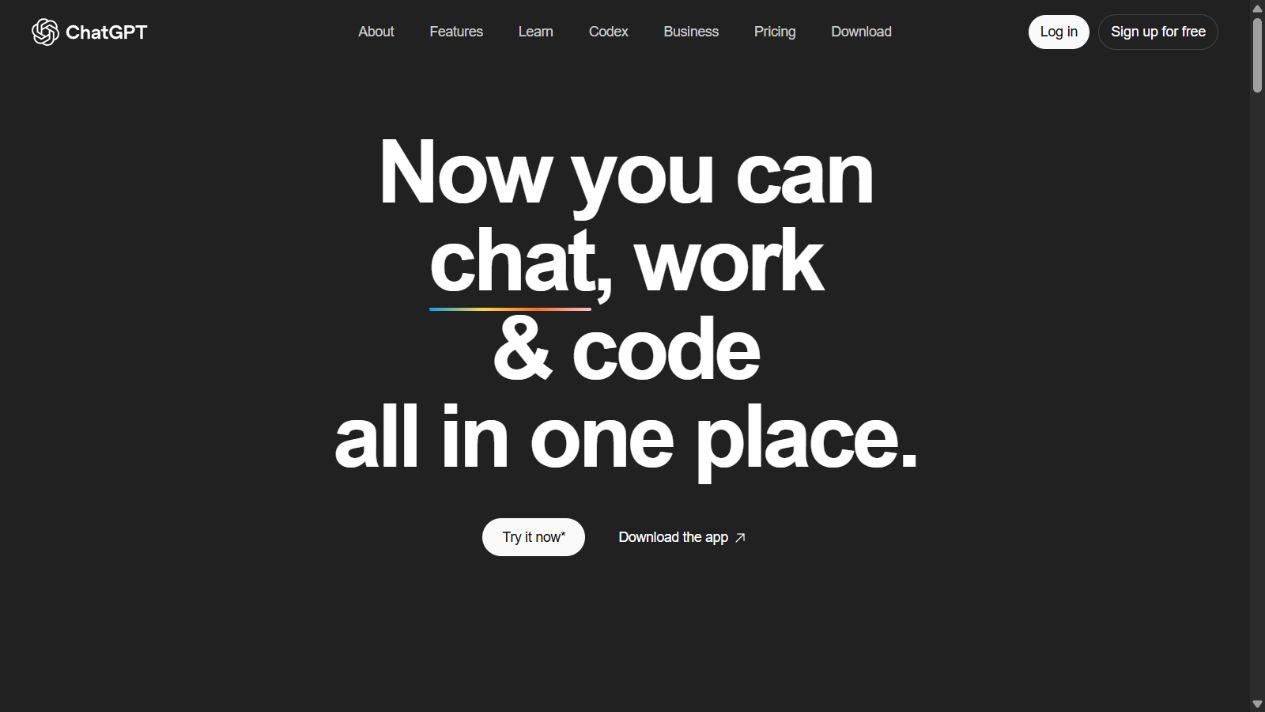
ChatGPT homepage captured August 15, 2026. Models, tools, plans, and interfaces can change.
Where ChatGPT fits
- Researching topics from approved public and connected sources.
- Drafting, rewriting, summarizing, translating, and structuring content.
- Analyzing documents, spreadsheets, images, and other supported files.
- Brainstorming, planning, learning, and creating reusable project context.
- Supporting coding, debugging, technical explanation, and related work.
- Giving non-ML specialists a common AI workspace.
- Connecting approved business tools and knowledge under workspace controls where supported.
ChatGPT strengths
ChatGPT reduces setup. A user does not need to select a base model, provision an accelerator, package an inference server, design a chat interface, or monitor an endpoint. The same workspace can move between prose, research, files, analysis, images, and code. That breadth often matters more to a general business team than the ability to choose between hundreds of model checkpoints.
Organizational plans also create a clearer adoption unit: workspace, users, policies, apps, administration, billing, and support. Buyers still need governance, but the operating burden is different from building and maintaining an internal model platform.
ChatGPT limitations
ChatGPT is not a model repository, dataset catalog, ML experiment tracker, or neutral deployment layer. It does not replace model cards, dataset cards, repository revisions, open-weight evaluation, custom endpoint sizing, or the ability to run a chosen model in a buyer-controlled environment. The OpenAI API is separate from a ChatGPT subscription, so a successful employee workspace does not automatically define an application architecture.
The platform’s breadth also increases governance scope. Users can upload files, connect apps, search external sources, create reusable configurations, and use new features as plans evolve. Administrators must decide which data and actions are allowed, how permissions are preserved, what review is required, and how feature changes are assessed.
What buyers must verify
Separate Free, paid individual, Business, Enterprise, and API use. Confirm models, limits, credits, apps, actions, projects, GPTs, retention, residency, identity, provisioning, role controls, support, audit, and data commitments for the chosen workspace. Test connected apps with least privilege and verify whether source permissions and citations remain visible enough for the task.
Sources: ChatGPT overview, ChatGPT pricing , OpenAI for business , and enterprise privacy .
Model choice and evaluation
Hugging Face provides a wider model-selection surface. That is valuable when the buyer needs a particular language, modality, licence, parameter size, architecture, latency profile, hardware target, or deployment pattern. It is not inherently better for accuracy. More candidates create more evaluation work and more ways to select poorly.
ChatGPT provides a managed selection of OpenAI models and tools. Users may choose among available modes or models, but they do not manage the complete inference stack. This can produce faster organizational adoption because the platform owner absorbs infrastructure decisions. It can be restrictive when a product requires open weights, a specialist community model, offline operation, custom hardware, or a particular deployment boundary.
For either product, build an evaluation set from real tasks. Record expected answer, acceptable variation, prohibited behavior, latency, cost, reviewer score, sources, and subgroup or language coverage. Freeze versions during comparison. A benchmark is invalid when one candidate receives retrieval, tools, or optimized prompts that the other does not.
Data, licensing, and security
Hugging Face requires artifact-level governance. Review model and dataset licences separately. Check whether commercial use, redistribution, derivatives, attribution, or field restrictions apply. Inspect repository files, dependency installation, remote code, serialization, and external downloads. Pin revisions and hashes. Private hosting does not cure an incompatible licence or undocumented training data.
ChatGPT requires workspace and workflow governance. Decide which information users may enter, which apps may connect, which actions may run, and which outputs need verification. Underlying permissions should be preserved when connected data is retrieved. Sensitive or regulated workflows may need a constrained workspace, disabled features, shorter retention, or a different technical design.
Both products require prompt-injection controls when external content can influence tools or actions. Treat retrieved documents and web pages as untrusted data. Separate instructions from evidence, restrict tools, validate action parameters, require confirmation for consequential changes, and log results for review.
Deployment and operations
Hugging Face offers several routes: inference providers, dedicated Inference Endpoints, Spaces hardware, and clients that can connect to compatible local endpoints. Each route has different custody, scaling, provider, hardware, network, observability, and cost implications. Production teams need capacity planning, health checks, rollback, incident response, patching, evaluation, and model lifecycle management.
ChatGPT is operated as a service. The buyer manages adoption and configuration rather than inference clusters. That lowers infrastructure burden but does not eliminate operational work. Workspace administrators must manage users, groups, apps, policies, support, feature rollout, training, incidents, and vendor change. Application developers using OpenAI APIs must evaluate that API architecture separately.
Pricing and total cost
Do not compare a ChatGPT seat with the price of a single Hugging Face subscription. They purchase different things.
For Hugging Face, model:
- individual, team, and enterprise subscriptions;
- private repositories, storage, egress, and collaboration;
- inference provider usage and provider-specific pricing;
- endpoint instance, accelerator, region, scaling, idle, and uptime choices;
- Spaces hardware and persistent storage;
- engineering, MLOps, security, evaluation, monitoring, and support;
- model migration, dependency maintenance, and incident response.
For ChatGPT, model:
- individual or workspace seats;
- included model and tool limits;
- credits or usage for selected features;
- apps, connectors, data, and administration;
- Enterprise terms, support, retention, and residency;
- training, change management, review, and workflow controls;
- separate API cost when building applications.
The cheaper option depends on the job. ChatGPT will usually be cheaper than building a model platform for broad employee assistance. Hugging Face can be economically attractive when a product needs a selected model, controlled deployment, high-volume specialist inference, or reusable internal ML infrastructure. Poor engineering or low utilization can reverse that advantage.
Which should you choose?
Choose Hugging Face when
- The organization is building an AI product, model platform, research workflow, or specialist application.
- Model and dataset discovery, licences, revisions, and reproducibility matter.
- Teams need open or third-party model choice.
- Dedicated endpoints, provider choice, local compatibility, or infrastructure control are requirements.
- ML engineering, evaluation, security, and operations have accountable owners.
Choose ChatGPT when
- The organization wants a managed assistant for broad knowledge work.
- Most users are not ML engineers.
- Research, writing, files, analysis, images, voice, and coding need one interface.
- Fast adoption matters more than choosing model weights or hosting.
- Workspace administration and business controls meet the risk requirements.
Use both when
Use ChatGPT as an approved employee workspace and Hugging Face as a governed builder platform when the responsibilities are distinct. Do not let experimentation bypass enterprise controls. Define approved organizations, repositories, models, datasets, providers, endpoints, ChatGPT workspaces, apps, data classes, and reviewers. Maintain separate inventories for employee tools and production AI systems.
A practical pilot
- Select ten representative employee tasks and ten representative product or ML tasks.
- Define quality, evidence, latency, cost, security, licensing, and operational criteria.
- Configure a governed ChatGPT workspace for the employee tasks.
- Select a small Hugging Face model and dataset candidate pool using documented criteria.
- Pin revisions and record licences, provenance, dependencies, and evaluation results.
- Test provider and dedicated-endpoint options where deployment matters.
- Run privacy, prompt-injection, access, failure, export, and deletion scenarios.
- Calculate three-year cost including people and operations.
- Choose one, both, or neither based on separate workload evidence.
Final recommendation
Choose Hugging Face when you need to build with models, datasets, AI applications, inference providers, or dedicated deployments and have the engineering discipline to govern them. Choose ChatGPT when you need a managed general-purpose AI workspace that people can use across research, writing, files, analysis, images, voice, and coding.
The products are not natural substitutes. Hugging Face gives builders a broad component and deployment surface. ChatGPT gives users a finished assistant experience. The best architecture may include both, but only when ownership, data boundaries, evaluation, licensing, security, and cost are explicit.
Frequently asked questions
Is Hugging Face better than ChatGPT?
Hugging Face is better for model, dataset, application, and deployment work. ChatGPT is better for managed general-purpose assistance. A specific answer requires defining whether the buyer is building AI infrastructure or using an assistant.
Can Hugging Face replace ChatGPT?
It can support chat applications and model inference, but replacement requires model selection, interface development, retrieval, evaluation, security, infrastructure, and user support. It is not a direct subscription replacement.
Can ChatGPT replace Hugging Face?
No for model repositories, datasets, open-model experimentation, Spaces, or controlled deployments. Yes for some end-user tasks that do not require those capabilities.
Which is better for developers?
Hugging Face is stronger for developers building AI systems or selecting models. ChatGPT is stronger as a managed coding, research, and problem-solving assistant. Many developers use both for different jobs.
Which is better for business users?
ChatGPT is generally easier for broad business adoption. Hugging Face is more suitable when ML engineering teams need model, data, licensing, hosting, or deployment control.
Is Hugging Face free?
Public resources and free entry points exist, but private collaboration, storage, providers, endpoints, compute, Spaces hardware, support, and enterprise controls can cost money. Infrastructure and engineering are part of total cost.
Should a company use Hugging Face and ChatGPT together?
Yes, when ChatGPT serves governed employee work and Hugging Face serves governed AI development. Keep separate inventories, data rules, access, evaluation, licensing, security, and owners.
Frequently asked questions
Is Hugging Face better than ChatGPT?
Hugging Face is better for discovering, evaluating, sharing, fine-tuning, and deploying open or third-party models, datasets, and AI applications. ChatGPT is better for people who want a managed general-purpose assistant for research, writing, files, analysis, images, voice, coding, and connected work without building the model-serving stack.
Can Hugging Face replace ChatGPT?
Hugging Face can provide chat interfaces, inference providers, endpoints, Spaces, and access to many models, but replacing ChatGPT requires selecting models, building interfaces, managing prompts and retrieval, evaluating quality, securing data, operating infrastructure, and supporting users. It is a platform choice, not a direct account swap.
Can ChatGPT replace Hugging Face?
ChatGPT can cover many end-user knowledge tasks, but it does not replace Hugging Face Hub's model and dataset repositories, model cards, Spaces, collaborative ML workflows, open-model experimentation, or dedicated deployment choices. Teams building AI products may use both.
Which is better for developers?
Hugging Face is stronger when developers need model choice, repositories, datasets, libraries, open-source workflows, providers, or dedicated inference endpoints. ChatGPT is stronger as a managed coding and research assistant. The best choice depends on whether the developer is building AI infrastructure or using AI to build something else.
Which is better for business users?
ChatGPT is usually the easier starting point for broad business users because it provides a managed workspace and consistent assistant experience. Hugging Face is more appropriate when an organization has ML engineering capacity and requires model, hosting, deployment, licensing, or architecture control.
Is Hugging Face free?
Hugging Face provides public resources and free entry points, while paid subscriptions, storage, private collaboration, inference providers, endpoints, compute, Spaces hardware, and enterprise capabilities can add cost. Review the current pricing and the cost of the selected infrastructure and provider.
Should a company use Hugging Face and ChatGPT together?
Yes, when the workflows are distinct. ChatGPT can support managed employee knowledge work, while Hugging Face supports model research, experimentation, product development, and controlled deployment. Define data boundaries, approved models, licensing, evaluation, security, and ownership before using both.