Ideogram vs ChatGPT: Which Is Better?
Compare Ideogram and ChatGPT for AI images, typography, style references, editing, research, team use, privacy, pricing, and creative workflows.
Direct answer
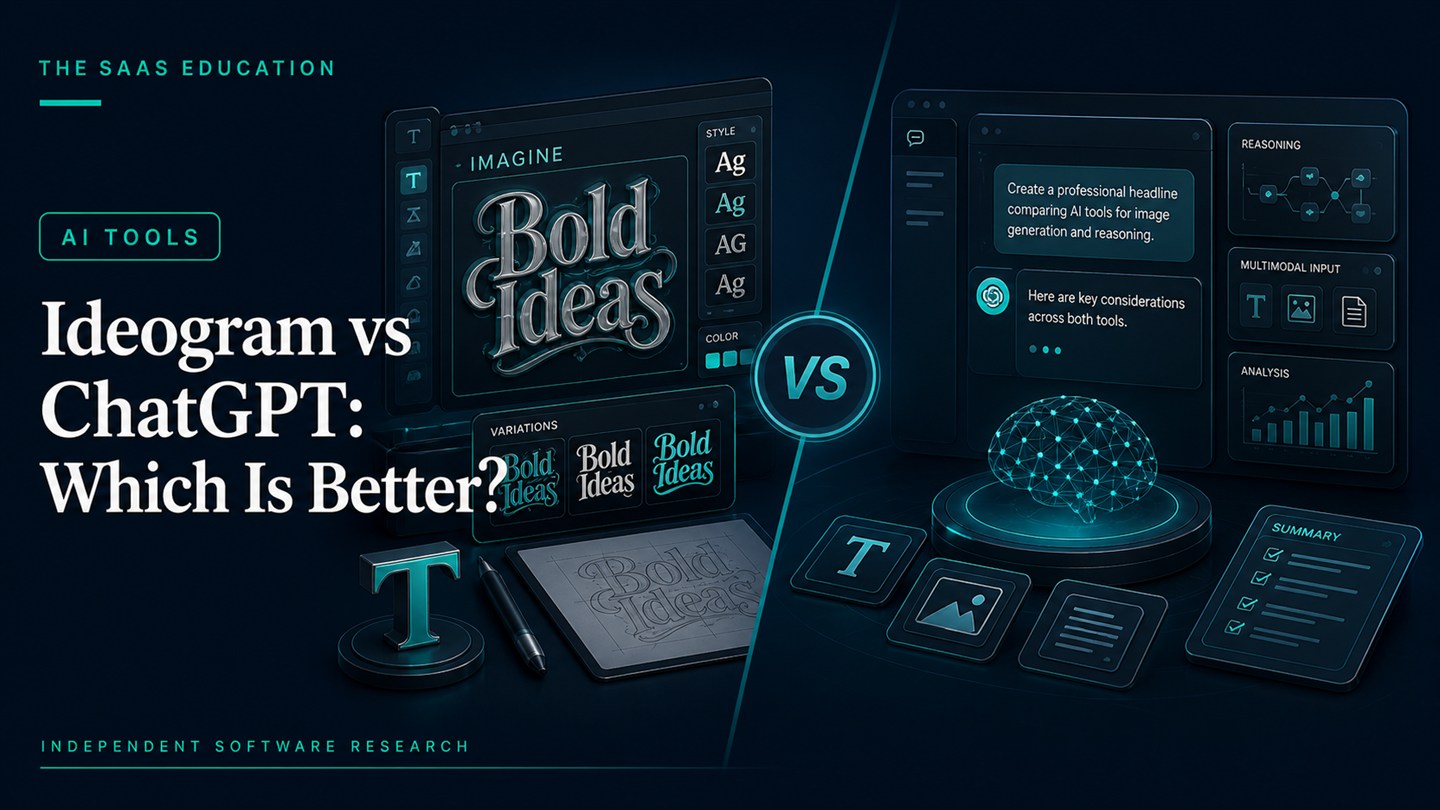
Ideogram is better when the primary job is producing and refining AI images with typography, style references, character references, Canvas editing, batch workflows, and image-specific production controls. ChatGPT is better when image creation is one part of a broader workflow involving research, writing, files, data analysis, coding, projects, apps, and conversational iteration.
Both products can generate and edit images from natural-language instructions. They differ in product center. Ideogram is a specialist generative-media environment. Its official documentation highlights typography, photorealism, logos, posters, Character Reference, Style Reference, Canvas, Magic Fill, Extend, Remix, batch generation, background control, aspect ratios, private generation, and API access. ChatGPT Images sits inside a general assistant that can reason about a brief, research context, draft copy, work with files, and continue the conversation around the image.
The correct choice is not established by one impressive output. Image systems vary by prompt, model, reference, aspect ratio, rendering mode, editing method, safety rules, and randomness. A buyer should create a representative prompt set, score outputs blind where practical, measure usable assets per generation, and record editing time, brand compliance, text accuracy, identity consistency, provenance, and total cost.
This comparison uses official sources checked on August 31, 2026. It does not claim hands-on image testing or a universal quality winner.
Ideogram vs ChatGPT at a glance
| Decision area | Ideogram | ChatGPT |
|---|---|---|
| Best starting point | Dedicated AI image design and production | Broad assistant workflows that include images |
| Core strength | Typography, references, Canvas, image controls, and production-oriented plans | Conversational planning, research, copy, files, analysis, and image creation in one workspace |
| Typography | Explicit specialist positioning for text in images | Officially supports adding text; verify spelling and layout |
| References | Style and Character Reference workflows | Image upload and conversational reference-based creation or editing |
| Editing | Canvas, Magic Fill, Extend, Remix, background control | Prompt-based image editing in conversation |
| Batch work | CSV-driven batch generation on eligible plans | General conversational generation; plan and workspace limits apply |
| Team option | Team plan with central billing and collaboration positioning | Business and Enterprise workspaces with broader administration and security controls |
| API | Ideogram API documented separately | OpenAI API is separate from ChatGPT subscriptions |
| Pricing unit | Plans and image-generation credits | ChatGPT plan allowances, limits, or workspace credits; API billed separately |
| Main risk | Public generation defaults, reference rights, misleading visuals, text errors, and credit economics | Broad data and app access, misleading visuals, text errors, plan complexity, and workspace governance |
How we evaluated the products
We reviewed official Ideogram documentation, feature pages, plans, licensing, FAQ, privacy, and terms alongside official OpenAI ChatGPT Images, pricing, Business, privacy, security, and system-card material. We assessed nine questions:
- Generation: prompt following, styles, aspect ratios, rendering choices, and output workflow.
- Typography: legibility, spelling, layout, logos, posters, and design text.
- Consistency: character, style, product, composition, and reference-image control.
- Editing: inpainting, outpainting, remixing, background control, transparency, and iteration.
- Production: queues, credits, batch generation, download formats, privacy, API, and asset organization.
- Context: research, copy, files, conversation, reusable instructions, and connected workflows.
- Governance: ownership, rights, consent, likeness, safety, data treatment, administration, and audit.
- Economics: subscriptions, credits, retries, review, editing, external design tools, and API use.
- Operational fit: roles, brand process, approval, storage, provenance, accessibility, and change management.
Feature availability does not prove quality. Recommendations below are best-fit inferences from documented product orientation. Teams should test the exact model, plan, and interface they intend to buy.
1. Ideogram: best for dedicated AI image design
Ideogram describes itself as an AI image platform and emphasizes text rendering, photorealism, logos, posters, visual design, Character Reference, Style Reference, and Canvas. Its documentation covers Magic Prompt, Remix, Magic Fill, Extend, background control, multiple aspect ratios, image upload, private generation, batch generation, API access, rendering modes, negative prompts, and seeds depending on plan and model.
This focus creates a recognizable creative workflow. A user can begin with a prompt, choose style and aspect ratio, generate variants, use references, move into Canvas, replace or extend areas, and download the selected asset. Paid tiers add production controls such as private generation, image upload, larger queues, more credits, and eligible batch features.
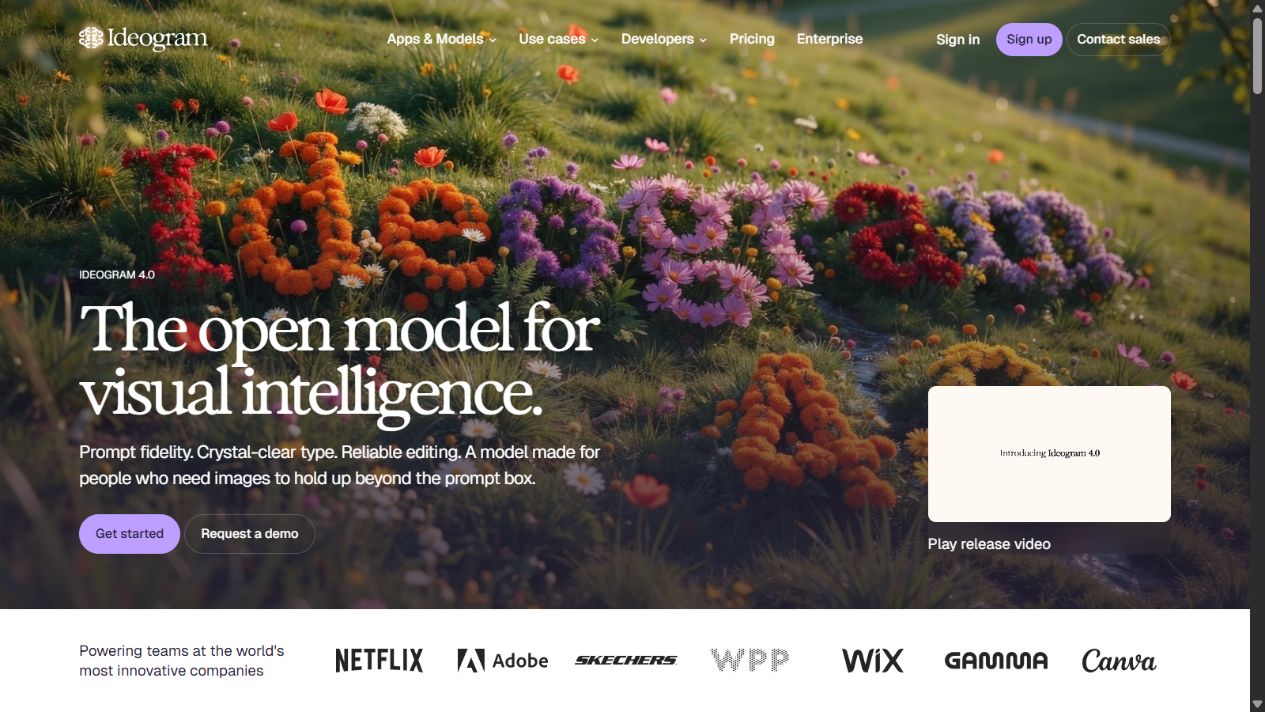
Ideogram homepage captured August 31, 2026. Models, plans, credits, features, interfaces, and licensing can change.
Where Ideogram fits
- Creating posters, social graphics, concept art, logos, merchandise concepts, and marketing visuals.
- Testing image prompts where visible typography is important.
- Reusing a style or character reference across related assets.
- Editing a composition with Canvas, Magic Fill, Extend, or Remix.
- Generating many prompts through eligible batch tools.
- Building image generation into an application through the Ideogram API.
- Supporting creative teams that need image-specific queues, credits, and privacy options.
Ideogram strengths
Specialization is the clearest advantage. The interface and plan structure are built around image generation rather than a general chat subscription. Typography is not an incidental capability; Ideogram explicitly presents it as a reason to use the platform. That makes it a logical finalist for brand graphics, posters, covers, ads, product concepts, and other assets where words are part of the composition.
Reference controls also provide explicit production levers. Style Reference is intended to carry visual characteristics, while Character Reference focuses on identity consistency from an uploaded image. These workflows can be easier to teach and govern than repeatedly describing a style or person in text. They do not guarantee perfect fidelity, and they do not grant rights to use a reference.
Canvas creates a path beyond first-generation selection. Inpainting, outpainting, remixing, background changes, and region-level edits can reduce the need to regenerate an entire scene. Batch generation can support teams with structured prompt inventories, provided they control review volume and do not confuse quantity with useful output.
Ideogram limitations
Ideogram is not positioned as a complete knowledge-work platform. It can support visual generation, but it does not replace the broader research, file analysis, data analysis, coding, project, voice, and connected-work capabilities documented for ChatGPT. A creative team may therefore need additional tools for briefs, copy, evidence, planning, and collaboration.
The credit model requires operational measurement. Different models and rendering settings consume different credits, while retries, references, edits, batch runs, and discarded variants affect effective cost. “Up to” image counts are theoretical maxima based on specified settings, not a prediction of approved assets.
Privacy defaults matter. Ideogram documentation distinguishes private generation on eligible paid plans. Buyers should verify whether prompts, uploads, generated images, profiles, and gallery activity are public or private under the exact plan and settings. Never upload confidential assets, unreleased products, personal likenesses, client materials, or protected brand files until permissions and terms are approved.
What buyers must verify
Confirm the current model, credit cost, priority and slow queues, concurrent generations, privacy, deletion, image upload, reference limits, download formats, batch limits, API pricing, rate limits, storage, licensing, data use, support, and team controls. Test text-heavy designs for spelling and hierarchy, and test references across poses, lighting, groups, angles, clothing, and edits.
Sources: Ideogram documentation , plans and pricing , Character Reference , and licensing .
2. ChatGPT: best for images inside a broader work conversation
OpenAI documents ChatGPT Images as a way to create and edit images through conversation. Users can request an image, upload an existing image, describe changes, add details or text, and request transparent backgrounds. Image availability and advanced modes vary by tier. The same ChatGPT environment also supports research, writing, files, analysis, images, voice, projects, apps, and coding according to the current plan.
The advantage is context around the asset. A marketer can research an audience, build a campaign brief, draft copy, explore concepts, generate an image, revise it, and prepare channel variations in one conversation or project. A product team can analyze source material before creating a diagram or mockup. This is different from a dedicated image-production interface even when the resulting images compete for the same use.
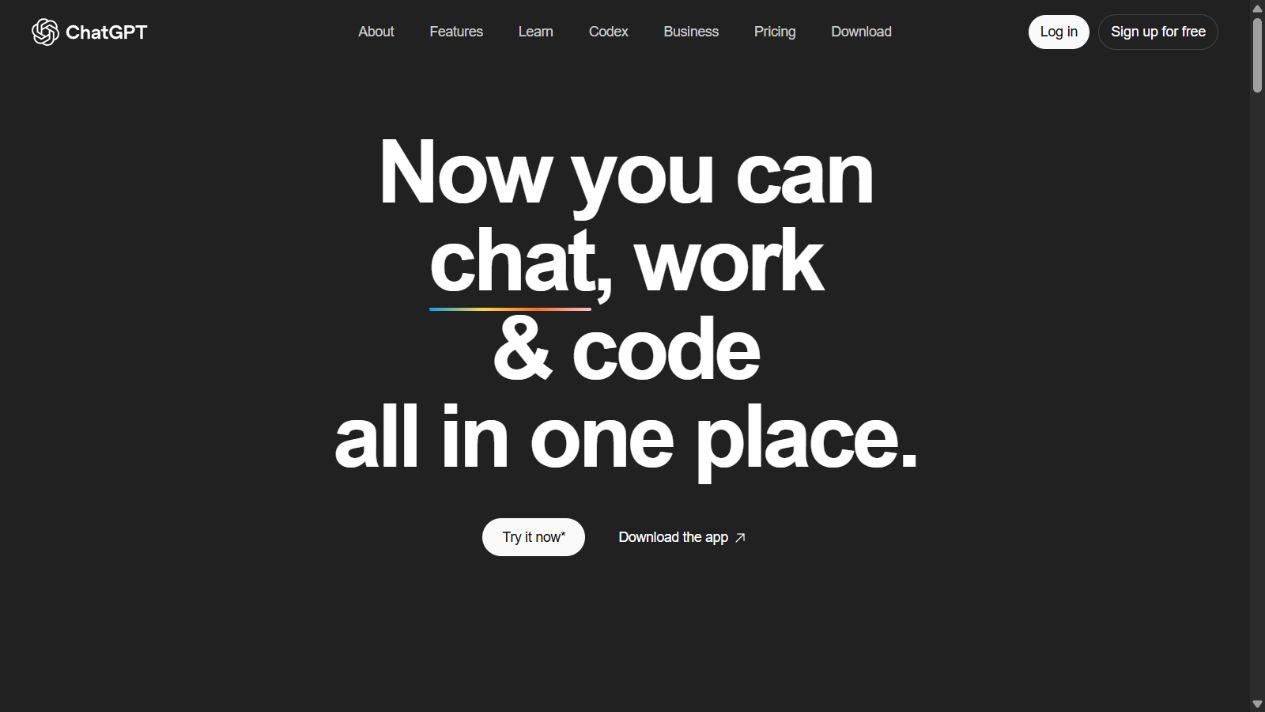
ChatGPT homepage captured August 15, 2026. Models, image tools, plans, limits, prices, and interfaces can change.
Where ChatGPT fits
- Turning research, documents, data, or a conversational brief into visual concepts.
- Drafting copy and developing the visual direction in the same workspace.
- Creating or editing images through natural-language iteration.
- Requesting transparent backgrounds or text as part of an image instruction.
- Supporting non-specialists who already use ChatGPT for broader work.
- Organizing creative context in projects or reusable configurations.
- Providing a managed organizational workspace under Business or Enterprise controls.
ChatGPT strengths
ChatGPT reduces tool switching when the image is one deliverable inside a wider job. The user can ask questions, compare approaches, inspect files, refine the brief, and create the asset without treating every step as a separate application. Conversation history can preserve intent across iterations.
The platform is also easier to justify when many roles need AI assistance but only some generate images. A Business or Enterprise workspace can cover multiple task types under a common administration layer. OpenAI publishes business-data commitments and security information for specified organizational offerings. Buyers still need to verify current entitlements and configure features appropriately.
ChatGPT’s conversational model can help users articulate changes in ordinary language. Instead of learning a dedicated Canvas control, a user may describe what should remain and what should change. This can be accessible, but precision must be tested. An edit can alter details that the user expected to preserve.
ChatGPT limitations
ChatGPT does not expose the same specialist image-production structure described by Ideogram. Ideogram’s explicit rendering modes, credits, references, Canvas tools, batch workflow, and image-focused plan surface may be better for a team producing high volumes or requiring repeatable visual controls.
Broad workspaces also create broader governance. Users can combine uploaded files, connected sources, research, code, and image creation. Administrators must define acceptable data, app permissions, retention, sharing, external actions, and review. Consumer and business data terms differ, so account type cannot be ignored.
Plan economics can be harder to isolate. Image generation may be included within plan limits, governed by credits, or billed separately through an API or flexible arrangement. A ChatGPT subscription does not include OpenAI API usage. Verify the purchasing unit before comparing cost with Ideogram credits.
What buyers must verify
Confirm current image models, editing, reference behavior, transparency, text handling, resolution, aspect ratios, limits, credits, workspace availability, retention, sharing, admin controls, and API separation. Test whether conversational edits preserve identity, layout, product details, typography, and brand rules. Record model and verification date because capabilities change.
Sources: Images in ChatGPT , ChatGPT pricing , ChatGPT Business FAQ , and business data privacy .
Typography, posters, and brand graphics
Ideogram is the natural first test when accurate-looking words are central to the image. Its documentation explicitly highlights typography, logos, posters, and design layouts. That does not remove review. Generated words can contain spelling errors, incorrect punctuation, malformed letterforms, weak hierarchy, or invented claims. A logo can resemble a protected mark. A poster can fail contrast or legibility requirements.
ChatGPT Images also documents adding text. Its broader conversation can help develop the headline, supporting copy, audience, and visual concept before generation. The practical comparison should use a fixed set of assets: a poster with a headline and date, a product ad with a short claim, a book cover, a social tile, and a simple logo concept. Score exact character accuracy, hierarchy, alignment, brand fit, and editing time.
For production, keep final text editable outside the generated raster whenever possible. Generate the visual base, then typeset critical copy in a controlled design tool. This improves accessibility, localization, corrections, and brand consistency.
Character and style consistency
Ideogram offers distinct Style Reference and Character Reference concepts. The separation is useful: a style reference should influence look and composition, while a character reference aims to preserve identity. Buyers should test both independently and together. One attractive example does not establish consistency across a campaign.
ChatGPT can accept uploaded images and conversational edit instructions. This may be sufficient for occasional reference-based work, especially when the user wants to discuss the scene and revise it iteratively. Test whether important features remain stable when changing pose, age presentation, clothing, background, camera angle, lighting, crop, and surrounding characters.
Any use of a real person’s likeness requires consent, lawful purpose, and appropriate review. Do not infer that technical capability grants permission. Sensitive, political, sexual, deceptive, or high-stakes depictions require stricter controls and may be prohibited by vendor policy or law.
Editing and iteration
Ideogram Canvas gives users explicit spatial tools for generating, filling, extending, and remixing. This can suit designers who want to work on a visual surface. Seeds, negative prompts, rendering choices, references, and aspect ratios add further controls depending on plan and model.
ChatGPT uses conversation as the primary control surface. A user can describe the edit and continue refining. This lowers the learning barrier but can make region-level intent less explicit. The best approach depends on whether the team prefers direct visual controls or language-led iteration.
Test destructive and preservation-sensitive edits: change the background without changing the product, remove one object, extend a scene, replace text, preserve a face, isolate a subject, and create transparent output. Record how often unrelated details change and how many attempts reach approval.
Team workflow, privacy, and governance
Ideogram’s current pricing material lists a Team plan with central billing and early collaboration access, while private generation is available on eligible paid plans. Enterprise is contact-based. Buyers should request current information about identity, roles, workspace separation, asset sharing, retention, model training, security evidence, support, API governance, and contractual commitments.
ChatGPT Business provides a shared workspace, administration, billing, and documented business-data treatment. OpenAI says it does not train on organization data from Business and Enterprise by default. Enterprise adds further controls. These statements apply to defined offerings, not every personal account.
For either platform, maintain an asset record with prompt, model, date, references, source rights, editor, reviewer, changes, intended channel, and approval. Review outputs for factual accuracy, trademarks, copyright risk, likeness, harmful stereotypes, deceptive presentation, accessibility, and regulatory claims. AI generation should enter an existing creative approval process, not bypass it.
Pricing and total cost
At the August 31, 2026 check, Ideogram listed Free, Plus, Pro, Team, and Enterprise paths. The public pricing page showed Plus at $20 monthly or $15 per month billed annually, Pro at $60 monthly or $42 annually, and Team at $30 monthly or $20 annually per member with a two-member minimum. Plans include different credits, queues, privacy, references, batch features, and administration. Verify the live page because plan structures and credit costs change.
ChatGPT offers Free and paid individual tiers plus Business and Enterprise. Image access and advanced modes vary by plan, while organizational flexible pricing can use credits. The OpenAI API is a separate purchase. Verify the exact image model, limits, credits, and seat type rather than using an old price table.
Calculate cost per approved asset, not cost per generated image. Include prompts, rejected outputs, editing, typography correction, rights review, brand review, accessibility, storage, integrations, subscriptions, API use, and external design tools. A more expensive specialist can be cheaper when it produces a higher approval rate; a broad platform can be cheaper when it replaces several tools.
Which product should you choose?
Choose Ideogram when
- Image generation is a primary production workflow rather than an occasional assistant feature.
- Typography, posters, logos, merchandise, or text-heavy graphics are central.
- Style and character references need explicit controls.
- Canvas editing, batch generation, private generation, or image-focused queues matter.
- The team will measure credit use and approved-output economics.
Choose ChatGPT when
- Images are one part of research, writing, files, analysis, coding, or project work.
- Users value conversational planning and iteration more than specialist image controls.
- The organization already needs a broad managed AI workspace.
- Creative briefs and source material need to be analyzed before generation.
- Central business administration and broader employee adoption are priorities.
Use both when
Use both when ChatGPT supports research, briefs, copy, and broad knowledge work while Ideogram serves as the specialist visual-production environment. Define handoffs: where approved copy lives, which references may be uploaded, who owns prompts, how assets are named, how provenance is recorded, and where final files are stored.
Avoid uncontrolled duplication. If both products generate the same asset types for the same users, measure approval rate and cost, then standardize the primary path. Exceptions should be documented rather than becoming personal preference without governance.
A practical image benchmark
Create 20 to 30 tasks representing real work. Include:
- A poster with exact headline and date.
- A product scene that must preserve design details.
- A consistent character across five contexts.
- A style-controlled campaign series.
- A transparent-background subject.
- Inpainting and object removal.
- Outpainting to a new aspect ratio.
- A data-inspired illustration based on a brief.
- A safety-sensitive prompt that should be handled appropriately.
- A batch of structured campaign variants.
Run comparable settings, save every result, and hide product identity from reviewers where possible. Score prompt adherence, typography, identity, anatomy, composition, brand fit, edit preservation, safety, accessibility, time, retries, and cost. Re-test after major model changes.
Final verdict
Ideogram is the better specialist for teams that need typography, image references, Canvas editing, batch production, and explicit image-generation controls. ChatGPT is the better generalist for people who want to move from research and copy to image creation inside a broader conversational workspace.
Do not treat either answer as an image-quality ranking. Run a prompt benchmark with the actual plan, model, references, and approval process. The winning product is the one that produces more approved, rights-cleared, on-brand assets with less correction and governance friction.
Frequently asked questions
Is Ideogram better than ChatGPT for AI images?
Ideogram is more specialized for image production and explicit creative controls. ChatGPT is broader and can embed image creation in research, writing, files, and analysis. Test quality on your prompts.
Can Ideogram add text to images?
Yes. Typography is a documented Ideogram focus. Inspect every generated word for spelling, punctuation, layout, claims, trademarks, contrast, and readability.
Can ChatGPT edit existing images?
Yes. OpenAI documents uploading images and describing edits, as well as adding text, details, or transparent backgrounds. Current availability and limits vary.
Which is better for consistent characters?
Ideogram provides a dedicated Character Reference workflow. ChatGPT supports reference-based conversational creation and editing. Test identity preservation across difficult scenes before choosing.
Which is better for business teams?
Ideogram Team is oriented toward image workflows; ChatGPT Business is a broader administered AI workspace. Compare collaboration, privacy, security, asset controls, and total workflow scope.
How much does Ideogram cost?
At the check date, Plus was $20 monthly, Pro $60, and Team $30 per member monthly; annual rates were lower, and Enterprise required contact. Verify current credits and prices.
Can a company use both?
Yes. Use clear workflow boundaries, approved references, provenance records, human review, storage rules, and cost measurement to prevent duplication and unmanaged risk.
Sources
Frequently asked questions
Is Ideogram better than ChatGPT for AI images?
Ideogram is the more specialized choice for image generation, typography, posters, logos, style and character references, Canvas editing, batch workflows, and image-focused credits. ChatGPT is the broader choice when image creation is one part of research, writing, files, analysis, coding, and conversational iteration. Image quality must be tested on the buyer's prompts.
Can Ideogram add text to images?
Ideogram explicitly positions typography and text rendering as core strengths. It is suitable for testing posters, logos, social graphics, and layouts containing words. Generated text still requires visual inspection for spelling, punctuation, brand rules, factual claims, trademarks, and accessibility.
Can ChatGPT edit existing images?
Yes. OpenAI documents image creation and editing in ChatGPT, including uploading an image and describing changes, adding details or text, and requesting transparent backgrounds. Availability, models, limits, and editing behavior depend on the current tier and interface.
Which is better for consistent characters?
Ideogram offers a dedicated Character Reference workflow based on one reference image, while ChatGPT supports reference-based conversational image editing and generation. Neither should be selected from marketing examples alone; test identity drift, pose, lighting, clothing, angles, group scenes, and prohibited transformations.
Which is better for business teams?
Ideogram Team is image-production oriented and documents central billing plus collaboration access, while ChatGPT Business offers a broader shared workspace with administration and business-data commitments. Choose based on whether the team needs a specialist visual pipeline or a multi-purpose AI workspace, then verify current security and contractual terms.
How much does Ideogram cost?
At the August 31, 2026 check, Ideogram listed Free, Plus at $20 monthly or $15 per month annually, Pro at $60 monthly or $42 per month annually, Team at $30 monthly or $20 annually per member with a two-member minimum, and Enterprise by contact. Credits, features, taxes, and prices can change.
Can a company use Ideogram and ChatGPT together?
Yes. ChatGPT can support research, briefs, copy, prompt development, and broad knowledge work, while Ideogram can handle specialized visual generation and iteration. Define asset provenance, approved data, human review, licensing checks, brand controls, storage, and the system of record before combining them.