Is Anyword Worth It?
Is Anyword worth it? Evaluate its marketing workflow, predictive scoring, brand controls, pricing fit, limitations, and alternatives before buying.
Direct answer
Anyword is worth considering for a marketing team that produces substantial repeat content and needs reusable brand context, marketing-specific workflows, predictive performance signals, and content intelligence in one specialist platform. It is usually not worth the additional subscription for occasional drafting, broad non-marketing work, or teams that will not run controlled performance tests.
The decision depends less on whether Anyword can generate text and more on whether its specialist workflow removes measurable friction. General AI assistants can already draft ads, emails, landing-page copy, and outlines. Anyword has to justify itself through structure: brand and audience context, campaign formats, prediction, performance data, governance, and a repeatable path from brief to measured result.
This assessment uses official Anyword materials checked on August 23, 2026. It does not claim hands-on testing or guaranteed campaign outcomes.
The short verdict
| Decision factor | Assessment |
|---|---|
| Best fit | Marketing teams producing repeat, performance-oriented copy across several channels |
| Main reason to buy | Specialist marketing workflow with reusable context and predictive decision support |
| Main reason to avoid | Low production volume or an existing general AI workflow already meeting the need |
| Evidence required internally | Editing time, approval time, brand corrections, test results, and incremental subscription cost |
| Verdict | Worth a controlled pilot for the right marketing operation, not an automatic purchase |
What buyers are really paying for
Anyword is not valuable merely because it can generate copy. The more defensible value lies in reducing repeated setup and connecting content production to marketing context.
Official product and documentation pages describe reusable brand voices, target audiences, campaign and content templates, a Predictive Performance Score, content improvement, and performance-data workflows. These features can create a more organized production system than starting every task in an empty chat window.
That distinction matters when several people create content. A shared brand definition can reduce repeated prompting. Audience profiles can make briefs more consistent. Templates can standardize common campaign formats. Prediction and content intelligence can give reviewers another signal when selecting variants.
None of those features removes editorial accountability. Brand context can be incomplete. Predictions can be wrong for a specific market. Generated copy can contain unsupported claims. A team still needs source verification, compliance checks, channel-specific editing, and real performance measurement.
When Anyword is likely worth it
Your team produces high volumes of repeat marketing content
The economics become more credible when the same workflows recur every week: paid-social variants, lifecycle emails, landing-page sections, product messaging, and campaign briefs. A specialist platform can save time when it stores context that would otherwise be rebuilt manually.
Volume alone is not enough. The team should measure whether Anyword reduces the time from brief to approved asset. Count meaningful edits and corrections rather than the number of generated words. More output is not automatically more value.
Brand consistency is an operational problem
Reusable brand and audience context is useful when multiple writers, contractors, or regional teams interpret guidelines differently. Anyword can provide a structured starting point, but someone must own the underlying definitions and update them when positioning changes.
The platform is worth more when governance already exists. If nobody maintains the brand context or reviews output, the tool can spread inconsistent assumptions faster.
You will test predictions against real outcomes
Anyword’s Predictive Performance Score is one of its clearest differentiators. The score should be treated as a hypothesis, not a result. A disciplined team can compare recommended variants with a control and record actual conversion, click, or engagement outcomes.
Buyers should ask what the score represents, which audiences and formats it supports, and how closely those conditions resemble their own channel. The feature has little practical value if the team accepts the highest score without experimentation.
Historical performance data can inform future work
Content Intelligence becomes more relevant when a business has enough clean, comparable performance data to identify patterns. A small team with scattered campaigns and inconsistent tracking may not be ready to benefit from this layer.
Before buying, confirm which data sources can connect, what permissions are required, and whether the team can maintain the integration. A technically available integration is not the same as a reliable measurement process.
When Anyword is probably not worth it
You only need occasional copy assistance
A business producing a few short assets each month may not recover the cost and implementation effort. A general assistant plus a clear brief and editorial checklist may be sufficient.
You need one AI workspace across many departments
Anyword is designed around marketing. Teams seeking broad support for research, coding, internal knowledge, data analysis, and operations should compare it with general AI workspaces. Adding a specialist tool makes sense only when the marketing advantage is material.
You expect the platform to replace testing or expertise
Prediction is not proof. Brand controls are not a substitute for positioning. Generation is not fact-checking. Anyword will disappoint a buyer who expects automatic high-performing copy without reliable inputs, review, and experimentation.
Your existing stack already solves the workflow
Many marketing platforms, writing tools, and general AI products overlap with parts of Anyword’s capability. Map the current workflow before adding software. If brand context, templates, review, and performance analysis already work, the incremental benefit may be small.
Pricing and total-cost questions
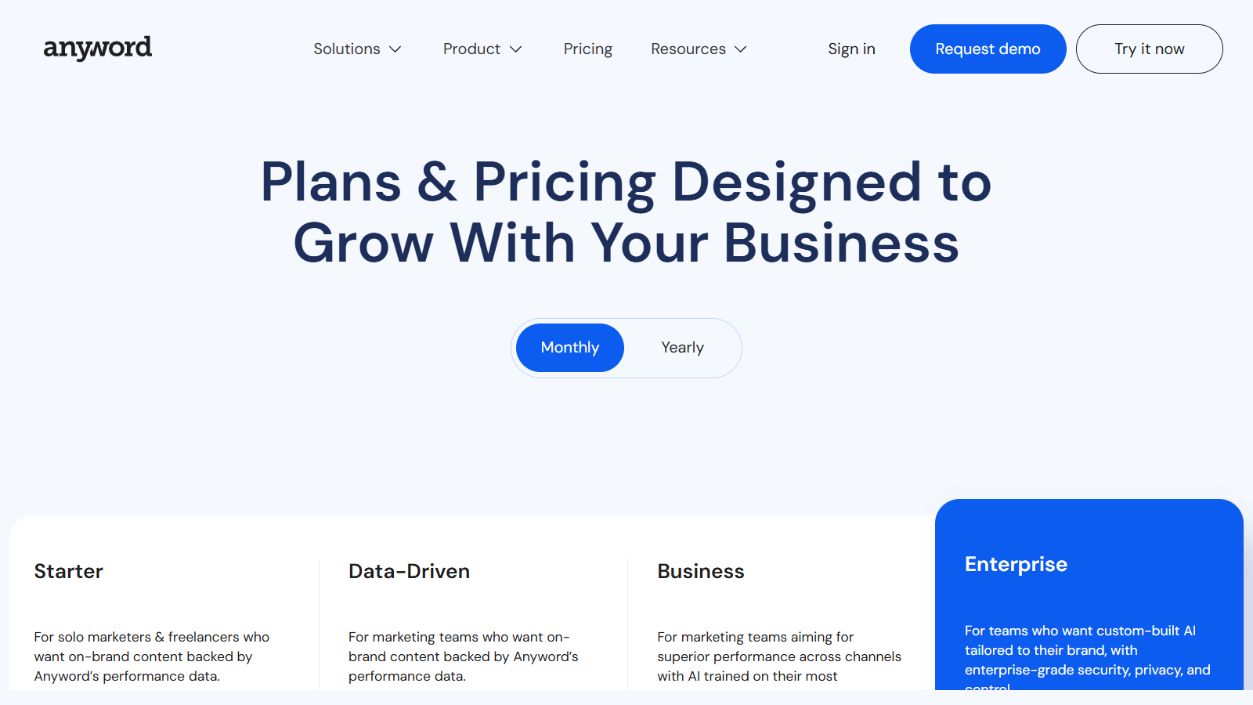
Anyword presents tiered plans with differences in seats, workspaces, brand voices, prediction allowances, and intelligence capabilities. Prices and packaging are volatile and should be verified on the official pricing page immediately before purchase.
The subscription is only part of the cost. Include:
- time to define brand voices and target audiences;
- data-connection and permission work;
- training and workflow documentation;
- additional seats or workspaces;
- editorial and legal review;
- experimentation costs;
- overlap with tools already purchased.
A low headline price can still produce poor value when adoption is weak. A higher plan can be justified when it replaces fragmented work and improves measurable throughput. Buyers should compare annual cost with hours saved and performance improvements actually observed during a pilot.
Do the calculation with conservative assumptions. If a team expects to save ten hours each month, count only time that can realistically be redirected to valuable work. Do not assign a financial benefit to every generated draft. Subtract administration, review, testing, and training time. Then model a low, expected, and high adoption case. This exposes whether the purchase remains sensible when only part of the team uses it. It also gives the owner a measurable threshold for renewal instead of relying on subjective satisfaction.
A practical 30-day pilot
Use one repeatable campaign type rather than testing every feature.
- Choose a baseline workflow. Record current briefing, drafting, editing, approval time, and channel results.
- Configure limited context. Add one brand voice, one audience, and approved source material.
- Create a control. Keep a comparable asset produced through the existing process.
- Generate and review variants. Track factual corrections, brand edits, and rejected outputs.
- Run the channel test. Use a statistically sensible experiment where traffic permits.
- Calculate total effort. Include setup and review time, not only drafting speed.
- Make a role-specific decision. Identify who benefits, who administers the platform, and which work should remain elsewhere.
Success criteria should be defined before the pilot. Useful measures include approval-cycle time, edits per asset, brand-policy exceptions, campaign throughput, and validated channel performance. Avoid using generated quantity as the primary metric.
Implementation and governance requirements
Anyword should enter an existing content process rather than become an ungoverned parallel channel. Assign an owner for brand context, audience definitions, approved claims, templates, and user access. Document which source material writers may use and which subjects require legal, product, or compliance review.
Access should follow job responsibility. Not every user needs control over shared brand settings or performance-data connections. Review the provider’s current privacy, security, retention, and administration material against the organization’s requirements before uploading customer information, unreleased product details, or regulated content.
Create a simple output policy. It should explain that generated claims require source verification, predictions require testing, and a human remains accountable for publication. Record recurring errors during the pilot. If the same factual, tone, or formatting problem appears repeatedly, update the shared context or workflow instead of correcting each output indefinitely.
Implementation is successful when the process becomes more reliable, not merely faster. A five-minute first draft that creates twenty minutes of correction is not necessarily an improvement over a slower but more accurate existing process.
Renewal decision after the pilot
At renewal, compare the documented benefit with the full annual cost. Separate genuine platform value from the temporary excitement of adoption. Ask:
- Did approval time fall after accounting for setup and review?
- Did brand corrections decrease?
- Were predictive recommendations tested, and did they add useful signal?
- Which teams used the product consistently?
- Which paid capabilities remained unused?
- Could the same outcome be achieved with an existing platform?
Renew when the evidence shows a repeatable operational benefit and clear ownership. Downgrade or cancel when usage is sporadic, overlap is substantial, or the team cannot connect the platform to measurable decisions. A specialist marketing tool should earn its place through specialist value.
Anyword compared with the main alternatives
The closest alternative depends on the actual problem.
- A general AI workspace may be better when breadth, flexible reasoning, and cross-functional use matter more than specialist marketing structure.
- A writing assistant may be enough when the main need is editing, grammar, or tone rather than campaign generation and prediction.
- An SEO content platform may fit better when briefs, search visibility, and optimization workflows are the primary job.
- An enterprise content platform may be stronger when approvals, asset management, localization, and governance dominate.
- The existing marketing stack may remain the best option when current templates and performance reporting already work.
Read our Anyword alternatives guide for a fit-based shortlist and Anyword vs ChatGPT comparison for the specialist-versus-general decision.
Buying checklist
Before approving a subscription, confirm:
- the exact plan and billing cadence;
- included seats, workspaces, brand voices, and prediction allowances;
- required data integrations and permissions;
- ownership of brand and audience definitions;
- the review process for facts and regulated claims;
- how predictions will be tested;
- export, retention, privacy, and security requirements;
- which existing subscriptions overlap;
- the success threshold for renewal.
Final recommendation
Anyword is worth it when the buyer has a genuine marketing operations problem: repeat production, inconsistent context, slow approvals, and enough measurable campaign activity to test recommendations. It is not worth buying merely to access another text generator.
The safest decision is a controlled pilot with a baseline, a narrow workflow, and documented success criteria. Treat predictive scores as hypotheses, preserve human accountability, and verify the current plan details before purchase.
Document the decision and the evidence behind it so the same assumptions can be reviewed at renewal.
Frequently asked questions
Is Anyword worth paying for?
It can be worth paying for when structured brand context, repeat campaign workflows, and performance-oriented decision support save measurable time or improve a tested process. Occasional users may not recover the additional cost.
Is Anyword better than ChatGPT?
Anyword is more specialized for marketing context, campaign formats, prediction, and content intelligence. ChatGPT is broader. The better choice depends on whether specialist structure or cross-functional flexibility is the main requirement.
Can Anyword guarantee better conversion rates?
No. Predictions are not guarantees. Teams should compare variants through controlled tests and use their own channel data.
Who should avoid Anyword?
Low-volume teams, buyers without a repeatable review process, and organizations already satisfied with a general assistant may not receive enough incremental value.
Does The SaaS Education test Anyword hands-on?
No. This page uses official sources and does not claim first-hand testing, independent prediction validation, or measured campaign lift.
Sources: Anyword , pricing , support documentation , integrations , and product updates.
Frequently asked questions
Is Anyword worth paying for?
Anyword can be worth paying for when a marketing team produces repeat campaign copy, maintains structured brand context, and can validate predictive recommendations against real channel results. It is harder to justify for occasional drafting.
Is Anyword better than ChatGPT?
Neither product is universally better. Anyword is more specialized around marketing context, campaign formats, prediction, and content intelligence; ChatGPT is a broader general-purpose workspace.
Can Anyword guarantee better conversion rates?
No. Predictive scores and recommendations are decision-support signals, not guarantees. Teams should use controlled tests and their own conversion data.
Who should avoid Anyword?
Low-volume teams, businesses without a repeatable review process, and organizations seeking one assistant for many non-marketing tasks may not receive enough specialist value.
Does The SaaS Education test Anyword hands-on?
No. This assessment is based on official sources checked on August 23, 2026 and does not claim first-hand product testing.