Is Bolt.new Worth It?
Assess whether Bolt.new is worth it for prototypes, internal tools, startup apps, and production work based on capability, cost, risk, and fit.
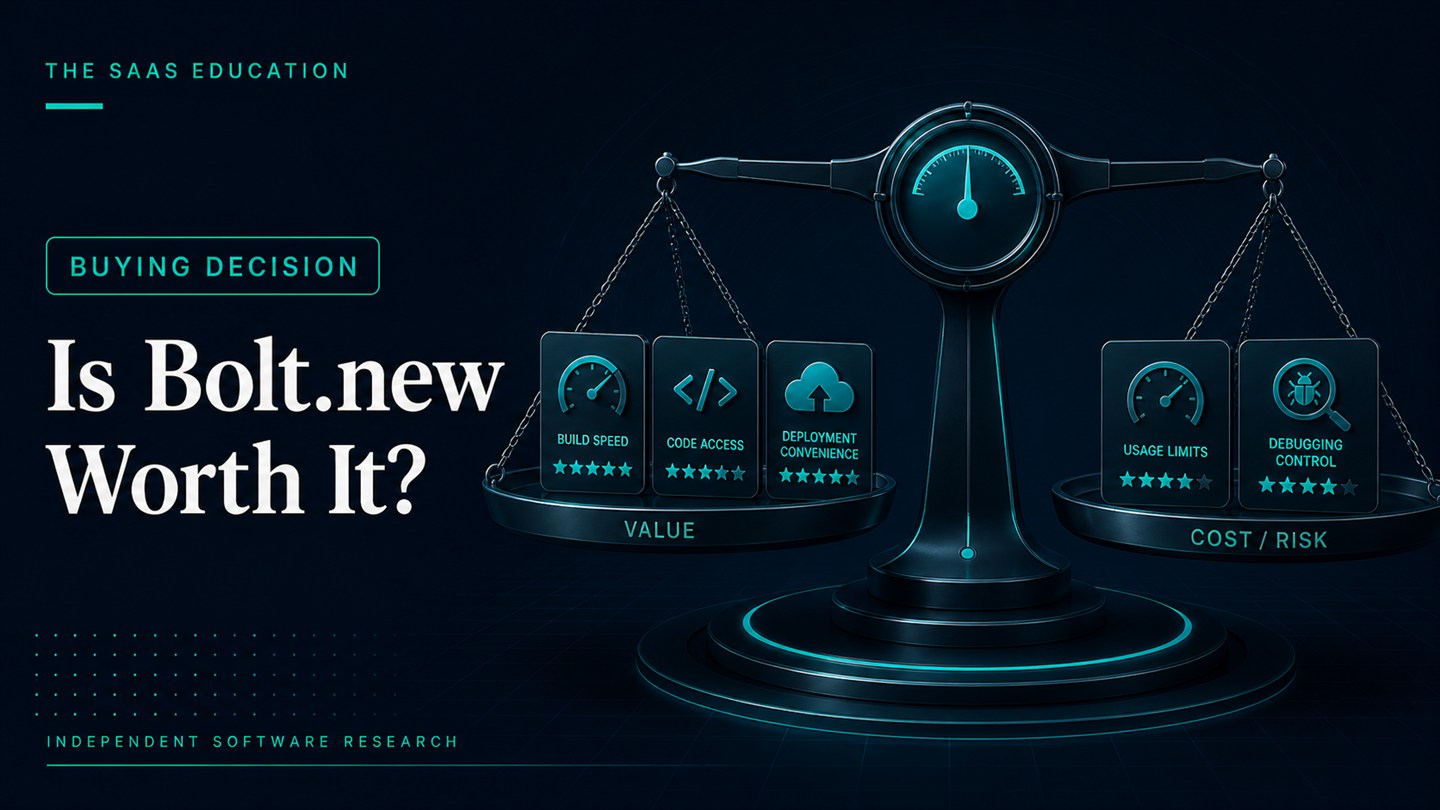
Direct answer
Bolt.new is worth it for rapid web prototypes, contained internal tools, and teams that can review and own generated code. It is not worth treating as an unsupervised shortcut to sensitive, regulated, or business-critical production software. Its value comes from reducing the distance between a written requirement, editable code, a running preview, and deployment. Its risk comes from mistaking that speed for verified security, maintainability, or operational readiness.
The deciding evidence should come from a representative pilot, not a feature list. Measure retained output, token consumption, manual repair, defects, deployment effort, and ongoing ownership. We checked official Bolt sources on August 24, 2026 but did not conduct a hands-on benchmark.
Bolt.new value summary
| Situation | Verdict | Reason |
|---|---|---|
| Founder validating a contained web-app idea | Often worth testing | Fast generation can create useful learning before a larger build |
| Product team prototyping an internal workflow | Often worth testing | A running workflow reveals missing states and requirements |
| Developer accelerating a familiar web pattern | Potentially worth it | Setup and routine implementation may be reduced |
| Non-technical owner launching a sensitive app | Not without expert review | Data, permissions, security, and operations remain unresolved |
| Complex legacy or regulated system | Usually not the primary path | Integration, governance, and reliability demands dominate |
| Team with no maintenance owner | Not worth publishing | Generated software still requires ongoing ownership |
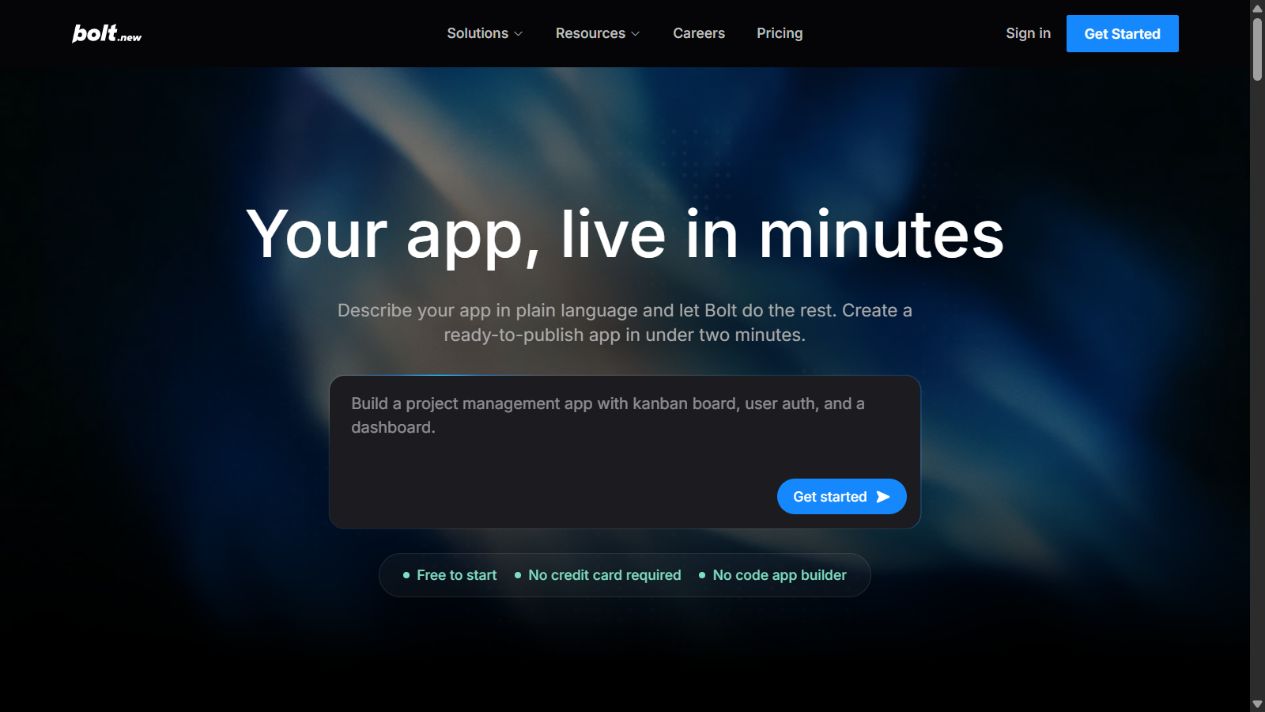
Why Bolt can be worth it
It creates a concrete prototype quickly
Written requirements leave room for different interpretations. A running prototype allows stakeholders to inspect navigation, data entry, states, and interactions. Discovering a missing approval step before conventional development can create real value.
The prototype should answer a decision. Generating screens without a research question produces activity rather than evidence.
It integrates generation, code, preview, and deployment
Bolt reduces the setup between an idea and a visible application. Users do not need to assemble every local tool before the first experiment. The code remains available for inspection and modification.
This integration matters when time-to-learning is the constraint. It matters less when the organization already has an efficient engineering template and strict infrastructure requirements.
It can improve collaboration around requirements
Product, design, operations, and engineering participants can discuss the same working artifact. A prototype can expose edge cases more effectively than a static description.
Collaboration remains productive only when decisions and ownership are documented. The chat history should not become the sole specification or change record.
It can reduce repetitive setup for developers
A developer who recognizes good and bad output can use Bolt to establish familiar application patterns and then take ownership. The ability to inspect and edit code preserves a route to conventional engineering.
The time saved should be measured after review and repair, not at the first preview.
Why Bolt may not be worth it
Generated quality is variable
The result depends on the brief, context, stack, required behavior, and subsequent changes. A polished interface can conceal weak authorization, validation, error handling, dependencies, or architecture.
If the team cannot evaluate those areas, the apparent productivity gain is unreliable.
Usage cost is not fully predictable from the plan fee
AI work consumes tokens, and large projects or repeated regeneration can use allowances faster than expected. Hosting, external APIs, databases, domains, and services can add separate costs.
Manual security review, testing, accessibility work, monitoring, and maintenance also belong in total cost.
Production responsibility does not disappear
Someone must own the repository, data, credentials, deployment, logs, backups, incidents, dependencies, and support. Bolt can accelerate implementation but cannot be accountable for an organization’s live service.
If nobody accepts that role, the project should remain a disposable prototype.
Broad iteration can create regressions
Prompting the agent to make large changes can alter working behavior. The team needs version control, small tasks, acceptance criteria, and regression tests.
Repeated correction without understanding the cause can consume usage while increasing technical debt.
High-risk use cases require stronger controls
Applications involving payments, identity, health, employees, customer records, or critical operations require legal, privacy, security, and domain review. A product capability page does not prove compliance for a specific deployment.
Is Bolt.new worth it for small businesses?
It can be worthwhile when a small business wants to validate a simple internal workflow, campaign tool, directory, calculator, or prototype and has access to a technical reviewer. The business should use synthetic data during discovery and define who will maintain anything that goes live.
It is a poor choice when the owner expects a one-time prompt to replace requirements, security, and support. Small teams have less capacity to absorb an incident, so operational simplicity and data minimization matter more, not less.
Is Bolt.new worth it for startups?
Startups may benefit from faster product discovery and stakeholder demonstrations. A functioning prototype can test whether users understand a workflow before the company invests in a complete architecture.
The risk is allowing a temporary MVP to become permanent infrastructure without review. Before customer use, decide which generated components will be retained, who owns them, and what must be rebuilt or hardened.
Is Bolt.new worth it for developers?
For developers, value depends on whether generated work survives review. Bolt may reduce scaffolding, interface assembly, and initial deployment effort. Developers can also use the running environment to clarify requirements with non-technical stakeholders.
It is less valuable when the output conflicts with the approved stack, creates dependency churn, or requires more correction than a conventional implementation. Measure retained code and defect rate rather than prompts completed.
Is Bolt.new worth it for enterprise teams?
An enterprise can use Bolt for controlled discovery where account ownership, data policy, approved use cases, repositories, and release gates are defined. Team controls and collaboration should be evaluated against existing identity, audit, procurement, and development processes.
It is not automatically suitable for enterprise production because a team plan exists. Security, privacy, contractual, data-location, continuity, and compliance requirements must be assessed against the actual environment and use case.
Calculate total value
Start with the outcome: a decision learned, a workflow validated, or a useful service delivered. Then subtract all relevant costs:
- plan and token usage;
- hosting, domains, databases, and external services;
- specification and prompt preparation;
- code and architecture review;
- security and privacy assessment;
- functional and accessibility testing;
- manual repair and rework;
- deployment, monitoring, backup, and support;
- migration or exit work.
Compare that total with a developer using a conventional stack, another AI coding tool, a no-code platform, an agency, or not building the project. The cheapest subscription does not necessarily create the lowest-cost outcome.
A 10-point pilot gate
Bolt is worth further investment only if a representative pilot can answer yes to these questions:
- Did the project solve the defined user job?
- Were acceptance criteria met beyond the happy path?
- Can a developer understand and maintain the code?
- Are authentication, authorization, and data handling appropriate?
- Did accessibility and mobile checks pass?
- Were token consumption and manual repair acceptable?
- Can the team deploy, monitor, back up, and roll back?
- Are repositories, accounts, domains, and data company-owned?
- Can the application move to another environment if needed?
- Is a named owner accountable for maintenance and incidents?
A critical security, data, or ownership failure should block publication even if the average score looks good.
Measure value by project stage
Discovery value
During discovery, the useful output is not the amount of code. It is the number and importance of assumptions resolved. Track whether the prototype clarified the user flow, exposed a missing state, invalidated an idea, improved stakeholder agreement, or produced a testable requirement.
Bolt can be worth paying for even when the prototype is discarded if it prevents a larger investment in the wrong workflow. Conversely, a visually polished prototype has little discovery value when it confirms only what the team already assumed.
Delivery value
During delivery, measure the percentage of generated work that passes review and remains in the validated revision. Record engineering hours for correction, tests added, defects introduced during changes, and deployment effort.
The relevant comparison is the full time required to reach an approved result through another route. Do not compare Bolt’s first preview with a developer’s production-ready release; those are different milestones.
Operational value
After release, track reliability, incidents, performance, support demand, dependency work, cloud usage, and time needed for routine changes. A tool that accelerates generation but creates fragile operations may have negative lifecycle value.
Record whether another qualified person can understand and change the application. If maintenance depends on the original prompt operator, the project has a concentration risk that should reduce its value assessment.
Monthly renewal scorecard
Use a short scorecard before renewing or upgrading:
| Measure | Healthy signal | Warning signal |
|---|---|---|
| Completed outcomes | Projects reach validated decisions or releases | Many attractive but abandoned prototypes |
| Retained output | Most generated work survives review | Large portions are manually rebuilt |
| Usage efficiency | Tokens support accepted changes | Broad regeneration and repeated corrections dominate |
| Defect trend | Regression rate falls as workflow improves | Each iteration breaks unrelated behavior |
| Ownership | Repositories, data, domains, and deployment have named owners | Assets depend on personal accounts or one operator |
| Operations | Monitoring, backup, rollback, and support are tested | Team cannot diagnose or recover failures |
| Portability | Independent build and export remain viable | Team is unsure how to leave the platform |
Renew when the evidence shows repeatable value, not because the team has unused credits or fears losing project momentum. Downgrade when the workload is occasional, and stop when projects do not reach useful outcomes.
Red flags that should stop a production rollout
Pause the project if any of these remain unresolved:
- authorization is enforced only in the interface;
- secrets appear in source files, prompts, or public configuration;
- live sensitive data was used without approval;
- nobody can explain the generated architecture;
- dependencies or licenses have not been reviewed;
- critical workflows lack tests and reproducible acceptance evidence;
- keyboard, focus, labels, or mobile behavior fail;
- production and test credentials are mixed;
- no logs, backups, incident owner, or rollback procedure exists;
- code, domain, database, or deployment is controlled by a personal account;
- the team cannot export and independently build the project;
- a required legal, privacy, security, or compliance review is incomplete.
These are not minor polish items. They determine whether fast application generation creates acceptable business software or transfers risk into production.
Evidence to retain for the buying decision
Keep the original brief, source revision, test data, acceptance results, code-review notes, security findings, accessibility results, token and service usage, manual hours, deployment record, screenshots, known limitations, and owner approvals. Date every volatile product or pricing fact.
This evidence lets another reviewer challenge the decision and makes future comparisons fair. Without it, “worth it” becomes a subjective reaction to the interface rather than an accountable assessment of outcomes and risk.
When to choose an alternative
Choose Lovable when a guided full-stack web-app workflow and documented GitHub synchronization better fit the team. Consider Replit Agent when a broader cloud development environment is important. Consider v0 for React, Next.js, and Vercel-oriented work. Consider Base44 when an integrated prompt-to-app platform with built-in services is the stronger fit.
Use a conventional engineering workflow when architecture, legacy integration, regulation, reliability, or infrastructure control is the dominant requirement.
Final verdict
Bolt.new is worth testing when rapid, reviewable application generation can create useful learning or reduce familiar implementation work. It is worth buying when a realistic pilot shows that retained output, total cost, risk, and maintenance are better than the alternatives. It is not worth deploying solely because the preview works.
FAQs
Is Bolt.new worth it for non-developers?
It can be worthwhile for contained prototypes. Production use still needs qualified technical review and an accountable owner.
Is Bolt.new worth it for developers?
Yes when it reduces setup and iteration while the developer retains code, test, security, and deployment ownership.
Is it worth it for production apps?
Only after the specific project passes architecture, security, data, accessibility, reliability, operations, and maintenance gates.
What is the biggest cost risk?
Counting only the subscription while ignoring usage, hosting, services, review, repair, testing, and maintenance.
What should I test before paying?
Build one representative workflow and measure retained code, defects, token use, manual repair, deployment, portability, and total ownership effort.
Official sources
Frequently asked questions
Is Bolt.new worth it for non-developers?
It can be worth it for validating a contained prototype, but a non-developer should not publish a sensitive or critical application without qualified technical review.
Is Bolt.new worth it for developers?
It can be valuable when it reduces setup and iteration for familiar web patterns while the developer retains ownership of code, testing, security, and deployment.
Is Bolt.new worth it for production apps?
Only when the specific generated project passes architecture, security, data, accessibility, reliability, deployment, monitoring, and maintenance gates.
What is the biggest cost risk?
The largest risk is evaluating only the subscription while ignoring token use, hosting, external services, manual repair, testing, security, and maintenance.
Did The SaaS Education test Bolt.new?
No. This verdict uses official sources checked on August 24, 2026 and does not claim hands-on testing.