Is ChatGPT Worth It?
Decide whether ChatGPT is worth paying for based on workflow fit, usage limits, accuracy, privacy, administration, and measurable returns.
Direct answer
ChatGPT is worth it for people and teams that use it repeatedly for defined research, writing, analysis, file, planning, coding, image, or voice workflows and can verify the output. It is not worth paying for merely because AI feels useful or because a paid plan offers more features.
Start with free access. Record the tasks where limits, missing tools, slower availability, or fragmented workflows prevent useful completion. Upgrade only when a current paid plan removes those constraints and the benefit exceeds subscription, review, administration, and risk costs.
For businesses, value depends on governance as much as capability. A broad assistant can accelerate work, but it can also spread unsupported claims, expose inappropriate data, duplicate specialist systems, and increase review effort. Approve specific use cases, plan boundaries, and human responsibilities before buying seats widely.
The short verdict by buyer
| Buyer | Likely verdict | Reason |
|---|---|---|
| Occasional personal user | Start free | Light questions and experiments may not justify recurring cost |
| Frequent writer or analyst | Often worth testing | Files, research, iteration, and higher limits may reduce cycle time |
| Developer | Workflow-dependent | Coding value depends on repository context, tools, testing, and current plan |
| Small business | Worth a governed pilot | Broad utility can help several roles, but data and review rules are essential |
| Large organization | Requires formal evaluation | Identity, retention, apps, residency, audit, support, and contracts matter |
| High-stakes professional | Assistant, not authority | Medical, legal, financial, safety, and regulated work require qualified review |
What ChatGPT currently offers
ChatGPT is a conversational AI workspace. Current official OpenAI information describes text conversation, web search, Deep Research, file uploads, data analysis, images, voice, projects, Canvas, memory, tasks, apps, and coding-related capabilities, with access varying by plan, account, region, and current product state.
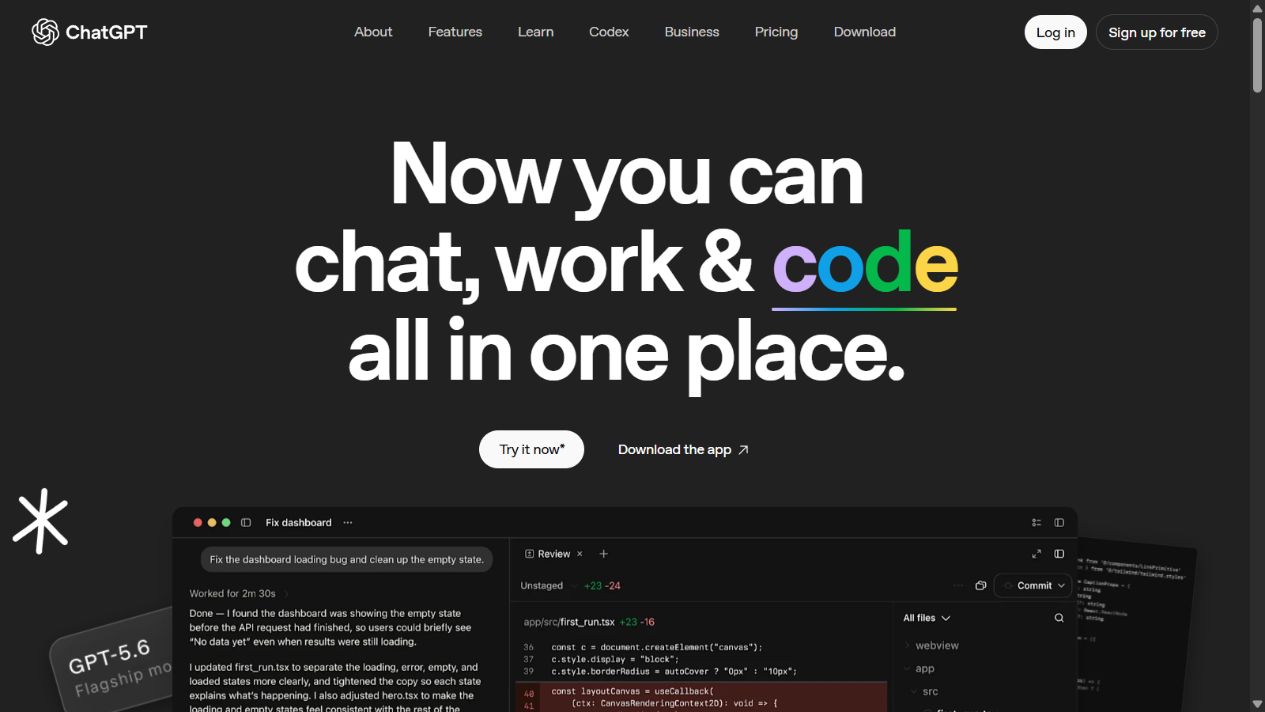
The important word is workspace. Value rarely comes from one answer. It comes from a repeatable process in which the user supplies context, receives a useful transformation, verifies the result, and moves it into an accountable business system.
This article does not repeat every feature or price. See our ChatGPT features guide and ChatGPT pricing analysis for those details. Here, the question is whether the product creates enough practical value to justify adoption.
When ChatGPT is worth it
1. The task repeats
A recurring workflow is easier to measure and improve than occasional experimentation. Examples include turning approved notes into meeting summaries, extracting fields from consistent documents, drafting a first outline from verified sources, explaining code, preparing questions for an interview, or analyzing a structured file.
Repetition lets the user create a standard prompt, context checklist, acceptance rubric, and review process. It also reveals whether the tool saves time after novelty fades.
2. The input and output are clear
ChatGPT performs better inside a bounded assignment. State the audience, decision, source material, constraints, required structure, prohibited claims, and definition of done. Ask it to identify missing information instead of inventing completion.
“Help with marketing” is difficult to evaluate. “Using these approved product notes, draft three landing-page structures for operations leaders, preserve these four claims exactly, and flag missing evidence” is measurable.
3. Human review is affordable
AI output is not free once review is included. A useful workflow makes verification easier than creating the work from scratch. If a subject expert must reconstruct every claim, repair tone, restore context, and check fabricated sources, the apparent speed disappears.
Use ChatGPT where reviewers can recognize errors and where the consequence of a missed error is controlled. Increase review depth with financial, contractual, technical, reputational, or safety impact.
4. Paid capabilities remove a real bottleneck
Paid plans can offer more access or capabilities than free use, but feature availability changes. Document the bottleneck first: file limits, research capacity, model access, images, voice, projects, connected sources, response availability, or workspace controls.
Upgrade for that requirement, not for a vague sense that a more expensive model must be better. Recheck whether the benefit remains at renewal.
5. One workspace replaces fragmented effort
ChatGPT may reduce switching among a search tool, writing assistant, file analyzer, coding helper, image ideation tool, and note workspace. Consolidation can be valuable when quality remains acceptable and the organization knows which system owns final records.
Do not force specialist workflows into ChatGPT solely to reduce subscriptions. Accounting, CRM, records, design production, regulated decisions, and operational systems may require controls that a general assistant does not own.
When ChatGPT is not worth it
Use is infrequent or unfocused
If a user opens the product a few times per month for questions that free search, documentation, or existing software answers well, a recurring subscription is difficult to justify. Paying can create pressure to use the tool even when it adds no value.
The user cannot verify the domain
ChatGPT can sound confident when wrong. OpenAI explicitly warns that it may produce inaccurate facts, fabricated quotations, studies, citations, and overconfident answers. Search and Deep Research can add sources, but users must still inspect whether each source supports the claim.
When nobody can review the answer, use an authoritative source or qualified professional rather than treating generated fluency as expertise.
Sensitive data lacks approved controls
Do not upload confidential, customer, personal, regulated, legal, security, or unreleased information into an unapproved account. Individual and business offerings can have different data and administration terms. Review the exact plan, settings, contract, retention, training use, regions, apps, and sharing model.
The workflow creates more review than value
A poor first draft can anchor reviewers, introduce subtle errors, and create unnecessary alternatives. Measure correction categories and reviewer minutes. If people spend longer making the result safe and useful than they spent on the prior process, stop or redesign the task.
The tool becomes an avoidance mechanism
Repeated prompting can replace decision-making. Users may generate endless versions, plans, or summaries without contacting a customer, reading the source, running the test, or completing the deliverable. Set a prompt limit and a point at which the accountable person must decide.
Is free ChatGPT enough?
Free access is the correct starting point for most individuals. Test representative tasks, not novelty prompts. Record quality, limits, interruptions, files, research, and accepted output.
Free may be enough when use is occasional, inputs are public and low risk, tasks are short, current limits do not interrupt work, and specialist tools are unnecessary. It may also be enough for learning the interface before a formal business pilot.
Paid access becomes easier to justify when a user repeatedly reaches relevant limits, requires a paid capability, needs more predictable access, or can consolidate work. The plan must match the current official pricing page because names, models, and included tools evolve.
Do not confuse a ChatGPT subscription with API access. Developers using OpenAI models inside applications pay through separate API billing and must account for engineering, observability, security, evaluation, and consumption.
Is ChatGPT Plus worth it?
Plus is commonly the first paid individual tier. It can be worthwhile for a frequent user who needs more access and current paid features but does not require the highest individual limits or organizational administration.
Run a one-month test with a defined workload. Set a baseline from the previous month, then measure accepted tasks, time, corrections, and interruptions. If paid access mainly increases experimentation rather than completed work, return to free.
Personal paid plans are not automatically suitable for company data. An employer should approve account type, use cases, data classification, and ownership. Work created in a personal account can create offboarding and record problems.
Is ChatGPT Pro worth it?
Pro is a high-cost individual option aimed at users who value greater access to advanced capabilities. It is not automatically “better value” than Plus. The buyer needs enough high-value usage to justify the price difference.
Identify which Pro-specific access changes an outcome. Estimate how many accepted tasks use that capability, how much time or external cost it saves, and how often limits would otherwise stop work. Discount optimistic savings for review and failure.
If the justification is “I want the best model,” the business case is incomplete. Compare output against a rubric and include latency, correction, reliability, and the availability of lower-cost workflows.
Is ChatGPT worth it for small businesses?
ChatGPT can be a flexible starting point for a small business because one workspace may support drafts, research, files, analysis, customer-response preparation, planning, and coding assistance. Breadth is useful when employees cover multiple roles.
The same breadth creates risk. Define approved tasks, prohibited data, source requirements, human approvals, account ownership, and record storage. Do not let generated text send itself to customers, alter financial records, make employment decisions, or publish claims without accountable review.
Pilot with a few roles and three to five workflows. Useful candidates are low-to-medium risk, frequent, measurable, and easy to review. Avoid starting with the most consequential or least understood process.
Business and enterprise evaluation
Organizations should evaluate identity, user lifecycle, permissions, workspace sharing, connected applications, retention, deletion, training terms, encryption, audit, residency, support, availability, legal terms, and incident response.
Test administrator work: onboarding, offboarding, role change, recovery, public links, app approval, investigation, export, and policy enforcement. A security document is not proof that the organization’s configuration and workflow are correct.
Classify data as public, internal, confidential, personal, customer, regulated, and prohibited. Map each approved use case to allowed data and a required reviewer. Train with examples of safe refusal and escalation, not only successful prompts.
Accuracy and hallucination cost
ChatGPT’s value declines when errors are expensive or difficult to detect. A fabricated citation in an internal brainstorm may be caught quickly; the same citation in a published health, legal, financial, or engineering document can create serious harm.
Require primary sources for material claims. Open links, check dates, read context, reproduce calculations, and validate quotations. Ask the assistant to separate known facts, source-backed inference, assumptions, and missing evidence.
Maintain a regression set for recurring workflows. After major product or model changes, rerun representative prompts and compare factual restraint, formatting, tool behavior, citations, privacy handling, and required corrections.
Calculate ChatGPT ROI
Use conservative numbers:
Monthly value = accepted hours saved + avoided external cost + measurable capacity gain - subscription - review - administration - correction - risk cost.
Count only accepted work. Ten generated drafts have no value if the team publishes one after rewriting it completely. Time saved by a junior employee is not equal to the same number of specialist hours, and freed capacity has value only if it is used.
Track:
- time to first useful output;
- time to approved output;
- factual and structural corrections;
- reviewer minutes;
- abandoned outputs;
- tasks completed before limits interrupt work;
- support and administration;
- incidents and near misses;
- external spend genuinely avoided;
- adoption after 30 and 90 days.
Review the subscription quarterly. Remove inactive seats and workflows that do not meet the acceptance threshold.
A four-week pilot
Week one records the existing baseline and defines approved tasks, sources, data, reviewers, and success measures. Week two tests free access where appropriate. Week three tests the proposed paid plan with the same tasks. Week four reviews quality, limits, governance, and cost.
Use representative work: one research task, one document transformation, one file or data task, and one role-specific workflow. Include a difficult prompt, an ambiguous source set, and an error-recovery scenario.
Do not let an AI specialist perform every task. Ordinary users and administrators must demonstrate safe, repeatable use. Capture where people bypass instructions, trust weak output, or cannot find approved context.
Approve the purchase only when measurable benefits exceed total cost and identified risks have owners. Set renewal and exit criteria at the same time.
Final verdict
ChatGPT is worth it when it becomes a governed, repeatable assistant for accepted work. Frequent users who need current paid capabilities can justify an individual subscription; small businesses can justify a controlled pilot; larger organizations need formal security, administration, and workflow evaluation.
It is not worth paying for unused capacity, unsupported confidence, uncontrolled data sharing, or endless generation. Start free, identify a real bottleneck, test the lowest suitable plan, measure complete outcomes, and keep humans responsible for facts and decisions.
Sources
- ChatGPT
- ChatGPT pricing
- What is ChatGPT?
- Does ChatGPT tell the truth?
- ChatGPT data controls
- OpenAI enterprise privacy
- OpenAI security and privacy
Frequently asked questions
Is ChatGPT worth paying for?
Yes, when paid access repeatedly improves accepted work enough to exceed subscription, review, administration, and correction costs. Otherwise, free access is the better choice.
Is free ChatGPT enough?
It can be enough for occasional, low-risk work when limits and missing paid capabilities do not interrupt the task. Test representative workflows before upgrading.
Is ChatGPT worth it for a small business?
Often worth a controlled pilot. Approve specific workflows, account ownership, data rules, sources, and reviewers. Do not treat a general assistant as a replacement for accountable specialist systems.
Should I choose Plus or Pro?
Choose the lowest current plan that supports the required workflow. Pro needs a measurable use case for its additional access; preference for a premium label is not sufficient.
What is ChatGPT’s biggest weakness?
It can produce fluent but incorrect or unsupported output. Important facts, references, calculations, and decisions require independent verification.
Does ChatGPT include API usage?
No. ChatGPT plans and OpenAI API billing are separate products. Application builders must model API and engineering costs independently.
How quickly should ChatGPT pay for itself?
A four-week pilot can establish initial evidence, while a 90-day review shows sustained adoption. Cancel, downgrade, or redesign use when accepted value does not exceed total cost.
Frequently asked questions
Is ChatGPT worth paying for?
It is worth paying for when higher limits or paid capabilities repeatedly reduce accepted-work time by more than the subscription and review cost. Occasional users should test the free plan first.
Is free ChatGPT enough?
Free access can be enough for light, non-critical use. Paid access becomes easier to justify when users regularly need higher limits, files, research, images, voice, projects, or organizational controls.
Is ChatGPT worth it for small businesses?
It can be, when the business approves specific workflows and data rules, measures outcomes, and retains accountable human review. A subscription does not replace domain controls or specialist software.
What are ChatGPT's biggest limitations?
ChatGPT can be wrong, fabricate support, oversimplify, reflect incomplete context, and change as models or features evolve. Users must verify important claims and govern sensitive data.
Should I buy ChatGPT Plus or Pro?
Choose the lowest current plan that supports the required workflow and realistic usage. Pro only makes sense when its higher access or specialist capabilities produce measurable value beyond Plus.
Does a ChatGPT subscription include API usage?
No. ChatGPT subscriptions and OpenAI API billing are separate. Teams building integrations should model API consumption, engineering, monitoring, and security separately.
How can I measure ChatGPT ROI?
Compare subscription, review, administration, and correction costs with conservative savings in accepted deliverables, cycle time, avoided external work, or improved capacity. Do not count generated words or prompts as value.