Is Claude Worth It?
Decide whether Claude is worth paying for based on workflow fit, plan limits, document and coding needs, verification cost, and privacy.

Direct answer
Claude is worth it for people who repeatedly work with long documents, structured writing, research, analysis, or code and can verify the result. It is usually not worth paying for if use is occasional, prompts are vague, outputs are rarely put into production, or another tool already handles the same workflow well.
The sensible buying path is to start with Claude Free, test real assignments, and record where capacity or plan restrictions stop useful work. A paid plan earns its place only when removing those constraints produces more value than the subscription, review time, administration, and risk.
Claude should not be evaluated by how impressive one response feels. Evaluate accepted deliverables: a reviewed brief, a working test, an accurate document analysis, a usable first draft, or a research memo whose sources were checked. Generated words and chat volume are activity, not return.
Quick verdict by user
| User | Likely verdict | Why |
|---|---|---|
| Occasional individual | Start free | Infrequent questions may not justify a recurring subscription |
| Writer or researcher | Often worth testing | Long material, iteration, web research, and file workflows can save meaningful time |
| Developer | Workflow-dependent | Value depends on code context, tool access, tests, and review requirements |
| Heavy daily user | Consider Pro or Max | Higher capacity matters only when limits interrupt valuable work |
| Small team | Pilot before rollout | Governance, shared context, administration, and seat utilization affect return |
| High-stakes professional | Assistant only | Legal, medical, financial, security, and safety decisions require qualified review |
What a Claude subscription buys
Claude is Anthropic’s AI workspace for conversation, writing, document work, research, code, files, projects, and connected workflows. Exact access varies by plan, account, location, and current product state. Anthropic’s plan guidance currently distinguishes Free for occasional use, Pro for regular use, and Max tiers for frequent or intensive use.
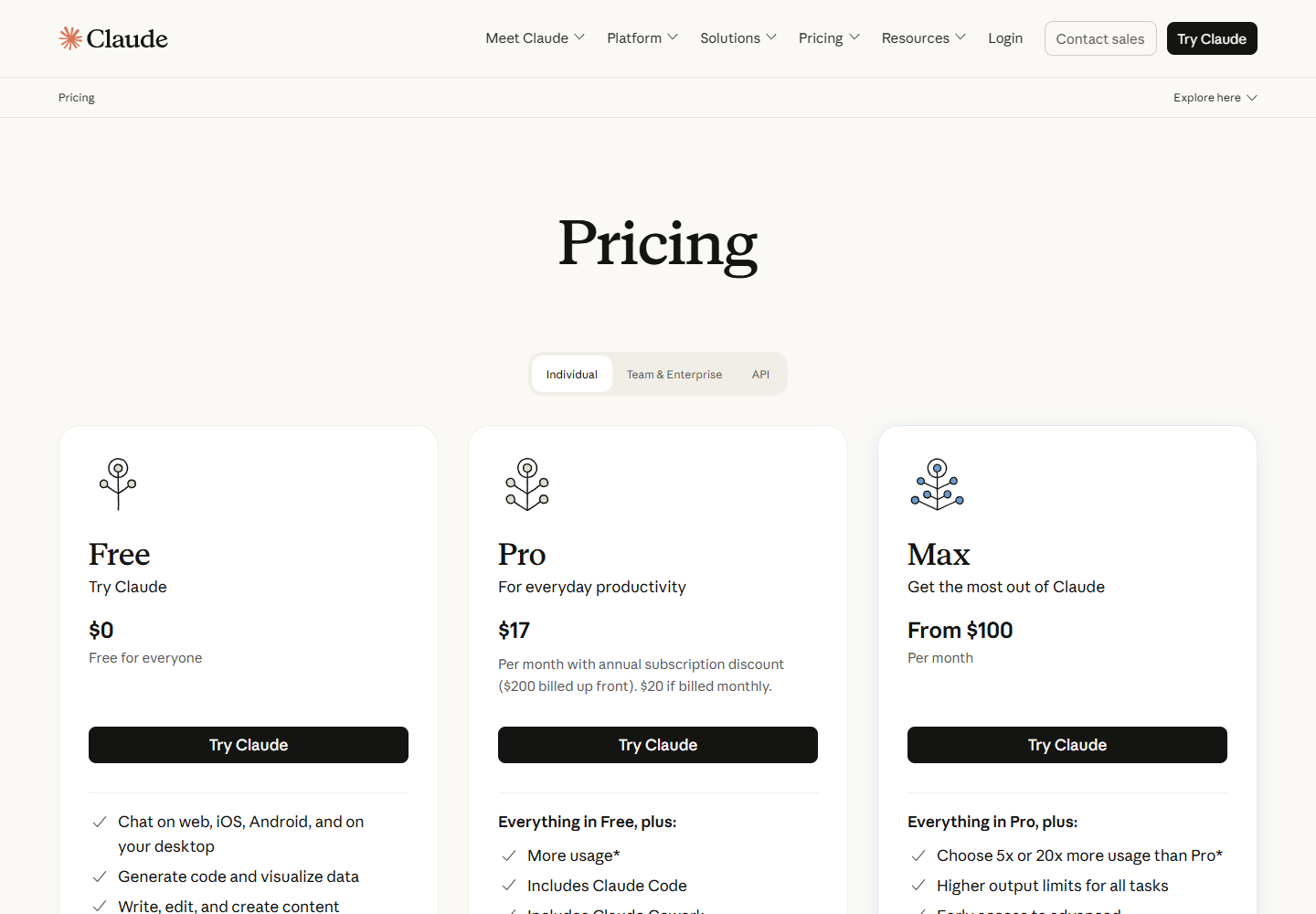
On September 7, 2026, Anthropic’s official plan guide listed Free at $0, Pro at $20 monthly or $200 annually in the United States, Max 5x at $100 monthly, and Max 20x at $200 monthly. Those numbers are a verification snapshot, not a permanent quote. Check the official Claude pricing page for local price, tax, capacity, model access, and current terms.
The subscription covers the Claude consumer workspace. Anthropic states that API and Console usage is separate. A developer building Claude into a product therefore needs a different cost model covering tokens, engineering, evaluation, monitoring, security, and support.
When Claude is worth it
You work with substantial source material
Claude can be valuable when the input is a collection of approved documents rather than an open-ended prompt. A user can ask for a structured comparison, a list of conflicts, a draft based only on supplied material, or questions that expose missing evidence.
The gain is not that Claude has read a document. The gain is that it reduces the effort required to locate, organize, and transform relevant information while the user retains responsibility for checking quotations, calculations, obligations, and conclusions.
This fit is strongest when source boundaries are clear. Ask Claude to cite file names or supplied sections, distinguish direct evidence from inference, and state when the material does not answer a question. That makes review faster and discourages confident completion of missing facts.
Writing is iterative and reviewable
Claude is useful for outlines, alternatives, restructuring, summaries, tone adjustments, interview questions, and first drafts. The best assignments specify audience, objective, required evidence, prohibited claims, format, and acceptance standard.
A vague request such as “write our strategy” creates an attractive but difficult-to-audit response. A bounded request such as “turn these approved interview notes into a 700-word decision brief, preserve the three quoted metrics, label assumptions, and finish with unresolved questions” creates an inspectable deliverable.
Payment becomes easier to justify when this pattern repeats every week. A reusable brief and review checklist can convert scattered chats into a dependable editorial process.
Research needs current sources and synthesis
Anthropic documents web search and research capabilities, with availability depending on the current plan and model. These features can reduce the time needed to discover sources and assemble an initial map of a topic.
That does not make the final answer authoritative. Search can miss primary evidence, interpret a source incorrectly, or carry a weak claim across several summaries. Open important citations, check whether they support the nearby statement, prefer primary documentation, and record the verification date for volatile facts.
Claude is worth more when it shortens discovery while your process still includes source review. It is worth less when users accept the synthesis without opening the evidence.
Coding assistance reaches tested results
For developers, Claude can explain unfamiliar code, propose changes, draft tests, identify likely failure paths, and help iterate on implementation. The practical value depends on how much context it can use and whether the environment supports a disciplined edit-test-review loop.
A plausible code block is not a completed engineering task. Count value only after relevant tests pass, security and data concerns are reviewed, style matches the repository, and a human understands the change. A workflow that generates large patches but increases review time may have negative return despite high output volume.
Paid capacity removes a documented interruption
The free plan has session-based limits, and message capacity can vary with demand and workload. Paid plans offer different usage capacity, but they are not necessarily unlimited. Long files, intensive research, or repeated complex sessions may consume capacity faster than simple prompts.
Before upgrading, keep a short log for one or two weeks. Record the task, interruption, time lost, workaround, and estimated business impact. If free limits repeatedly interrupt valuable work, Pro may be reasonable. If Pro is the documented bottleneck for sustained daily use, evaluate Max against the value of that additional capacity rather than treating it as an automatic upgrade.
When Claude is not worth it
Use is occasional
Someone who asks a few lightweight questions each month may receive enough value from Free. Subscription convenience is real, but convenience without recurring productive use is a weak reason for another monthly expense.
The work cannot be verified economically
If a specialist must reconstruct every claim, inspect every source, and rewrite most of the result, Claude may add a review layer instead of saving time. This is common when the assignment is under-specified or the reviewer lacks the context needed to identify subtle errors.
The consequence of error is high
Claude can be wrong, omit qualifications, invent support, or follow a mistaken premise. It should not independently make medical, legal, financial, employment, security, safety, or regulatory decisions. It may help organize approved material or prepare questions, but accountable professionals must make and document the decision.
Sensitive data is not governed
Do not paste confidential, personal, regulated, client, or proprietary information into any AI service simply because access is convenient. An organization should review current contractual terms, data handling, retention, access, connectors, identity controls, and permitted-use policy before adoption.
Individual subscriptions and organization plans are not interchangeable governance choices. A team should evaluate the applicable workspace and contract rather than buying personal plans ad hoc.
It duplicates an existing system
If a company already has an assistant integrated into its approved document, productivity, or development environment, adding Claude may fragment context and governance. Compare the complete workflow, not model personality in isolation. Switching cost, integrations, controls, support, and user adoption can matter more than marginal response preference.
Free vs Pro vs Max
Choose Free when
- You are learning how Claude handles your work.
- Usage is occasional and interruptions are inexpensive.
- You have not yet defined a repeatable workflow.
- You need evidence before requesting a subscription.
Choose Pro when
- Claude supports regular accepted work.
- Free capacity repeatedly interrupts that work.
- Paid capabilities remove a specific documented constraint.
- Conservative monthly savings exceed the current subscription and review cost.
Consider Max when
- Pro capacity is a measured constraint, not an assumed future problem.
- Claude is used frequently across valuable tasks.
- Interruptions create real delivery cost.
- The additional monthly price is small relative to verified incremental value.
Do not buy Max because it sounds like the best version. Buy it only when usage evidence supports it. Capacity that remains unused has no operational value.
A practical ROI calculation
Use a conservative monthly model:
Net value = accepted hours saved × loaded hourly value + avoided external cost − subscription − review cost − administration − expected error cost
Suppose a user completes eight reviewed deliverables per month and saves 25 accepted minutes on each. That is about 3.3 hours. If those hours can be redirected to valuable work, Pro may be easy to justify. If the user saves five minutes but spends fifteen checking and repairing each output, the subscription has not created a gain.
Do not assume every saved minute becomes revenue. Use a conservative value for recovered capacity and include training, prompt maintenance, source checking, corrections, and governance. Measure a baseline before the pilot so enthusiasm does not become the metric.
How to test Claude before paying
- Choose three repeatable tasks. Select real work with clear inputs and accepted outputs.
- Define a baseline. Record current completion time, quality, rework, and delay.
- Create an acceptance rubric. Include factual accuracy, completeness, style, security, and source requirements.
- Run several examples. One excellent answer does not establish reliability.
- Count total time. Include prompting, waiting, verification, editing, and moving work into the final system.
- Record failures. Note unsupported claims, missed instructions, capacity interruptions, and context problems.
- Upgrade only for a proven constraint. Choose the lowest plan that supports the successful workflow.
Repeat the measurement after the novelty period. The question is not whether Claude can perform a task once; it is whether the combined human-and-Claude process remains faster, accurate enough, and governable.
Claude versus alternatives
Claude is not automatically the best assistant for every buyer. ChatGPT may fit users who prefer OpenAI’s broader workspace and ecosystem. Gemini may suit organizations centered on Google’s productivity environment. Perplexity may appeal when source-led web discovery is the primary job. Specialist coding, writing, search, or document tools may provide tighter workflows.
Compare alternatives using the same test set. Keep inputs, acceptance criteria, reviewer, and measurement window consistent. Evaluate task completion, factual correction, citations, context handling, integration fit, controls, and total cost. Brand preference alone is not a procurement method.
Risks and controls
| Risk | Practical control |
|---|---|
| Unsupported factual claims | Require source links and verify consequential statements |
| Sensitive-data exposure | Define approved data classes and workspace rules |
| Overreliance | Keep an accountable human owner for every deliverable |
| Inconsistent output | Use examples, templates, rubrics, and final checklists |
| Hidden review cost | Measure total cycle time, not generation time |
| Capacity surprises | Test representative files and session patterns before selecting a plan |
| Product change | Record verification dates and recheck official documentation |
Final verdict
Claude is worth paying for when it is part of a repeatable, reviewable workflow and paid access removes a measured barrier. It is especially plausible for frequent document, writing, research, analysis, and coding work where users can supply strong context and recognize errors.
It is not worth paying for simply to have another general AI subscription. Start free, test accepted outcomes, include review and governance in the cost, and choose the lowest current plan that supports the proven need. The best evidence is not a feature list; it is a reliable improvement in finished work.
Sources
Use a documented renewal test rather than relying on remembered convenience. Export thirty days of representative completed tasks and classify each as accepted, heavily revised, abandoned, or risky. Calculate time saved after verification, not before it. Identify which results depended on a paid feature or higher limit and whether another approved tool already covered the same job. For team access, include inactive seats, administration, training, privacy review, and support in the cost. Renew only when the subscription repeatedly improves a real deliverable and the organization can preserve source evidence, review ownership, and a fallback workflow.
Frequently asked questions
Is Claude worth paying for?
Claude is worth paying for when regular document, research, writing, analysis, or coding work runs into free-plan limits and the paid capacity saves more accepted-work time than the subscription and review cost.
Is the free version of Claude enough?
It can be enough for occasional questions and small experiments. Test representative work on Free before upgrading, because paid access does not remove verification duties or every usage limit.
Is Claude Pro worth $20 per month?
At the US list price checked on September 7, 2026, Pro can be justified when it removes a recurring capacity bottleneck or enables valuable features. Local pricing, taxes, limits, and plan details should be rechecked before purchase.
Is Claude worth it for coding?
It can be useful for explaining, drafting, reviewing, and iterating on code, but value depends on repository context, tool access, tests, security review, and how often the workflow reaches an accepted result.
Does a Claude subscription include API usage?
No. Anthropic documents Claude subscriptions and Claude API or Console access as separate products with separate billing.
What are Claude's biggest limitations?
Claude can produce inaccurate or unsupported output, misunderstand incomplete context, hit usage limits, and expose different capabilities by plan. Consequential work still needs source and expert review.
How should a business evaluate Claude?
Run a limited pilot on approved repeatable tasks, define permitted data and acceptance criteria, measure total time including review, and buy the lowest plan that reliably supports the validated workflow.