Jasper vs ChatGPT: Which Is Better?
Compare Jasper and ChatGPT for marketing workflows, brand governance, research, analysis, team controls, pricing, and implementation.
Direct answer
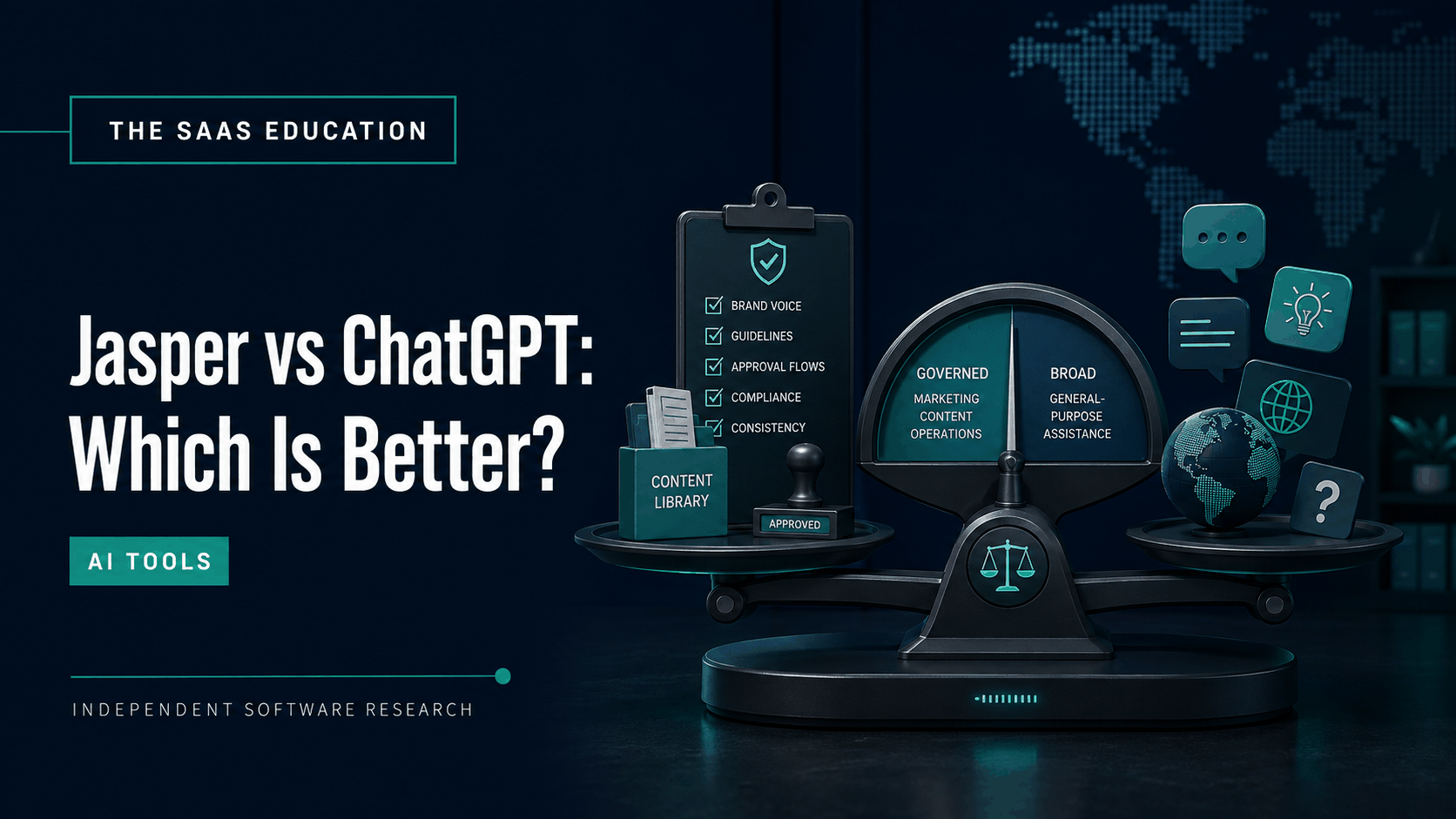
Jasper is better for a marketing organization that wants a purpose-built system for brand context, repeatable marketing workflows, campaign content, and marketing agents. ChatGPT is better for individuals and teams that need a broader assistant across research, writing, analysis, files, images, planning, and other knowledge work.
The choice is not simply specialist versus generalist. Buyers should compare the operating system around the output: approved sources, brand rules, permissions, collaboration, review, measurement, model access, privacy, administration, and total cost. A specialist product can reduce marketing workflow design. A general-purpose assistant can reduce tool fragmentation across the company.
This comparison uses official sources checked on August 31, 2026. We did not run a controlled prompt or output-quality test, so recommendations concern documented fit and buyer validation rather than a claim that one model writes better.
Jasper vs ChatGPT at a glance
| Requirement | Jasper | ChatGPT |
|---|---|---|
| Primary orientation | Marketing platform | General-purpose AI assistant |
| Best fit | Brand-aware campaign and content operations | Cross-functional research, writing, analysis, files, and planning |
| Brand context | Central product emphasis | Configurable through plan-dependent instructions, files, projects, and company context |
| Workflow design | Marketing agents, apps, and marketing-specific workflows | General tools, projects, assistants, and agentic capabilities by plan |
| Research and analysis | Relevant inside marketing workflows | Broader research, search, file, and analysis scope |
| Administration | Marketing-team and business controls vary by plan | Individual and organizational workspace controls vary by plan |
| Pricing approach | Per-seat Pro plus sales-led Business | Free and paid individual and organizational plans |
| Main risk | Paying for specialist structure the team does not operationalize | Broad usage without sufficiently specific marketing governance |
How we evaluated the products
We compared the documented product scope against eight buying questions:
- Can the platform preserve approved brand, audience, product, and style context?
- Does it support repeatable workflows rather than isolated prompts?
- Can users research, cite, analyze, draft, review, and revise inside a controlled process?
- Are collaboration, permissions, administration, privacy, and security suitable for the organization?
- Can the team measure content operations and business outcomes without relying on unsupported attribution?
- What limits apply to seats, models, agents, context, files, generation, integrations, and support?
- How much implementation, training, review, and permanent ownership is required?
- Can the organization export its knowledge, prompts, content, evidence, and workflow records later?
We excluded vendor customer outcomes from the verdict. Case studies can illustrate use cases, but results depend on data, talent, process, brand strength, distribution, market, and measurement.
Jasper: best for a purpose-built marketing operation
Jasper’s official positioning centers on marketing. Its current product and pricing material describes a marketing AI platform with Canvas, agents for marketing workflows, brand voice, knowledge assets, audience context, and business options for more complex organizational requirements.
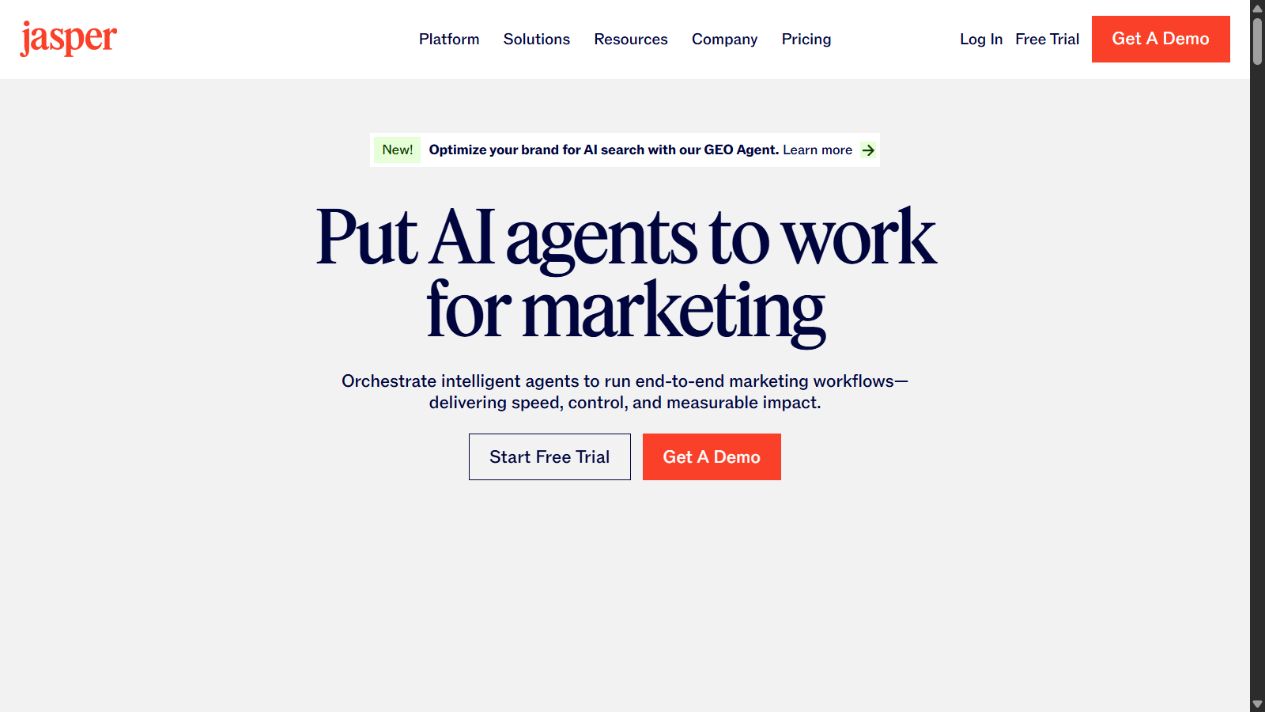
Jasper homepage captured August 31, 2026. Confirm current agents, plan limits, and commercial terms.
That orientation matters because a marketing team rarely needs text alone. It needs an approved brief, product truth, audience, brand language, campaign structure, channel variants, review, and a record of what was published. Jasper can reduce the amount of system design required to make those elements visible to creators.
Where Jasper is stronger
Jasper is the clearer starting point when marketing leadership wants a dedicated platform rather than asking every employee to invent prompts and organize context independently. Brand voices, knowledge assets, audiences, Canvas, and marketing-oriented agents create a more explicit content operating model.
This can be valuable for distributed teams and agencies. A central team can define approved context while regional marketers, content teams, demand generation, product marketing, and partners work on channel-specific assets. The practical benefit is not automatic quality; it is a stronger chance of repeatability and easier governance.
Jasper also has a clearer product boundary. Procurement can evaluate it as a marketing system, assign an owner, define approved workflows, and measure adoption against campaign operations. That may be easier than governing a general assistant used differently by every function.
Where Jasper needs careful validation
Marketing specialization can become expensive structure if the team only needs occasional drafting. Validate which agents and workflows are included, what users can customize, how knowledge is retrieved, how brand rules conflict, and what happens when approved facts change.
Test source evidence. Brand consistency does not establish factual accuracy. Product claims, statistics, comparisons, legal statements, prices, and regulated content still need current sources and accountable review. Determine whether Jasper preserves citations and source context through the drafting and approval process used by the organization.
The public Pro plan has historically been priced per seat while Business uses custom pricing. Model the complete deployment: creators, reviewers, administrators, agencies, brand workspaces, services, integration, training, support, and any other AI products still required.
Sources: Jasper , Jasper pricing , Jasper Trust Center , and Jasper Help Center .
ChatGPT: best for broad cross-functional knowledge work
OpenAI describes ChatGPT as a general AI assistant. Official product, capability, and pricing material covers plan-dependent writing, reasoning, search, deep research, files, data analysis, image input and generation, voice, projects, and organizational workspace features.
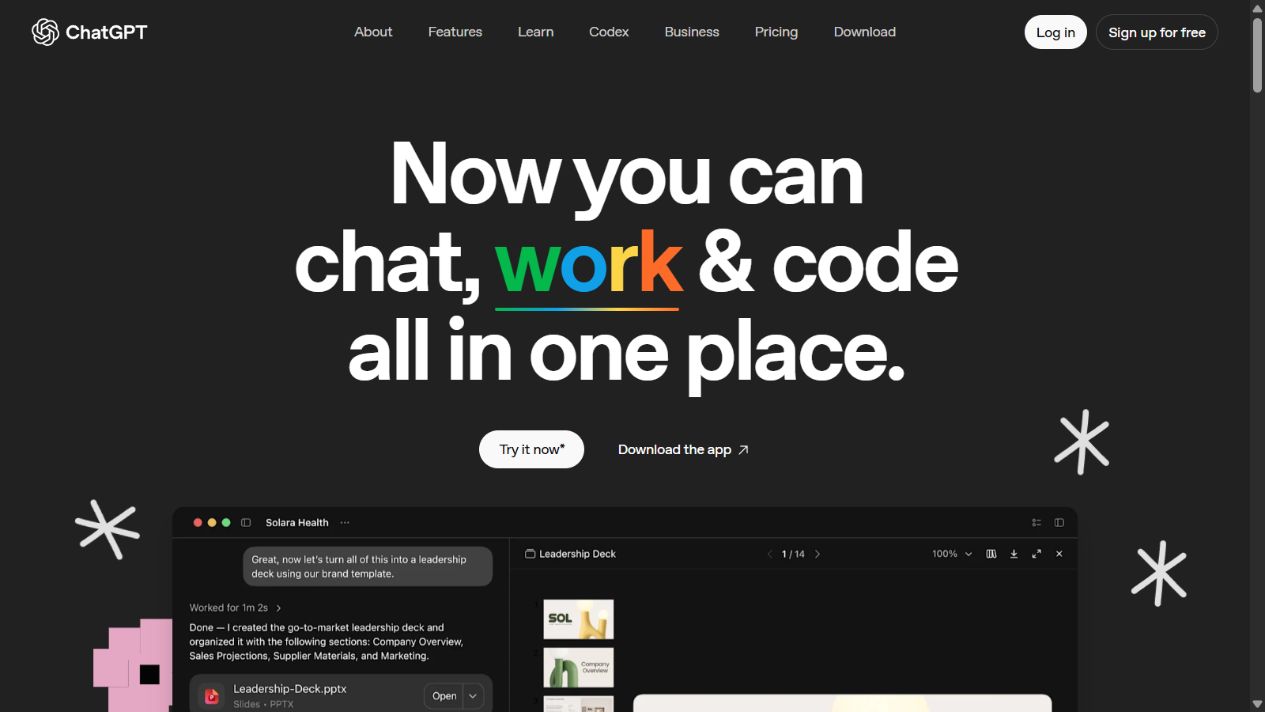
ChatGPT homepage captured August 31, 2026. Models, tools, limits, and workspace controls vary by plan.
The breadth changes the business case. A marketer can research a category, analyze a spreadsheet, summarize interviews, develop positioning, draft content, create an image, and plan a campaign in one environment. Other teams can use the same workspace for operations, finance, customer support, product, engineering, and internal knowledge.
Where ChatGPT is stronger
ChatGPT is stronger when the job begins before content production. Market research, document analysis, structured reasoning, data work, interview synthesis, planning, and cross-functional collaboration often determine whether a campaign brief is good. A broad assistant can keep those stages connected.
It can also reduce duplicate AI subscriptions. If the organization already governs ChatGPT for many teams, marketing may be able to build approved instructions, projects, source libraries, review procedures, and reusable workflows rather than buying a separate platform.
Organizational plans are relevant when administrators need centralized billing, users, workspace controls, company knowledge, connectors, and contractual treatment that differs from individual accounts. Buyers must map each requirement to the exact current plan instead of assuming the consumer interface represents the business service.
Where ChatGPT needs careful validation
Breadth can produce inconsistency. Without a marketing operating model, users may create their own prompts, upload conflicting references, use stale product claims, and publish content with different tones. The organization must define approved context, source hierarchy, naming, exclusions, review, and version control.
Test how instructions and knowledge behave across projects, chats, users, tools, and model updates. A brand guide attached to one project does not automatically govern every marketing interaction. Determine which context is authoritative, who updates it, and how creators know they are using the current version.
ChatGPT outputs can be wrong. Search or research tools improve evidence access but do not remove the need to inspect sources, distinguish facts from inference, and obtain specialist review. High-volume generation can increase review burden if users treat fluent output as approved content.
Sources: ChatGPT, ChatGPT pricing , ChatGPT capabilities , and ChatGPT FAQ .
Brand governance comparison
Jasper makes marketing context a central product concept. This gives buyers a clearer place to evaluate brand voice, audiences, product knowledge, and campaign workflows. ChatGPT can also use instructions and files, but the team may need to design more of the governance structure itself.
For either product, create a context hierarchy:
- approved company and product facts;
- brand principles and prohibited language;
- audience definitions and regional differences;
- legal, compliance, and substantiation rules;
- channel and format standards;
- current campaigns, offers, dates, and calls to action;
- examples that demonstrate style without becoming factual sources.
Assign an owner and expiry date to every high-risk source. Test conflicts deliberately: old versus new pricing, global versus regional policy, brand tone versus legal wording, and campaign urgency versus accessibility. The winning platform is the one that handles those conflicts transparently and predictably in the configured workflow.
Research, evidence, and factual accuracy
ChatGPT has the broader documented research and analysis scope. That makes it attractive for developing a brief from web research, uploaded documents, interviews, and data. Jasper may be sufficient when research inputs are already approved and the main requirement is transforming them into marketing content.
Neither platform should become the source of truth. Require factual claims to point to approved internal or external evidence. Preserve links, document versions, retrieval dates, calculations, and reviewer decisions. Separate sourced facts, analysis, assumptions, and creative language.
Build a claim register for important campaigns. Include the claim, source, owner, market, expiry date, required disclaimer, and allowed channels. This reduces the risk that an accurate sentence becomes misleading after a price, product feature, regulation, or promotion changes.
Workflow and agent comparison
The word “agent” can describe very different capabilities. Buyers should ignore the label and test a bounded workflow end to end. For example: turn an approved launch brief into a landing-page draft, three email variants, five social assets, a reviewer packet, and a source record.
Observe what the platform can do without manual repair. Can it find the current brief, follow brand rules, preserve mandatory language, adapt by channel, stop when a source is missing, request approval, and record decisions? Can an administrator inspect and update the workflow without rebuilding it from scratch?
Jasper’s advantage is that marketing agents are part of its product orientation. ChatGPT’s advantage is that general tools can support research, analysis, files, images, and tasks outside marketing production. The better system is the one that completes the organization’s real workflow with fewer hidden manual steps and acceptable control.
Security, privacy, and administration
Evaluate the exact service and plan. Cover data use, retention, deletion, encryption, subprocessors, regions, access control, single sign-on, provisioning, audit, sharing, connectors, incident response, business continuity, and contractual obligations.
Create data categories for public, internal, confidential, personal, customer, regulated, and prohibited information. Configure controls where possible and train users on what cannot be uploaded. Review external actions, connected applications, and content publishing separately from conversational use.
Administrative usability matters. Test onboarding, offboarding, role changes, agency access, temporary workers, workspace ownership, content export, account recovery, and investigation. A policy that administrators cannot enforce or audit is not a reliable control.
Pricing and total cost
Do not compare one published seat price with another and stop. Model:
- creator, reviewer, administrator, contractor, and agency seats;
- plan limits, models, agents, knowledge, files, images, credits, and usage;
- implementation, brand and knowledge setup, workflow design, integration, and migration;
- training, support, content operations, evidence review, and permanent administration;
- duplicate tools retained for research, analytics, images, automation, or publishing;
- failed or low-quality output, review time, rework, and brand risk;
- renewal exposure, export, archival, and switching cost.
Jasper may justify a specialist premium when it reduces campaign lead time and governance work. ChatGPT may justify broader organizational spend when it serves many functions. Measure accepted work and cycle time, not tokens or generated words.
Which should you choose?
Choose Jasper when:
- marketing is the primary use case;
- brand voice, knowledge, audiences, and campaign workflows need a dedicated home;
- leadership wants marketing-specific agents and a clear platform owner;
- users mainly transform approved inputs into repeatable marketing deliverables;
- the organization accepts a specialist tool alongside other AI systems.
Choose ChatGPT when:
- users need research, analysis, files, planning, writing, images, and cross-functional work;
- one governed assistant should support multiple departments;
- marketing can build and maintain its own context and workflow standards;
- broad flexibility matters more than an opinionated marketing environment;
- reducing duplicated AI subscriptions is a priority.
Use both only when the boundary is explicit. For example, ChatGPT may support research and strategy while Jasper manages governed campaign production. Define which system owns sources, brand context, final content, approvals, and records. Otherwise, two platforms create duplicated knowledge, inconsistent output, extra cost, and uncertain accountability.
Pilot plan
Run a six-week pilot with representative users and three real workflows: a researched thought-leadership article, a product campaign, and a regional channel adaptation. Use approved sources and the same brief in both products.
Measure setup time, time to approved output, factual corrections, brand corrections, accessibility issues, reviewer effort, workflow failures, source traceability, user adoption, administration, and cost. Include an incident drill involving a stale claim or unauthorized upload.
Do not let vendor specialists complete the decisive tasks. Ordinary users and administrators must prove that the workflow remains safe and repeatable after the demonstration team leaves.
Quality measurement and change management
Define quality before the pilot begins. A useful scorecard separates factual accuracy, source support, brand compliance, audience relevance, structural clarity, channel fit, accessibility, originality, and conversion readiness. Reviewers should score each dimension independently and record the corrections required. A single label such as “good” hides whether the platform produced a strong idea with weak evidence or accurate content with poor brand fit.
Measure first-pass acceptance and final acceptance. First-pass acceptance shows how well the configured system follows the brief. Final acceptance shows whether the workflow can reach publishable quality after human revision. Track the number and type of edits, reviewer minutes, approval rounds, abandoned outputs, and content later corrected after publication.
Keep humans accountable for consequential decisions. AI can propose positioning, structure, variants, and edits, but product owners must confirm capabilities, legal teams must approve regulated language, analysts must confirm calculations, and channel owners must approve the final experience. Make those responsibilities visible inside the workflow rather than relying on an informal expectation that someone will check.
Plan for product change. Jasper and ChatGPT can update models, interfaces, tools, limits, and plan packaging. Maintain a small regression set of approved briefs and expected controls. Re-run it after material changes and review whether tone, factual restraint, formatting, citations, privacy behavior, or workflow steps changed.
Finally, create a user feedback loop. Capture where employees cannot find approved context, duplicate work, bypass a workflow, or receive conflicting output. Resolve the underlying knowledge or process problem before adding more prompts. Sustainable adoption comes from a maintained content system, not from a one-time library of clever instructions.
Before renewal, repeat several original pilot tasks without vendor assistance. Compare the current results with the baseline and review configuration effort, source quality, approval time, and unresolved exceptions. This reveals whether improvements came from the platform, from temporary implementation support, or from employees quietly repairing outputs outside the measured workflow.
Final verdict
Jasper is the better choice for a dedicated, brand-governed marketing content operation. ChatGPT is the better choice for broad research, analysis, creation, and cross-functional knowledge work. The decision should follow the operating model, not a single writing sample.
Whichever platform wins, fund the system around it: approved sources, context ownership, user permissions, workflow design, human review, measurement, training, and exit. Those controls determine whether AI accelerates reliable marketing or simply increases the volume of content that must be corrected.
Review the decision at renewal using accepted output, cycle time, reviewer effort, incidents, adoption, and total cost rather than generation volume alone.
Frequently asked questions
Is Jasper better than ChatGPT?
Jasper is better when a marketing organization needs a purpose-built environment for brand context, marketing workflows, campaign content, and marketing agents. ChatGPT is better when users need a broad assistant for research, writing, files, analysis, images, planning, and cross-functional knowledge work.
Is ChatGPT cheaper than Jasper?
The products use different plans and value models. Compare current official prices alongside seats, limits, workspace controls, implementation, brand setup, workflow duplication, and the number of other tools each platform can replace.
Can Jasper replace ChatGPT for a marketing team?
It can replace some marketing content and workflow uses, but it may not replace broad research, analysis, file, coding, or cross-functional assistant tasks. Test the team's real work rather than comparing feature lists.
Can ChatGPT maintain a brand voice?
ChatGPT can use instructions, files, projects, and organizational context according to plan and configuration. Teams must test how reliably approved brand rules, claims, terminology, and exclusions persist across users and workflows.
Which tool is better for content marketing?
Jasper deserves priority for a governed, marketing-specific content operation. ChatGPT may be stronger for mixed research, strategy, analysis, drafting, and operational work. Output quality depends on the brief, sources, configuration, review, and user skill.
Do Jasper and ChatGPT make factual mistakes?
Both can produce inaccurate or unsupported output. Require approved sources, evidence checks, subject-matter review, and clear accountability before publishing factual, legal, financial, medical, product, or performance claims.
Should a company use both Jasper and ChatGPT?
Possibly. A company may assign Jasper to governed marketing production and ChatGPT to broader knowledge work. This only makes sense when ownership, data rules, workflow boundaries, cost, and duplicated capabilities are explicit.