Komo vs ChatGPT: Which Is Better?
Compare Komo and ChatGPT for AI search, cited research, deep research, writing, files, analysis, automation, pricing, governance, and buyer fit.
Direct answer
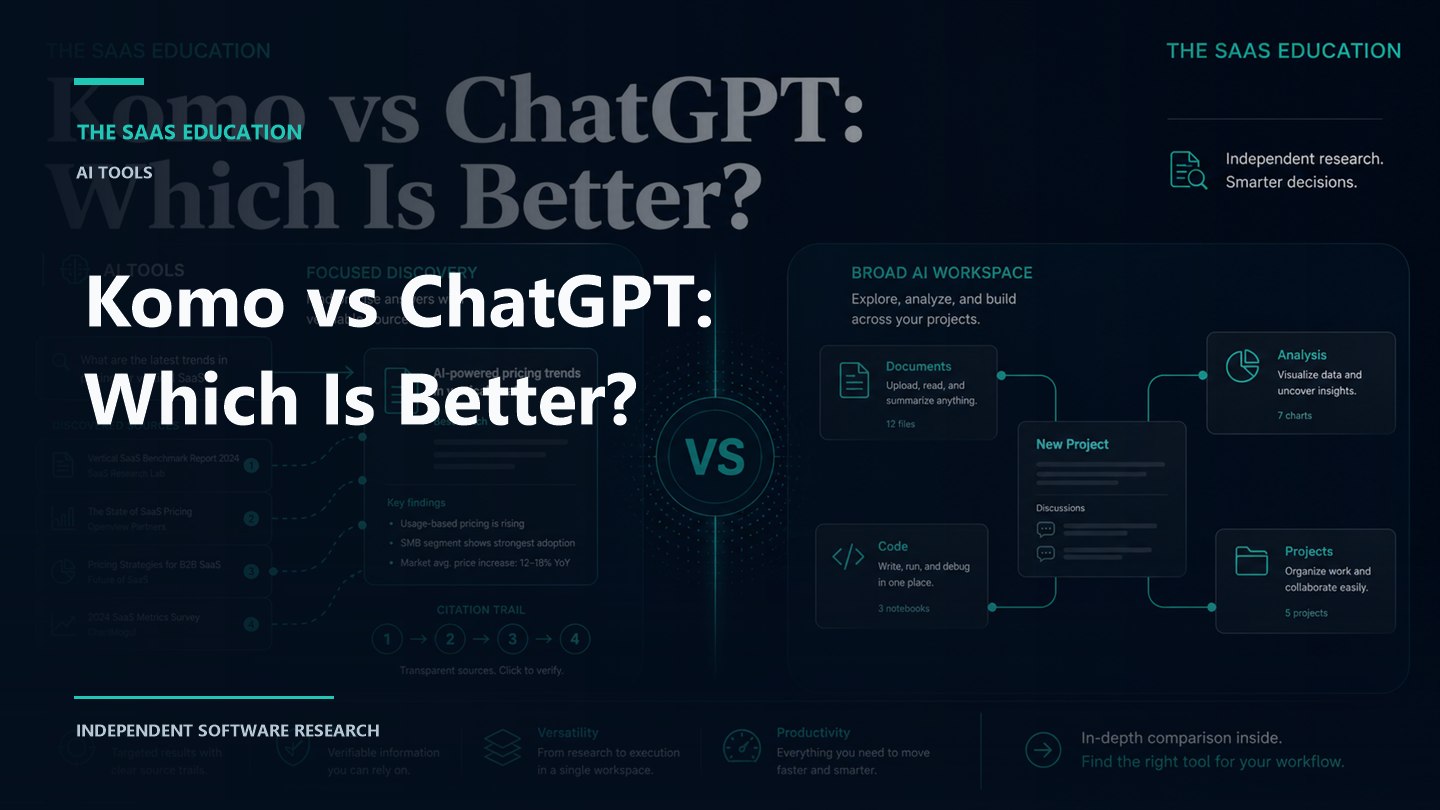
Komo is better for a focused, search-first experience built around current web questions and visible sources. ChatGPT is better as a broader AI workspace for research, writing, uploaded files, data analysis, coding, projects, images, and connected applications. Choose Komo when discovery and source inspection are the job. Choose ChatGPT when research is one stage in a larger production workflow.
This is not a simple model-versus-model contest. Komo’s public interface emphasizes web search, people search, Deep Research, history, and source-linked answers. Its official documentation describes a wider professional product spanning structured research, document analysis, playbooks, and automation. ChatGPT is positioned as a general-purpose assistant and workspace whose exact capabilities vary by plan and configuration.
Quick comparison
| Area | Komo | ChatGPT |
|---|---|---|
| Primary experience | AI search and research | General-purpose AI workspace |
| Strongest use | Focused web discovery with sources | Research plus downstream creation and analysis |
| Source workflow | Search-first, source-linked answers | Search, deep research, files, and connected sources by plan |
| Broader work | Document and automation capabilities are described in official documentation | Writing, files, data, coding, projects, images, and apps |
| Main buying risk | Confusing the public search surface with broader documented capabilities | Assuming broad capability guarantees correct or complete evidence |
| Best evaluation | Retrieval quality and source support | End-to-end accepted output across the workflow |
Komo: best for search-first research
Komo’s homepage starts with the question, “What do you want to know?” The interface exposes web, people, and Deep Research choices and describes itself around answers with sources. This makes the product legible for a user who wants to investigate a topic rather than begin inside a general chat workspace.
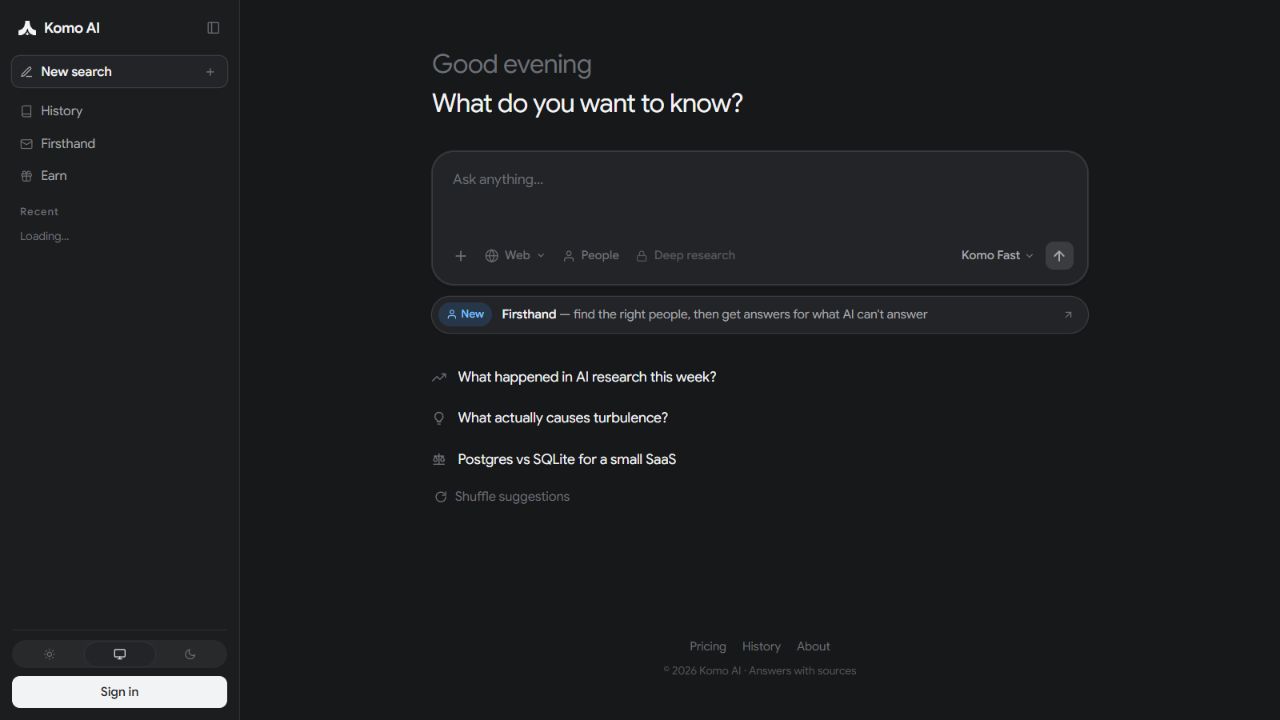
That focus can reduce setup friction. A researcher can phrase a question, inspect the response, open cited pages, refine the query, and preserve history without first deciding which general assistant mode or workflow to use. The advantage matters only when the sources are relevant and actually support the generated claims.
Komo’s documentation broadens the story. It describes research and automation for professional teams, including structured research, document analysis, and repeatable playbooks. A buyer should therefore ask for a demonstration of the exact edition under consideration. Do not infer that every documented workflow is available in the public search experience or entry plan.
ChatGPT: best for research that continues into work
ChatGPT is the stronger choice when a question leads to a document, spreadsheet analysis, code, plan, image, presentation outline, or recurring team project. Its value is breadth: users can combine conversation with web research, files, analysis, and other capabilities available to their plan.
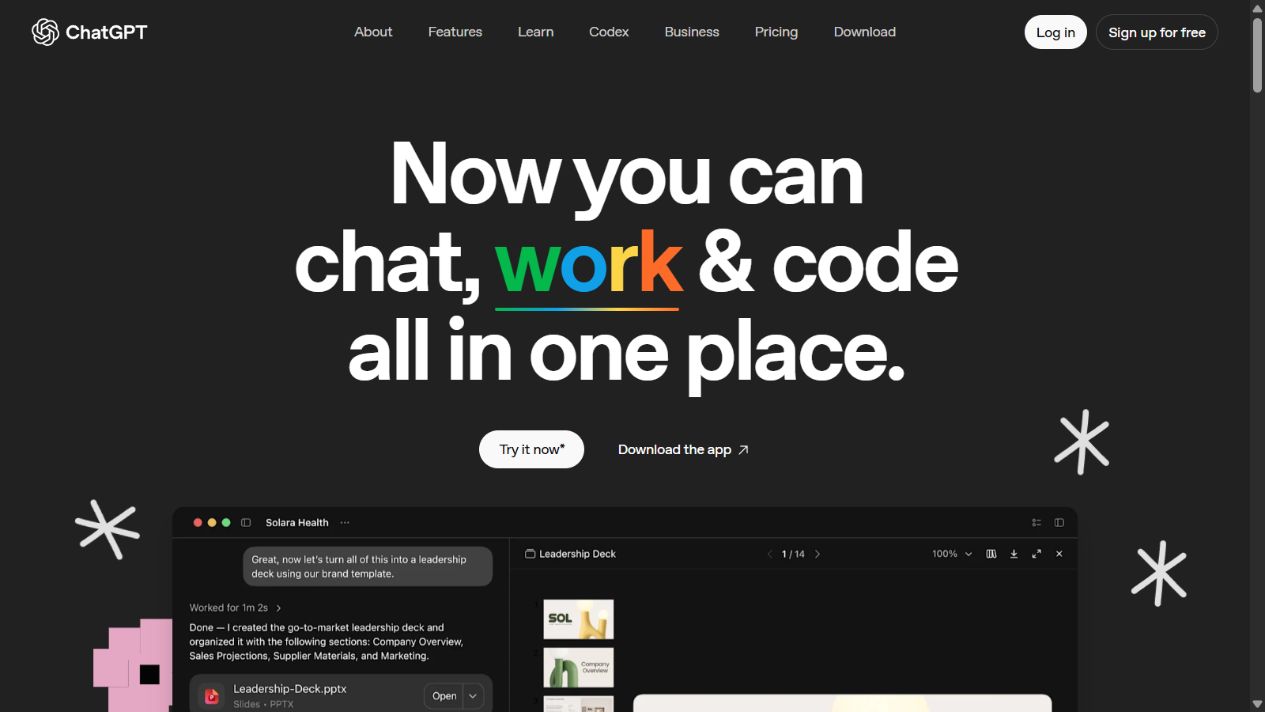
Breadth creates its own governance problem. Users can move quickly from evidence gathering into confident prose, calculations, or recommendations. Reviewers must still distinguish retrieved evidence, model interpretation, and unsupported inference. A polished answer is not automatically an auditable answer.
What current ranking coverage misses
Search results for this comparison are thin and often repeat older descriptions of Komo as a private or ad-free search engine. That framing does not fully capture the current homepage or the broader official documentation. Generic AI-tool directories also tend to compare feature checklists without testing whether citations support individual claims.
The more useful comparison is a workflow test: discovery, evidence inspection, synthesis, production, review, export, governance, and cost. It should also separate the product users can access today from capabilities mentioned elsewhere in documentation or sales material.
Evidence quality and citation verification
A citation is useful only when it supports the nearby claim. In either tool, open a sample of sources and check authorship, publication date, primary versus secondary status, geographic relevance, and whether the quoted conclusion survives its original context. Count unsupported claims separately from broken links. A response with ten citations can be weaker than one with three well-matched primary sources.
Komo’s search-first design makes this review path prominent. That is an interface advantage, not an accuracy guarantee. ChatGPT can also return linked research, but its broader conversational flow can encourage users to continue drafting before completing source review. Teams should require a claim ledger for consequential work: claim, source, supporting passage, date checked, confidence, and reviewer.
For current events, regulations, prices, product capabilities, and market data, freshness matters. Record both publication date and retrieval date. For scientific, legal, financial, or medical work, use domain databases and qualified review rather than treating either assistant as the final authority.
Deep research
Deep research should be judged by the usefulness of the research trail, not how long the report looks. Give both products the same bounded brief, approved source types, exclusions, geography, date range, required table, and citation format. Then score source recall, source quality, unsupported synthesis, contradictory evidence, reproducibility, and reviewer time.
Komo states that Deep Research requires a paid plan. Its documentation also describes structured research workflows. Confirm allowances, export formats, project persistence, collaboration, and whether the research surface shown in a sales demonstration matches the purchased edition. ChatGPT deep-research availability, limits, connectors, and model behavior similarly depend on current plan and configuration.
Neither product should quietly turn a research question into a recommendation. Require the report to distinguish facts, estimates, vendor claims, third-party opinions, and model inference. Ask for missing evidence and counterarguments before accepting the conclusion.
Writing, files, analysis, and coding
ChatGPT has the clearer advantage when the same workspace must transform research into multiple deliverables. A team may inspect sources, upload a spreadsheet, calculate scenarios, draft an executive memo, produce code, and maintain project context. That breadth can reduce handoffs and repeated prompting.
Komo may still be the better first tool when web discovery is the bottleneck. Its documented file and automation capabilities deserve evaluation, but buyers should not infer parity from category labels. Test the exact file types, size limits, table extraction, citation behavior, export, API access, and failure handling needed by the workflow.
The decision is not which product can technically produce text. Measure accepted output. Track how much generated work survives factual review, editing, formatting, and stakeholder approval. A cheaper answer that creates more correction work is not the cheaper workflow.
Research automation and repeatable workflows
Komo’s official documentation positions playbooks and automation as a differentiator beyond one-off search. That can matter to research, operations, sales, and diligence teams that repeat the same evidence-gathering process. Ask the vendor to build one representative workflow using your source policy, approval points, exception handling, and output schema.
ChatGPT can support repeatable work through projects, instructions, apps, and other plan-dependent capabilities. Its advantage is flexibility; its risk is that teams create many informal workflows without ownership. In both products, document the trigger, permitted sources, data access, expected output, reviewer, escalation rule, retention period, and change process.
Automation should stop when evidence is missing or contradictory. It should not fill gaps with plausible language. Test expired pages, inaccessible documents, ambiguous names, conflicting dates, and prompts designed to expose unsupported certainty.
Privacy, security, and governance
Do not evaluate privacy from marketing adjectives. Review the contract, data-processing terms, retention, training defaults, subprocessors, regions, encryption, identity controls, audit capabilities, deletion, legal hold, incident process, and administrator visibility for the proposed plan.
Classify allowed use cases. Public market research may be suitable for a broader pilot; customer records, employee data, unreleased financials, legal material, credentials, and regulated information need stricter approval. A search query can itself disclose strategy, so source discovery is not automatically low risk.
For ChatGPT, separate consumer, individual paid, business, enterprise, and API arrangements. For Komo, separate the public search interface from professional-team and automation terms. Never apply one product surface’s policy to another without verification.
Pricing and total cost
Compare the exact plans required for the workflow. Include seats, research allowances, credits, model or agent usage, connectors, storage, API consumption, implementation, security review, training, administration, support, and export or migration work. Model an ordinary month and a peak month.
Komo’s public interface indicates that Deep Research is paid, but that alone does not establish total commercial cost. ChatGPT pricing is also plan- and usage-dependent. Ask both vendors how limits are measured, whether unused capacity expires, what happens at the limit, and how administrators prevent unexpected consumption.
The largest hidden cost is duplicate work. If researchers discover sources in Komo and then manually recreate context in ChatGPT, quantify that handoff. Using both can be rational when Komo materially improves discovery and ChatGPT materially improves production, but the combined workflow should outperform either product alone.
How to run a fair pilot
Select 20 to 30 representative questions: straightforward lookups, ambiguous topics, current developments, contradictory evidence, multi-source synthesis, people research, uploaded documents, and one downstream deliverable. Freeze the briefs before testing.
Score each output for relevant-source recall, primary-source share, claim support, freshness, contradiction handling, factual corrections, time to accepted result, reviewer effort, export quality, and cost. Blind-review the final outputs where possible. Record failures, not just impressive examples.
Run a second round after users learn each interface. This separates onboarding friction from durable capability. Test administration and deletion as carefully as answer generation. End with a written decision covering approved use cases, prohibited data, ownership, review requirements, success thresholds, and exit criteria.
Decision scenarios
Market and competitor research
Start with Komo when an analyst needs to discover current pages, identify people, and inspect sources quickly. Start with ChatGPT when the assignment also requires uploaded internal data, calculations, a presentation outline, or several audience-specific deliverables. For either tool, require dated sources and separate a competitor’s own claim from independent evidence.
Academic and scientific questions
Neither product should automatically replace specialist literature databases. Test whether the required journals, papers, identifiers, and date ranges are discoverable. Record retractions, study design, sample limitations, and conflicting findings. If the work affects clinical, legal, or policy decisions, qualified review is mandatory.
Sales and account research
Komo’s people and web discovery can be useful for locating public evidence. ChatGPT may be stronger for turning approved findings into account briefs or analyzing exported data. Do not allow either tool to infer sensitive personal attributes or present unverified employment, funding, technology, or intent signals as facts.
Internal knowledge work
ChatGPT deserves priority when plan-approved connectors or uploaded files are central to the task. Komo’s documented document-analysis and operations capabilities should be demonstrated against the same permissions and corpus. Evaluate retrieval permissions, source citations, stale documents, conflicting policies, and whether deleted access disappears promptly from results.
Common failure modes
The first failure is citation decoration: links appear authoritative but do not support the sentence. The second is source narrowing, where the answer reflects only pages that are easy to retrieve. The third is freshness confusion, where an old source is used for a current claim. The fourth is entity confusion, especially for companies, people, products, or acronyms with similar names.
Another failure is scope drift. A user asks for evidence, but the assistant quietly adds recommendations or invented certainty. Prevent this by specifying allowed claims, evidence thresholds, and an explicit “insufficient evidence” outcome. Ask the product to surface disagreements instead of averaging them into a smooth narrative.
Operational failures matter too. Research can be lost, exports may omit citations, shared projects may expose information too broadly, or usage limits may interrupt a deadline. Test recovery, export, ownership transfer, offboarding, and support before making either tool part of a critical process.
Implementation checklist
- Name the business decision and the accountable owner.
- Define approved source types, date ranges, geographies, and exclusions.
- Classify data that may and may not enter the product.
- Test both products with the same frozen question set.
- Review every material claim against its cited source.
- Measure accepted output, corrections, elapsed time, and reviewer effort.
- Validate plan limits, administration, retention, export, and deletion.
- Document the handoff to writing, analysis, CRM, or another system.
- Set a renewal threshold based on measurable workflow improvement.
- Re-test after major product, model, pricing, or policy changes.
This checklist prevents a familiar purchasing mistake: selecting the answer that looks most impressive in a demonstration rather than the system that produces dependable work under ordinary constraints.
Assign a named research owner after selection. That person should maintain approved prompts, source rules, evaluation questions, access reviews, and a record of material product changes. Review the workflow quarterly and whenever pricing, models, connectors, retention terms, or research capabilities change. Ownership turns an impressive pilot into a controlled operating practice and gives users somewhere to report weak sources, unexpected costs, or unsafe behavior before those problems spread.
Include ambiguous questions in the evaluation set, not only prompts with easy factual answers. Ask each product to identify missing evidence, distinguish fact from inference, explain contradictory sources, and state when a conclusion cannot be supported. Reviewers should score restraint as well as completeness. A shorter answer that exposes uncertainty is often more useful than a polished response that hides weak evidence. Also test whether citations survive export and collaboration, because a research result loses much of its value when the supporting trail disappears during handoff.
Record these results.
Final verdict
Choose Komo when focused web discovery, visible sources, and a search-first research experience are the primary requirements. Give it additional weight when its demonstrated structured-research or playbook capabilities match a repeatable professional workflow.
Choose ChatGPT when research must continue into writing, files, data analysis, coding, images, projects, and connected business work. Its broader surface makes it the more versatile single subscription, provided the organization governs sources, data, and output review.
Use both only when a measured pilot proves a valuable division of labor. The durable advantage is not the assistant that produces the longest answer; it is the workflow that reaches a supported, reviewable decision with the least avoidable effort.
Sources
- Komo official search interface
- Komo official documentation
- Komo pricing
- ChatGPT
- OpenAI ChatGPT pricing
- OpenAI enterprise privacy
Frequently asked questions
Is Komo better than ChatGPT?
Komo is better for focused web discovery with a search-first interface. ChatGPT is better for broader work that combines research with files, writing, analysis, coding, projects, images, or connected applications.
Is Komo an AI search engine or an automation platform?
Its public interface is presented as an AI search engine. Official documentation also describes structured research, document analysis, playbooks, and automation, so buyers should validate the exact product surface and plan.
Which tool is better for citations?
Komo makes sources especially visible, while ChatGPT can also produce source-linked research. In both cases, inspect whether each source supports the claim rather than scoring citation count alone.
Can Komo replace ChatGPT?
It may replace the discovery stage for search-heavy users. It is less likely to replace ChatGPT where teams depend on its broader downstream creation, file, analysis, coding, or project workflows.
Which product is safer for company data?
Safety depends on the exact plan, contract, configuration, data type, and controls. Review retention, training terms, access, audit, regions, subprocessors, deletion, and incident processes before approving sensitive use.
Is using both products worthwhile?
Only when Komo measurably improves source discovery and ChatGPT measurably improves downstream work enough to justify the extra subscription, handoff, governance, and training cost.
Frequently asked questions
Is Komo better than ChatGPT?
Komo is better when the primary job is focused web discovery with visible sources and a search-first interface. ChatGPT is better when research must continue into writing, file analysis, data work, coding, projects, apps, or broader team workflows.
Is Komo an AI search engine or an automation platform?
Its public interface is presented as an AI search engine, while official documentation also describes structured research, document analysis, playbooks, and automation. Buyers should verify which product surface and plan contains the capabilities they need.
Which tool is better for cited research?
Komo makes source-linked web answers central to its search experience. ChatGPT also supports web search and deep research, but citation presence alone is not proof of accuracy in either product; users must inspect the underlying sources and claims.
Can Komo replace ChatGPT for business work?
Not usually for teams that rely on ChatGPT for mixed writing, files, analysis, coding, projects, images, or connected applications. Komo can replace or complement the research-discovery portion of a workflow when focused search is the priority.
Which is better for deep research?
The answer depends on source coverage, evidence quality, traceability, export, and downstream workflow requirements. Run the same representative research brief in both products and score supported claims rather than response length.
Should a company use both Komo and ChatGPT?
Possibly, but only when Komo produces a measurable discovery advantage and ChatGPT remains useful downstream. Define ownership and handoff rules so teams do not pay for duplicate research without improved decisions.