Meta AI vs ChatGPT: Which Is Better?
Compare Meta AI and ChatGPT for everyday assistance, research, files, images, voice, projects, privacy, team use, and long-running work.
Direct answer
Meta AI is the better starting point when you want a free everyday assistant inside Meta’s apps, social discovery, shopping context, image creation, or voice-led help. ChatGPT is the better starting point for structured knowledge work involving projects, files, web research, data analysis, writing, Canvas, and organizational controls.
The right choice depends less on a model leaderboard and more on where the work begins and where the result must go. Meta AI is closely connected to Meta’s consumer ecosystem. Its official pages emphasize access through Meta AI on the web and app, plus WhatsApp, Instagram, Messenger, and Facebook. ChatGPT is organized as a broader work environment where conversations, files, instructions, tools, and shared project context can support a continuing task.
This comparison uses live search discovery and official Meta and OpenAI sources checked September 5, 2026. We did not run a controlled benchmark of factual accuracy, image quality, reasoning, speed, or voice latency. Models and rollouts are changing quickly, so claims about a permanent performance winner would not be defensible.
Meta AI vs ChatGPT at a glance
| Requirement | Better starting point | Why |
|---|---|---|
| Ask for help inside WhatsApp, Instagram, Messenger, or Facebook | Meta AI | It is embedded across Meta’s documented app surfaces |
| Discover current public social perspectives | Meta AI | Meta documents answers that can cite public content from its apps |
| Organize recurring work around chats, files, and instructions | ChatGPT | Projects are designed as persistent context hubs |
| Draft and revise a document or code in an editable workspace | ChatGPT | Canvas is a dedicated writing and coding surface |
| Analyze uploaded structured data | ChatGPT | OpenAI documents a code-backed data-analysis environment |
| Image creation for casual social workflows | Meta AI | Image creation and editing are central to the Meta experience |
| Source-backed multi-step research | ChatGPT, with Meta AI as a specialist input | ChatGPT documents search and deep research; Meta adds public social context in selected experiences |
| Controlled organization-wide deployment | ChatGPT | Business and enterprise plans publish workspace and data commitments |
| Private or regulated work | Neither consumer experience by default | Approve the account, controls, data path, and review process first |
This table describes product orientation, not measured quality. A feature appearing on a product page does not prove that it will perform your specific task correctly.
What Meta AI is designed to do
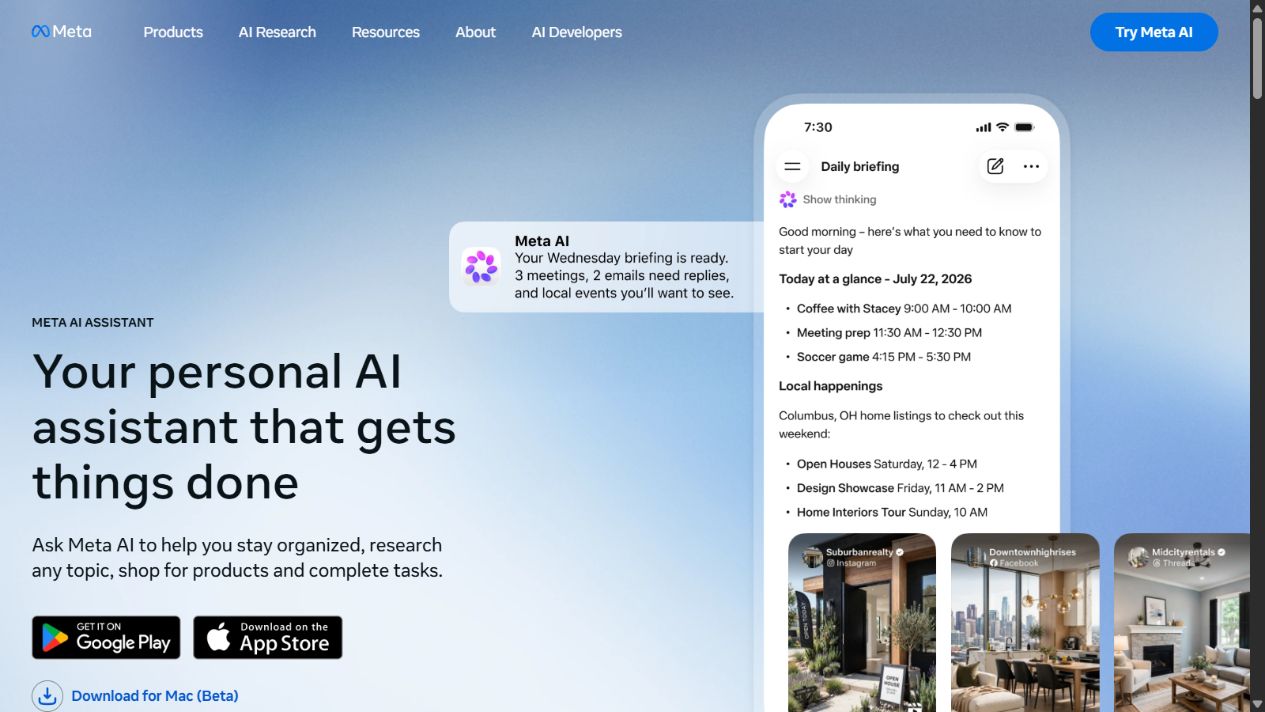
Official Meta AI assistant homepage , captured September 5, 2026. The image documents current vendor positioning and interface presentation, not measured task quality.
Meta positions Meta AI as a personal assistant that appears where many people already communicate and discover content. The official assistant page lists the Meta AI web experience, mobile app, a Mac beta, and access within WhatsApp, Instagram, Messenger, and Facebook. That distribution is its clearest practical distinction.
Meta also documents text and voice conversations, image creation and editing, file and photo input, local recommendations, shopping, research reports, presentations, scheduled or continuing tasks, and Incognito Chats. Some newer capabilities are rolling out only in selected markets or surfaces. Treat the web page as a capability map, then verify whether the exact feature appears in your account.
The social layer can be useful when the task depends on what people are discussing publicly. Meta says selected answers can cite public posts from Instagram, Facebook, and Threads. A person looking for style references, local recommendations, creator perspectives, Marketplace options, or social trends may value that context more than a conventional list of web links.
That strength has a boundary. Public social content is not automatically reliable evidence. Popular opinions can be incomplete, promotional, manipulated, or unrepresentative. Use the social layer to discover perspectives, not to replace authoritative sources for health, legal, financial, security, or procurement decisions.
What ChatGPT is designed to do
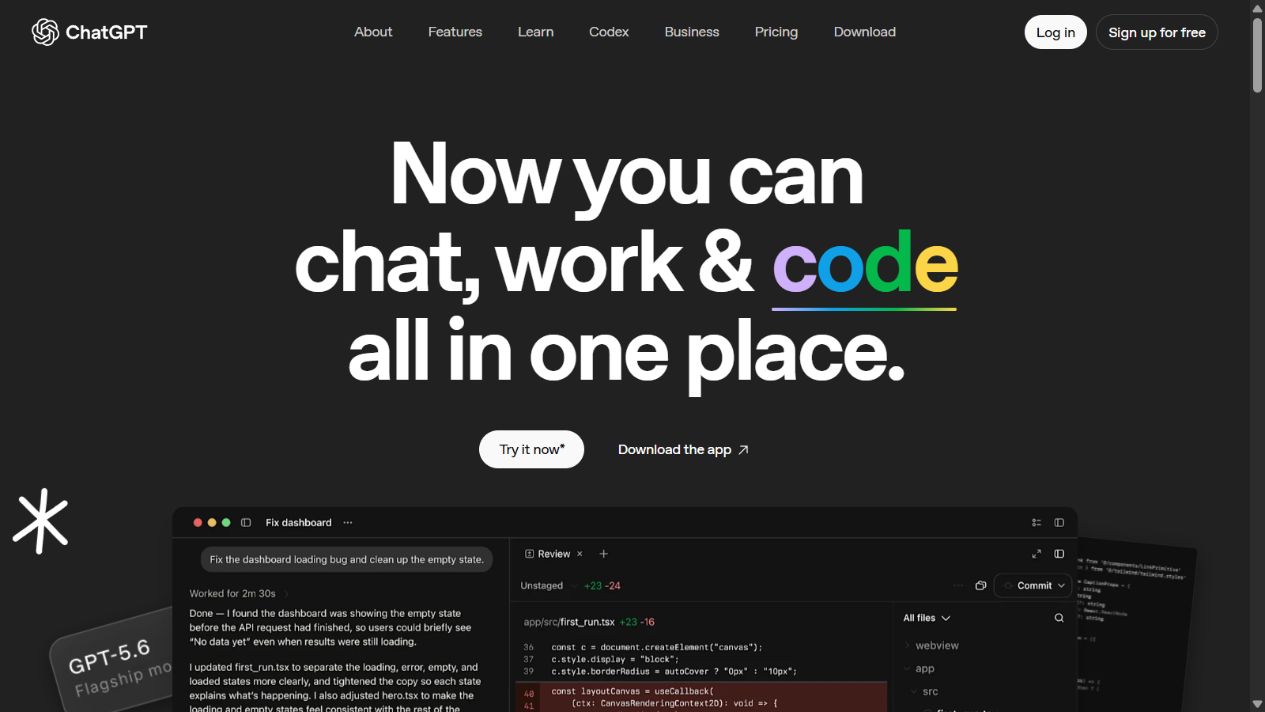
Official ChatGPT overview homepage, captured September 5, 2026. Product tools and availability depend on the current account and plan.
OpenAI describes ChatGPT as a conversational assistant for questions, writing, reasoning, translation, planning, coding, files, images, and other forms of knowledge work. Its capabilities overview also documents web search, deep research, file uploads, data analysis, voice, Canvas, memory, projects, scheduled tasks, and GPT-related experiences. Access depends on plan and settings.
Projects are important when work continues beyond one conversation. OpenAI says a project can hold chats, uploaded files, and project instructions. Shared projects can provide a common context hub, while organizational controls apply in eligible workspaces. That makes ChatGPT more naturally suited to a research report, recurring analysis, content program, software project, or policy workflow that must preserve decisions and source material.
Canvas provides an editable surface for writing and coding. Data analysis can execute code in a controlled environment to examine structured files and produce calculations or visualizations. Search can retrieve current web information with citations, while deep research is intended for longer multi-source investigation. These tools create a broader workbench, but they do not guarantee correctness. A cited answer can misread a source, a calculation can use the wrong definition, and generated code can contain defects.
Which is better for everyday questions?
Meta AI is attractive when convenience inside an existing Meta app matters most. A user can ask a question in the same environment where a conversation or piece of content already exists. Voice and camera-led interactions can also reduce the effort of describing what is visible.
ChatGPT is attractive when the question may grow into a longer task. A quick explanation can become a saved project, a document revision, a file analysis, or a cited research brief. The advantage is continuity of workflow rather than proof that every answer is better.
For simple questions, test both with the same acceptance criteria. Check whether the answer addresses the request, distinguishes facts from suggestions, provides usable sources when needed, and avoids inventing missing details. Do not judge only by confidence or conversational style.
Which is better for search and research?
ChatGPT is the clearer default for formal research. OpenAI documents web search with source links and deep research for multi-step investigations. A project can retain the brief, files, instructions, and follow-up conversations. This structure helps when the output needs a traceable scope and repeated revision.
Meta AI can be the more distinctive research input when public social discussion is relevant. Its product pages emphasize answers rooted in public posts, local recommendations, shopping, and current perspectives from Meta’s ecosystem. For a creator trend, local event, product aesthetic, or public community discussion, that can surface useful leads.
Neither should become the sole authority. For a software purchase, collect vendor documentation, contract terms, security material, and independent evidence. For a current event, open the cited reporting. For a numerical claim, verify the original dataset and definition. Keep a source ledger outside the chat if the decision has financial or operational consequences.
Which is better for images and creative work?
Meta AI places image generation and editing close to social and conversational use. Its official media-generation page describes presets, edits, and image creation across supported Meta surfaces. That makes it a natural starting point for casual concept exploration and shareable visual ideas.
ChatGPT also documents image input, generation, and natural-language editing. Its broader advantage is surrounding work: a user can research a topic, develop a brief, analyze references, draft copy, and iterate on an image inside one continuing project.
We did not compare output quality. Visual quality changes with the model, prompt, reference material, safety controls, and requested style. Run a defined trial using your real deliverables. Check text rendering, brand consistency, edit precision, accessibility, provenance, rights, and the effort needed to reach an approved asset.
Which is better for files, documents, and data?
ChatGPT has the clearer documented workflow for sustained file and data work. OpenAI’s capabilities page describes document uploads, extraction and summarization, image interpretation, and code-backed data analysis. Projects can group relevant files with instructions and conversations.
Meta AI’s current assistant page also documents multiple files, documents, photos, spreadsheets, charts, and reports. The practical question is not whether an upload button exists. Test whether the product preserves table structure, cites the right passage, identifies uncertainty, handles version changes, and supports the output format you need.
Use synthetic or approved data during evaluation. Compare calculated totals with a known result. Ask the assistant to show its assumptions and source rows. If a task affects payroll, contracts, customers, security, or financial reporting, require independent review in the authoritative system.
Which is better for voice and mobile use?
Meta AI’s distribution across mobile social apps and its connection to Meta glasses make voice and camera interaction central to its identity. Meta documents natural voice conversations, live visual assistance in supported experiences, and continuity across its dedicated app and selected devices.
ChatGPT also offers voice on supported web, mobile, and desktop experiences, with plan-dependent limits and features. It may be preferable when the spoken conversation needs to connect to an existing project, uploaded material, research, or another work artifact.
Test voice in the actual environment. Check interruptions, names, numbers, accents, background noise, consent, transcript accuracy, and whether users can review a consequential action before it occurs. A natural conversation can still misunderstand the instruction.
Privacy and data controls
Do not compare privacy using one marketing sentence. First identify the account type and interaction mode.
Meta documents Incognito Chats as a private mode for supported Meta AI experiences, with messages processed in a protected environment and disappearing by default. Availability must be confirmed in the relevant app and market. A normal Meta AI interaction is not automatically an Incognito Chat.
OpenAI’s consumer Data Controls allow users to choose whether conversations help improve models, export data, delete an account, and use Temporary Chats. OpenAI says Temporary Chats are not saved in history or used to train models and are deleted from its systems after 30 days, subject to stated abuse-monitoring behavior. Business offerings have separate enterprise privacy commitments, and organizational settings can differ from consumer controls.
For either product, document what users may submit, which mode they must use, who can access shared artifacts, how long data is retained, and what happens when a team member leaves. Do not paste client credentials, private contracts, health information, production data, or regulated records into an unapproved consumer account.
Team administration and business use
ChatGPT has the clearer documented path for managed team deployment. Its Business and Enterprise offerings include plan-dependent workspace administration, identity and access options, data commitments, collaboration, usage controls, and support. Exact features and commercial terms must be verified for the plan and contract.
Meta AI is primarily positioned as a personal assistant across Meta’s ecosystem. Meta separately offers business agents and business tools, but those are not the same procurement decision as giving employees a dedicated managed AI workspace. A company should not infer enterprise administration from the presence of Meta AI inside an employee’s WhatsApp or Instagram account.
For a business pilot, define approved tasks, accounts, data classes, reviewers, success measures, and stop conditions. Export accepted results to the system of record. A conversational history should not become the only location for a policy, calculation, client decision, or production change.
Costs and usage limits
Meta currently describes everyday Meta AI use as free and says it is testing limits and subscription access for some compute-intensive features. It does not provide one stable universal paid-price table on the assistant page. Regional and account availability can differ.
ChatGPT offers free and paid individual and organizational plans. The current pricing system also distinguishes included limits, optional or pooled credits for advanced organizational features, and separately billed API usage. A ChatGPT subscription does not automatically include API consumption.
Compare total workflow cost, not only the monthly headline. Include user count, advanced usage, review time, integrations, administration, data controls, training, and the cost of correcting errors. Recheck the official purchase page immediately before subscribing because limits and plan contents can change faster than an annual comparison article.
Portability, accessibility, and switching cost
Neither assistant should become the only repository for important knowledge. Before committing to one, export a representative conversation or deliverable, record the source links, and confirm that another team member can continue the work without access to one person’s private history. Store approved documents, calculations, code, and decisions in the organization’s normal systems of record.
Accessibility also belongs in the evaluation. Test keyboard navigation, screen-reader labels, zoom, captions, transcript quality, contrast, and the ability to complete a task without relying only on voice, images, or color. Availability inside a familiar app is useful only when every intended user can operate the relevant controls and review the result.
Switching cost comes from more than subscriptions. Saved instructions, memories, project files, shared links, connected apps, and team habits can make a product difficult to replace. List those dependencies during the pilot. Prefer workflows where source material and accepted outputs remain portable even if the assistant changes.
When Meta AI is the better choice
Choose Meta AI as the starting point when:
- assistance inside WhatsApp, Instagram, Messenger, or Facebook is central;
- public social perspectives, local discovery, creators, or Marketplace context are useful inputs;
- voice, camera, and casual image creation matter more than a formal project workspace;
- the required features are available in your region and account;
- the task is low risk and the output will be independently checked when necessary.
Its strongest advantage is contextual convenience within Meta’s consumer ecosystem.
When ChatGPT is the better choice
Choose ChatGPT as the starting point when:
- work needs persistent projects, files, instructions, and multiple revisions;
- web research, source links, document drafting, coding, or structured data analysis are central;
- an editable Canvas or broader tool workflow is useful;
- a team needs a documented business or enterprise workspace path;
- results must move through a controlled review process into another system.
Its strongest advantage is breadth and continuity across knowledge-work tasks.
A practical evaluation test
Run the same three approved tasks in both products:
- Ask a current factual question and verify every source.
- Provide a mixed-format file and compare extraction, explanation, and traceability.
- Produce one real deliverable, then record prompts, edits, errors, review time, and export steps.
Score task completion, evidence quality, correction effort, privacy fit, accessibility, continuity, and total cost. Do not average unlike tasks into one meaningless winner score. Weight each task according to how often it occurs and the consequence of an error.
Final recommendation
Start with Meta AI for everyday assistance embedded in Meta apps and for workflows where public social context, shopping, voice, or casual visual creation is genuinely useful. Start with ChatGPT for projects, files, research, data analysis, writing, coding, and managed organizational work.
Many individuals can use both without making both official systems. Define one source of truth for important work, verify outputs, and keep sensitive information inside approved accounts and workflows. The better assistant is the one that fits the task, evidence standard, and governance model you can actually maintain.
Sources checked
- Meta AI official assistant page
- AI at Meta
- Meta guide to using Meta AI
- Meta: Introducing Muse Spark
- Meta AI task and research update
- Meta Incognito Chat announcement
- OpenAI ChatGPT overview
- ChatGPT capabilities overview
- Projects in ChatGPT
- Searching the web with ChatGPT
- ChatGPT Data Controls FAQ
- ChatGPT pricing
- OpenAI enterprise privacy
- Flexible pricing for organizational plans
Frequently asked questions
Is Meta AI better than ChatGPT?
Meta AI is the better starting point for assistance inside Meta apps and experiences that use current public social context. ChatGPT is generally the stronger starting point for structured projects, files, research, data analysis, writing, and team-managed knowledge work.
Is Meta AI free to use?
Meta describes Meta AI as free for everyday use but says it is testing usage limits and subscription access for some compute-intensive features. Availability and limits can differ by market and account.
Can Meta AI access Instagram and Facebook content?
Meta documents experiences that cite public posts from Instagram, Facebook, and Threads and provide recommendations rooted in its apps. This does not mean every private item or account is available to every conversation.
Can ChatGPT work with files and images?
Yes. OpenAI documents file and image uploads, image analysis and generation, data analysis, and projects, subject to current plan limits, settings, supported formats, and workspace controls.
Which is better for research, Meta AI or ChatGPT?
Both document research capabilities. ChatGPT is the clearer starting point for a structured, source-backed research workflow retained in a project. Meta AI can be useful when public social perspectives, shopping, or local discovery are material inputs.
Which is better for business teams?
ChatGPT has the clearer documented path for dedicated business workspaces, administration, enterprise privacy commitments, projects, and organizational controls. Teams should still verify the exact plan and data configuration before adoption.
Should I share confidential information with either assistant?
Do not submit confidential or regulated information until your organization has approved the product, account type, retention settings, access controls, and intended use. Consumer settings and organizational workspace commitments are not interchangeable.