Midjourney vs ChatGPT: Which Is Better?
Compare Midjourney and ChatGPT for image creation, art direction, editing, research, writing, video, privacy, collaboration, and production.
Direct answer
Midjourney is better for creators who want a dedicated image-first environment for visual ideation, style exploration, personalization, references, variations, organization, and plan-dependent video. ChatGPT is better when image creation is one part of a broader conversational workflow involving research, writing, files, analysis, code, projects, or detailed iterative editing.
The choice should not be reduced to which platform produces the prettiest image from one prompt. Visual quality is subjective, models change, and results depend on prompt, references, settings, iteration, and selection. The more durable difference is workflow. Midjourney is organized around making and exploring visual work. ChatGPT is organized around a conversation that can produce and transform several kinds of work, including images.
This comparison uses live search discovery and official Midjourney and OpenAI sources checked September 6, 2026. We did not run a controlled test of quality, realism, typography, prompt adherence, editing accuracy, speed, consistency, or video output.
Midjourney vs ChatGPT at a glance
| Requirement | Better starting point | Why |
|---|---|---|
| Explore many visual directions quickly | Midjourney | Its image-first create, explore, variation, and organization environment supports discovery |
| Build a recognizable visual style | Midjourney | Personalization, style references, moodboards, and related controls are central workflows |
| Combine image work with research and writing | ChatGPT | Images sit inside a broader assistant workspace with search, files, projects, and Canvas |
| Make conversational edits | ChatGPT | Users can describe changes in ordinary language within the ongoing context |
| Organize an image-generation library | Midjourney | The web experience is designed around visual creation, archive, exploration, and organization |
| Produce exact final typography | Neither by itself | Final text should be checked and placed in a production design tool |
| Generate plan-dependent video | Midjourney | Midjourney documents image-to-video and related creation workflows |
| Create a report with supporting images | ChatGPT | Research, writing, data, and images can stay in one project workflow |
| Confidential client work | Depends on approved setup | Terms, account, privacy, visibility, retention, rights, and client approval decide suitability |
What Midjourney is designed to do
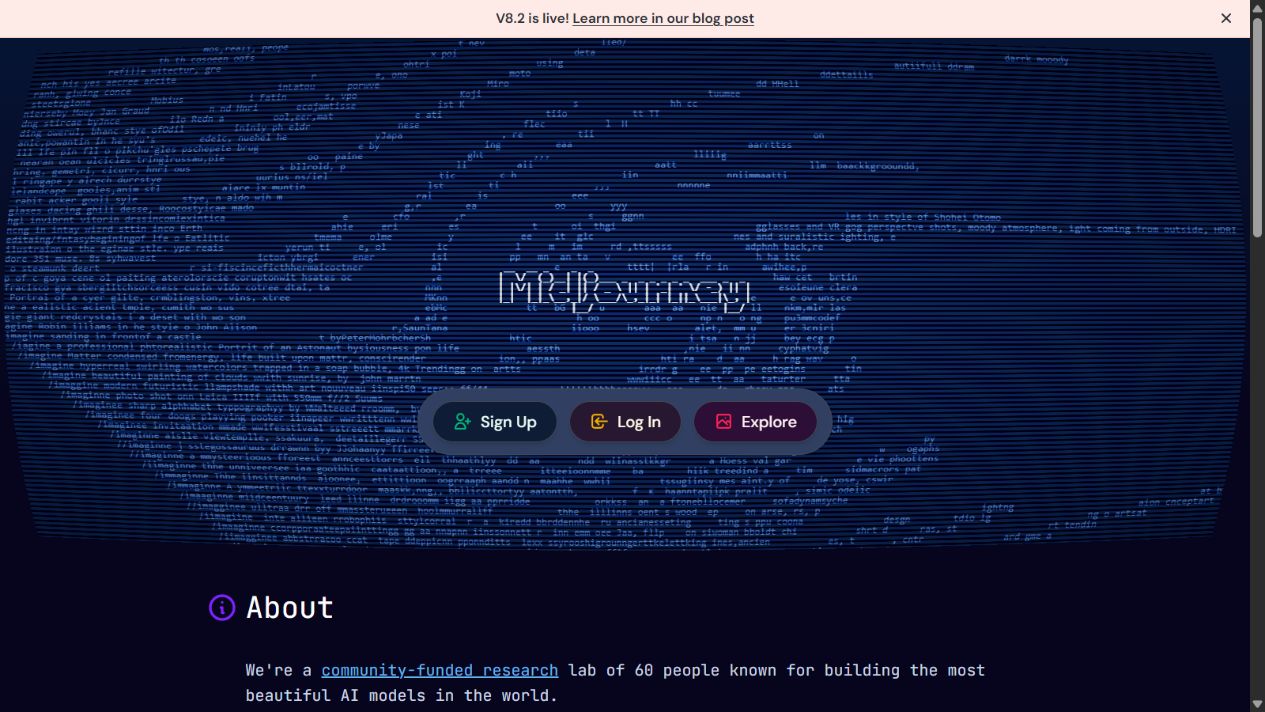
Official Midjourney homepage, captured August 31, 2026. The image documents the current vendor experience, not an independent quality result.
Midjourney is a visual creation platform. Its official website and documentation describe web-based creation, exploration, editing, organization, personalization, moodboards, style references, image references, parameters, variations, and model-dependent image or video workflows.
The product encourages visual iteration. A creator can begin with a prompt, inspect several interpretations, vary a promising result, change composition or style, use references, edit regions, extend framing, organize outputs, and develop a visual direction. The surrounding gallery and exploration environment can also help users understand what kinds of prompts and aesthetics are possible.
That specialization is its clearest advantage. The interface does not need to pretend that an image is merely an attachment to a text conversation. It can emphasize comparison, selection, variation, visual memory, and style development.
What ChatGPT is designed to do
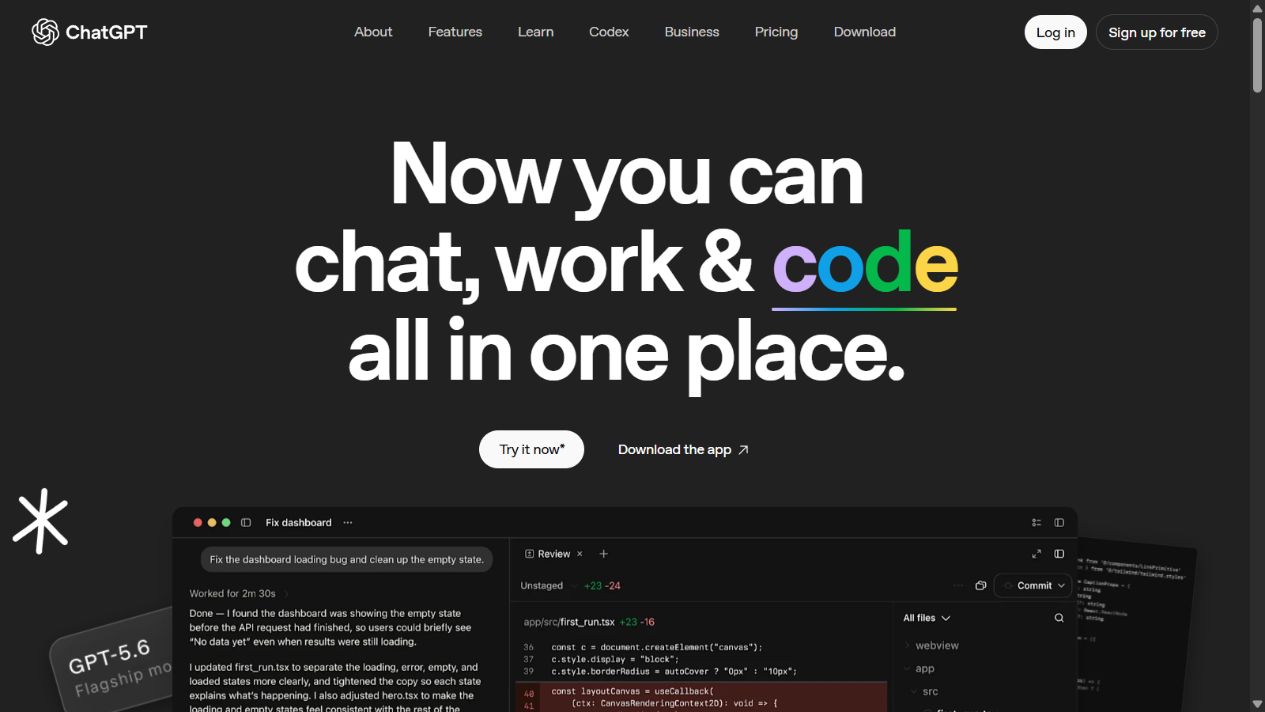
Official ChatGPT overview homepage, captured September 5, 2026. Image capabilities depend on the current model, plan, settings, and limits.
ChatGPT is a general-purpose AI workspace that includes image generation and editing. OpenAI documents text and image input, image creation, conversational changes, writing, web search, deep research, file analysis, data analysis, voice, projects, Canvas, and other plan-dependent tools.
The advantage is context. A user can research a market, upload a brief, analyze references, develop positioning, write campaign copy, generate a visual, request changes, and produce implementation notes in the same conversation or project. The assistant can use the preceding discussion to understand why the image exists rather than treating every prompt as an isolated command.
This broad workflow is valuable for people who do not identify as visual specialists. They can explain the business requirement in ordinary language and ask for revisions such as changing the background, removing an object, adapting the composition, or preserving a selected element. The result still needs visual and factual review.
Which is better for visual ideation?
Midjourney is the stronger starting point when the goal is broad visual exploration. Its create and explore experience is designed to show alternatives, encourage selection, and move from one visual direction to related variations. Style references, personalization, and moodboards can help a creator develop a coherent aesthetic rather than repeatedly rebuilding style language from scratch.
ChatGPT can also brainstorm visual directions, and the conversation can produce a stronger brief before generation. It is useful when the problem is initially vague: the user can discuss audience, message, composition, constraints, brand, and channel before requesting the image. However, a specialist generating hundreds of visual directions may prefer a library designed around images rather than a long conversational history.
The practical workflow can combine them. Use ChatGPT to clarify the brief and identify constraints, then use Midjourney for wide visual exploration. Bring selected results into a design system for final execution. That sequence is useful only when rights, privacy, and transfer between tools are approved.
Which is better for style control?
Midjourney has the clearer image-specialist orientation. Official documentation describes personalization, style references, moodboards, image prompts, character or object reference mechanisms where available, and parameters that influence generation. These controls can help a creator move from generic prompting toward a repeatable visual language.
Repeatable does not mean identical. Generative systems introduce variation, and a style reference is not a deterministic brand template. Teams should define what may vary and what must remain fixed. Logos, exact typography, product geometry, regulated claims, safety details, and identity-sensitive subjects generally require stronger production controls.
ChatGPT’s conversational context can preserve written art direction and explain why a style matters. It may be easier to request one specific change while keeping other instructions stable. For a continuing campaign, a project can hold the brief and supporting files, subject to current file and workspace controls. The team should still maintain a conventional brand system outside the model.
Which is better for prompt adherence?
There is no defensible universal answer without a controlled test. Prompt adherence depends on the requested scene, number of constraints, model, references, aspect ratio, safety behavior, and iteration method. A result that feels artistically stronger may ignore a required object. A literal result may feel less original.
ChatGPT’s conversational model can be helpful for complex requirements because the user can clarify intent, identify a missed constraint, and request a targeted correction. Midjourney provides parameters and visual reference workflows that may give experienced users more direct control over composition and style. Both can omit, distort, substitute, or invent details.
Use a requirement checklist. Record subject count, environment, viewpoint, aspect ratio, required objects, prohibited objects, brand constraints, text, identity, and output purpose. Evaluate each requirement separately instead of choosing the most attractive thumbnail.
Which is better for editing existing images?
Both document editing workflows. Midjourney’s web editor and variation tools support modifying and extending visual outputs, using source images under the current product rules. ChatGPT supports conversational image editing where a user can upload or select an image and describe the desired change.
ChatGPT is attractive for a bounded edit expressed in natural language: remove one object, replace a background, preserve a subject, or adjust lighting. Midjourney is attractive when the edit is part of continued visual exploration and variation. Neither should be assumed to preserve every pixel outside the requested area.
For production edits, state invariants explicitly. Identify what may change and what must remain unchanged. Compare faces, hands, product labels, logos, dimensions, text, color, shadows, edges, and background. Keep the original file and save versions rather than overwriting the approved source.
Typography and graphic design
Generated text has improved, but exact typography remains a production risk. Misspellings, substituted characters, inconsistent capitalization, distorted marks, and unreadable small text can appear. Even correct words may use poor hierarchy or spacing.
Use generated typography for concept exploration, not as unquestioned final copy. For a landing page, advertisement, pricing graphic, legal notice, packaging label, or accessibility-sensitive asset, create the visual foundation and add verified text in a design application. Check contrast, font licensing, reading order, responsive crops, alternative text, and localization.
ChatGPT can help write and proof the copy before design. Midjourney can help explore expressive poster-like treatments. The final system should separate approved content from pixels when accuracy and reuse matter.
Video and motion
Midjourney documents plan- and model-dependent video creation, including workflows that animate visual material. That makes it the clearer choice in this comparison when a creator wants to extend image ideation into short generated motion.
ChatGPT’s current capabilities and connected products can change, so buyers should verify the exact account rather than infer video support from the general AI brand. For either platform, generated motion needs review for continuity, artifacts, identity, rights, audio, captions, aspect ratio, duration, and export suitability.
An advertising team should test the full delivery path. A visually interesting clip may still fail platform specifications, accessibility requirements, product accuracy, or client approval.
Research, writing, and campaign work
ChatGPT is the stronger choice when the image is one component of a larger deliverable. Search and deep research can support discovery. Files and projects can hold background material. Canvas can support writing and revision. Data analysis can inspect structured information. The same workspace can produce the brief, copy, image directions, alternative text, QA checklist, and handoff notes.
Midjourney does not need to duplicate that breadth to be valuable. Its role can be the specialist visual engine inside a wider content process. A team should decide where the authoritative brief lives, how prompts and references are approved, where outputs are stored, and which system records the selected final asset.
Avoid a fragmented workflow in which important decisions exist only inside private chats. Store approved briefs, source rights, model settings, selected outputs, edit history, and final files in a shared system with ownership and retention.
Privacy, visibility, and client work
Creative teams regularly handle unreleased campaigns, product designs, customer data, recognizable people, licensed assets, and confidential strategy. Do not upload that material until the organization has approved the product, account, terms, settings, and purpose.
Midjourney’s plan documentation describes differences involving generation, compute, and privacy-related features. Verify current visibility defaults and any private mode before client work. ChatGPT account types and data controls also differ. OpenAI publishes separate business-data commitments for eligible offerings, but the workspace still requires configuration and access governance.
Client permission matters independently of a vendor setting. A private generation mode does not grant the right to use a person’s likeness, confidential design, copyrighted source, trademark, or client material. Record provenance and approval.
Commercial rights and originality
Read current terms for the exact account and jurisdiction. Rights can depend on subscription, user type, source material, local law, and contract. A vendor’s permission to use an output does not guarantee that the output is free from third-party claims.
Search for similar marks and recognizable protected elements before commercial publication. Do not ask the model to imitate a living artist or competitor identity when a distinct visual direction would meet the business need. Use owned or licensed references and preserve records of source, prompt, edits, and approval.
For high-value identity, packaging, advertising, or merchandise, obtain qualified legal review. Generative convenience does not replace clearance.
Collaboration and asset management
Midjourney’s visual archive and organization tools can support creators reviewing many outputs. ChatGPT projects can preserve conversations, files, and instructions around a campaign. Neither automatically replaces a digital asset management system, brand library, approval workflow, or production design application.
Define naming, versions, owner, campaign, market, language, rights status, approval status, expiration, and final location. Prevent draft generations from appearing in a client-facing library. Keep originals and final production files separate.
For team adoption, evaluate whether reviewers can compare versions, leave useful feedback, reproduce a direction, and understand which output is approved. Generation speed without selection discipline creates more clutter, not more value.
Pricing and total cost
Midjourney subscription plans differ by current compute, speed, concurrency, privacy, and related limits. ChatGPT plans differ by model and tool access, usage, workspace, administration, and service limits. Check current pricing pages immediately before purchase.
Include the cost of prompt development, failed generations, review, retouching, typography, upscaling, storage, asset management, rights review, and production handoff. Also account for overlapping subscriptions if the team uses both.
Measure useful approved outputs per project, not raw images generated. A tool that creates more variations can be expensive if selection and correction consume the saved time.
When to choose Midjourney
Choose Midjourney when:
- image creation is the primary job;
- the team values visual exploration and style development;
- personalization, references, moodboards, and variations fit the process;
- creators need a visual archive and image-centered workflow;
- plan-dependent video experimentation matters;
- the organization can handle final typography, design, rights, and approval elsewhere.
When to choose ChatGPT
Choose ChatGPT when:
- image work begins with research, files, or a detailed conversational brief;
- users need writing, analysis, coding, or planning alongside images;
- iterative natural-language edits are central;
- projects should retain instructions and supporting material;
- non-designers need a broad assistant rather than a specialist image environment;
- the organization can configure an approved workspace and review process.
Evaluation checklist
Test both products with the same set of representative assignments:
- A broad concept requiring several distinct visual directions.
- A brand-constrained image with explicit required and prohibited elements.
- A composition guided by owned reference material.
- A targeted edit that must preserve everything outside one change.
- A graphic containing short exact text.
- A multi-image campaign requiring visual consistency.
- A realistic product or service scene requiring factual accuracy.
- A responsive asset requiring desktop, mobile, and social crops.
- A confidential scenario tested only in an approved environment.
- A complete handoff including source, rights, alt text, and approval.
Score adherence, visual usefulness, edit control, typography, artifacts, consistency, time, cost, privacy, collaboration, and downstream production effort. Record model, settings, references, and date because results will change.
Final verdict
Midjourney is the better image specialist. ChatGPT is the better general creative workbench. Choose Midjourney when the team needs deep visual exploration, style systems, variations, and an image-centered creation environment. Choose ChatGPT when image generation must connect naturally with research, writing, files, analysis, projects, and conversational editing.
Many professional teams will use both, but only a defined production workflow turns generated options into reliable assets. Keep the authoritative brief, source rights, brand rules, exact typography, approval, and final files outside the model. Select based on approved output quality and total production effort, not one impressive prompt.
Sources checked
- Midjourney
- Midjourney documentation
- Midjourney website overview
- Midjourney documentation
- Midjourney editor
- Midjourney personalization documentation
- Midjourney style references
- Midjourney video
- ChatGPT overview
- Creating images in ChatGPT
- ChatGPT capabilities
- Projects in ChatGPT
- OpenAI business data
Frequently asked questions
Is Midjourney better than ChatGPT for images?
Midjourney is the stronger starting point for image-first exploration, visual style development, personalization, moodboards, and variation workflows. ChatGPT is often better when image creation must stay inside a conversational process that also uses research, files, writing, analysis, or precise iterative instructions.
Which is better for beginners, Midjourney or ChatGPT?
ChatGPT can be easier for beginners who want to describe a result conversationally and refine it through ordinary language. Midjourney offers a more specialized visual environment, but users should learn its creation, parameter, reference, editing, organization, and privacy workflows.
Which is better for text inside images?
Both products can generate typography, but neither should be trusted for final production text without inspection. For exact legal, pricing, accessibility, or brand copy, generate the visual foundation and place verified text in a design tool.
Can Midjourney edit an existing image?
Yes. Midjourney documents web editing and tools for modifying, reframing, varying, and extending visual work, subject to current model and plan availability. Verify the exact editor behavior and rights for the intended source image.
Can ChatGPT create and edit images?
Yes. OpenAI documents image generation and editing within ChatGPT, including conversational changes and image input, subject to plan, model, safety, account, and usage limits.
Which is better for private client work?
Use only an approved account and workflow. Check the current product terms, visibility defaults, private-generation options, retention, training settings, sharing, access, and contract. A private mode does not replace client permission or internal review.
Should a creative team use both Midjourney and ChatGPT?
A team may use Midjourney for broad visual exploration and ChatGPT for research, briefs, prompt development, conversational edits, copy, and cross-format work. Define which tool owns each stage, where approved assets are stored, and how rights and final quality are reviewed.