Mistral Le Chat vs ChatGPT: Which Is Better?
Compare Mistral Vibe, formerly Le Chat, with ChatGPT across work, chat, coding, research, files, integrations, deployment, plans, and governance.
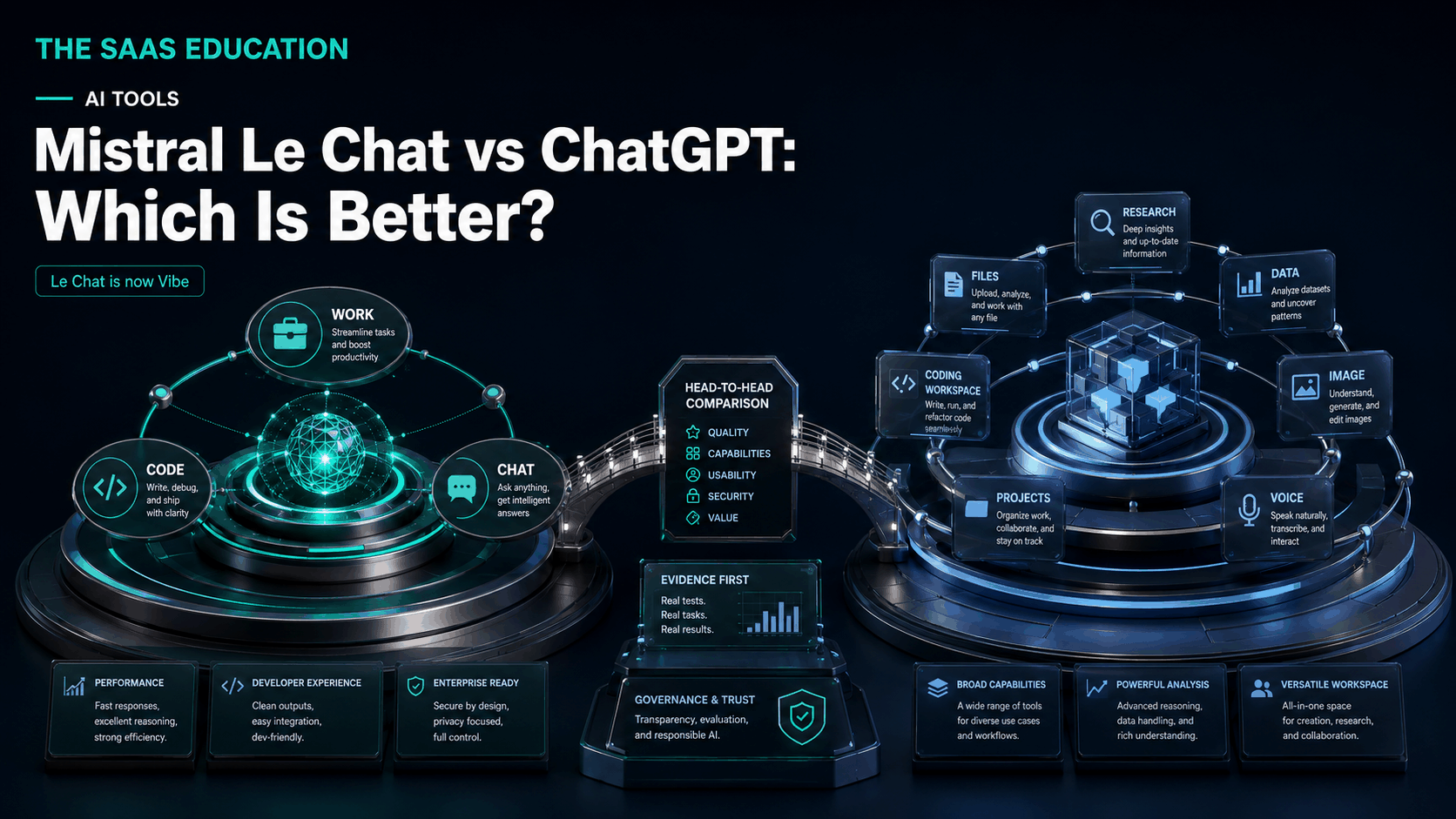
Direct answer
ChatGPT is the better general-purpose starting point for most individuals and teams that want one broad, established AI workspace. Official documentation covers conversation, writing, web search, Deep Research, file uploads, data analysis, image creation, voice, Canvas, Projects, memory, tasks, apps, GPT-related experiences, and coding workflows, subject to plan and account limits.
Mistral Vibe is the more interesting choice when its professional Work, Code, and Chat structure, connectors, MCP compatibility, Mistral ecosystem, or enterprise deployment options match a specific requirement. It should not be evaluated as the old Le Chat interface alone. Mistral officially states that Le Chat is now Vibe, with existing accounts, plans, conversations, and settings carried over.
There is no defensible universal answer to which model is “smarter” from feature pages alone. This comparison therefore focuses on product design, documented workflows, governance, and buying fit. Teams comparing output quality should run controlled tests with the same prompts, inputs, review rubric, and current plan on both products.
Mistral Le Chat vs ChatGPT: quick comparison
| Area | Mistral Vibe, formerly Le Chat | ChatGPT |
|---|---|---|
| Product structure | Work, Code, and Chat modes | Conversational workspace with plan-dependent tools and specialist work modes |
| Everyday chat | Quick turn-based Chat mode | Broad general conversational experience |
| Professional work | Work mode for multi-stage tasks, research, drafts, summaries, and scheduled runs | Search, Deep Research, files, data analysis, Canvas, Projects, tasks, apps, and other tools |
| Coding | Vibe Code across terminal, supported editors, web, and remote work | ChatGPT coding assistance plus plan-dependent Codex-related workflows |
| Research | Web, connected sources, and Deep Research as a Work skill | Search and Deep Research with citations |
| Files and data | Uploads, connected knowledge, documents, spreadsheets, and code-related workflows | File uploads, document work, data analysis, charts, and code execution for supported analysis |
| Connections | Connectors and documented MCP compatibility | Apps and connected-service capabilities, subject to plan and settings |
| Deployment emphasis | Mistral documents enterprise deployment and data-residency options | OpenAI documents managed business and enterprise privacy, security, and administration |
| Best fit | Buyers aligned with Mistral’s agent, coding, connection, and deployment model | Buyers wanting the broadest general ChatGPT workspace and ecosystem |
Important naming update: Le Chat is now Mistral Vibe
The historical comparison keyword says “Mistral Le Chat vs ChatGPT,” but using the old name without explanation would be inaccurate. Mistral’s current official product page says Le Chat is now Vibe. Its documentation describes three modes:
- Work: multi-stage professional tasks across apps and tools, including research, drafts, summaries, and scheduled work.
- Code: coding in the terminal, supported editors, and remote cloud sessions.
- Chat: quick turn-based conversations and legacy Le Chat features such as Agents, Think mode, Code Interpreter, and Memories.
Mistral also states that accounts, plans, conversations, and settings carry over. The comparison below uses “Mistral Vibe” for the current product and mentions “Le Chat” where necessary to serve users searching for the former name.
How we compared the products
We first reviewed current search results to identify the buyer questions behind this comparison. Ranking pages emphasize speed, intelligence, privacy, price, and features, but many claims are difficult to compare because they use different dates, plans, models, prompts, or anecdotal tests.
We then checked official Mistral and OpenAI product, documentation, pricing, privacy, and security sources. We did not perform a controlled benchmark, so this article does not claim that one assistant is faster, more accurate, more creative, or more private in every situation.
The decision criteria are:
- Fit with recurring chat, research, document, data, and coding workflows.
- Ability to connect approved organizational knowledge and applications.
- Identity, permissions, retention, data-use, residency, and deployment requirements.
- Inspectability of sources, outputs, code, and actions.
- Plan limits, seats, consumption, administration, support, and total cost.
- Migration and fallback effort if the product changes or becomes unavailable.
Mistral Vibe overview
Mistral Vibe is positioned as a unified agent for productivity and coding. The current product is broader than a simple chatbot and separates quick conversation from longer professional work and code execution.
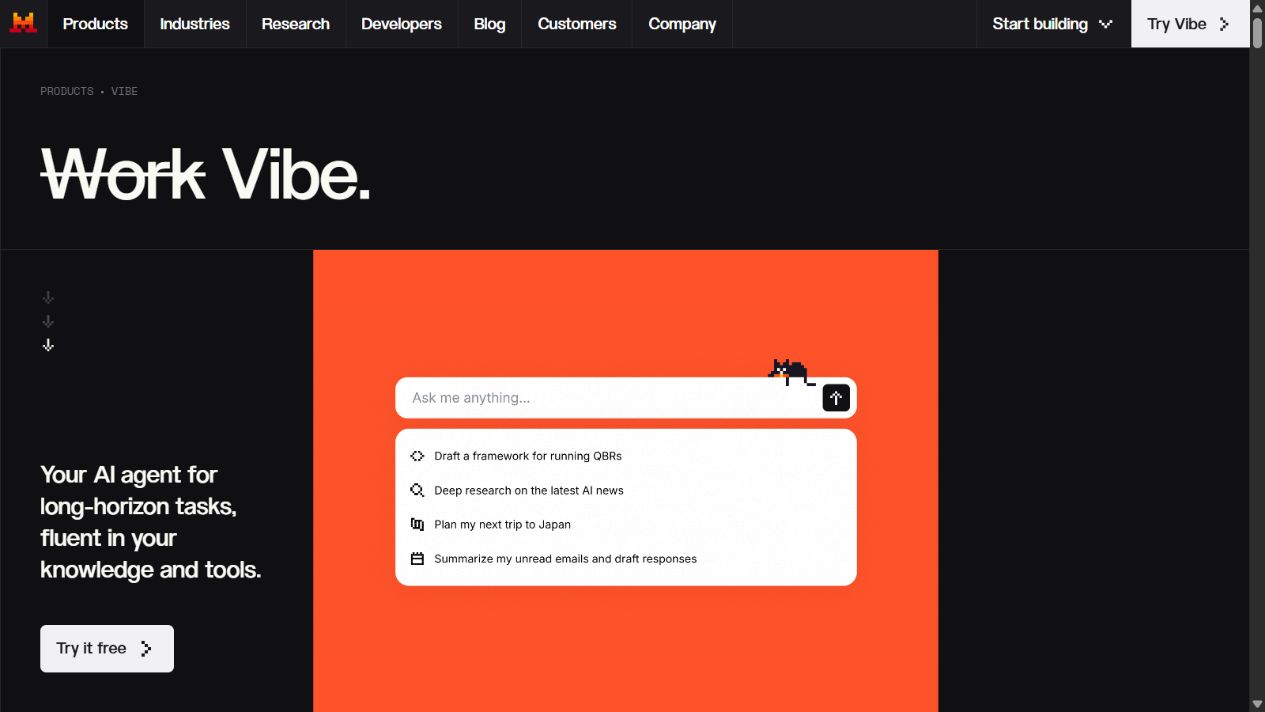
Where Mistral Vibe is strongest
The clearest differentiator is product structure. A user can choose a quick conversational mode, a work-oriented mode for longer deliverables and connected tasks, or a coding mode. Mistral’s official page describes uses including research, meeting preparation, document creation, spreadsheet analysis, connected tools, recurring workflows, testing, and remote coding.
Mistral also emphasizes connectors and MCP compatibility. That matters to organizations that want the assistant to use approved context from email, calendars, collaboration systems, development platforms, or internal tools. Connection breadth alone is not enough; each connection still needs identity, permission, data, and action controls.
Enterprise buyers may find Mistral’s documented deployment choices relevant. The official product page describes enterprise deployment on premises, in private cloud, or on Mistral Cloud, with data-residency positioning. These claims must be evaluated against an actual architecture, contract, region, model, and support requirement rather than treated as automatic privacy superiority.
Mistral Vibe limitations to consider
The product has recently changed name and scope. Documentation, user expectations, plan packaging, and interface conventions may continue to evolve. A buyer should confirm which legacy Le Chat features remain in Chat, which capabilities moved to Work, what requires a paid plan, and how current mobile, editor, terminal, and web experiences differ.
The Mistral ecosystem may also require more evaluation for teams whose applications, training, templates, or governance processes were built specifically around ChatGPT. Migration is not merely exporting conversation text; it includes prompts, projects, files, connections, automations, review procedures, and user habits.
Who should choose Mistral Vibe?
Choose Mistral Vibe when Work, Code, and Chat align with a defined set of professional tasks; when Mistral connectors or MCP compatibility matter; or when enterprise deployment requirements justify a detailed Mistral evaluation. It is also a credible alternative for buyers who want to diversify model and vendor dependency.
Sources: Mistral Vibe , Vibe documentation , and Le Chat is now Vibe .
ChatGPT overview
ChatGPT is a broad general AI workspace. Official OpenAI documentation covers everyday conversation and writing alongside current-information search, longer research, files, data analysis, images, voice, Canvas, Projects, memory, tasks, apps, GPT-related experiences, and coding assistance.
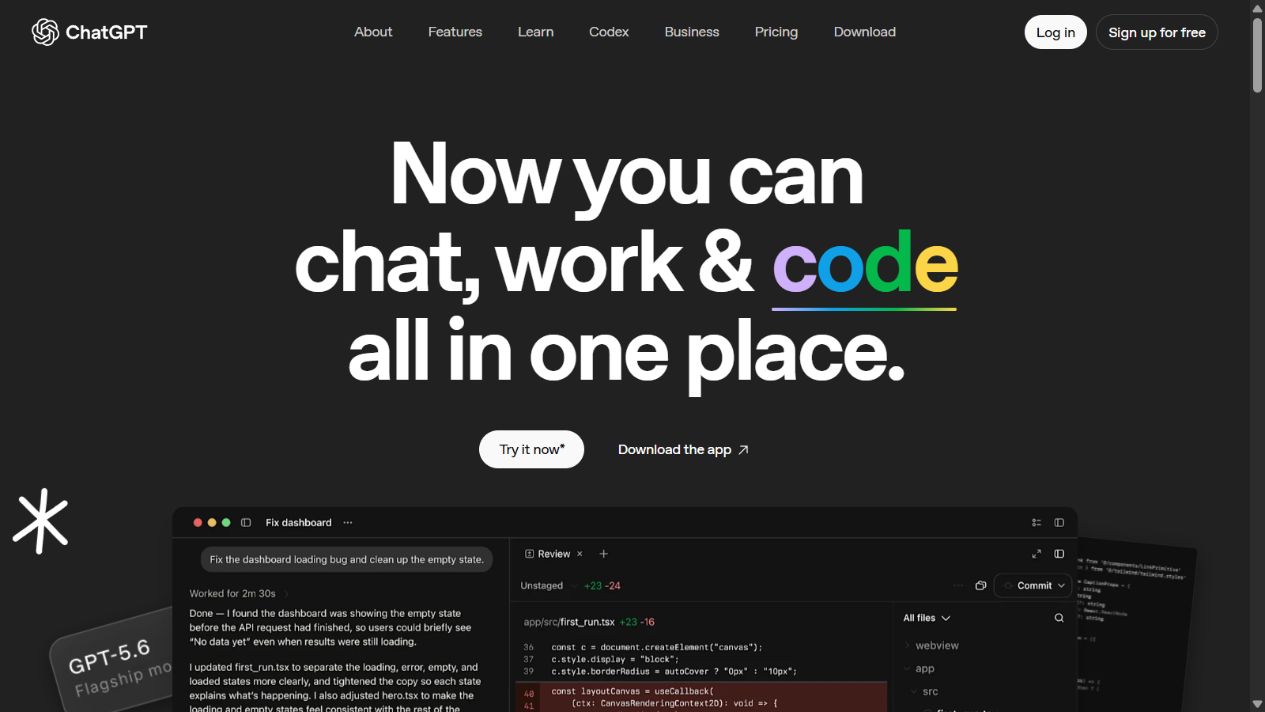
Where ChatGPT is strongest
ChatGPT’s main advantage is breadth in one familiar environment. A conversation can develop into source-backed research, a file analysis, a calculation, a draft in Canvas, an image, or a continuing Project. This reduces switching for users who need a general assistant rather than one specialized workflow.
Projects can organize related chats, files, and instructions. Search supports faster current-information questions, while Deep Research is designed for longer multi-source investigation and a cited report. Data analysis can execute code for supported calculations and visualizations. Apps can connect approved services, subject to current plan, region, and workspace controls.
OpenAI also offers business and enterprise-oriented plans with administration, privacy, and security documentation. That makes managed adoption preferable to employees mixing personal accounts and sensitive company information. It does not remove the need for an organizational AI policy.
ChatGPT limitations to consider
Breadth can make the product difficult to govern. Different models, tools, limits, settings, apps, and plan entitlements may apply to different users. A team can generate a great deal of content without improving a defined business outcome.
ChatGPT can also produce plausible but incorrect output. Citations, file extraction, calculations, code, and recommendations require review appropriate to their impact. Memory and project context are conveniences, not authoritative systems of record. Important decisions and final work should be preserved in governed business systems.
Who should choose ChatGPT?
Choose ChatGPT when a broad group needs a flexible assistant across writing, research, files, analysis, creative work, and coding, and the organization can manage data, connections, review, and record ownership. It remains the easier general starting point when there is no Mistral-specific deployment or workflow requirement.
Sources: ChatGPT overview, ChatGPT capabilities , and ChatGPT pricing .
Detailed comparison
Everyday conversation and writing
Both products support conversational questions, drafting, rewriting, summarization, and follow-up refinement. Mistral keeps a dedicated Chat mode for quick turn-based interaction. ChatGPT places conversation at the center of a wider workspace.
Do not choose based on a single impressive response. Build a test set from actual work: explain a technical concept to a client, rewrite a brief under constraints, identify missing information, challenge a proposal, and preserve required terminology. Blind-score the outputs using the same rubric, then repeat because generated responses vary.
Verdict: Tie at the category level. ChatGPT has the stronger general-workspace case; Mistral Vibe deserves testing when its current assistant behavior or organizational fit is attractive.
Web search and research
Mistral documents web research, connected sources, and deeper research in Work. OpenAI documents ChatGPT Search and Deep Research. Both can reduce discovery and synthesis time, but neither removes source review.
A useful research test checks whether citations exist, open correctly, support the exact sentence, are current, and prioritize primary evidence. Also inspect whether the assistant distinguishes fact from inference and acknowledges conflicting sources.
Verdict: ChatGPT is the safer general starting point because its Search and Deep Research workflows are extensively documented. Mistral Vibe is competitive for teams that value combined web, internal-source, and Work-mode research. A controlled pilot should decide.
Documents and data analysis
Mistral’s product page describes work with documents, spreadsheets, databases, connected sources, and generated deliverables. ChatGPT documents file uploads and data analysis with code execution for supported calculations and charts.
Test the difficult parts: scanned PDFs, inconsistent tables, hidden spreadsheet logic, large files, date and currency formats, and reconciliation to a known answer. A polished summary is not proof that extraction or calculation was correct.
Verdict: ChatGPT has a strong documented general analysis workflow. Mistral Vibe is compelling when document creation and connected-data tasks fit Work. Neither should become the sole financial or operational record.
Coding
Mistral Vibe Code is explicitly designed for terminal, editor, web, and remote coding workflows. Mistral describes repository context, feature work, tests, documentation, remote agents, and migrations. ChatGPT supports coding assistance, while OpenAI’s broader Codex experiences address agentic development workflows depending on product access.
Coding evaluation must include repository permissions, secret handling, sandboxing, generated diffs, test execution, dependency changes, security scanning, human review, and rollback. Output quality depends on language, repository, task, context, and selected model.
Verdict: Mistral Vibe deserves serious evaluation for teams attracted to one Mistral Work-and-Code product. ChatGPT is stronger for organizations already using OpenAI’s assistant and coding ecosystem. No universal quality winner is claimed.
Images, voice, and multimodal work
ChatGPT has documented image input and generation, image editing, and voice experiences. Mistral documents voice input and broader document and multimodal work, but current capabilities and limits should be checked by plan and mode.
Creative teams should test exact media formats, editing control, brand consistency, accessibility, rights terms, generation limits, and production handoff. The presence of an image button says little about whether it replaces a specialist design workflow.
Verdict: ChatGPT is the broader documented general creative and voice choice. Mistral Vibe may be sufficient for teams whose primary need is professional work and coding rather than a complete creative workspace.
Projects, memory, and recurring context
Mistral documents retained conversations and settings, Memories in Chat, reusable agents, connected knowledge, and scheduled or triggered work. ChatGPT documents Projects, memory, scheduled tasks, and GPT-related reusable experiences.
In both products, convenient context can become stale or inappropriate. Users should know what is remembered, where files are stored, who can access shared material, and how to remove or update context. Authoritative policies and customer records belong elsewhere.
Verdict: Both support continuity. ChatGPT is the more familiar project-centered general workspace; Vibe’s agent and mode structure may better fit organizations designing longer connected work.
Apps, connectors, and automation
Mistral emphasizes more than 100 tool connections, email, calendar, Slack, GitHub, Jira, and MCP compatibility on its official page. OpenAI documents apps in ChatGPT that can find, summarize, or interact with connected services depending on the app, account, and workspace.
The key question is not connector count. Evaluate authorization scope, tenant boundaries, consent, action confirmation, logging, data retention, prompt-injection defense, administrator approval, and revocation. Begin read-only where possible.
Verdict: Mistral Vibe has a clear connector and MCP-oriented proposition. ChatGPT has an expanding apps ecosystem. Choose based on the exact approved systems and security model rather than catalog size.
Privacy, security, and deployment
Mistral’s enterprise materials emphasize customization, deployment choices, and data residency. OpenAI publishes enterprise privacy, security, and business-data commitments for organizational offerings. These are different commercial and technical configurations, not simple brand-level labels.
Ask both vendors the same questions: Is data used for training by default under this exact offering? What are retention and deletion terms? Which regions and subprocessors apply? How do identity, SSO, roles, audit logs, encryption, connectors, and support work? Can the required model run in the required environment? What contractual commitments are available?
Verdict: Mistral Vibe is particularly relevant when deployment architecture and Mistral-controlled environments are decision drivers. ChatGPT is compelling for a managed SaaS workspace with documented organizational controls. Legal, security, and architecture review must determine the winner.
Plans and total cost
Both products offer free and paid paths, with organizational options. Prices and entitlements can change by region, term, promotion, seat, consumption, and contract, so this article avoids a static price contest.
Calculate seats, usage or credits, connected services, administration, migration, training, review, coding infrastructure, support, and specialist tools that remain necessary. A lower subscription can cost more if the workflow requires additional review or integration work.
Verdict: No universal cost winner. Model the complete approved workload against current official quotes and plan pages.
Which should you choose?
Choose Mistral Vibe if
- You want the current Work, Code, and Chat product structure.
- Mistral’s connectors or MCP compatibility fit your approved stack.
- Deployment, data residency, private-cloud, or on-premises evaluation is central.
- Your development team wants to test Mistral’s unified coding workflow.
- Vendor diversification is an explicit resilience goal.
Choose ChatGPT if
- You want the strongest general starting point across varied knowledge work.
- Search, Deep Research, files, data analysis, images, voice, Canvas, and Projects need to coexist.
- Your users already understand ChatGPT and migration would add little value.
- OpenAI’s current business administration and privacy model fits requirements.
- You want a broad assistant before selecting specialist workflows.
Use both only if
Separate products solve defined needs and the organization can govern both. Dual subscriptions without task boundaries increase cost, data sprawl, review inconsistency, and training work. Define which system is approved for each data class and workflow.
A fair pilot plan
- Select 15 to 25 representative tasks across chat, research, documents, data, and code.
- Remove sensitive information and use equivalent inputs.
- Test the same current plan class and document all enabled tools.
- Score factual accuracy, citation support, completeness, instruction adherence, review time, and usability.
- Test failures, refusals, unavailable sources, malformed files, and interrupted connected actions.
- Review identity, permissions, retention, connectors, logs, residency, and contracts separately from output quality.
- Measure total time to an approved deliverable, not generation speed alone.
- Record migration and fallback requirements before committing.
The pilot should be blind-scored where possible. A user who knows which vendor produced an output may reward familiarity or brand expectations. Repeat important tasks because one response is not a stable benchmark.
Final verdict
ChatGPT is better for most buyers seeking a broad general AI workspace with a mature set of documented capabilities. Mistral Vibe, formerly Le Chat, is better positioned for buyers who specifically value its Work, Code, and Chat design, connectors and MCP compatibility, or Mistral’s enterprise deployment proposition.
The rebrand changes the comparison: this is no longer simply one chatbot against another. It is a choice between two evolving work platforms. Select the one that passes your real tasks, governance requirements, and total-cost model, and preserve human review for consequential outputs.
Sources checked
Frequently asked questions
Is Mistral Le Chat now called Vibe?
Yes. Mistral's official product, documentation, and Help Center state that Le Chat is now Vibe. The same account, plan, conversations, and settings carry over, while the product is organized around Work, Code, and Chat modes.
Is Mistral Vibe better than ChatGPT?
Neither is universally better. Mistral Vibe is compelling for buyers prioritizing its unified Work, Code, and Chat model, connectors, MCP compatibility, and Mistral deployment options. ChatGPT is the stronger general starting point for a broad established workspace spanning conversation, research, files, data, images, voice, Canvas, projects, apps, and coding.
Which is better for business, Mistral Vibe or ChatGPT?
The answer depends on required applications, data controls, identity, residency, deployment, administration, and workflows. Run a governed pilot with representative tasks and review each vendor's current business, privacy, security, and contractual documentation.
Which is better for coding?
Mistral documents Vibe Code across terminal, editor, and remote workflows, while OpenAI offers ChatGPT and Codex-related coding capabilities. Compare repository context, permissions, sandboxing, tests, review, deployment boundaries, and total cost in your own environment rather than relying on a generic quality claim.
Can both tools search the web and perform research?
Yes, both vendors document web and research capabilities. Mistral places longer research in Vibe Work, while OpenAI documents Search and Deep Research in ChatGPT. Users must still inspect citations, dates, scope, and primary evidence.
Which has better privacy?
A universal privacy winner cannot be declared from product positioning alone. Compare the exact plan, data-use terms, retention, training controls, connectors, residency, deployment, administrator settings, and contract that apply to your organization.
Should I switch from ChatGPT to Mistral Vibe?
Switch only if a pilot shows that Vibe's workflows, controls, deployment options, or commercial fit materially improve your work. Include migration, retraining, integrations, archived conversations, review effort, and fallback requirements in the decision.