NotebookLM vs ChatGPT: Which Is Better?
Compare NotebookLM, now Gemini Notebook, with ChatGPT for source-grounded research, citations, files, writing, analysis, privacy, and team workflows.
Direct answer
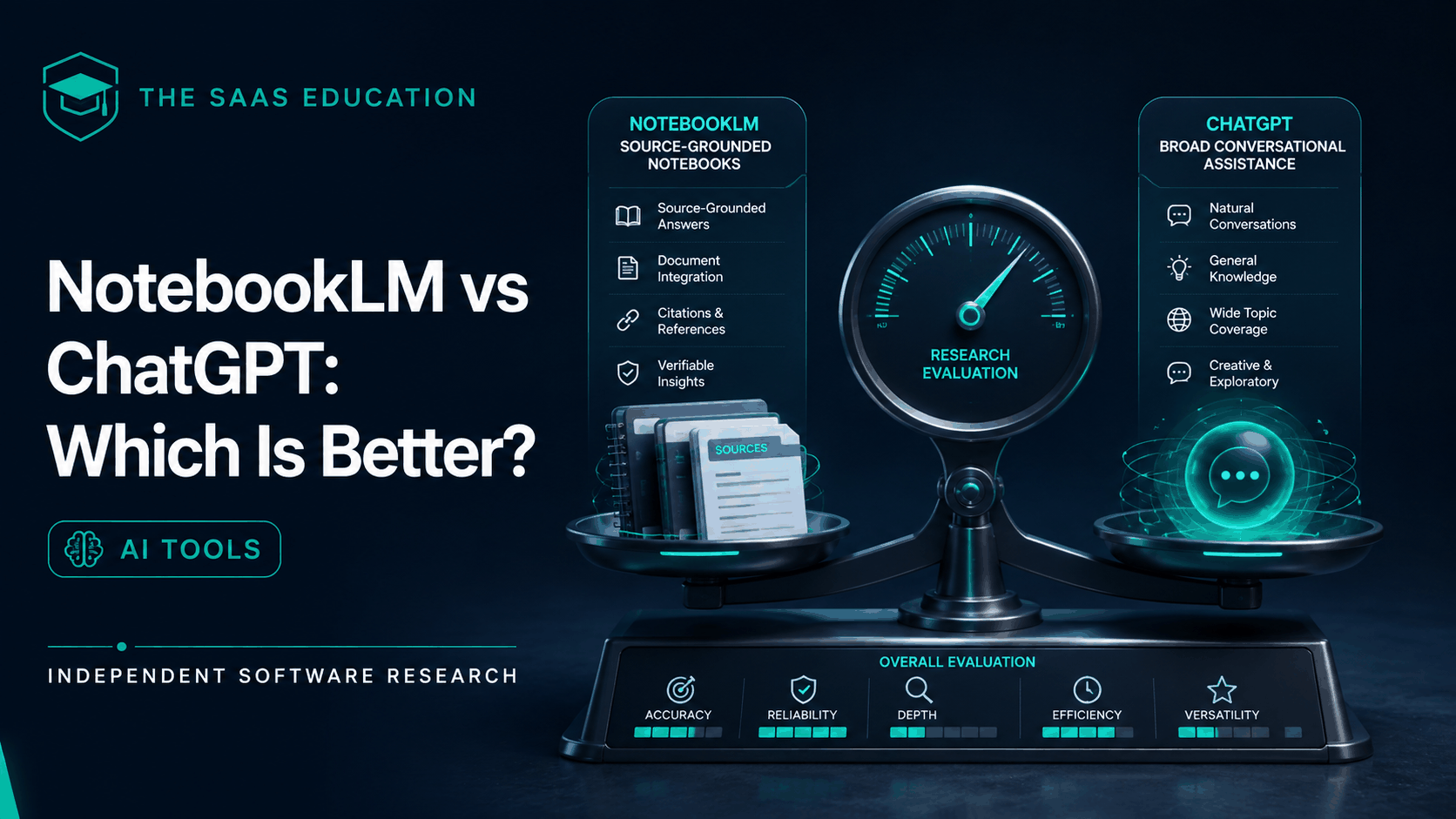
NotebookLM, renamed Gemini Notebook by Google in July 2026, is better when the job begins with a defined set of sources and the reader needs answers, summaries, and artifacts that can be traced back to those materials. Its notebook structure, selected sources, inline citations, Audio Overviews, study guides, mind maps, and other research outputs are designed around understanding a corpus.
ChatGPT is better when the job is broader than source synthesis. It can support writing, analysis, coding, web search, deep research, files, data work, images, voice, projects, Canvas, and other plan-dependent workflows in one general-purpose environment.
The practical answer is not that one product is universally smarter. They organize work differently. NotebookLM is source-first; ChatGPT is task-first. Choose based on what must constrain the answer and what deliverable comes next.
Important naming note
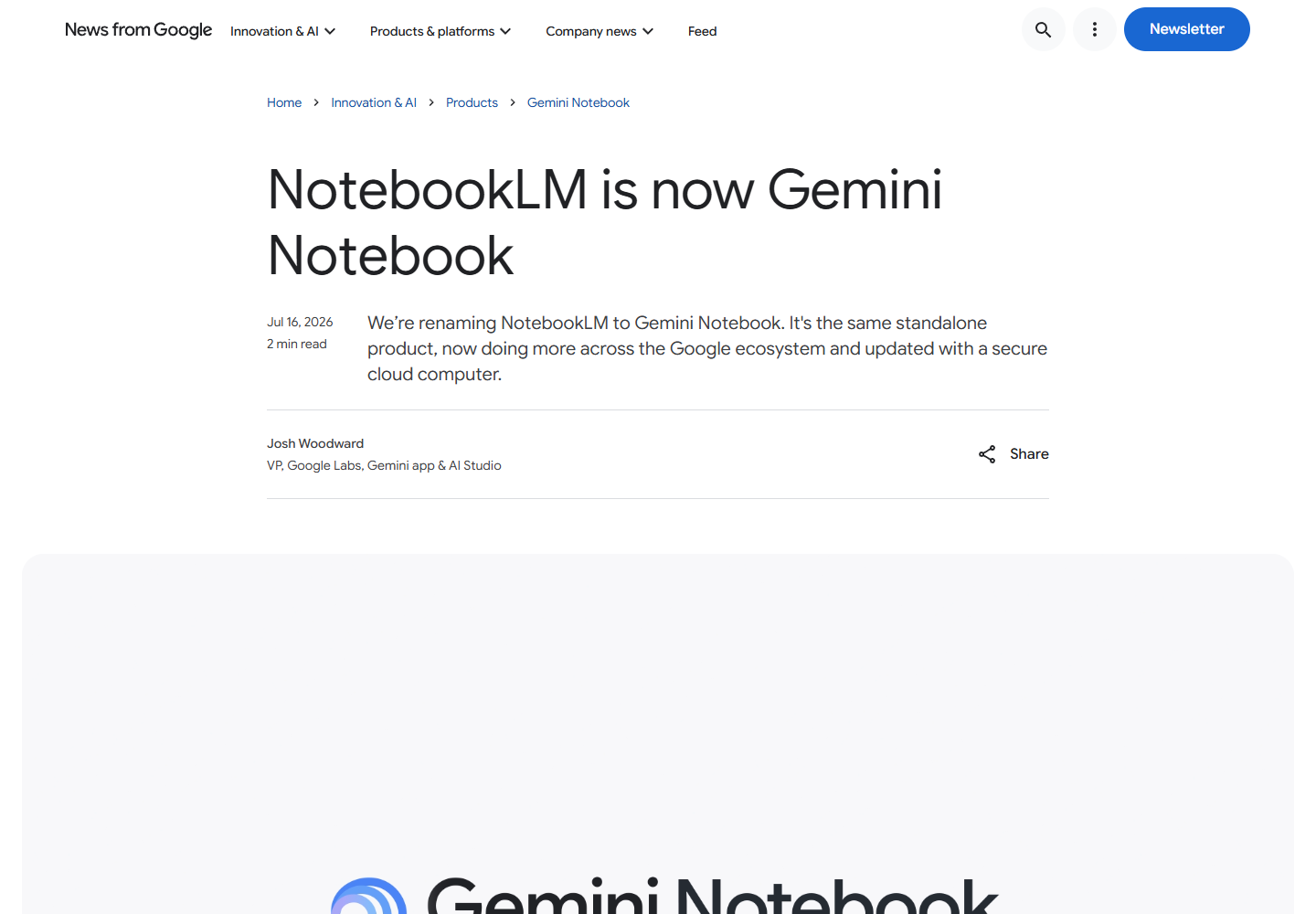
Google announced on July 16, 2026 that NotebookLM is now Gemini Notebook. Google describes it as the same standalone product with deeper connections across its ecosystem. This article keeps “NotebookLM” in the title because that is the scheduled query and still a widely used product name, but current product references use Gemini Notebook where clarity requires it.
NotebookLM vs ChatGPT at a glance
| Area | NotebookLM / Gemini Notebook | ChatGPT |
|---|---|---|
| Core model | Source-grounded notebook | General-purpose AI workspace |
| Best starting point | A defined evidence collection | A question, task, or deliverable |
| Citation experience | Inline citations tied to notebook sources | Web citations and file analysis vary by tool and workflow |
| Source organization | Persistent notebook with selected sources | Chats, Projects, files, and research tools |
| Research artifacts | Briefings, study guides, audio, mind maps, slides, and other notebook outputs | Reports, documents, data analysis, code, images, Canvas, and broader outputs |
| Broad creative work | More constrained by notebook purpose | Stronger general-purpose range |
| Coding and data | Expanding research and code-analysis capabilities | Broad coding, execution, and data-analysis workflows depending on plan |
| Collaboration | Shared notebooks and Google-account context, subject to rules | Shared chats, Projects, workspace features, and organizational controls depending on plan |
| Main risk | Weak or incomplete source set creates bounded but incomplete work | Broad context can produce unsupported or difficult-to-trace claims |
How we compared them
We reviewed current search results for “NotebookLM vs ChatGPT” to understand buyer intent. Ranking pages focus heavily on source grounding, citations, study workflows, audio summaries, document analysis, and ChatGPT’s broader capabilities. We used those themes as questions, not as facts.
Material claims were checked against official Google and OpenAI product, help, pricing, and data-use pages. We did not run a controlled accuracy benchmark, so this article does not assign invented scores or claim that either product wins a universal test.
Our comparison criteria were:
- How sources enter and constrain the workspace.
- Whether readers can trace a claim to evidence.
- Support for long documents and mixed source types.
- Research, study, writing, analysis, and coding workflows.
- Deliverable and artifact creation.
- Collaboration and persistent context.
- Data handling, organizational controls, and account requirements.
- Plan, usage, and workflow cost.
- Failure modes and human review effort.
- Fit for repeatable individual and team work.
Where NotebookLM is better
Researching a defined source collection
NotebookLM is built around sources. Google documents support for PDFs, websites, YouTube videos, audio, Google Docs, Slides, Sheets, images, Word files, text, Markdown, CSV, PowerPoint, ePub, and other supported inputs, subject to current limits.
That source panel changes the research habit. Instead of asking an open question and hoping the answer reflects the right evidence, the user first assembles a corpus. A policy analyst can add approved regulations and internal guidance; a student can add course readings; a product team can add interviews and specifications.
This does not guarantee completeness. If the corpus excludes a decisive source, the answer may be carefully grounded and still wrong for the broader question. The notebook is only as representative as its source set.
Traceable answers and citations
Google describes NotebookLM chat as grounded in notebook sources with inline citations. That makes it easier to inspect the passage supporting a statement. For evidence-heavy work, lower verification friction can matter more than fluent prose.
Use citations as navigation, not proof. Open the cited passage, confirm that it supports the claim, inspect qualifiers, and check whether another source contradicts it. A citation can be real while the interpretation remains too broad.
Turning the same evidence into several formats
NotebookLM can transform sources into outputs such as study guides, briefings, Audio Overviews, mind maps, slide decks, video overviews, and other artifacts as availability evolves. This is useful when several audiences need different ways into the same material.
For example, a research lead might create a briefing for executives, an audio overview for a commute, a question set for a workshop, and a source-grounded chat for follow-up. The value comes from reusing one governed evidence base.
Staying within an approved evidence boundary
A defined notebook can reduce accidental drift into unapproved material. This is useful for policy review, training, due diligence, literature synthesis, and internal knowledge work. It does not replace access controls or professional judgment, but it creates a clearer boundary than an unconstrained general chat.
Where ChatGPT is better
General-purpose work beyond the source pack
ChatGPT covers a broader range of work modes. Official documentation currently describes web search, deep research, file uploads, data analysis, images, voice, Canvas, memory, Projects, and model-dependent capabilities. A user can move from research to a spreadsheet analysis, code explanation, draft, image, or structured plan without changing products.
That breadth matters when the source pack is only one input. A consultant might analyze documents, search current information, draft options, calculate scenarios, create a client-ready outline, and refine language in the same workspace.
Open-ended exploration
NotebookLM is strongest when the user knows which sources matter. ChatGPT is often more useful earlier, when the problem itself is still being defined. It can help identify questions, map alternatives, generate hypotheses, or search for current material before a formal evidence pack exists.
Open exploration creates a different risk: unsupported synthesis can sound confident. Separate brainstorming from verified findings. Mark assumptions and require evidence before a statement enters a final deliverable.
Coding, data, and production workflows
ChatGPT’s broader coding and data-analysis environment can be a better fit when research feeds directly into calculations, transformations, debugging, prototypes, or operational documents. Product and plan availability varies, so teams should test the exact environment rather than assuming every advertised capability is enabled.
Flexible persistent workspaces
Projects can organize chats, files, and context around recurring work. This is useful when a team needs not only source questions but also drafting rules, analysis conventions, reusable instructions, and multiple deliverable threads.
The distinction is subtle: a NotebookLM notebook treats sources as the center of gravity; a ChatGPT Project treats the broader body of work as the center of gravity.
Source grounding is not the same as truth
Source grounding answers “where did this come from?” more readily. It does not automatically answer:
- Is the source accurate?
- Is it current?
- Is it complete?
- Does it apply to this jurisdiction or case?
- Was a table, chart, footnote, or exception imported correctly?
- Does the cited passage justify the conclusion?
For high-stakes work, create a source register with owner, date, jurisdiction, version, authority, and limitations. Require important conclusions to cite primary evidence. Record disagreements instead of forcing a single answer.
ChatGPT workflows need the same discipline. Web search citations can improve traceability, but the reviewer should open sources, prefer primary material, and distinguish directly supported facts from inference.
Which is better for students?
NotebookLM is a strong starting point when the course provides a defined reading list. Students can ask questions across sources, build study guides, inspect citations, and generate alternative formats. It is especially useful for comparing arguments or locating where a concept appears.
ChatGPT is stronger as a flexible tutor when the student needs explanations at different levels, practice questions, feedback on reasoning, coding help, writing support, or exploration beyond the supplied material.
Use either tool within academic-integrity rules. Do not submit generated writing as original work, upload material without rights, or treat a citation produced by an AI system as a verified bibliography entry.
Which is better for business research?
NotebookLM fits evidence-pack workflows:
- Define the decision and scope.
- Collect approved primary and internal sources.
- Label versions and access rights.
- Ask repeatable questions across the corpus.
- Inspect citations and record conflicts.
- Produce a briefing tied to the evidence.
ChatGPT fits broader decision workflows:
- Frame the decision and unknowns.
- Search or research current external context.
- Analyze files and structured data.
- Generate and challenge options.
- Build calculations, drafts, or implementation plans.
- Convert findings into several deliverables.
Many teams can use both. ChatGPT can help scope the investigation and produce outputs; NotebookLM can serve as the traceable evidence workspace. The handoff needs rules so claims do not lose their citations when moved between systems.
Privacy and governance
Do not make a product-wide privacy assumption from one marketing statement. Account type matters.
Google states that NotebookLM data handling differs across personal, Workspace, and education contexts, and that uploaded data is not used to train NotebookLM unless feedback is provided, with additional protections described for qualifying organizational accounts. Administrators may need to enable access.
OpenAI publishes separate data-control and business terms for consumer and organizational use. ChatGPT plan, workspace settings, connectors, retention, sharing, and administrative controls affect risk.
Before use, classify the data and verify:
- Whether uploading is permitted.
- Which account and contract apply.
- Human review or training treatment.
- Retention, deletion, export, and legal hold.
- Sharing and public-link behavior.
- Connector permissions and inherited access.
- Regional or industry requirements.
- Incident reporting and offboarding.
Neither product should become an unofficial repository for sensitive records without an approved operating model.
Pricing and limits
Both products offer free access and paid paths, but direct price comparison is misleading. Gemini Notebook premium capability may be delivered through eligible Google AI or Workspace plans. ChatGPT has individual and organizational plans, while API billing is separate.
Compare the complete workflow cost:
- Required subscription or workspace edition.
- Source, file, notebook, project, message, model, and tool limits.
- Team seats and administrative requirements.
- Storage and connected services.
- Verification and correction time.
- Export, archiving, and integration effort.
- Cost of a second product when one tool does not cover the full workflow.
Limits change. Verify the current official plan and help pages at purchase and again before renewal.
A practical side-by-side test
Use the same non-sensitive evidence pack and the same evaluation prompts in both tools.
Prepare five to ten representative sources containing:
- A clear fact.
- A qualified or conditional rule.
- Two sources that disagree.
- A table or structured dataset.
- A source that is irrelevant but superficially similar.
- A recent update that supersedes an older document.
Ask each product to:
- Summarize the decision context.
- Answer five factual questions with source support.
- Identify contradictions and missing evidence.
- Extract a structured table.
- Draft a recommendation separating fact from inference.
- Revise the output after one source changes.
- Create a second format for another audience.
Score citation correctness, source coverage, unsupported claims, handling of conflicts, revision effort, output usefulness, user effort, export quality, and administrator controls. Repeat important prompts because one good response is not a reliability measure.
Decision guide
Choose NotebookLM / Gemini Notebook when:
- A defined source collection should constrain the answer.
- Inline citation traceability is central.
- Study, briefing, or evidence-synthesis artifacts are required.
- The team repeatedly works from the same approved corpus.
Choose ChatGPT when:
- The work spans research, writing, coding, data, images, and planning.
- Open-ended exploration is useful.
- The user needs a broad assistant and persistent project workspace.
- Source synthesis is only one stage in a larger production workflow.
Use both when an evidence notebook and a general production assistant have distinct, governed roles. Avoid paying for both when users cannot explain the handoff.
Preserve citations when moving work between tools
A two-product workflow can lose the very traceability that justified NotebookLM. Do not paste a clean summary into ChatGPT without its source map and then publish the rewritten result as though the citations still support every sentence.
Use a small claim ledger. Give each important claim an identifier, source link, quoted or paraphrased supporting passage, date, owner, and verification status. When ChatGPT reorganizes or edits the material, require those identifiers to remain attached until final editorial review. Any newly generated claim returns to an “unverified” state, even when it sounds consistent with the evidence.
For recurring research, version the source collection and final deliverable. Record which notebook, source set, model or tool context, and review date produced the approved result. This makes later updates easier: reviewers can identify what changed instead of repeating the entire investigation or trusting an old AI summary whose inputs are no longer visible.
Final verdict
NotebookLM is better for source-grounded understanding. ChatGPT is better for general-purpose knowledge work. The most trustworthy workflow is the one that makes evidence boundaries, citations, assumptions, review, and data rules explicit.
If the task is “tell me what these approved documents say and show me where,” begin with Gemini Notebook. If it is “help me investigate, analyze, create, and iterate across many kinds of work,” begin with ChatGPT.
Frequently asked questions
Is NotebookLM better than ChatGPT?
It is better for a defined source corpus and traceable synthesis. ChatGPT is better for broader tasks and output types. The right answer depends on whether evidence boundaries or workflow breadth matter more.
Is NotebookLM still called NotebookLM?
Google renamed it Gemini Notebook in July 2026. The older name remains widely searched, and some official support paths still use it.
Does NotebookLM use only uploaded sources?
Notebook chat is grounded in selected notebook sources. Source discovery and Gemini integrations can involve other material or different grounding behavior, so verify the active context.
Can ChatGPT cite uploaded documents?
ChatGPT can analyze files and provide citations in supported web-research workflows, but it does not replicate NotebookLM’s exact source-panel and inline-citation experience. Check every important reference.
Which tool is better for students?
NotebookLM fits course-source study and cited synthesis. ChatGPT fits adaptive explanation, practice, coding, and broader tutoring. Academic rules and verification still apply.
Which tool is better for business research?
NotebookLM is strong for a governed evidence pack. ChatGPT is strong for broader investigation and deliverable creation. Mature teams may use both with a documented handoff.
Is NotebookLM more accurate than ChatGPT?
No universal accuracy claim is justified without a controlled task-specific benchmark. Source grounding improves traceability, but source quality, completeness, model behavior, and human review remain decisive.
Sources
Run one provenance test before subscribing. Give each product the same approved source packet, include one conflicting document and one outdated statement, then ask for a briefing with citations and unresolved questions. Verify every citation manually. Prefer the workflow that makes uncertainty and source boundaries easiest to inspect.
Frequently asked questions
Is NotebookLM better than ChatGPT?
NotebookLM, now Gemini Notebook, is better when work must stay grounded in a defined source collection with visible citations and research artifacts. ChatGPT is better as a broader assistant for writing, analysis, coding, web research, images, voice, and varied workflows.
Is NotebookLM still called NotebookLM?
Google renamed NotebookLM to Gemini Notebook in July 2026. The same standalone product continues, while the older NotebookLM name remains common in searches and documentation paths.
Does NotebookLM use only uploaded sources?
Notebook chat is designed to ground responses in selected notebook sources. Source discovery can bring in web or Drive material, and Gemini integrations have different grounding behavior, so users should confirm the active product and sources.
Can ChatGPT cite uploaded documents?
ChatGPT can analyze uploaded files and can search the web with citations, but its general workspace is not identical to NotebookLM's source-first notebook and inline citation model. Verify citations and source passages in either product.
Which tool is better for students?
NotebookLM is often the stronger starting point for studying a defined reading set and generating source-grounded guides or overviews. ChatGPT is more flexible for tutoring, explanation, practice, writing, and broader exploration.
Which tool is better for business research?
Use NotebookLM for an approved evidence pack and traceable synthesis. Use ChatGPT for broader analysis and deliverable creation. Many teams benefit from a governed workflow that uses both, with human verification.
Is NotebookLM more accurate than ChatGPT?
Source grounding can make claims easier to trace, but neither product guarantees accuracy. Completeness, source quality, prompt design, model behavior, and human review still determine reliability.